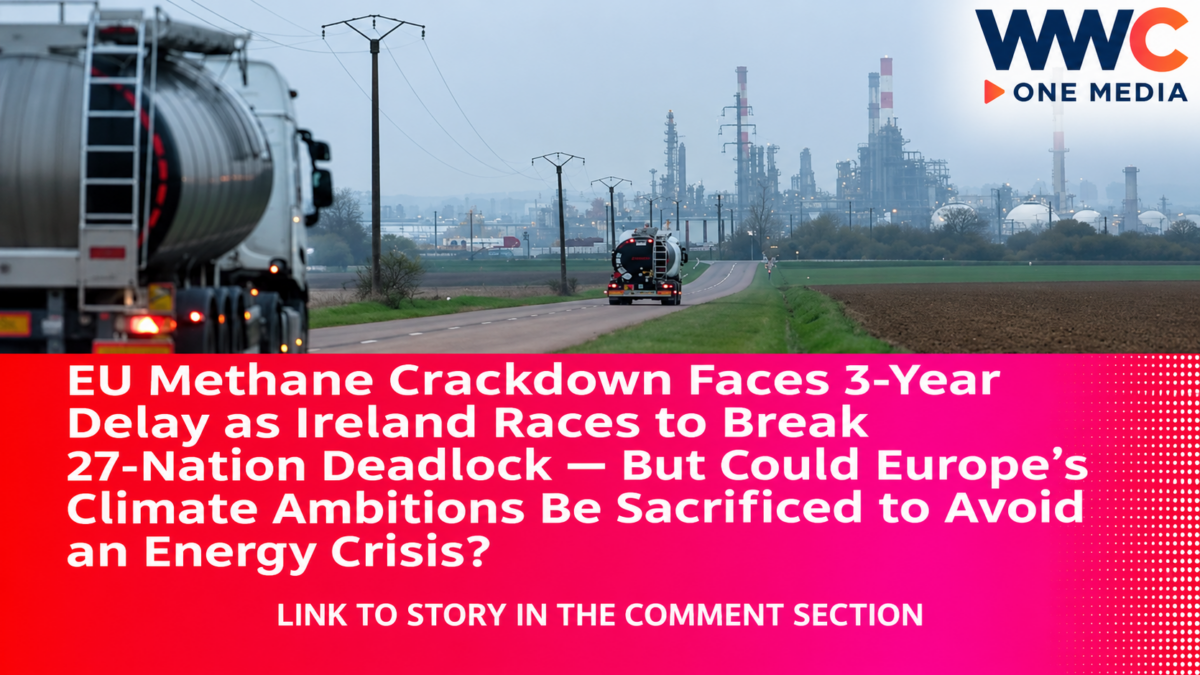
BRUSSELS / DUBLIN / MANILA — Ireland is racing to secure a political agreement among European Union governments over a controversial postponement of methane-emissions requirements, as fears of another winter energy crisis collide with the bloc’s commitments to fight climate change.
The EU’s 27 member states remain divided over whether selected methane-monitoring and reporting obligations for fossil-fuel importers should be delayed by one year or three years.
Ireland, which currently holds the rotating presidency of the Council of the European Union, is attempting to broker an agreement ahead of renewed discussions scheduled for November 6, 2026.
According to Bloomberg’s November 4 report and independent reporting by EUobserver and ICIS, the dispute centers on the European Commission’s proposed one-year postponement of requirements affecting imported natural gas, crude oil and coal.
But the European Parliament has already backed a substantially longer delay.
On October 22, lawmakers voted 341 to 225, with six abstentions, to support amendments extending important compliance deadlines by several years.
The disagreement has become more urgent as Europe confronts volatile gas prices, disruption to energy supplies from the Middle East and fears that strict compliance requirements could complicate the procurement of essential fuel.
Environmental organizations warn that delaying the rules could undermine one of the EU’s most important measures for reducing methane, a powerful greenhouse gas.
With Europe facing high energy costs and governments split over how much time importers need, can Ireland secure a compromise without weakening the EU’s climate commitments?
Ireland Seeks Agreement Before November 6 EU Talks
The Irish presidency has been trying to bridge competing positions among EU governments.
The European Commission proposed a targeted one-year delay on October 14, arguing that energy importers and regulators need additional time to implement complex methane-monitoring requirements.
Several governments support that approach.
France, Spain, Finland, Denmark, Luxembourg and Portugal have been identified among countries favoring the Commission’s shorter postponement.
But Italy, Poland, the Czech Republic, Hungary, Slovakia, Greece and Slovenia have pushed for a longer, three-year delay.
Other member states remain undecided or open to compromise.
The division has already disrupted the legislative timetable.
An earlier attempt to agree the Council’s negotiating position failed, forcing Ireland to postpone the next discussions until November 6.
Irish Energy Minister Darragh O’Brien has acknowledged the difficulty of finding an acceptable compromise.
A successful Council agreement would establish the governments’ negotiating position, but it would not by itself complete the legislative changes.
The final terms would still have to be agreed with the European Parliament.
What Exactly Are the EU Methane Rules?
The controversy involves Regulation (EU) 2024/1787, adopted in 2024 to reduce methane emissions linked to the fossil-fuel industry.
The legislation applies to natural gas, crude oil and coal.
It introduces requirements for measuring, reporting and verifying methane emissions, alongside measures to reduce avoidable leaks, venting and flaring.
Methane is released when natural gas escapes from wells, pipelines, processing equipment and other infrastructure.
Emissions can also occur during oil extraction and coal mining.
The EU regulation seeks to encourage suppliers to identify and reduce these losses.
For imported fossil fuels, the legislation progressively introduces requirements concerning emissions associated with production outside the European Union.
Under the existing rules, importers must demonstrate from January 1, 2027, that certain contracts concluded or renewed after August 4, 2024, are covered by methane-monitoring, reporting and verification measures equivalent to EU standards.
Additional reporting and methane-intensity obligations apply later.
The proposed amendments would postpone selected deadlines.
They would not repeal the entire methane regulation.
Why the European Commission Wants a One-Year Delay
The European Commission says the current international energy situation has made implementation more difficult.
Its October 14 proposal cites disruptions to energy supplies caused by the conflict in the Middle East, particularly the severe interruption of shipping and fossil-fuel exports through the Strait of Hormuz.
The disruption has restricted available energy supplies and contributed to unusually high prices.
European importers have warned that some overseas suppliers may not be able to demonstrate compliance with the required monitoring arrangements by January 2027.
The Commission argues that additional time would help governments establish national penalty systems, accredit independent verifiers and provide workable compliance mechanisms.
Under its proposal, the initial importer monitoring requirements would effectively move from January 2027 to January 2028.
Other specified reporting deadlines would also move by one year.
The Commission maintains that the postponement is intended to improve implementation rather than abandon methane-reduction objectives.
But environmental groups question whether delaying enforcement is necessary.
European Parliament Pushes for an Even Longer Postponement
The European Parliament’s October 22 decision significantly complicated negotiations.
Lawmakers approved amendments going further than the Commission’s preferred one-year delay.
Under Parliament’s negotiating position, importers would have until May 31, 2031, rather than May 31, 2029 under the Commission’s proposal, to demonstrate compliance with certain monitoring and verification requirements for eligible fuel-supply contracts.
Parliament also supported extending the first methane-intensity reporting deadline for relevant importers and EU producers to August 2031.
Some reporting deadlines for domestic oil and gas operators would be moved as well.
These are proposed deadlines, not dates that have already replaced the existing legal requirements.
The Parliament also proposed measures intended to prevent sanctioned energy exporters from benefiting from the additional implementation time.
Any final arrangement will require negotiations between the Parliament and member states.
For Ireland, that means securing agreement among governments is only one part of a larger legislative challenge.
Europe’s Energy Crisis Is Driving the Political Pressure
The methane dispute is unfolding against an exceptionally difficult energy-market backdrop.
The conflict involving Iran has disrupted oil and gas shipments through the Persian Gulf.
The resulting supply shock has intensified competition between European and Asian buyers for liquefied natural gas.
According to the International Energy Agency’s Global Gas Security Review 2026, European and Asian gas prices rose to their highest levels since the 2022–2023 energy crisis.
European benchmark gas prices averaged close to $20 per million British thermal units between March and October, approximately 70% higher than a year earlier.
Competition for available LNG shipments has increased concerns about winter supply.
Those pressures help explain why European governments are sensitive to additional uncertainty affecting fuel imports.
WWC ONE MEDIA previously examined the Middle East supply shock in Oil Prices Crash Nearly 8% as Iran Peace Talks Send Brent to $104 — But Could One Failed Deal Trigger a $140-a-Barrel Shock?.
That report explored how quickly oil prices can react to diplomatic developments and the risks surrounding energy shipments through the region.
The methane negotiations have become part of the broader struggle to ensure reliable energy supplies while limiting environmental damage.
Why the United States Is Pressuring Europe
The United States has also expressed concern about the EU’s methane regulations.
American producers have become major suppliers of liquefied natural gas to Europe.
US officials and energy companies argue that the compliance framework could create legal uncertainty and disrupt fuel deliveries.
Companies may need to demonstrate that methane emissions associated with production, processing and transportation have been adequately monitored.
For complex international supply chains, gathering and verifying that information can be challenging.
Industry representatives have called for clearer requirements and additional time to develop the necessary systems.
Their argument is that poorly coordinated implementation could discourage suppliers from entering contracts with European customers.
However, that risk remains disputed.
Environmental organizations argue that complying with methane-monitoring standards should not necessarily prevent suppliers from selling gas to Europe.
They also note that reducing methane leaks can preserve fuel that would otherwise escape into the atmosphere.
The debate therefore concerns not only the cost of compliance, but also whether delays would meaningfully improve Europe’s energy security.
Why Methane Matters More Than Many People Realize
Methane is one of the most important greenhouse gases contributing to global warming.
Although it remains in the atmosphere for a shorter period than carbon dioxide, it traps substantially more heat over a 20-year period.
Scientists consider rapid methane reductions among the most effective ways to slow warming in the near term.
Oil and gas operations are important sources because methane can escape through faulty equipment, pipelines and production facilities.
In some cases, operators can reduce emissions by detecting leaks and repairing infrastructure.
Capturing otherwise wasted methane may also increase the volume of gas available for productive use.
The European Commission cited International Energy Agency estimates that more than 350 billion cubic meters of natural gas were lost globally through flaring, venting and leakage in 2024.
Those losses illustrate why methane reduction can support both climate protection and energy efficiency.
Environmental advocates therefore argue that a prolonged postponement could delay economically useful improvements as well as emissions reductions.
Environmental Groups Warn of a Dangerous Precedent
The proposed delay has attracted criticism from climate organizations concerned about weakening the EU’s environmental framework.
Campaigners argue that governments should improve implementation rather than repeatedly postpone legally established deadlines.
The European Environmental Bureau and other advocacy organizations have challenged the justification for delaying the rules.
On October 29, environmental campaigners filed a complaint with the European Ombudsman concerning the Commission’s handling of methane requirements.
The complaint does not establish that the Commission acted unlawfully.
It reflects concerns that the proposed postponement could undermine climate-policy credibility and the rulemaking process.
For environmental groups, the broader danger is that regulatory uncertainty may discourage companies from investing in emissions-monitoring equipment.
For industry representatives, the opposite concern applies: uncertain technical requirements could lead to investment in systems that do not ultimately satisfy regulators.
The dispute illustrates the difficulty of balancing environmental ambition with the practical implementation of complex international rules.
Could the Delay Affect Global LNG Prices?
An agreement to postpone certain requirements could reduce regulatory uncertainty for European energy importers.
That might make it easier for buyers to negotiate contracts with suppliers that need more time to document emissions.
However, a delay would not automatically lower gas prices.
The cost of LNG depends on production, shipping capacity, storage inventories, seasonal demand and geopolitical developments.
Europe continues to compete with Asian buyers for flexible shipments.
Even with simpler compliance requirements, limited global supply could keep prices elevated.
Likewise, retaining the existing methane timetable would not necessarily produce an immediate fuel shortage.
The scale of any supply impact remains uncertain.
The International Energy Agency and European regulators have emphasized the importance of improving energy security through diversified supply, efficiency and stronger infrastructure.
For investors and consumers, the critical issue is whether regulatory changes actually improve access to affordable energy.
Why the Strait of Hormuz Is Central to the Debate
The Strait of Hormuz has emerged as a major factor in Europe’s energy-policy decisions.
The waterway is essential for international oil and LNG shipments.
Disruption to tanker traffic has forced buyers to seek alternative supplies and shipping routes.
WWC ONE MEDIA documented the security risks in Iran Says It Struck an Oil Tanker in the Strait of Hormuz — Now the World Is Watching What Happens Next.
That report examined an Iranian claim involving an oil tanker and the risks posed to international shipping.
The incident illustrates the geopolitical uncertainty influencing energy markets.
European governments are therefore facing a difficult combination of challenges.
They want to reduce dependence on unstable fossil-fuel supply routes.
They also need sufficient imports to meet near-term energy demand.
And they are seeking to maintain environmental rules that encourage cleaner production.
The methane dispute reflects the tension among those objectives.
What the Dispute Means for Renewable Energy
The debate also raises questions about how quickly Europe can reduce its dependence on imported fossil fuels.
Renewable energy projects, improved electricity networks and energy-storage systems could reduce exposure to some imported fuel-price shocks over time.
However, transitioning energy systems requires significant investment and infrastructure development.
WWC ONE MEDIA previously examined a related approach in MGEN and VITRO Explore Renewable-Powered Data Centers to Support Philippine AI Growth.
That Philippine initiative involves studying how renewable power generation and digital infrastructure could be developed together.
The project is unrelated to the EU methane negotiations.
Its relevance lies in the broader challenge of building reliable energy systems while reducing dependence on emissions-intensive fuels.
For Europe, methane controls and renewable-energy investment are complementary policies rather than substitutes.
Methane rules aim to reduce emissions associated with the fossil fuels still being produced and consumed.
Renewable energy can reduce the need for some fossil-fuel consumption over the longer term.
Could Another Energy Shock Affect the Philippines?
Although the negotiations concern European regulations, their consequences may extend into Asian energy markets.
Europe and Asia compete for LNG supplies, particularly when demand rises and export capacity becomes constrained.
If European buyers increase LNG purchases, prices available to Asian importers may also come under pressure.
That could affect electricity-generation costs and broader energy-market conditions in countries dependent on imported fuels.
The Philippines has already experienced challenges involving electricity supply reliability.
WWC ONE MEDIA previously reported the issue in Visayas and Mindanao Are Back Under Red Alert — But the Bigger Test Comes When the Next Power Plant Goes Offline.
That report examined generating-plant outages and limited electricity reserves.
The Philippine grid concerns are separate from the EU methane rules, and no direct causal link should be assumed.
Nevertheless, both demonstrate how energy security depends on reliable infrastructure and access to affordable fuel.
European regulatory decisions may influence international energy contracting, although the effects on Philippine prices would be indirect and uncertain.
What Happens on November 6?
The next major development is the planned meeting of EU ambassadors under Ireland’s Council presidency.
Governments will attempt to agree on their position regarding the proposed amendments.
Three possible outcomes remain.
A compromise around a one-year delay: This would broadly support the European Commission’s preferred approach.
Support for a longer postponement: This would bring the Council closer to the European Parliament’s position, although the details could still differ.
Another failure to reach agreement: This could prolong regulatory uncertainty as the January 2027 deadline approaches.
Even if governments agree on November 6, the legislation will still require negotiations with Parliament and final adoption.
The November 6 talks are therefore an important political milestone, not an automatic deadline for changing the law.
The Bigger Picture: Will Europe Choose Energy Security or Climate Enforcement?
Ireland’s effort to broker a compromise comes at a critical moment for European energy policy.
The EU has committed to reducing methane emissions, recognizing that preventing leaks can provide rapid climate benefits.
But the continuing Middle East energy shock has exposed the bloc’s vulnerability to disruptions in imported fuel supplies.
The European Commission believes a targeted one-year delay would give companies and governments enough time to prepare.
The European Parliament has endorsed a longer postponement.
And member states remain divided.
For energy companies, the immediate priority is regulatory certainty.
For environmental campaigners, it is preventing an important climate law from being weakened.
For European households and businesses, reliable and affordable energy remains an urgent concern.
No single postponement can resolve all three challenges.
As Ireland prepares for a crucial November 6 effort to break the EU’s methane-rule deadlock, will European governments agree on a limited one-year delay—or could pressure to postpone enforcement for three years become a major retreat from the bloc’s climate ambitions?