WASHINGTON, UNITED STATES / MANILA, PHILIPPINES — November 5, 2026 | WWC ONE MEDIA | Artificial Intelligence, US Elections, Technology and Global Business
America’s artificial intelligence revolution has encountered an extraordinary political revolt, with voters across the United States overwhelmingly backing restrictions on the massive data centers that power some of the world’s most advanced technology.
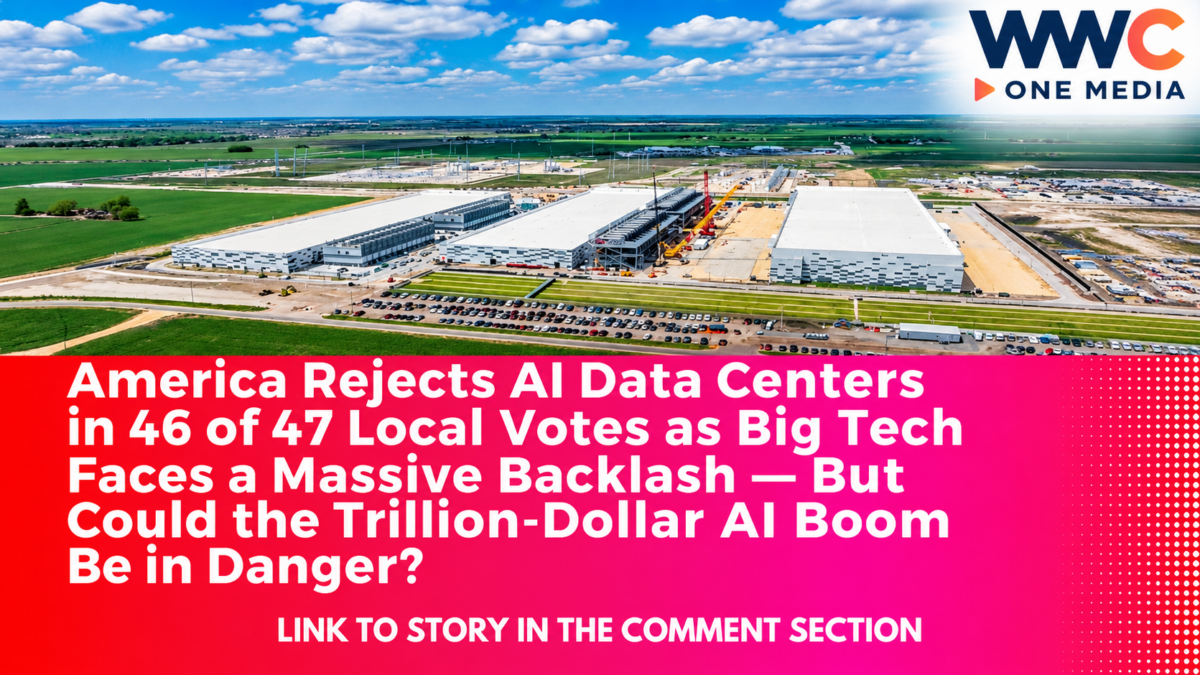
In one of the strongest electoral warnings yet delivered to the technology industry, 46 of 47 decided local ballot measures concerning data-center development produced outcomes favoring tighter restrictions, according to Ballotpedia’s November 4, 2026, election scorecard.
Only one measure resulted in an outcome favorable to data-center developers.
That exception occurred in Harwood, North Dakota, where residents rejected proposed additional oversight requirements for large industrial projects.
The results represent a significant setback for an industry preparing to spend enormous sums on artificial intelligence infrastructure, including advanced computing facilities, electrical networks, cooling systems and thousands of powerful processors.
According to Bloomberg, The Washington Post, Stateline, Route Fifty and Data Center Dynamics, the November 3 midterm elections revealed growing public resistance to projects that promise economic investment but can also create concerns over electricity bills, water consumption, noise, land use and government transparency.
The backlash is particularly significant because it crosses traditional political divisions.
Communities in Republican-leaning and Democratic-leaning areas alike have expressed concerns about the rapid expansion of industrial-scale computing facilities.
For companies such as Amazon, Microsoft, Google and Meta, the message is increasingly difficult to ignore.
Building the infrastructure necessary for the next generation of artificial intelligence may depend not only on securing billions of dollars in financing and enormous amounts of electricity, but also on winning support from the communities expected to host it.
The central question now is whether the technology industry can rebuild public confidence before local restrictions delay more projects — or whether America’s AI infrastructure expansion is entering a much more expensive and politically dangerous era.
Big Tech Faces Election-Night Defeat as Voters Demand Data Center Restrictions
The November 3 midterm elections delivered a striking series of local decisions affecting artificial intelligence infrastructure.
According to Ballotpedia’s November 4 tally, voters had decided 47 data-center-related measures during 2026.
Of those, 46 produced outcomes favoring additional limits or requirements, while one favored development.
Three additional measures were still awaiting votes.
The restrictions took several forms.
Some communities approved bans on certain data centers.
Others adopted zoning restrictions, temporary moratoriums, electricity-use limits or requirements for greater public involvement before construction could begin.
Several measures were advisory rather than legally binding.
The results therefore do not mean that 46 communities voted to shut down all existing facilities.
Instead, they demonstrate broad opposition to allowing large data-center projects to proceed without stronger safeguards.
The Washington Post reported that voters in at least 29 jurisdictions approved bans or restrictions, while other early tallies showed additional measures favoring opponents.
Ohio emerged as one of the strongest centers of resistance.
Communities including Granville, Hubbard, Piqua, Urbana and Upper Sandusky backed restrictions or bans, according to Data Center Dynamics.
The wave of opposition also reached California, Illinois, Wisconsin and other states.
The geographical spread is important.
Data-center developers increasingly seek locations with affordable land, access to electricity and supportive local governments.
But the election results suggest those conditions may no longer be sufficient.
Residents increasingly want evidence that projects will deliver meaningful economic benefits without imposing disproportionate costs on surrounding neighborhoods.
Only One Town Sided With Developers — But the North Dakota Result Has a Twist
Harwood, North Dakota, became the standout exception to the national trend.
Voters rejected a proposed charter amendment requiring additional independent reviews and public hearings for certain large industrial developments, including major data centers.
The measure was defeated by 325 votes to 105.
That result meant existing approval procedures would remain in place.
However, Harwood residents were not voting directly to approve construction of a new data center.
The referendum concerned how future large development decisions would be reviewed.
The distinction is essential.
Harwood’s mayor, Blake Hankey, opposed the amendment, arguing that its language was unclear and could create burdens for businesses beyond data-center developers.
Supporters said stronger oversight was necessary after residents learned about a major project that had moved forward rapidly.
The controversy centers on a roughly $3 billion data-center development associated with Applied Digital.
Residents complained that construction advanced only weeks after the project became public.
The development has been promoted as an economic opportunity for the small community, including the prospect of approximately 200 jobs.
Local officials have also emphasized the importance of potential tax revenue.
The election result therefore reflects a debate over economic development, transparency and the limits of local regulation.
It does not establish unanimous community support for AI infrastructure.
Why Americans Are Turning Against AI Data Centers
Artificial intelligence is often presented as an engine of economic growth, but the physical infrastructure behind it can create substantial local challenges.
Modern AI facilities contain thousands of high-performance processors operating around the clock.
These systems require dependable electricity, cooling equipment, telecommunications infrastructure and large buildings.
Depending on their design, data centers can also require significant water resources.
For nearby residents, the effects can include construction activity, industrial noise, changes in land use and additional pressure on local utilities.
Electricity affordability has become one of the most contentious issues.
When a utility must build new transmission lines, substations or generating facilities to serve a large data center, questions arise about who should pay.
If infrastructure costs are spread across a utility’s broader customer base, households and smaller businesses could face higher charges.
However, the impact varies according to local electricity rules, contracts and cost-allocation arrangements.
Not every data center automatically raises nearby residential electricity bills.
WWC ONE MEDIA previously examined this dispute in Electricity Bills Are Soaring as Utilities Race to Upgrade Power Grids — But Who Will Pay for the AI Energy Boom?.
The report discussed the difficulty utilities face when planning costly infrastructure around uncertain future demand.
For communities already dealing with expensive electricity, the prospect of subsidizing additional industrial-scale power consumption can generate strong political opposition.
Data Center Opposition Has Become a National Political Issue
The election results reflect a broader change in how Americans view artificial intelligence infrastructure.
A Washington Post-ABC News-Ipsos poll released before the election found that roughly seven in ten Americans opposed building new data centers in their communities.
A separate Quinnipiac survey reported that 72% of respondents opposed a new local data center, compared with 65% earlier in the year.
These surveys suggest the backlash is not confined to a small number of communities facing particular developments.
Public concerns are spreading as AI infrastructure becomes more visible.
Residents increasingly question whether promised economic benefits justify electricity demand, environmental impacts and changes to surrounding land.
The issue has also become politically sensitive for elected officials.
Local leaders who support projects may face pressure from residents seeking stricter oversight.
Developers, meanwhile, argue that overly restrictive regulations could discourage investment, reduce tax revenue and eliminate potential employment opportunities.
The competing arguments have transformed what was once a specialized planning issue into a significant public-policy debate.
Ohio Becomes a Major Battleground for America’s AI Expansion
Ohio played an especially important role in the November 3 results.
Data Center Dynamics reported that at least 14 bans or other restrictions had passed in the state.
Several communities approved measures limiting facilities based on electricity demand or other development criteria.
In Grove City, voters supported requirements for public approval of certain large projects meeting thresholds involving acreage, electricity use or water consumption.
Other municipalities backed restrictions on facilities exceeding 25 megawatts.
These measures reflect concerns about the extraordinary scale of modern computing infrastructure.
A 25-megawatt facility can represent a substantial industrial electricity customer.
Some proposed AI campuses require several hundred megawatts, creating even greater demands on electrical networks.
For local governments, the challenge involves balancing potential tax income and business investment against infrastructure costs and community concerns.
Developers may also face difficulties when neighboring communities adopt different regulations.
A project blocked in one jurisdiction could move to another location with less restrictive rules.
That possibility creates another question for policymakers: whether local prohibitions resolve infrastructure concerns or simply relocate development to communities with less political influence.
Could Local Opposition Threaten Hundreds of Billions in AI Investment?
The financial stakes extend far beyond individual towns.
The United States is experiencing an unprecedented wave of investment in computing infrastructure.
Technology companies are expanding facilities to support AI models, cloud services, digital applications and enterprise computing.
Before the election, Bloomberg reported that more than 40 data-center-related measures were on local ballots and that hundreds of billions of dollars in potential investment could be affected.
The measures do not automatically cancel that amount of spending.
Some projects may be redesigned, relocated or delayed rather than abandoned.
Nevertheless, the results introduce substantial uncertainty for developers.
Construction delays can increase financing expenses, postpone customer revenue and complicate agreements with equipment suppliers and utilities.
Projects may also require additional environmental assessments, public consultations or modifications to electricity supply arrangements.
WWC ONE MEDIA previously covered the scale of the investment boom in Bank of America Predicts $2.1-Trillion AI Data Center Explosion by 2028 — But Could a Global Power Shortage Bring the Entire Boom Crashing Down?.
That article examined Bank of America Global Research’s forecast that worldwide data-center spending could reach approximately $2.1 trillion annually by 2028.
The estimate represents projected global industry expenditure, not spending guaranteed to occur or money already lost because of the US election results.
The distinction matters.
An ambitious investment forecast can become harder to achieve when developers encounter electricity shortages, construction delays, financing pressures and political resistance.
Data Center Developers Face a Growing Cost-of-Electricity Problem
Electricity has emerged as one of the most important constraints on the AI infrastructure boom.
Building a large data center requires more than purchasing advanced chips.
Operators must secure reliable power supplies, cooling capacity, grid connections and backup systems.
In some regions, electrical infrastructure projects can take years to complete.
Transformers, substations and transmission equipment may also face supply-chain constraints.
Meanwhile, technology companies are competing to secure long-term electricity arrangements.
These developments can create difficult decisions for utility companies.
Building too little infrastructure risks delaying economically valuable projects.
Building too much can expose utilities and customers to unnecessary costs if anticipated data centers never open.
The November election results add another complication.
Even technically feasible projects may encounter political barriers.
Developers could therefore face situations in which financing and equipment are available but local permits remain uncertain.
That would increase the importance of community consultation earlier in the planning process.
Trump Previously Proposed Payments to Communities Hosting AI Data Centers
Before the midterm elections, President Donald Trump proposed a different approach to addressing local resistance.
He suggested that technology companies should compensate communities hosting large data centers.
The proposal reflected growing recognition that residents may be more willing to accept infrastructure projects when they receive tangible financial benefits.
WWC ONE MEDIA covered the proposal in Trump Tells Big Tech to Pay Americans for Hosting AI Data Centers — But Who Will Really Foot the Electricity Bill?.
Potential community benefits could include local tax revenue, infrastructure improvements, employment commitments and financial arrangements intended to offset additional costs.
However, such measures would not necessarily resolve every concern.
Residents may still oppose facilities because of noise, water consumption, environmental impacts or changes to the character of their communities.
Compensation also requires careful design.
Authorities must determine who receives benefits, how infrastructure costs are allocated and whether developers meet their long-term commitments.
The election results suggest that public acceptance cannot simply be assumed because a project promises substantial investment.
The AI Data Center Backlash Is Spreading Beyond the United States
Although the November 3 vote took place in the United States, the underlying conflict is increasingly international.
Communities in Europe, Asia and Africa have also raised concerns about large data-center developments.
Issues include electricity affordability, water availability, land-use changes and the environmental consequences of expanding computing infrastructure.
WWC ONE MEDIA examined these trends in AI Data Center Backlash Is Spreading Across Europe, Asia and Africa — But Billions in Investment Are Already at Risk.
The report discussed how permitting difficulties and community resistance can affect investment decisions even outside the United States.
For multinational technology companies, this creates a broader challenge.
Moving a project from one country to another does not necessarily eliminate concerns about electricity, water or community consultation.
New locations may face different regulatory requirements, infrastructure limitations and political pressures.
Developers increasingly need to consider social acceptance alongside financial returns and technical feasibility.
What the US Election Means for the Philippines and Southeast Asia
The growing resistance to data-center development has important implications for the Philippines and Southeast Asia.
Countries across the region are seeking investments in cloud infrastructure, telecommunications, artificial intelligence and digital services.
The Philippines has opportunities to attract international computing infrastructure projects, particularly as businesses increase demand for local data storage and digital connectivity.
However, reliable and competitively priced electricity remains essential.
Data centers require significant power availability, and the cost of electricity can influence where companies choose to invest.
The US experience highlights the importance of transparent planning.
Local governments should assess whether proposed projects can secure adequate electricity without unfairly transferring infrastructure costs to residential customers.
Environmental impacts, water requirements and employment commitments should also be examined before approvals are granted.
Some developers are already exploring models that integrate power generation and data-center infrastructure.
WWC ONE MEDIA reported on Philippine efforts in MGEN and VITRO Explore Renewable-Powered Data Centers to Support Philippine AI Growth.
The initiative involves studying potential facilities that could combine digital infrastructure with renewable-energy resources.
However, the partnership remains exploratory, and specific projects are not guaranteed.
The broader lesson is that countries hoping to participate in the AI investment boom must account for infrastructure and community concerns before development reaches an advanced stage.
Can Big Tech Still Win Community Support?
Despite the election results, data-center development is unlikely to disappear.
Demand for cloud computing, digital storage and artificial intelligence continues to drive interest in new computing capacity.
The industry also offers potential economic benefits.
Large construction projects can employ contractors and skilled workers, while completed facilities may generate property-tax revenue and create technical and maintenance jobs.
For smaller communities, these benefits can be meaningful.
But the number of permanent jobs at a data center may be relatively limited compared with its construction costs and electricity demand.
Developers therefore face increasing pressure to demonstrate that community benefits extend beyond initial investment announcements.
Greater transparency over electricity agreements, independent environmental assessments, enforceable infrastructure commitments and meaningful public consultations could become more important.
Some communities may support projects after receiving clearer information and stronger guarantees.
Others may continue opposing construction regardless of potential economic benefits.
The next phase of the AI boom could depend on whether developers adapt to that reality.
The Bigger Question: Is America’s AI Infrastructure Boom Facing a Political Breaking Point?
The November 3 election results have exposed an important weakness in the AI investment narrative.
Technology companies can secure enormous financing commitments, purchase advanced processors and announce ambitious expansion plans.
But they cannot automatically secure public approval for the physical infrastructure those plans require.
The results of 47 decided ballot measures — with 46 favoring restrictions and only one producing a development-friendly outcome — demonstrate how widespread local opposition has become.
For technology companies, the consequences could include longer project timelines, higher development costs and greater scrutiny of promised economic benefits.
For residents, the election represents an opportunity to demand stronger oversight of developments that could reshape their communities.
And for policymakers, the challenge is balancing technological progress against electricity affordability, environmental protection and democratic participation.
The result does not prove that the AI industry is headed for collapse.
Nor does it establish that all proposed data centers will be blocked.
But it sends a powerful message to investors and developers: America’s artificial intelligence infrastructure expansion must now contend with a public increasingly willing to say no.
As 46 local votes deliver a warning to Big Tech and only one favors development, could America’s growing data-center rebellion force technology companies to rethink their trillion-dollar AI ambitions — or will the industry find a way to rebuild public trust before more projects are blocked?