SYDNEY, AUSTRALIA / MANILA, PHILIPPINES — November 5, 2026 | WWC ONE MEDIA | Global Business, Retail Industry & Economic News
One of Australia’s most iconic retail institutions has suffered a historic financial collapse, sending shockwaves through the country’s shopping industry and raising serious questions about the future of thousands of employees, suppliers and department stores.
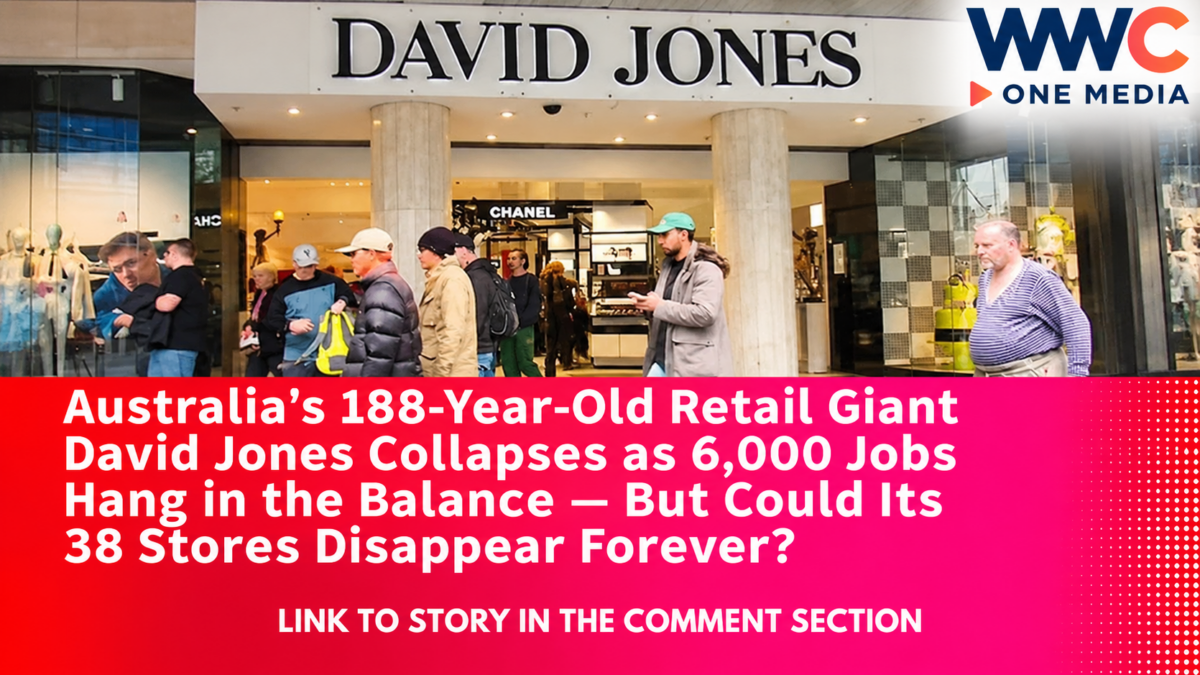
David Jones, the 188-year-old department store chain that has served generations of Australian shoppers since 1838, has entered voluntary administration and receivership after rescue negotiations with a major landlord broke down.
The extraordinary development marks the first administration in the retailer’s nearly two-century history and threatens to permanently reshape one of Australia’s most recognizable shopping brands.
According to Bloomberg, Reuters, ABC News Australia and Inside Retail, the company’s financial troubles intensified after unpaid rent, years of losses and weakening consumer demand pushed the business toward a breaking point.
Approximately 6,000 employees across its remaining 38 stores in Australia and New Zealand now face an uncertain future.
The collapse comes just weeks before the crucial Christmas shopping season, when retailers typically depend on stronger sales to boost revenue and generate cash.
But while David Jones has entered formal insolvency proceedings, its stores have not all been ordered to close.
Administrators and receivers are expected to explore ways to restructure the company, reduce costs and potentially secure new ownership.
The question now gripping Australia’s retail industry is whether David Jones can survive as a smaller business — or whether its 188-year legacy is approaching its final chapter.
David Jones Collapses After 188 Years as Rescue Talks Break Down
The collapse followed unsuccessful negotiations between David Jones and Scentre Group, the company that operates Westfield shopping centres across Australia and New Zealand.
Scentre Group disclosed that the department store chain had paid its rent through September 30, 2026, but had failed to make subsequent rental payments.
The financial dispute affected 17 Westfield locations occupied by David Jones.
According to ABC News Australia, Scentre Group chief executive Elliott Rusanow said the department store was in breach of its rental agreements.
The landlord also revealed that it had offered a proposal intended to help David Jones continue operating.
However, that proposal was rejected by the retailer’s private equity owner, Anchorage Capital Partners.
The collapse of negotiations eliminated a potential route to keeping the business afloat under its existing financial arrangements.
Reuters reported on November 5 that the department store chain subsequently entered voluntary administration.
McGrathNicol was appointed as administrator, while FTI Consulting was appointed as receiver to take control of operations and evaluate restructuring or sale options.
The appointments represent a major shift in control of the business.
Instead of continuing under ordinary management arrangements, the retailer must now navigate an insolvency process involving creditors, lenders, employees and potential buyers.
How a Department Store Founded in 1838 Reached the Brink
David Jones traces its origins to 1838, when Welsh immigrant David Jones established a retail business in Sydney.
Over the following 188 years, the chain became one of Australia’s most prominent department stores.
Its flagship locations in Sydney and Melbourne evolved into landmarks, attracting shoppers looking for fashion, beauty products, homewares and luxury goods.
For generations, David Jones occupied a special position in Australian shopping culture.
Families visited its stores for Christmas gifts, school clothing, weddings, formal occasions and major celebrations.
The company described itself as the world’s oldest continuously operating department store.
However, longevity could not shield the business from profound changes in consumer behaviour.
Over the past decade, traditional department stores have struggled against the expansion of online shopping platforms, international fashion chains and specialty retailers.
Consumers increasingly discovered they could compare prices, order products and receive deliveries without visiting a large shopping centre.
The rise of fast-fashion retailers and digital marketplaces intensified competition.
At the same time, major luxury brands increasingly developed their own boutiques and direct-to-consumer sales channels.
These changes weakened the competitive position of traditional department stores.
David Jones found itself squeezed between discount-driven retailers and luxury brands offering more specialized shopping experiences.
Financial Losses Reveal the Depth of David Jones’ Crisis
The department store’s collapse followed several years of deteriorating financial performance.
Australian media reports indicate that David Jones recorded a pre-tax loss of approximately A$95.5 million in the 2025 financial year, compared with a loss of roughly A$74.1 million in 2024.
That represents a worsening of about A$21.4 million.
Sales also declined, with reported annual revenue falling to approximately A$2 billion.
The losses highlight the difficulty of maintaining a large physical retail network when sales volumes are weakening and operating expenses remain high.
Department stores face substantial fixed costs, including property leases, employee wages, utilities, logistics, store maintenance and inventory financing.
Even when customers continue shopping, revenue may be insufficient to cover those expenses.
David Jones also reportedly missed the deadline to lodge its 2026 financial statements with Australia’s corporate regulator, ASIC.
The failure to file accounts on time added to concerns about the retailer’s financial condition.
Industry reports also described difficulties involving suppliers, including delayed payments and changes to trading arrangements.
For a retailer dependent on maintaining extensive product selections, supplier confidence is essential.
If major brands reduce shipments or demand stronger payment guarantees, stores can struggle to maintain the merchandise needed to attract customers.
Unpaid Rent at Westfield Becomes the Breaking Point
David Jones’ relationship with Westfield owner Scentre Group became central to its financial crisis.
The department store occupied space in 17 Westfield shopping centres.
Scentre Group disclosed that David Jones had provided approximately A$45 million in bank guarantees across its relevant Australia and New Zealand portfolio.
The landlord said roughly A$30 million of that exposure was attributable to Scentre’s share, equivalent to approximately eight months of gross rent.
These guarantees provided some protection to the property group if the retailer failed to satisfy its obligations.
However, the unpaid rent illustrated a deeper problem.
David Jones was struggling to meet the cost of operating its existing network.
Reports suggested its owners had been attempting to negotiate rental concessions and close underperforming stores.
An arrangement was discussed that could have substantially reduced the chain’s physical footprint.
Ultimately, the failure to reach an agreement contributed to the decision to place the business into administration.
For commercial landlords, David Jones’ financial collapse also creates potential challenges.
Large department stores traditionally function as anchor tenants, helping shopping centres attract customers and generate activity for surrounding businesses.
If major stores close, shopping centre operators may need to find replacement tenants or redesign large retail spaces.
Around 6,000 Workers Face an Uncertain Future
The crisis has created immediate uncertainty for thousands of retail employees.
Reuters reported that approximately 6,000 workers were employed across David Jones’ remaining 38 stores.
The company’s chief executive, Erica Berchtold, was expected to address employees as news of the administration emerged.
However, entering administration does not automatically mean every employee will lose their job.
Receivers may continue operating stores while they assess the financial viability of the business and search for buyers.
Some locations could remain open under new ownership.
Others may be closed if their trading performance cannot justify ongoing costs.
The Shop, Distributive and Allied Employees’ Association, which represents retail workers, has indicated that it will work to protect employees affected by the crisis.
Questions remain about the potential number of redundancies, whether all stores will remain operational through Christmas and how any restructuring will affect workers’ entitlements.
Until the receivers announce a formal restructuring plan, the total number of jobs that could disappear remains unknown.
Could David Jones Shrink From 38 Stores to Just 12?
One of the most consequential possibilities involves a dramatic reduction in the department store’s physical presence.
Australian media reports indicate that David Jones’ owners had explored reducing the company’s network from 38 stores to approximately 12.
That would represent a reduction of 26 locations, or more than two-thirds of its current network.
However, such a reduction has not been confirmed as the final restructuring plan.
The proposal illustrates the scale of cost-cutting that may be necessary to create a financially sustainable business.
Analysts expect that stores in highly profitable central business districts could have a stronger chance of surviving than underperforming suburban or regional locations.
Flagship locations may remain attractive because of their established customer bases, brand recognition and premium retail positioning.
But even prominent stores must generate sufficient revenue to justify their costs.
Receivers will need to examine lease obligations, store profitability, inventory, supplier relationships and available financing before deciding which locations could remain open.
The possibility of large-scale closures creates broader uncertainty for shopping centres that have relied on David Jones as a major tenant.
Christmas Shopping Season Could Determine the Retailer’s Survival
The timing of the collapse is particularly significant.
November and December are among the most important trading months for Australian retailers.
Black Friday promotions and Christmas shopping can generate substantial sales volumes.
For a struggling department store, those seasonal revenues may be important in determining whether operations can continue during restructuring.
Receivers may seek to preserve the strongest trading locations while attempting to sell inventory and stabilize supplier relationships.
However, aggressive discounting could also reduce profit margins and place competitive pressure on other retailers.
MST Marquee analyst Craig Woolford told ABC News that a potential administration before Christmas could create difficulties for competitors if the business resorted to unusually heavy discounting.
The challenge for the receivers will be balancing short-term cash generation with the longer-term value of the brand.
Selling too much inventory at steep discounts may generate cash but weaken the prospects of rebuilding the business.
Closing stores too quickly could also disrupt supplier arrangements and reduce the company’s attractiveness to potential buyers.
What Happens to David Jones Gift Cards, Refunds and Online Orders?
The collapse also raises important questions for customers.
Australian consumer advocates have warned that gift card holders should consider using existing balances promptly because their treatment may change during insolvency proceedings.
If a retailer enters administration, unused gift cards may become unsecured creditor claims, depending on the circumstances and any arrangements made by administrators or receivers.
That does not mean every David Jones gift card has automatically become invalid.
The treatment of existing cards will depend on decisions made during the restructuring process.
Customers with pending deliveries, lay-by arrangements or refund requests may also encounter uncertainty.
Consumer experts recommend retaining receipts, monitoring official retailer announcements and contacting payment providers when goods purchased by card are not delivered.
Australian Consumer Law may continue to provide rights relating to faulty products, although recovering money directly from an insolvent retailer can become more complicated.
ABC News Australia reported that consumer advocates had urged shoppers to be cautious about buying additional gift cards while the company’s future remained unresolved.
For thousands of customers preparing for Christmas, these practical questions may become as important as the fate of the department store itself.
Australia’s Cost-of-Living Crisis Adds Pressure to Retailers
David Jones’ collapse comes at a difficult time for Australian consumers.
Households continue to face pressure from inflation, rising borrowing costs and elevated prices for essential goods.
The Reserve Bank of Australia recently increased its benchmark interest rate to 4.85%, the highest level in approximately 18 years.
Higher interest rates increase borrowing costs for households with variable-rate mortgages and can reduce the amount of disposable income available for shopping.
WWC ONE MEDIA examined these pressures in Australia Raises Interest Rates to 18-Year High of 4.85% as Inflation Surges — But Could a Housing Crash Be the Price of Victory?.
The latest central bank decision has intensified concerns about household finances, property prices and the outlook for consumer spending.
For retailers selling discretionary goods such as fashion, accessories and luxury products, weaker household budgets can translate into slower sales.
However, Australia’s overall consumer spending has not collapsed.
Official data showed household spending increased 0.6% in September to approximately A$82.6 billion, exceeding economists’ expectations.
WWC ONE MEDIA covered the development in Australia’s Household Spending Beats Forecasts at A$82.6 Billion as Fuel Costs Surge — But Could the Unexpected Rebound Trigger Even Higher Interest Rates?.
The apparent contradiction highlights an important economic distinction.
Higher overall spending does not necessarily mean every retail category is performing well.
Households may be paying more for fuel, groceries and essential services while reducing purchases of clothing, homewares and nonessential products.
For a retailer such as David Jones, that shift can be particularly damaging.
Why Traditional Department Stores Are Struggling Worldwide
David Jones is not the only established retail company confronting profound structural changes.
Across international markets, retailers have been closing stores, reviewing leases and restructuring operations as consumer preferences evolve.
In the United States, some major retail chains have reduced their physical networks to improve profitability.
WWC ONE MEDIA previously reported on Starbucks to Close 250 North American Stores in Second Major Wave of Closures.
Although Starbucks operates a different business model from David Jones, the example highlights a common financial challenge: large retail networks must continually reassess whether individual locations justify their operating costs.
Another example involves the American children’s clothing retailer The Children’s Place, which has faced severe financial pressure.
WWC ONE MEDIA examined its situation in Children’s Place Faces Possible Liquidation as Sales Plunge 19% and Cash Falls to $7.2 Million — But Can a Last-Minute Buyer Save 514 Stores?.
The circumstances are different, but the underlying lesson is similar.
Strong brand recognition and decades of business history cannot guarantee survival when operating costs, financing pressures and customer preferences change.
David Jones’ crisis demonstrates the growing importance of adapting store networks, digital commerce and inventory strategies to evolving consumer behaviour.
Private Equity Owner Anchorage Capital Faces a Major Setback
David Jones’ collapse also represents a setback for Anchorage Capital Partners.
The private equity firm acquired the department store business from South Africa’s Woolworths Holdings in a transaction announced in late 2022 and completed in 2023.
The acquisition was intended to provide an opportunity to reposition the retailer and improve its financial performance.
However, the turnaround proved increasingly difficult.
Reports indicated that David Jones continued to suffer losses, while its store network remained expensive to operate.
The collapse of negotiations with Scentre Group exposed the limits of the restructuring options available under the existing ownership structure.
With administrators and receivers now involved, Anchorage’s control over the company has been fundamentally reduced.
A future sale could leave its equity investment substantially impaired or potentially worthless, depending on recoveries and creditor claims.
The final financial consequences will depend on the outcome of the insolvency process.
What Happens Next to David Jones?
The next phase will focus on whether the business can be rescued, sold or substantially downsized.
McGrathNicol will examine the company’s financial position as administrator.
FTI Consulting, acting as receiver, will assess operational options and the potential recovery of funds for secured creditors.
Several outcomes remain possible.
A buyer could acquire the entire business and attempt a comprehensive restructuring.
Alternatively, investors could purchase selected stores, brands or assets.
The receivers could also close underperforming locations while preserving a smaller network of profitable stores.
A complete liquidation remains possible if the business cannot attract sufficient financial support or a viable buyer.
However, liquidation has not been established as the inevitable outcome.
The company still possesses a recognizable brand, established flagship locations and long-standing relationships with Australian consumers.
Whether those strengths are sufficient to attract new investment remains uncertain.
The Bigger Question: Is This the End of Australia’s Department Store Era?
David Jones’ collapse represents far more than another corporate insolvency.
It marks a defining moment for an institution that has helped shape Australian retail culture for nearly two centuries.
Founded in 1838, the department store survived world wars, economic depressions, major recessions and enormous technological changes.
Yet the combination of changing shopping habits, high operating costs, financial losses and unsuccessful rescue negotiations has brought the historic chain into administration.
Around 6,000 employees now face uncertainty.
Suppliers are assessing their financial exposure.
Landlords must consider the future of large retail spaces.
Customers are questioning the security of purchases, gift cards and deliveries.
And investors are watching whether a business with nearly 200 years of history can attract a new owner willing to fund its recovery.
The situation also offers a warning to traditional retailers across Asia and beyond.
A famous brand may attract customers, but long-term survival requires a business model capable of generating sustainable profits.
Physical stores must offer experiences and services that justify their operating costs.
Digital sales channels must meet changing expectations.
And companies must maintain enough financial flexibility to survive periods of weak consumer demand.
For David Jones, the immediate priority is no longer expansion or market dominance.
It is survival.
As Australia’s oldest department store enters administration for the first time in 188 years, will a buyer emerge to save one of the country’s most recognizable retail institutions — or could thousands of jobs and dozens of stores vanish as the company fights for its future?