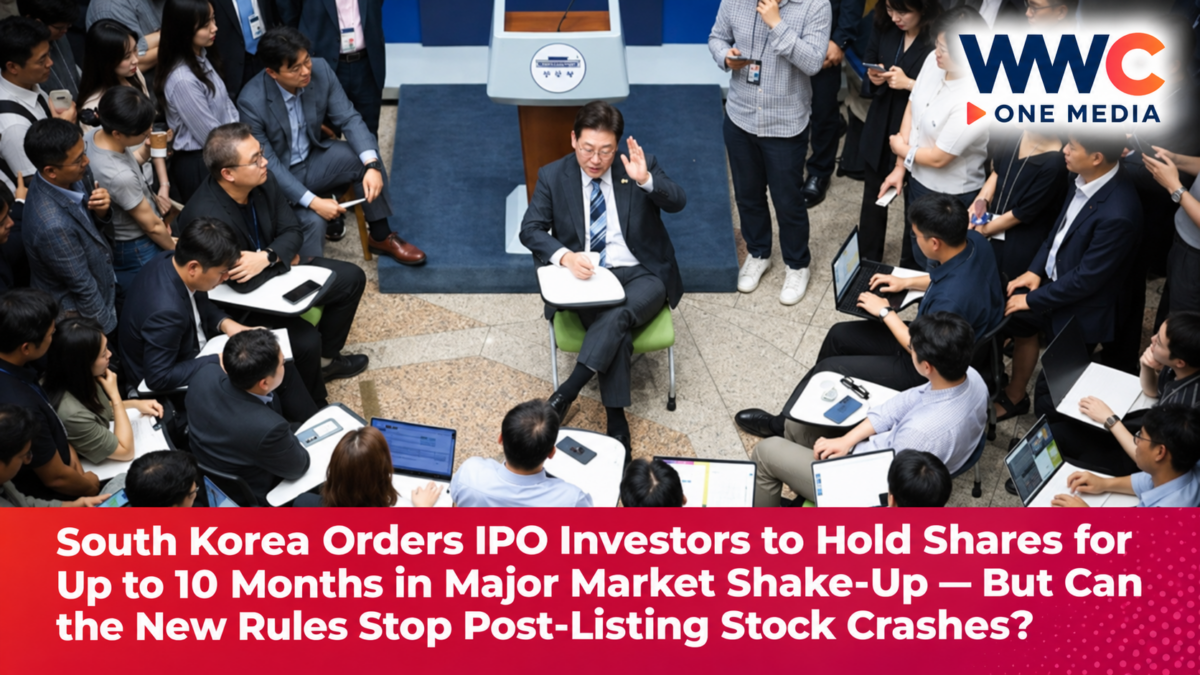
South Korea is preparing a major overhaul of its initial public offering market, introducing new restrictions designed to stop institutional investors from immediately dumping newly listed shares and leaving ordinary investors exposed to sharp price declines.
Beginning November 13, 2026, qualified institutional investors participating in Korea’s new cornerstone investor system will be required to hold their allocated IPO shares for six to ten months.
The reform follows growing concerns about speculative trading, inflated IPO valuations and sudden share-price collapses after companies begin trading on the Korea Exchange.
The Financial Services Commission (FSC) confirmed that South Korea’s Cabinet approved revisions to the Enforcement Decree of the Financial Investment Services and Capital Markets Act on November 3.
The new framework introduces two important mechanisms: cornerstone investors who commit to holding shares and preliminary bookbuilding that allows underwriters to assess investor demand before establishing an IPO’s indicative price range.
The changes will affect companies seeking to list on both the KOSPI main market and the technology-oriented KOSDAQ market.
For investors who have watched highly anticipated IPOs surge on their first trading day only to plunge afterward, the government’s message is clear.
Seoul wants a market that rewards longer-term investment rather than short-term speculation.
But can forcing major institutions to hold shares for up to ten months prevent damaging selloffs—or will the new rules simply postpone the next wave of selling pressure?
Why South Korea Is Changing Its IPO Rules
South Korea’s IPO market has faced recurring concerns over extreme price movements.
Newly listed companies can attract enormous investor attention, particularly when they operate in technology, biotechnology, semiconductor manufacturing or other high-growth industries.
Strong demand sometimes pushes share prices sharply higher immediately after listing.
But those gains can disappear when institutional investors sell their allocations to lock in profits.
The resulting selling pressure can produce sudden losses for investors who purchased shares after trading began.
Financial regulators want to reduce this behavior by encouraging institutional investors to make longer-term commitments.
Instead of allowing all participating investors to pursue immediate exits, the new cornerstone framework allocates shares in advance to institutions that agree not to sell them during specified periods.
The objective is to improve price stability and build investor confidence.
However, even a successfully implemented lockup system cannot guarantee that a company’s shares will remain above its IPO price.
Business performance, valuations, interest rates and wider market conditions will continue influencing share prices.
What Is a Cornerstone Investor?
A cornerstone investor is a major investor that commits to purchasing shares in an IPO before the company begins public trading.
The arrangement is already familiar in financial centers such as Hong Kong.
These investors can provide early demand for an offering and help establish confidence among other potential buyers.
In exchange for receiving an advance allocation, cornerstone investors accept contractual restrictions on selling their shares.
South Korea’s new rules formally establish this structure within its domestic IPO system.
The arrangement is intended to provide companies and underwriters with greater visibility over institutional demand.
It can also reduce the amount of cornerstone-held stock immediately available for resale after listing.
But the protection has limits.
Cornerstone investors are not required to guarantee the company’s performance.
They may still suffer losses if the share price declines.
And they may sell their holdings after the applicable restrictions expire.
Korea Introduces Three Different Lockup Periods
One of the most important features of the reform is its staggered holding schedule.
Instead of imposing the same lockup expiry date on every cornerstone investor allocation, regulators have divided the shares into three portions.
| Portion of cornerstone allocation | Minimum holding period |
|---|---|
| 50% | 6 months |
| 30% | 8 months |
| 20% | 10 months |
The structure is designed to prevent all restricted shares from becoming available for sale simultaneously.
For example, an institution receiving 100,000 cornerstone shares would have 50,000 shares subject to the six-month restriction, another 30,000 subject to eight months, and the remaining 20,000 restricted for ten months.
The institution could not sell each portion before its respective lockup expires.
The schedule applies to the cornerstone allocation, not automatically to every share an institution owns.
Staggering the expiry dates may reduce the risk of a single concentrated selling event.
However, it does not eliminate the possibility of selling pressure as each group of shares becomes available.
Investors will still need to monitor upcoming lockup expirations.
KOSPI and KOSDAQ Face Different Allocation Limits
The government has also established different limits for South Korea’s two main stock markets.
For KOSPI IPOs, cornerstone investors may collectively receive up to 20% of the eligible general institutional allocation.
A single cornerstone investor may receive no more than 10% of that allocation.
For KOSDAQ IPOs, the collective ceiling is 30%, while the individual investor ceiling is 20%.
The limits are calculated after excluding shares reserved for retail investors, employee stock ownership associations and specified policy funds.
This is a significant distinction.
A 30% KOSDAQ cap does not mean cornerstone investors can automatically receive 30% of every IPO’s total shares.
KOSDAQ receives a higher limit partly because its offerings tend to be smaller and a greater portion of shares may be allocated to certain policy-supported investment funds.
Regulators want to provide enough flexibility for qualified institutional investors to participate without allowing cornerstone arrangements to dominate an offering.
New Rules Aim to Stop Inflated IPO Prices
The reform goes beyond restricting sales.
South Korea will also introduce preliminary bookbuilding.
Under the new process, IPO underwriters can assess institutional investors’ interest before submitting the formal securities registration statement.
They can ask qualified institutions about the prices they might be willing to pay and the number of shares they may wish to purchase.
That information can help issuers and underwriters establish a more realistic indicative offering-price range.
Previously, restrictions on early solicitation made it more difficult to assess demand before the formal disclosure process.
Regulators believe the new approach will improve price discovery.
The concept is straightforward.
If underwriters understand investor demand earlier, they may be better positioned to avoid setting offering prices that are disconnected from the market’s willingness to pay.
But preliminary investor interest is not a guarantee that an IPO will succeed.
Demand can change between the preliminary survey and the final offering.
Investors may also reassess their positions when market conditions deteriorate.
Institutional Investors Must Meet Financial Requirements
South Korea is not opening the cornerstone system to every investor.
Participating institutions must satisfy eligibility requirements intended to demonstrate financial capacity.
They must generally have equity capital or entrusted assets equivalent to at least 20 times the value of their intended cornerstone share subscription.
This is designed to ensure that institutions can absorb potential losses while their shares remain locked up.
The requirement is proportional to the size of the investment rather than based exclusively on an exceptionally high fixed minimum.
That may allow some qualified medium-sized institutional investors to participate.
For the preliminary bookbuilding process, general private fund managers and discretionary investment managers face a separate requirement of at least 30 billion won in entrusted assets.
The framework also requires participants to demonstrate the ability to evaluate companies and properly handle sensitive information.
The objective is to create a more disciplined institutional investor base.
Regulators Move to Prevent Conflicts of Interest
Cornerstone investor systems can introduce their own risks.
Underwriters might be tempted to allocate valuable shares to related businesses.
They could also seek to create an artificial appearance of demand by arranging commitments from investors connected to the issuer.
South Korea’s new rules include restrictions intended to prevent such behavior.
Cornerstone agreements with investors presenting specified conflicts of interest, including major shareholders and related parties, are prohibited.
The exchange of direct or indirect benefits in connection with cornerstone agreements is also banned.
Underwriters engaging in preliminary bookbuilding must follow procedures for managing nonpublic information.
That includes confidentiality agreements and recordkeeping requirements.
These safeguards matter because institutional investors may receive information before it becomes publicly available through a securities filing.
The government wants to improve early price discovery without creating opportunities for improper trading.
Nevertheless, effective implementation will depend on regulatory supervision and compliance.
Hong Kong’s IPO Problems Offer a Warning
South Korea’s reforms arrive as other Asian financial centers confront their own IPO challenges.
Hong Kong has experienced considerable volatility among newly listed companies, with some high-profile offerings trading below their issue prices.
WWC ONE MEDIA recently examined the situation in Hong Kong IPO Crisis Deepens as One in Four Deals Collapse in Worst Withdrawal Wave Since 2008.
The report explored how weak aftermarket performance and disagreements over valuation complicated fundraising for prospective issuers.
Hong Kong already uses cornerstone investors extensively.
That experience demonstrates an important limitation.
A cornerstone allocation can provide an initial foundation of demand, but it cannot protect an overvalued company indefinitely.
When market conditions worsen, investors may become less willing to participate in new offerings.
And even cornerstone investors can incur substantial losses if shares decline during their restricted holding periods.
For South Korea, the challenge is ensuring that the new system produces genuinely stronger pricing and more durable investment demand.
Philippine Investors Have Seen Similar Post-IPO Risks
The issue is relevant to investors outside South Korea.
The Philippines recently completed its largest IPO when GCash parent Mynt made its stock market debut in October.
WWC ONE MEDIA reported on the listing in GCash Parent Mynt Makes Stock Market History With ₱60.9-Billion IPO — But Can Its Shares Keep Rising?.
The landmark transaction attracted attention from institutional and retail investors.
But the company subsequently experienced price fluctuations after its listing.
A separate WWC ONE MEDIA investigation, Globe CEO and GCash Directors Bet ₱77 Million on Landmark IPO Before Share Price Drops, examined the pressure that emerged during the early trading period.
The Mynt example does not establish that Korea’s new rules would have prevented those price movements.
The Philippine and South Korean markets operate under different regulations and market structures.
Nevertheless, the comparison illustrates why IPO investors must distinguish enthusiasm during an offering from sustainable market demand after listing.
A successful IPO does not guarantee positive returns for investors who purchase shares at or above the offering price.
Retail Investors Want a Fairer IPO Market
Another concern involves access to promising new listings.
Large financial institutions frequently receive significant allocations during major IPOs.
Retail investors sometimes face limited opportunities to participate at the offering price.
WWC ONE MEDIA explored this issue in Robinhood Battles Wall Street for Anthropic’s Trillion-Dollar IPO as Retail Investors Chase AI Shares.
That report examined competition between retail brokerages and institutional investors for access to heavily anticipated technology offerings.
South Korea’s cornerstone framework addresses a different problem: the short-term resale of allocated shares.
However, regulators must balance institutional stability with fair access for individual investors.
That is one reason the new Korean allocation ceilings are calculated within the eligible institutional tranche rather than simply allowing cornerstone commitments to consume unrestricted portions of the entire offering.
For ordinary investors, greater stability could be useful.
But fair allocations, transparent disclosures and reasonable valuations remain equally important.
Will Lockups Create New Selling Pressure Later?
The greatest unresolved question involves what happens when the restrictions expire.
A six-month lockup prevents a cornerstone investor from selling the relevant shares during that period.
It does not require the investor to remain invested for years.
If the company’s share price has risen substantially, an institution may decide to take profits once the restriction ends.
If the share price has declined, the institution may choose to sell to limit further losses.
That creates the possibility of selling pressure six, eight and ten months after listing.
South Korean regulators have tried to reduce this risk by spreading the expiration dates.
But staggered restrictions cannot eliminate normal market behavior.
Much will depend on whether listed companies deliver earnings and growth sufficient to justify their valuations.
The reform could reduce immediate post-listing speculation while leaving broader valuation risks unchanged.
What the New Rules Mean for Korean Startups
For companies planning to raise capital through an IPO, the reforms could produce several benefits.
Early institutional commitments may provide greater confidence that an offering will attract sufficient demand.
Preliminary bookbuilding could improve the accuracy of indicative price ranges.
Longer holding commitments may also attract investors interested in business fundamentals rather than quick trading gains.
These changes could be particularly relevant to smaller growth companies seeking KOSDAQ listings.
However, the reforms may also create new challenges.
Some investors could demand lower offering prices in exchange for accepting longer holding restrictions.
Others may avoid cornerstone participation because they prefer more flexible access to their capital.
Issuers and underwriters will need to balance potential demand, valuation and long-term investor commitments.
The outcome will depend on how institutions respond when the regulations begin operating.
Could South Korea Become a More Attractive IPO Destination?
South Korea is home to globally recognized technology, semiconductor, automotive and manufacturing businesses.
Its capital markets play an important role in financing domestic companies and providing investment opportunities.
The government is seeking to make the IPO process more predictable and less vulnerable to abrupt speculative price movements.
For international investors, improved price discovery and stronger institutional commitments could make Korean listings more attractive.
But investor confidence depends on a much wider range of factors.
These include corporate governance, financial transparency, currency movements, economic growth and geopolitical conditions.
An IPO lockup system addresses one specific source of volatility.
It does not eliminate market-wide selloffs, weak company earnings or sudden changes in global risk appetite.
What Independent News Outlets Confirm
South Korea’s Financial Services Commission officially announced the Cabinet’s approval of the rule changes on November 3.
The government’s public announcement confirms the planned November 13 implementation date.
ChosunBiz independently reported the cornerstone allocation limits, staggered lockup requirements and investor eligibility conditions.
Seoul Economic Daily separately confirmed the 6-, 8- and 10-month restrictions and the introduction of preliminary demand surveys.
SBS News reported that the measures were intended to address short-term institutional trading and subsequent IPO price declines.
The Korea Herald also confirmed the KOSPI and KOSDAQ allocation ceilings and restrictions on conflicts of interest.
These sources consistently establish the regulatory framework.
However, the actual effect on future IPO prices cannot yet be measured because the system has not taken effect as of November 5.
The Bottom Line: Korea Is Changing the Rules, but Investors Still Face Risk
South Korea is taking a significant step toward changing the behavior of institutional investors in its IPO market.
The new cornerstone system requires participating institutions to hold allocated shares for up to ten months.
The government is also introducing preliminary bookbuilding, allocation ceilings and safeguards against conflicts of interest.
The objective is to discourage short-term speculation, improve IPO pricing and restore investor confidence.
But the reform is not a guarantee against losses.
Companies can still be overvalued.
Market conditions can still deteriorate.
And institutional investors may still sell shares when their lockups expire.
South Korea is attempting to make its IPO market less dependent on speculative first-day trading and more focused on long-term investment. Whether the system succeeds will become clearer only after the new rules are implemented and companies begin listing under them.
As Seoul prepares to restrict cornerstone investors from selling IPO shares for six to ten months, will the reform finally protect ordinary investors from sudden post-listing crashes—or could the next wave of selling simply arrive when the lockups expire?