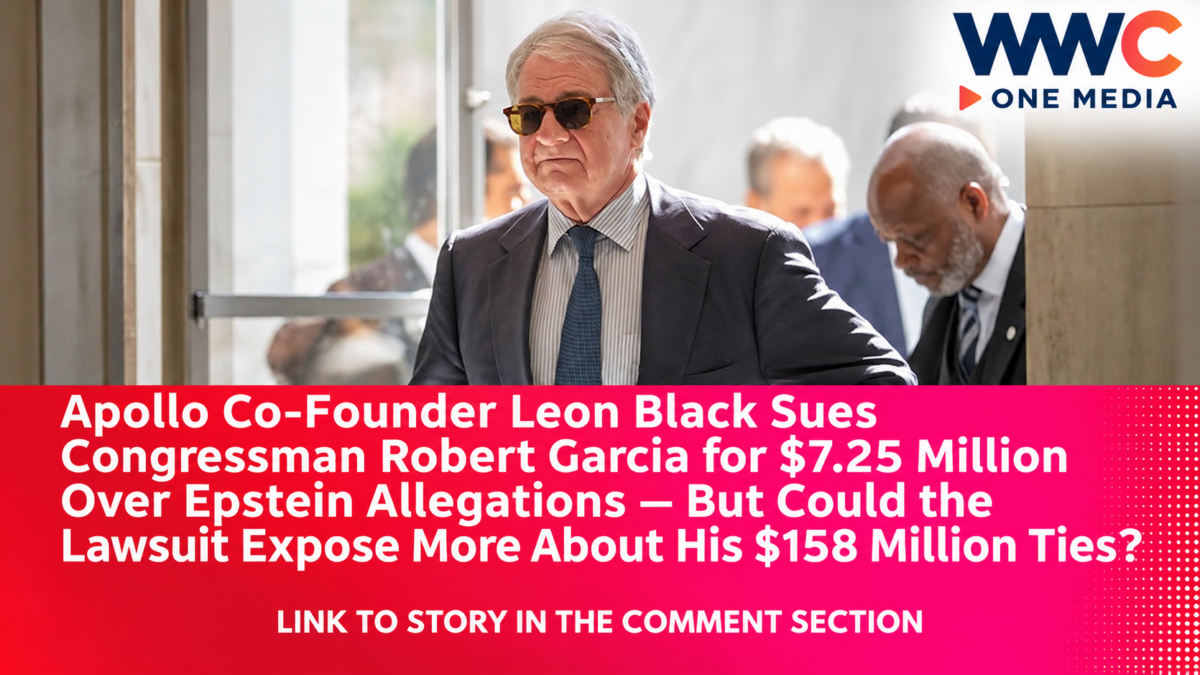
NEW YORK / WASHINGTON — Billionaire investor and Apollo Global Management co-founder Leon Black has launched a $7.25-million defamation lawsuit against Democratic Congressman Robert Garcia, escalating a legal and political confrontation over Black’s financial relationship with convicted sex offender Jeffrey Epstein.
The complaint, filed November 4 in the US District Court for the Southern District of New York, accuses Garcia of making false and damaging public statements linking Black to Epstein’s sexual abuse and trafficking activities.
According to Bloomberg and the Associated Press, Black is seeking compensatory and punitive damages and has requested a jury trial.
The lawsuit comes less than two months after the US House of Representatives approved a contempt-of-Congress resolution against Black for refusing to comply with subpoenas issued during a congressional investigation into Epstein’s activities and the federal government’s handling of the case.
At the center of the controversy are two sharply conflicting positions.
Garcia, the ranking Democrat on the House Oversight and Government Reform Committee, has publicly questioned Black’s relationship with Epstein and accused him of involvement in serious misconduct.
Black strongly denies participating in Epstein’s crimes or knowing about his trafficking activities.
Now the dispute is moving into another federal courtroom, raising a question with potentially significant consequences: Will Black’s lawsuit clear his name, or could it invite further legal scrutiny of the billionaire’s relationship with Epstein?
Leon Black Files $7.25-Million Defamation Lawsuit Against Robert Garcia
Black filed his civil complaint on Wednesday, November 4, accusing Garcia of making defamatory statements during a television interview.
The congressman’s remarks were made after Black appeared voluntarily before the House Oversight Committee in June 2026.
Garcia alleged that Black was centrally connected to Epstein’s criminal activities and said survivors had identified him in allegations involving abuse.
He also made a claim about Black’s interactions with Epstein shortly before Epstein’s death in federal custody in August 2019.
Black’s lawyers dispute those statements, describing them as false and malicious.
The legal complaint alleges that Garcia’s comments caused significant damage to Black’s reputation, business relationships and philanthropic activities.
Black also claims that the statements contributed to harassment and threats against him.
The lawsuit seeks $7.25 million in damages.
That amount is a demand made by the plaintiff, not money awarded by a court.
No finding that Garcia committed defamation has been established.
What Did Congressman Garcia Say About Black and Epstein?
The lawsuit centers on statements Garcia made publicly while Congress was examining Black’s financial dealings with Epstein.
Garcia alleged that Black had a central role in Epstein’s criminal activities.
He also said he had spoken with survivors who had made allegations involving the billionaire.
These are serious accusations.
However, their inclusion in political commentary or civil court filings does not establish that Black committed a crime.
Black’s legal team maintains that the allegations are false.
His lawyers have repeatedly stated that he had no knowledge of Epstein’s trafficking activities and did not participate in them.
As of the initial Associated Press report, Garcia’s office had not provided an immediate response to a request for comment on the new lawsuit.
Garcia had previously defended the congressional investigation and called for accountability from individuals whose financial relationships with Epstein attracted scrutiny.
The conflicting accounts are now central to the civil dispute.
Why Did Leon Black Pay Jeffrey Epstein $158 Million?
One of the most consequential established facts concerns the financial relationship between Black and Epstein.
An independent review commissioned by Apollo Global Management found that Black paid Epstein approximately $158 million between 2012 and 2017.
The review concluded that the payments were for tax, estate-planning and related financial services.
The timing attracted substantial attention because Epstein had already pleaded guilty in Florida in 2008 to offenses involving prostitution, including soliciting prostitution from a minor.
The review’s findings did not establish that Black participated in Epstein’s sexual crimes.
However, lawmakers have questioned why such substantial sums were paid to Epstein after his earlier conviction.
Congressional statements have cited a higher figure of more than $180 million in connection with the relationship.
Those numbers should not be treated as interchangeable.
The $158 million figure comes from Apollo’s review, while the larger amount reflects statements made by congressional investigators examining a broader set of financial dealings.
The disagreement over the payments’ significance remains one of the major issues surrounding the investigation.
Senate Investigators Have Also Questioned the Payments
Congressional interest in Black’s financial arrangements extends beyond the House Oversight Committee.
In June 2026, Senator Ron Wyden raised concerns about Black’s payments to Epstein in correspondence with the House investigation.
Wyden questioned whether the unusually large amounts paid for financial advice had been adequately explained.
His concerns also included whether financial institutions had properly reviewed and reported potentially suspicious transactions under applicable anti-money-laundering requirements.
The senator’s letter highlighted a separate $62-million settlement between Black and the government of the US Virgin Islands.
A settlement, however, is not automatically an admission of criminal guilt.
These inquiries illustrate why the payments continue to attract scrutiny, even as Black maintains that his relationship with Epstein involved legitimate professional services.
How the Epstein Investigation Led to a Congressional Contempt Vote
The latest defamation lawsuit did not emerge in isolation.
In June 2026, Black attended a voluntary interview with the House Oversight Committee.
During that appearance, lawmakers sought information about his relationship with Epstein, including questions involving nondisclosure agreements.
Black declined to answer certain questions and ended the appearance before the committee completed its examination.
The committee later issued subpoenas seeking testimony and documents.
Black challenged those demands, arguing that lawmakers had exceeded their legitimate investigative authority.
In September, the dispute escalated.
The House Oversight Committee voted 41–0 to recommend holding Black in contempt of Congress.
On September 16, the full House approved the contempt resolution by unanimous consent.
The matter was referred to the Justice Department for consideration of possible prosecution.
That referral does not mean Black has been convicted of a criminal offense.
The decision whether to pursue a criminal case is separate from Congress’s contempt resolution.
Black Had Already Sued the Congressional Committee
The November 4 defamation case is not Black’s first lawsuit stemming from the investigation.
In September, he filed a separate action challenging subpoenas issued by the House Oversight Committee.
His lawyers argued that the committee’s demands went beyond a legitimate legislative inquiry.
They also raised privacy concerns regarding potential nondisclosure agreements involving women who, according to the defense, were not necessarily connected to Epstein’s criminal activities.
The committee’s chairman, Republican James Comer, rejected the suggestion that the investigation lacked a legitimate purpose.
Comer emphasized the importance of obtaining information about Epstein’s financial relationships and the handling of federal investigations into his crimes.
Garcia likewise supported the committee’s efforts to compel additional information.
The legal fight consequently involves two distinct disputes.
One concerns Congress’s authority to obtain testimony and documents.
The other concerns whether Garcia made legally actionable defamatory statements.
A ruling in one proceeding would not automatically determine the outcome of the other.
Could the Lawsuit Put Garcia’s Statements Under Judicial Scrutiny?
The lawsuit raises questions about the legal protections available for statements made by members of Congress.
The US Constitution’s Speech or Debate Clause generally protects lawmakers from being questioned in court over legitimate legislative acts.
However, the extent of that protection can depend on the circumstances.
Statements made during formal legislative proceedings may be treated differently from remarks delivered in television interviews or other public forums.
Because Black’s complaint concerns public comments made by Garcia, questions about the applicable legal protections could become important.
Defamation claims involving public figures also face demanding legal standards.
A plaintiff who qualifies as a public figure generally must establish not only that a defamatory factual statement was false, but also that the defendant acted with the constitutionally required level of fault, often described as actual malice.
That standard concerns knowledge of falsity or reckless disregard for truth, rather than mere personal hostility.
The court must assess the particular statements, evidence, defenses and applicable law.
No conclusion about those issues should be assumed before the litigation proceeds.
Another High-Profile Defamation Fight Shows the Legal Stakes
The Black-Garcia case comes amid broader disputes over public statements, reputational damage and the limits of political speech.
WWC ONE MEDIA recently examined another major US defamation case in Trump Ordered to Testify Under Oath in $10 Billion BBC Defamation Battle — But Could His Own Lawsuit Backfire?.
That separate litigation concerns allegations over the editing of political remarks in a BBC documentary.
The legal issues and factual circumstances are different.
But both cases illustrate why allegations of reputational harm require more than headlines or large damages demands.
Plaintiffs must establish the necessary legal elements, while defendants may challenge the statements’ meaning, alleged falsity and claimed damages.
The amounts sought in a complaint are not evidence that those damages have occurred.
Defamation Lawsuits Against Political Critics Extend Beyond the United States
The relationship between political accountability and reputational rights has also generated litigation elsewhere.
In Thailand, Prime Minister Anutin Charnvirakul filed a defamation complaint against legal watchdog leader Yingcheep Atchanont over allegations connected to the country’s disputed Senate selection process.
WWC ONE MEDIA covered the case in Thailand PM Anutin Files Defamation Case Against iLaw Chief Over Senate Election Allegations.
The Thai case is legally unrelated to Black’s lawsuit and operates under a different legal system.
Nevertheless, both controversies involve the competing interests of personal reputation, public criticism and political oversight.
The fact that someone files a defamation action does not independently establish that the criticized statements were false.
Equally, a person’s role in public affairs does not eliminate every possible legal protection against defamatory claims.
Epstein-Related Disclosures Continue to Raise Financial Oversight Questions
The Epstein investigation has also renewed attention to financial institutions, wealthy clients and the handling of suspicious transactions.
Separately, WWC ONE MEDIA examined whistleblower issues and Epstein-related disclosures in UK Regulator Reviews Treatment of Whistleblower Simon Andriesz After His Death — But MPs Say the FCA Should Not Be Investigating Itself.
That report concerned a different financial-industry controversy involving regulatory oversight and allegations raised by a whistleblower.
It did not establish wrongdoing by Black or provide evidence supporting Garcia’s accusations.
The connection is broader: investigators and regulators face significant challenges when evaluating allegations involving powerful individuals and complex financial relationships.
Documents, testimony and legally obtained records remain essential to establishing what happened.
Congressional Subpoenas Are Powerful, but They Do Not Establish Guilt
The confrontation also illustrates how congressional investigative powers operate.
A subpoena can require a witness to appear or produce specified documents.
It is an investigative demand, not a criminal conviction.
Likewise, a witness’s decision to challenge a subpoena in court does not by itself prove involvement in the conduct being investigated.
WWC ONE MEDIA recently examined another politically sensitive federal investigation in Trump’s DOJ Floods Alaska Senate Race With 40-Plus Subpoenas Over Two Candidates Named Dan Sullivan.
That separate case concerns election-related allegations, not Epstein.
Its relevance is procedural: subpoenas are tools for gathering evidence, and allegations must be distinguished from findings supported by courts or other authorized bodies.
In Black’s case, Congress’s contempt action concerns compliance with its investigative demands.
The defamation lawsuit concerns Garcia’s public statements.
Neither proceeding, by itself, establishes that Black committed Epstein-related crimes.
What Happened to Apollo Global Management?
Black co-founded Apollo Global Management, one of the world’s major alternative investment firms.
He stepped down as chief executive in 2021 amid mounting scrutiny of his relationship with Epstein.
The company commissioned an external review of the payments.
That review documented the $158 million transferred to Epstein for financial services between 2012 and 2017.
Black’s departure became one of the most prominent corporate consequences of renewed public scrutiny of Epstein’s network of wealthy and influential associates.
However, the latest lawsuit is a personal legal action brought by Black.
It should not be described as a lawsuit filed by Apollo or as evidence that the company itself faces new criminal allegations in this matter.
The distinction between a founder’s personal litigation and a corporation’s legal responsibility is essential for accurate financial reporting.
Why the Case Matters for Epstein Survivors
The wider congressional investigation is focused partly on identifying institutional failures that allowed Epstein’s abuse and trafficking activities to continue.
Survivors have repeatedly called for accountability, transparency and access to information.
The House committee has sought testimony from individuals with financial or personal relationships with Epstein to understand how those relationships operated.
However, the rights of survivors also require careful handling of sensitive records.
Not every confidential agreement or personal relationship necessarily establishes involvement in criminal conduct.
The investigation must distinguish verified evidence from allegations, while protecting the privacy of people who have experienced abuse.
Black’s lawyers argue that some congressional requests could expose private information unrelated to the committee’s legitimate inquiry.
Lawmakers maintain that the requested documents may help answer unresolved questions.
The competing positions underscore the need for clear legal procedures and careful treatment of sensitive evidence.
What Happens Next? Three Major Questions
First, can Black establish that Garcia’s statements were legally defamatory?
The court may need to examine the specific remarks, their factual basis and the legal protections available to a member of Congress.
Second, will the congressional investigation obtain the documents and testimony it seeks?
The subpoena dispute and contempt referral remain separate from the defamation complaint.
Third, could the civil lawsuit create additional factual scrutiny?
Depending on the court’s rulings and applicable discovery rules, the parties may seek evidence relevant to the alleged statements and claimed reputational harm.
But discovery is not unlimited, and no particular document disclosure or testimony is guaranteed.
The Bigger Picture: A Legal Battle With Wider Implications
Leon Black’s $7.25-million lawsuit has added another layer to the continuing investigation into Jeffrey Epstein’s financial relationships and the institutions that surrounded him.
The facts established so far are significant.
Black paid Epstein $158 million over several years, according to an independent review commissioned by Apollo.
Congress has sought additional information about that relationship.
Black challenged the committee’s subpoenas.
The House approved a contempt resolution.
And Black has now accused one of the investigation’s leading Democratic lawmakers of defamation.
But the most serious allegations remain disputed.
Garcia’s public remarks are not judicial findings.
Black’s denials do not resolve the underlying factual questions.
And the newly filed lawsuit has not established liability on either side.
The next developments will depend on evidence, legal arguments and federal court rulings.