WASHINGTON / ANCHORAGE, Alaska — October 31, 2026
A closely contested US Senate election has erupted into a major legal and political confrontation after the Justice Department intensified a criminal investigation into allegations that Democratic operatives helped place a second candidate named Dan Sullivan on Alaska’s ballot to confuse voters and weaken the Republican incumbent.
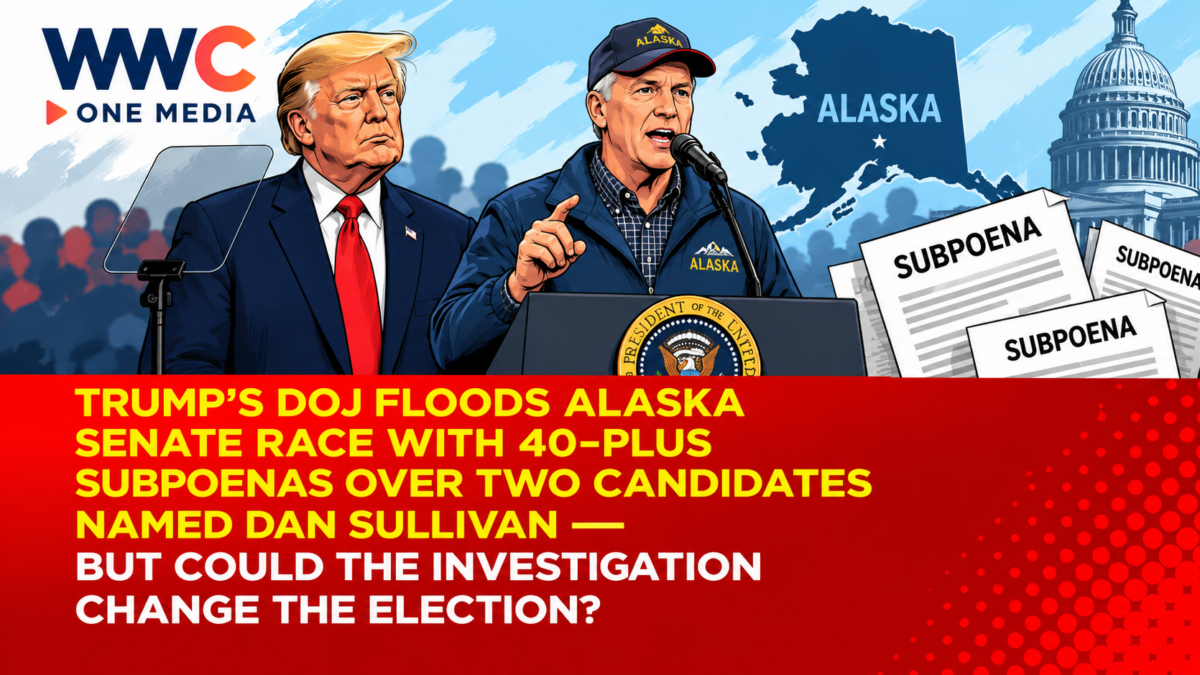
With the November 3 midterm elections just days away, federal investigators have issued more than 40 grand jury subpoenas and document-preservation requests, according to Reuters, citing a source familiar with the investigation.
The investigation centers on whether individuals associated with Democratic candidate Mary Peltola’s campaign helped recruit Daniel J. Sullivan Jr., a retired schoolteacher whose name closely resembles that of Republican Senator Dan S. Sullivan.
The controversy has attracted the attention of President Donald Trump, who has called for action against Peltola, while Alaska Governor Mike Dunleavy has ordered a separate state investigation.
On Friday, October 30, US Attorney Michael Heyman confirmed that the federal criminal investigation had been underway for several months.
He said recent revelations prompted a substantial increase in federal investigative resources in Alaska.
Yet the explosive allegations remain unproven.
Peltola denies knowing about the alleged recruitment effort, and the second Sullivan has denied being recruited by her campaign.
No criminal charges against the principal candidates were announced in the reporting reviewed.
The growing question is whether federal investigators will uncover evidence of unlawful voter deception — or whether the criminal investigation itself could become a defining controversy in one of America’s most consequential Senate races.
More Than 40 Subpoenas as DOJ Intensifies Alaska Investigation
The US Department of Justice has significantly expanded its investigation following new allegations about the origins of the second Sullivan’s candidacy.
According to Reuters, investigators issued more than 40 subpoenas and requests to preserve records, with additional investigative demands expected.
The requests reportedly reached the campaigns of Mary Peltola and Daniel J. Sullivan Jr.
The Associated Press separately confirmed that prosecutors had issued dozens of grand jury subpoenas and preservation requests.
Investigators are seeking information that could help establish whether political operatives coordinated efforts to place a similarly named candidate on the ballot and whether any related conduct violated federal law.
On October 30, Alaska US Attorney Michael Heyman publicly confirmed the criminal investigation.
He said the Justice Department had increased its investigative resources following reporting that raised additional questions about the alleged recruitment effort.
However, Heyman declined to publicly identify the specific crimes being investigated or the targets of the inquiry.
That distinction matters.
A grand jury subpoena is a legal mechanism for collecting testimony or documents.
Receiving one does not mean the recipient has been accused of a crime or that prosecutors have established wrongdoing.
WWC ONE MEDIA previously reported on the initial escalation in DOJ Issues New Subpoenas in Alaska Senate Race as ‘Spoiler Candidate’ Allegations Escalate — Could the Investigation Reshape the Election?.
The latest confirmation from federal prosecutors adds another layer to that developing story.
Why Are Two Men Named Dan Sullivan Running for the Same Senate Seat?
At the center of the controversy are two men with nearly identical names.
Republican incumbent Senator Dan S. Sullivan is running for another term in the US Senate.
Daniel J. Sullivan Jr., a retired schoolteacher from Petersburg, Alaska, is also a candidate.
The similarities between their names have raised questions about whether some voters might mistakenly select the wrong candidate.
The controversy intensified after The New York Times reported that individuals connected to Peltola’s political operation had discussed recruiting candidates who could draw votes away from Republican opponents.
The alleged strategy has been described as a ballot-composition project.
Under this approach, political operatives may encourage additional candidates to run in races where their presence could affect vote distribution.
Critics argue that placing a candidate with a nearly identical name on the ballot could deliberately mislead voters.
However, supporters of broad ballot access argue that otherwise eligible citizens should not be prevented from running merely because their candidacies could affect the chances of major-party candidates.
That disagreement has become a central legal issue in Alaska.
Alaska Supreme Court Previously Allowed the Second Sullivan to Run
The dispute surrounding Daniel J. Sullivan Jr. began before the latest federal subpoenas.
Earlier in 2026, Alaska election officials attempted to exclude him from the ballot, expressing concerns that his candidacy could mislead voters.
The Alaska Supreme Court subsequently overturned the decision and allowed his candidacy to proceed.
The court’s ruling is legally significant because it recognized the candidate’s eligibility under the applicable state election rules.
It did not establish that every possible act associated with his recruitment was lawful.
But it complicates arguments that his mere presence on the ballot constitutes criminal wrongdoing.
Legal analysts interviewed by Reuters and Associated Press have questioned whether encouraging a qualifying candidate to enter an election violates any federal criminal statute.
Political parties have historically supported or promoted additional candidates in efforts to divide an opposing party’s support.
Such strategies may be controversial or ethically questionable without automatically being illegal.
Establishing a criminal violation would require evidence satisfying the elements of a particular offense.
Mary Peltola Denies Knowing About the Alleged Recruitment
Democratic Senate candidate Mary Peltola has strongly rejected suggestions that she knowingly participated in the alleged recruitment effort.
Speaking in Juneau on October 29, Peltola said she had been unaware of any effort to place another Sullivan on the ballot.
She also rejected the suggestion that she wanted to trick voters.
Her campaign and the Democratic Senatorial Campaign Committee have denied involvement in the alleged scheme.
The denials are important because reporting about communications involving political allies does not automatically establish that a candidate personally knew about or authorized those activities.
Investigators would need to examine communications, financial transactions, testimony and other potentially relevant records to determine what happened.
Daniel J. Sullivan Jr. has also denied that Peltola’s campaign recruited him.
He has maintained that he is an independent candidate and said he had no contact with her campaign.
These competing claims remain unresolved.
The investigation therefore concerns allegations that must still be tested against evidence rather than treated as established findings.
Trump Demands Action as Alaska Election Becomes National Political Flashpoint
President Donald Trump has publicly condemned the alleged recruitment scheme and called for consequences for those involved.
He has suggested that Peltola should face prosecution or be excluded from the race.
Other senior Republican figures have criticized the allegations, arguing that deliberately recruiting a similarly named candidate could undermine voter confidence.
Alaska Governor Mike Dunleavy has ordered a separate state investigation into whether the alleged activity violated state law.
Republican lawmakers in Congress have also pursued inquiries into people reportedly connected to the recruitment effort.
Supporters of these investigations argue that authorities have a responsibility to determine whether political operatives deliberately deceived voters.
Critics raise a different concern.
They question whether the federal government’s actions, arriving immediately before a competitive election, could create a perception of political pressure on an opposition candidate.
The two issues need to be considered separately.
Government authorities can investigate credible allegations of criminal activity.
At the same time, the timing, scope and legal justification for politically sensitive investigations can be subject to legitimate public scrutiny.
DOJ Also Seeks to Intervene in Election Certification
The criminal investigation is only one part of the federal government’s response.
The Justice Department has separately pursued civil litigation concerning the certification of Alaska’s Senate election results.
According to Reuters, federal lawyers amended a lawsuit seeking to prevent certification under certain circumstances if the Republican incumbent loses narrowly.
The government’s argument focuses on potential confusion involving votes cast for the two similarly named candidates.
The proposed intervention has raised constitutional questions because states generally administer elections under their own laws, subject to applicable federal requirements.
Legal experts have questioned whether the federal government has sufficient authority and evidence to obtain the requested relief.
The civil lawsuit and criminal investigation are separate proceedings.
An unfavorable ruling in one would not automatically decide the other.
Nor does the existence of litigation mean the eventual election results will necessarily be invalidated.
A court would need to determine whether the requested legal remedy is justified.
What Is a Spoiler Candidate, and Is the Strategy Illegal?
A spoiler candidate is generally someone whose participation in an election changes the distribution of votes in a way that can affect the outcome between leading contenders.
For example, a third candidate might attract support from voters who otherwise would have chosen one of the two major-party nominees.
That can create a political advantage for another candidate.
The practice is neither new nor exclusive to one political party.
Republican and Democratic operatives have been accused in different elections of encouraging additional candidates to divide their opponents’ votes.
However, not every effort to recruit a spoiler candidate violates the law.
The legal questions become more serious when allegations involve unlawful campaign financing, fraudulent representations, intimidation or other prohibited conduct.
Reuters reported on October 30 that legal experts were skeptical of whether the conduct publicly described in Alaska would necessarily support a federal criminal prosecution.
They noted that encouraging a legally qualified individual to run for office can involve political expression protected by the First Amendment.
The circumstances would differ if investigators uncovered evidence of a legally defined fraudulent scheme or other independently unlawful conduct.
The distinction between aggressive campaigning and criminal deception will be central to the investigation.
Ranked-Choice Voting Could Complicate the Alleged Strategy
Alaska uses ranked-choice voting in its general elections.
Instead of selecting only one candidate, voters may rank candidates in order of preference.
If no candidate receives a majority of first-choice votes, the election proceeds through additional counting rounds under the state’s rules.
This system can reduce some effects associated with traditional vote splitting.
For example, a voter could rank the Republican incumbent first and another candidate second, or vice versa.
However, ranked-choice voting does not eliminate the possibility of confusion.
A voter who misunderstands the candidates’ identities could still rank someone differently from what they intended.
The legal question is whether confusion actually occurred and whether any proven misconduct would justify a particular remedy.
Simply having two similarly named candidates does not establish that voters were deceived.
Why the Alaska Senate Race Matters for Control of Congress
Alaska’s Senate contest has become one of the closely watched races in the November 3 midterm elections.
Republican incumbent Dan Sullivan is defending his seat against Peltola, a former Democratic member of the US House of Representatives.
The election could help determine which party controls the Senate.
That would have major implications for President Trump’s remaining two years in office.
Senate control affects confirmation of federal judges and executive nominees, legislative negotiations and congressional oversight.
The political stakes explain why both parties are devoting substantial attention to the Alaska race.
The larger midterm campaign is also entering its final stretch.
WWC ONE MEDIA has covered the Republican Party’s efforts to mobilize supporters in Trump Scraps Kansas and Iowa Rallies Days Before Midterms — Can Phone Campaigns Still Deliver the Republican Votes He Needs?.
Although that report concerns campaign strategy in other states, it provides context for the increasingly intense contest over congressional control.
Could the Criminal Investigation Affect Voter Confidence?
The Justice Department’s actions create two potentially competing concerns.
One is that genuine election misconduct, if proven, could undermine the integrity of the vote.
The other is that aggressive investigations targeting political campaigns immediately before an election could affect public perceptions of institutional neutrality.
American law enforcement agencies have traditionally emphasized the importance of avoiding inappropriate political influence over investigative decisions.
However, officials also have responsibilities to pursue credible evidence of crimes.
The difficulty arises when investigations intersect directly with ongoing elections.
An investigation can become politically consequential even before prosecutors make charging decisions.
Candidates may face additional scrutiny, voters may question the election process, and campaign resources may be diverted toward legal responses.
None of those consequences establishes whether the underlying allegations are true.
The public interest is best served by clear legal standards, reliable evidence and transparent judicial procedures wherever disclosure is permitted.
Jack Smith Controversy Highlights Wider Debate Over DOJ Independence
The Alaska investigation arrives amid broader disagreements about the Justice Department’s use of investigative powers.
Republicans have previously accused former special counsel Jack Smith of politicizing federal investigations involving Donald Trump.
Smith has denied those allegations and defended his decisions as evidence-based.
WWC ONE MEDIA examined the competing arguments in Ex-Trump Prosecutor Jack Smith Defends Investigations as Republicans Challenge His Tactics.
That controversy is legally separate from the Alaska Senate race.
But both involve a recurring institutional question: how can the Justice Department investigate politically powerful individuals while maintaining confidence that its decisions are grounded in law rather than partisan interests?
The answer depends on applying consistent legal standards, preserving due process and distinguishing allegations from findings.
Republicans Face Pressure to Defend Their Congressional Majorities
The Alaska investigation also comes as Republicans work to protect their position in Congress.
President Trump has sought to energize supporters by emphasizing economic promises and national political priorities.
The administration’s campaign messaging has included proposals that could have significant fiscal implications.
WWC ONE MEDIA previously examined one such proposal in Trump Promises Every US Adult $5,000 If Republicans Win Midterms — But $1.3 Trillion Plan Faces Major Questions.
That proposal is unrelated to the Alaska investigation, but it illustrates how national campaign messaging is competing with state-specific controversies in the final weeks of the election.
For Alaska voters, local concerns such as living costs, energy development, public services and federal-state relations remain important alongside the escalating legal dispute.
The investigation may dominate headlines, but it does not replace the broader policy choices facing voters.
What Happens Next in the Federal Investigation?
Several developments could determine the direction of the case.
First, federal prosecutors will review evidence obtained through subpoenas and preservation requests.
That process could include examining communications, records and testimony concerning the second Sullivan’s candidacy.
Second, the government will continue pursuing its separate civil election lawsuit.
Any court ruling could clarify whether federal authorities have a legal basis for interfering with certification under the circumstances described.
Third, Alaska’s state investigation could produce additional findings.
However, a state investigation does not automatically establish a federal offense, and the two processes operate under different legal frameworks.
Fourth, the November 3 election itself will proceed under applicable election procedures unless a court orders otherwise.
If the outcome is close, questions about ballot rankings and candidate identification could attract additional attention.
But investigators and courts would still need evidence before concluding that misconduct altered the results.
Could the Investigation Become Bigger Than the Election?
The Alaska case raises questions extending beyond one Senate contest.
It touches on the boundaries of political strategy, the legal protections afforded to candidates, the independence of federal prosecutors and the limits of government intervention in elections.
If prosecutors uncover evidence supporting criminal charges, the case could become a significant test of federal election law.
If no charges follow, critics may question whether the investigation and litigation were proportionate to the available evidence.
Either outcome could influence future debates about political conduct and election administration.
Yet the investigation’s ultimate significance should not be determined solely by partisan reactions.
The decisive factors are the facts investigators can establish and the law that applies to those facts.
The Bottom Line
The Justice Department’s expanding investigation into Alaska’s Senate race has transformed allegations about a similarly named candidate into a major national political controversy.
More than 40 subpoenas and document-preservation requests have reportedly been issued.
Federal prosecutors have confirmed the criminal investigation, while Alaska authorities are conducting a separate inquiry.
Mary Peltola and Daniel J. Sullivan Jr. deny the alleged recruitment arrangement, and no criminal charges against them have been reported in the material reviewed.
With Election Day approaching, both the legal questions and political stakes remain unresolved.
As investigators examine communications and campaign records, one question now hangs over Alaska’s fiercely contested Senate race: Will the evidence reveal an unlawful plan to deceive voters — or will the investigation become a defining test of the Justice Department’s role in America’s elections?