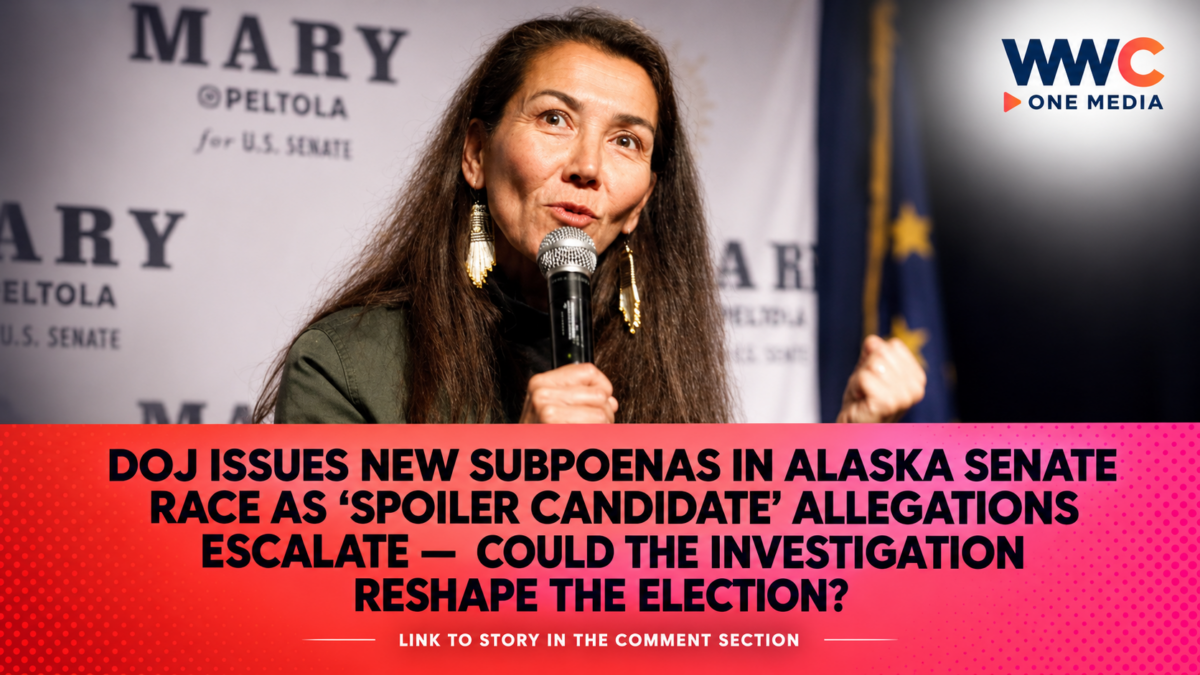
WASHINGTON, October 30, 2026 — The US Department of Justice has issued a new wave of grand jury subpoenas as it intensifies an investigation into allegations that a second candidate named Dan Sullivan was recruited to confuse voters and weaken Republican Senator Dan Sullivan’s re-election campaign in Alaska.
The investigation centres on claims that Democratic Senate candidate Mary Peltola’s campaign was involved in encouraging Daniel J. Sullivan Jr. to enter the race against incumbent Senator Dan S. Sullivan. The two candidates share a similar name, raising concerns that voters could mistakenly select the wrong candidate on the ballot.
The latest subpoenas follow reporting by The New York Times alleging that people connected to Peltola’s campaign and Democratic political organisations discussed recruiting candidates with names resembling those of Republican opponents.
However, the allegations remain under investigation. No criminal charges against Peltola or her campaign had been announced in the reporting available as of October 30. AP News+2
DOJ Expands Its Investigation With New Subpoenas
According to the Associated Press, the Justice Department issued additional subpoenas seeking grand jury testimony or documents, alongside demands to preserve potentially relevant records.
The AP report said the number of subpoenas and the identities of all recipients were not immediately clear.
A separate Reuters report provided further detail, citing a source familiar with the investigation who said more than 40 subpoenas and document-preservation requests had been issued, with additional requests expected. The recipients reportedly included the campaigns of Peltola and Republican challenger Dan J. Sullivan.
The investigation has been examining whether the second Sullivan entered the Senate race as part of an effort to divert votes from the incumbent.
Grand jury subpoenas are investigative tools used to obtain evidence. Their issuance does not establish that a crime occurred or that the people receiving them are guilty of wrongdoing. AP News+1
The developments also come amid wider questions about the Justice Department’s handling of politically sensitive investigations.
WWC ONE MEDIA previously examined disputes over federal investigative powers in its coverage of former special counsel Jack Smith’s Senate testimony, where lawmakers debated subpoenas, investigative methods and allegations of political bias.
Why Two Candidates Named Dan Sullivan Are at the Centre of the Dispute
The controversy involves two candidates whose names could potentially create confusion among voters.
Republican Senator Dan S. Sullivan is seeking re-election, while Daniel J. Sullivan Jr., a retired schoolteacher from Petersburg, Alaska, is also running.
Earlier this year, an Alaska elections official ruled Daniel J. Sullivan Jr. ineligible for the primary ballot, concluding that his candidacy appeared intended to confuse voters and compromise ballot fairness.
However, the Alaska Supreme Court overturned that decision and allowed him to run.
On the ballot, the incumbent is identified as Dan S. Sullivan, a registered Republican and the sitting senator. Daniel J. Sullivan Jr. appears without a party affiliation.
The distinction between the two candidates is central to the investigation because authorities are examining whether the second candidacy was encouraged as a deliberate strategy to draw support away from the incumbent. AP News+2
Peltola’s Campaign Faces Allegations, but Denies Wrongdoing
The controversy intensified after The New York Times published reporting based on interviews, text messages and documents suggesting that people associated with Peltola’s campaign had discussed recruiting candidates who could divide Republican support.
Peltola’s campaign has rejected the allegations.
The Democratic candidate has described the controversy as an attempt to intimidate her and distract voters from issues affecting Alaska, including the cost of living.
Daniel J. Sullivan Jr. has also denied being recruited by Peltola’s campaign. He previously said he had no contact with her team.
These denials are important because the central question is not simply whether political operatives discussed recruiting additional candidates, but whether any specific conduct violated applicable election or criminal laws. AP News+1
The dispute also echoes wider political and legal battles involving the Trump administration and federal investigations. WWC ONE MEDIA has covered other controversies surrounding the Justice Department, including the administration’s legal confrontation with the International Criminal Court and the debate over federal investigative powers and press freedom.
Trump Calls for Prosecution as Alaska Governor Orders Separate Probe
President Donald Trump has publicly called for Peltola and her campaign to face criminal prosecution.
Attorney General Todd Blanche also criticised the alleged recruitment effort, accusing Democrats of attempting to take votes away from the incumbent through a candidate with the same name.
Vice President JD Vance has voiced support for an investigation into possible election fraud.
Meanwhile, Alaska Republican Governor Mike Dunleavy has ordered a separate state investigation into the allegations.
Dunleavy said the reported recruitment effort raised concerns about election integrity and the possibility of deliberately misleading voters.
However, political criticism and calls for prosecution are not legal findings. Investigators must establish whether evidence supports a violation of the law before criminal charges can be justified. AP News+2
Is Recruiting a Spoiler Candidate Actually Illegal?
One of the most important questions surrounding the controversy is whether recruiting a candidate to divide an opponent’s voter base is itself a crime.
The practice, often described as ballot stacking or recruiting a spoiler candidate, is not automatically illegal under US election law.
Political organisations have historically supported additional candidates to influence how votes are distributed among competing parties. Similar tactics have been associated with both Republicans and Democrats.
The legal situation becomes more complicated if investigators establish that individuals engaged in conduct such as fraud, unlawful coordination or making false statements under oath.
The Guardian’s legal explainer noted that ballot stacking itself is not illegal, while lying under oath about coordination could potentially constitute perjury.
The Alaska Supreme Court’s earlier decision allowing Daniel J. Sullivan Jr. to remain on the ballot adds another legal complication. Legal experts have questioned what specific law would have been violated simply by encouraging an otherwise eligible candidate to run. The Guardian+1
Why the Investigation Matters Beyond Alaska
The Alaska Senate contest is among the closely watched races that could influence control of the US Senate after the November 2026 midterm elections.
That makes the investigation politically significant, particularly because it involves allegations against a Democratic candidate, a Republican incumbent and federal authorities operating under the Trump administration.
The controversy also raises broader questions about how far political campaigns can go when attempting to influence the composition of an election ballot.
There is a distinction between aggressive political strategy and unlawful interference. Determining where that line falls requires evidence and legal analysis, not simply accusations from competing campaigns.
The Justice Department’s subpoenas could help investigators establish whether communications, recruitment efforts or financial arrangements took place and who may have been involved.
But the existence of an investigation does not mean its allegations have been proven.
What Happens Next?
The immediate focus will be on what investigators uncover from the subpoenas and whether the evidence supports any criminal charges.
The separate investigation ordered by Alaska’s governor could also add another layer of scrutiny, while the candidates continue their campaigns ahead of the November election.
For now, Peltola denies wrongdoing, Daniel J. Sullivan Jr. says he was not recruited by her campaign, and the Justice Department has not publicly identified all the people under investigation.
The central question remains whether the second Sullivan’s candidacy was simply a controversial political manoeuvre or part of a coordinated effort that crossed a legal boundary.
As federal investigators seek more records and testimony, could the evidence turn a contentious campaign tactic into a criminal case — or will the investigation expose the limits of how far the government can intervene in an election?