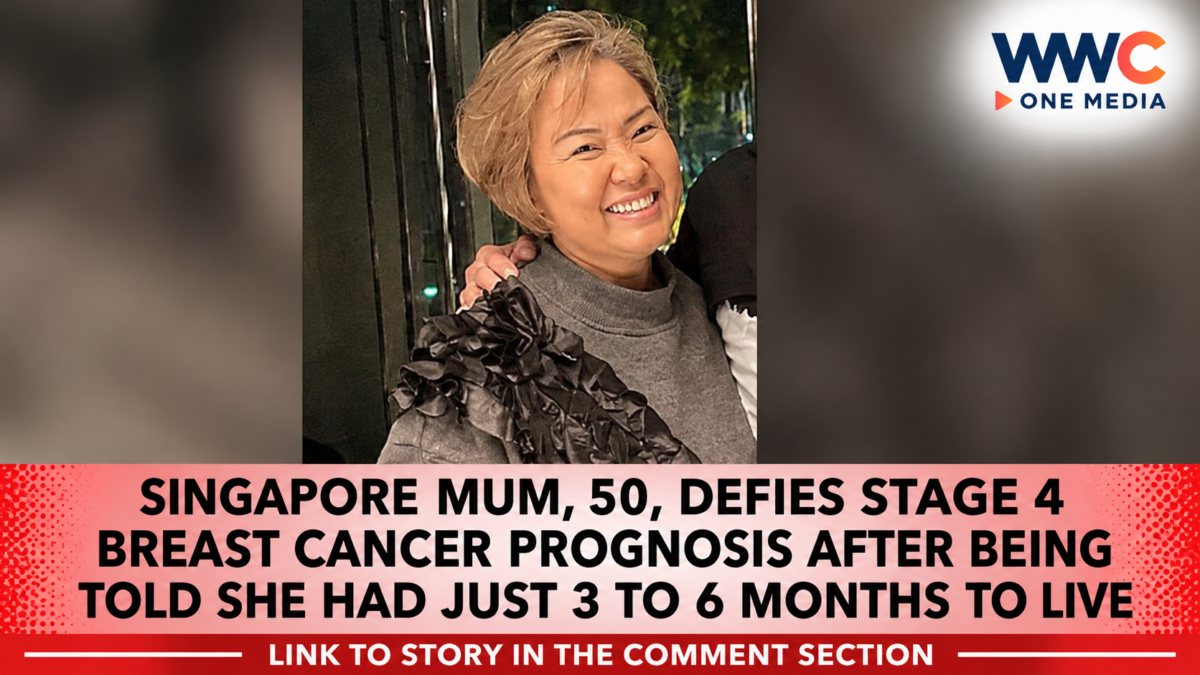
A Singapore mother of three who was once told she might have only three to six months to live after being diagnosed with stage 4 breast cancer is still going strong three years later — and her remarkable journey is bringing renewed attention to the importance of recognising symptoms, seeking medical help and making time for one’s health.
Irene Ho, now 50, was diagnosed with advanced breast cancer in 2023 after discovering a small lump in her left breast.
At the time, she was busy with work and postponed getting a health check-up because her company was short-staffed. But as the lump grew and the pain became worse, she eventually sought medical attention.
By then, the cancer had already spread to her bones.
The diagnosis changed her life. Doctors reportedly gave her an estimated three to six months to live, leaving Irene to confront the possibility that she might not have much time left with her three children and elderly parents.
Yet, three years after receiving that devastating news, she continues to work, attend treatment and spend time with the people she loves.
Her story was reported by AsiaOne on November 4, drawing on an interview with the Chinese-language newspaper Lianhe Zaobao published a day earlier.
A Small Breast Lump Became a Life-Changing Diagnosis
Irene’s journey began in July 2023, when she noticed a small lump in her left breast.
Initially, she did not prioritise getting it checked. Work commitments and staff shortages made it difficult for her to take time away from her job.
As the weeks passed, however, the lump grew and the pain became more noticeable.
When she eventually sought medical attention, investigations revealed that the cancer had already spread to her bones.
The diagnosis was particularly difficult because Irene was raising three children on her own while also caring about the wellbeing of her elderly parents.
According to the Zaobao interview, her greatest fear was not simply the possibility of dying. It was the thought of leaving her children and parents behind.
During the first month after her diagnosis, she struggled emotionally to accept what had happened.
She even sought legal assistance to prepare a will and made arrangements for her own funeral, according to the report.
It was a deeply confronting period for a woman who had been focused on supporting her family and maintaining her working life.
Three Years Later, She Is Still Working and Spending Time With Her Family
Despite the initial prognosis, Irene has continued living beyond the estimated three-to-six-month period.
Her progress has reportedly surprised her doctor.
Rather than allowing the uncertainty surrounding her illness to completely take over her life, she has tried to maintain as much of her usual routine as possible.
She continues working and sometimes attends the clinic for treatment in the morning before returning to work in the afternoon.
Her treatment plan includes oral medication and injections. According to the Zaobao report, the monthly cost can reach around S$1,000.
Irene chose this approach partly because it offers greater flexibility and allows her to continue working without as much disruption.
However, treatment has not been easy.
She reportedly experiences nausea, severe skin reactions, bone stiffness and weakening, as well as problems affecting the joints in her fingers.
Despite these difficulties, she continues making an effort to spend time with her children and loved ones.
Her experience highlights the reality that living with advanced cancer can involve ongoing treatment, side effects and uncertainty, even when a patient continues to maintain many aspects of everyday life.
Family and Friends Helped Her Find the Strength to Continue
Irene’s recovery journey has not been about medical treatment alone.
The support of family members and friends played an important role in helping her cope with the emotional impact of her diagnosis.
After initially struggling to accept the news, she gradually found a way to move forward.
She told Zaobao that she had come to accept that the illness had happened and that life still had to continue.
Her outlook shifted towards making the most of the time she has rather than constantly worrying about what might happen next.
She has also made a conscious effort to face each day with a smile and appreciate the time she can spend with her family.
Although her future remains uncertain, Irene has chosen not to let every day be dominated by thoughts about the next stage of her illness.
Her message is not that cancer can simply be overcome through positive thinking. Rather, her experience shows how emotional support and personal determination can help someone navigate an extremely difficult period.
Stage 4 Breast Cancer: What Does the Diagnosis Mean?
Irene’s story has also brought attention to what stage 4 breast cancer actually means.
Stage 4 breast cancer, also known as metastatic breast cancer, means the cancer has spread beyond the breast and nearby lymph nodes to other parts of the body.
In Irene’s case, the cancer had spread to her bones by the time it was diagnosed.
Other common sites where breast cancer may spread include the lungs, liver and brain.
Although stage 4 breast cancer is generally not considered curable with current standard treatments, treatment can help control the disease, manage symptoms and support quality of life.
The appropriate treatment depends on several factors, including the cancer’s biological characteristics, the locations affected and the patient’s overall health.
Treatment options may include hormone therapy, targeted medicines, chemotherapy, immunotherapy in selected cases, radiation therapy and other approaches.
Not every patient receives the same combination.
Irene’s experience should therefore not be interpreted as evidence that one particular treatment will produce the same result for other people with advanced breast cancer.
Her three-year journey is personal, and her treatment decisions were made in consultation with her medical team.
Breast Cancer Is Singapore’s Most Common Cancer Among Women
Irene’s experience comes amid a significant breast cancer burden in Singapore.
According to the 2023 Singapore Cancer Registry Annual Report, 13,935 breast cancer cases were recorded among women between 2019 and 2023.
Breast cancer remains the most commonly diagnosed cancer among women in the country.
The National Cancer Centre Singapore estimates that approximately one in 12 women in Singapore will develop breast cancer during their lifetime.
These figures underline why awareness and access to appropriate medical assessment remain important.
Breast cancer can affect women of different ages, and a person’s symptoms should not be dismissed simply because they are younger than the age commonly associated with the disease.
A previous AsiaOne report also highlighted younger mothers who were diagnosed with breast cancer, including women who initially mistook a lump for a blocked milk duct.
That coverage reinforces an important point: a persistent or unusual breast change deserves medical attention rather than assumptions about its cause.
Why Delaying a Medical Check-Up Can Matter
One of the most significant details in Irene’s story is that she initially postponed her health check-up because of work pressures.
Many people put off medical appointments because of busy schedules, financial concerns, family responsibilities or the belief that a symptom is probably harmless.
But changes in the breast should not be ignored.
Symptoms that warrant medical assessment include:
- A new lump or thickening in the breast or underarm.
- A persistent change in breast size or shape.
- Skin dimpling, swelling or unusual changes in breast appearance.
- A nipple that becomes newly inverted.
- Unusual nipple discharge, particularly if it contains blood.
- Persistent changes around the nipple or breast skin.
Not every breast lump is cancerous. Some are caused by benign conditions.
However, only an appropriate medical assessment can help determine what is happening.
Women who notice a new or persistent breast change should consult a healthcare professional rather than waiting for a routine screening appointment.
Screening is designed for people without symptoms; someone who has noticed a suspicious change may need diagnostic investigations instead.
Singapore’s Breast Cancer Screening Programme: Who Is Eligible?
Singapore provides subsidised breast cancer screening through its national preventive healthcare programmes.
Under the Healthier SG Screening programme, eligible women can access mammograms based on age, medical circumstances and screening history.
Current HealthHub guidance provides the following general recommendations:
- Women aged 50 and above: Mammogram screening is generally recommended every two years.
- Women aged 40 to 49: Screening may be considered annually, depending on individual circumstances and medical advice.
- Women aged 75 and above: Screening decisions should be discussed with a doctor, taking individual health and risk factors into account.
Eligible Singapore citizens can receive subsidised screening under the relevant programme requirements.
A mammogram uses low-dose X-rays to examine breast tissue and can identify abnormalities that may not be detectable through touch alone.
However, a normal mammogram does not guarantee that breast cancer will never develop. Women should continue paying attention to changes and seek medical advice if symptoms appear between screening appointments.
More information is available through the Singapore HealthHub breast screening guidance.
Singapore Is Also Expanding Support for Women at Higher Genetic Risk
Beyond routine mammograms, Singapore has been taking steps to improve access to genetic testing and preventive care for women with hereditary cancer risks.
In March 2026, The Straits Times reported on the Government’s plans to subsidise genetic testing for hereditary breast and ovarian cancer (HBOC) and expand financial support for certain risk-reducing procedures.
These measures are particularly relevant to women with a strong family history of breast or ovarian cancer or known inherited genetic mutations.
Genes such as BRCA1 and BRCA2 can carry inherited mutations associated with increased risks of certain cancers.
Genetic testing is not necessary for every woman. Doctors assess family history and other clinical factors to determine who may benefit from testing and specialist counselling.
The policy developments reflect a broader shift towards identifying elevated cancer risk earlier and helping eligible patients make informed decisions about prevention and treatment.
For more on Singapore’s wider women’s health initiatives, read WWC One Media’s report on expanded bone-density and muscle screening under Healthier SG.
The Importance of Emotional Support During Cancer Treatment
Cancer affects more than the body.
A diagnosis can place enormous emotional and financial pressure on patients and their families, particularly when someone is raising children or supporting elderly relatives.
Irene’s experience illustrates how a patient may have to balance treatment appointments, medication expenses, employment and family responsibilities at the same time.
Support from relatives, friends, healthcare professionals and cancer-support organisations can help patients navigate these challenges.
Singapore has organisations that provide cancer information, support services and assistance to patients and caregivers.
The Singapore Cancer Society, for example, offers programmes and services for people affected by cancer.
The National Cancer Centre Singapore also provides specialist care and support for patients navigating diagnosis and treatment.
The importance of protecting patients’ privacy is another part of the wider conversation surrounding cancer care. WWC One Media previously reported on a privacy incident involving the National Cancer Centre Singapore, in which email addresses belonging to 467 recipients of a hereditary breast and ovarian cancer event invitation were inadvertently exposed.
The incident highlighted why confidentiality and careful handling of sensitive health-related information matter. Read the reports here:
- National Cancer Centre Exposes 467 Email Addresses in Privacy Lapse
- National Cancer Centre Singapore Email Error Exposes Details of 467 Recipients
For a broader look at cancer treatment developments, readers can also explore WWC One Media’s report on expanded access to proton therapy for Filipino cancer patients through a Taiwan partnership.
Irene’s Message: Make the Most of the Time You Have
Three years after receiving a diagnosis that initially left her fearing she might not see another year, Irene continues to approach life one day at a time.
She has acknowledged that life does not come with guarantees and that the road ahead may be difficult and uncertain.
Rather than spending all her energy worrying about tomorrow, she has chosen to focus on how she responds to the challenges in front of her.
Her journey is a reminder of the importance of family, support and making time for one’s health — particularly when work and everyday responsibilities make it tempting to postpone medical appointments.
But her story should also be understood with care.
Not every person diagnosed with stage 4 breast cancer will have the same prognosis, treatment response or experience. There is no guaranteed timeline, and positive thinking alone cannot treat cancer.
What Irene’s experience demonstrates is that an initial prognosis does not describe every moment that follows. Individual outcomes can differ, and patients deserve appropriate treatment, support and dignity throughout their journey.
For Singapore’s women, her story carries an important reminder: do not ignore a persistent breast change, and do not let a busy schedule become the reason you delay seeking medical advice.