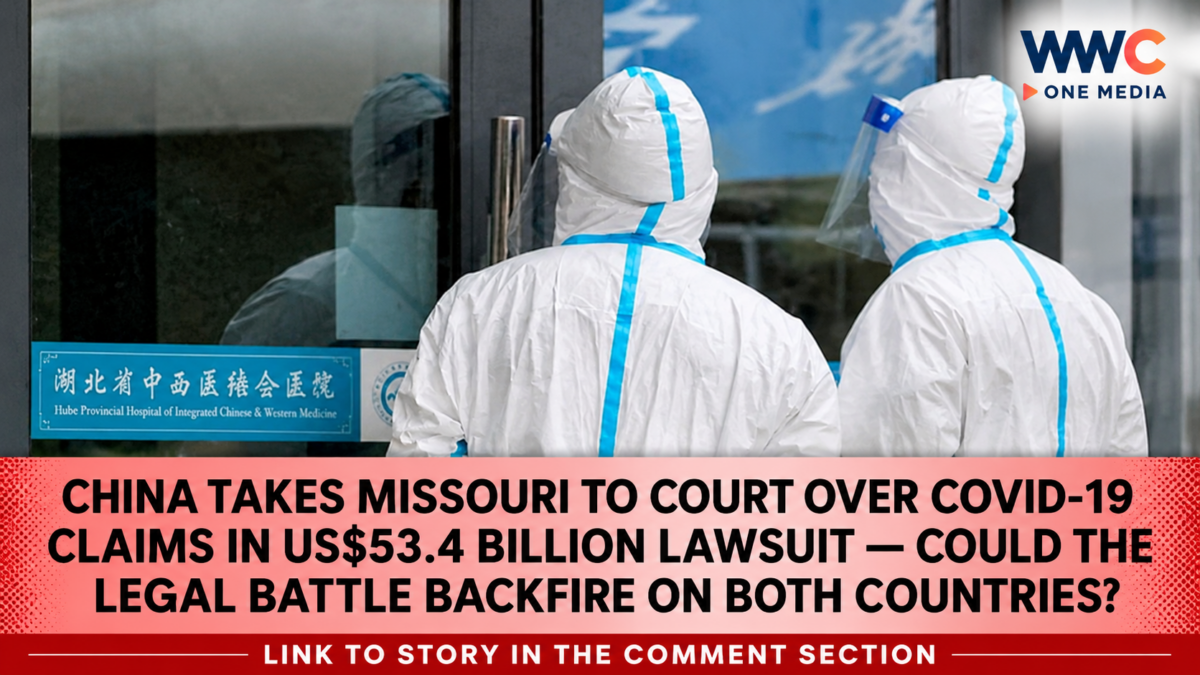
More than six years after COVID-19 changed the world, the pandemic is triggering another extraordinary legal confrontation between China and the United States.
A court in Wuhan has begun hearing a defamation lawsuit brought by Chinese authorities and scientific institutions against the US state of Missouri and several current and former Missouri attorneys general.
The plaintiffs accuse Missouri officials of pursuing what they describe as malicious litigation and spreading false, discriminatory and damaging claims about China’s role in the coronavirus pandemic.
Their demands are substantial: a public apology, restoration of their reputations and compensation reportedly totalling 356.44 billion yuan, or approximately US$53.44 billion.
The defendants include Missouri, former attorneys general Eric Schmitt and Andrew Bailey, and current Attorney General Catherine Hanaway, according to Reuters reporting.
The Missouri attorney general’s office had not immediately responded to Reuters’ request for comment when the report was published.
The case represents a remarkable reversal in a dispute that began in April 2020, when Missouri became one of the first US states to take China to court over alleged responsibility for pandemic-related economic damage.
That earlier lawsuit eventually produced a multibillion-dollar US default judgment against Chinese defendants. China rejected the American proceedings, while Missouri pursued efforts to collect the money.
Now, Chinese institutions are taking their own legal action against Missouri.
The dispute is no longer simply about the economic consequences of COVID-19. It has become a wider confrontation over reputational damage, international litigation, government accountability and the limits of enforcing court decisions across national borders.
But there is a major question hanging over the case: Can a Chinese court’s decision against an American state and its officials have meaningful consequences in the United States?
Wuhan Court Begins Hearing US$53.44 Billion COVID-19 Defamation Case
The Wuhan Intermediate People’s Court in China’s Hubei province is handling the case.
An official notice published on November 3 confirmed that the proceedings had moved forward. The South China Morning Post reported that a hearing had been held on the preceding Friday, while Reuters reported that the court had started hearing the case.
The plaintiffs are the Wuhan municipal government, the Wuhan Institute of Virology and the Chinese Academy of Sciences.
They allege that Missouri and the named officials orchestrated, promoted and pursued what they characterise as abusive litigation in the United States.
According to the Chinese complaint, the defendants also made statements that allegedly fabricated or disseminated false information and included stigmatising or discriminatory remarks.
The plaintiffs argue that the statements and legal actions damaged their reputations, harmed their public standing and caused substantial financial losses.
Their requested remedies include:
- A formal public apology from the defendants.
- Restoration of the plaintiffs’ reputations.
- Compensation for alleged economic and reputational damage.
- Public apologies through major media organisations and online platforms.
The reported compensation demand is 356.44 billion yuan, equivalent to approximately US$53.44 billion.
That figure makes the lawsuit particularly striking, but it must be understood correctly: it is the amount being sought by the Chinese plaintiffs, not money already awarded by the court.
The proceedings are ongoing, and no final judgment has been established in the reporting available as of November 5.
Who Is Being Sued by the Chinese Authorities?
The case targets the state of Missouri and several officials associated with its earlier legal campaign against Chinese entities.
The named individuals include:
Eric Schmitt
Schmitt served as Missouri attorney general before becoming a US senator representing Missouri.
He was a central figure in the state’s original lawsuit against Chinese defendants in 2020.
Andrew Bailey
Bailey succeeded Schmitt as Missouri attorney general and continued the state’s efforts to pursue the pandemic-related litigation.
He later left the state attorney general’s office.
Catherine Hanaway
Hanaway is Missouri’s current attorney general. She has continued the state’s efforts to pursue the earlier US judgment and has publicly criticised China’s counter-lawsuit.
The Chinese plaintiffs accuse the defendants of participating in or promoting litigation and statements that they say harmed the reputation of Wuhan and the scientific institutions involved.
These are allegations contained in a legal complaint. They have not been established as facts by a final judgment in the Chinese proceedings.
The case also raises questions about how a Chinese court will handle claims involving a US state and officials whose actions were connected to their government responsibilities.
Why Did Missouri Sue China in the First Place?
The origins of the legal dispute go back to April 2020, during the early months of the COVID-19 pandemic.
Missouri filed a lawsuit against the People’s Republic of China, the Chinese Communist Party, the government of Hubei province, the government of Wuhan and other related defendants.
The state’s complaint alleged that Chinese authorities concealed information about the emerging coronavirus, failed to act adequately to contain its spread and stockpiled personal protective equipment while other countries struggled to obtain supplies.
Missouri argued that the alleged conduct caused severe economic damage to the state and its residents.
The lawsuit also raised claims involving the availability and international distribution of medical equipment, including masks and other protective supplies.
China rejected the accusations and did not participate in the US court proceedings.
The case was significant because it attempted to hold a foreign sovereign and related entities financially responsible for pandemic-related harm.
However, the legal route was far from straightforward.
Under US law, foreign governments generally enjoy immunity from lawsuits, subject to specific exceptions under the Foreign Sovereign Immunities Act.
That legal protection became one of the central issues in Missouri’s case.
US Appeals Court Narrowed Missouri’s Original Lawsuit
One important detail often overlooked in coverage of the dispute is that Missouri did not initially win every claim it brought against China.
In January 2024, the US Court of Appeals for the Eighth Circuit reviewed the case and concluded that most of Missouri’s claims were blocked by foreign sovereign immunity.
However, the appeals court allowed one central allegation to proceed: the claim that Chinese defendants had hoarded personal protective equipment during the early stages of the pandemic.
This distinction matters.
The appeals court did not establish that China was responsible for creating the coronavirus or conclusively determine the pandemic’s origin.
Instead, it ruled that the PPE-hoarding allegation could proceed under the relevant legal framework, while other claims remained barred.
The distinction is important because COVID-19’s origins have remained a separate scientific and intelligence question.
The World Health Organization and other international bodies have repeatedly emphasised the need for further evidence and cooperation to establish a conclusive account of how the pandemic began.
The Missouri lawsuit should therefore not be treated as a scientific determination of the virus’s origin.
Missouri Secured a US$24 Billion-Plus Default Judgment Against China
The legal dispute took another major turn in March 2025.
A federal court in Missouri entered a default judgment against Chinese defendants after they did not appear in the proceedings.
The judgment was reported at more than US$24 billion, with subsequent reporting and interest calculations placing the amount at approximately US$24.5 billion.
The ruling was based on the surviving claims and evidence presented by Missouri.
A default judgment is different from a decision reached after both sides fully participate in a trial.
Because the Chinese defendants did not appear to contest the case, the court proceeded without their participation.
China rejected the judgment and said it would not recognise the ruling.
The Chinese government also maintained that the US proceedings were politically motivated and legally improper.
Missouri, meanwhile, treated the decision as a major legal victory and began exploring ways to enforce it.
The ruling became one of the most unusual examples of a US state attempting to obtain substantial compensation from a foreign sovereign over pandemic-related allegations.
However, winning a judgment and collecting the money are two very different challenges.
Why Missouri Has Struggled to Collect the Money
Missouri’s legal victory does not automatically mean that it can seize Chinese government property.
Enforcement against foreign sovereign assets is governed by complicated legal rules.
Under US law, foreign government property generally receives protection from attachment and execution, although certain exceptions exist.
Missouri has been exploring whether Chinese-owned assets could be identified and targeted to satisfy the judgment.
In December 2025, Missouri Attorney General Hanaway announced that China had filed the counter-lawsuit in Wuhan as the state moved towards efforts to collect the US judgment.
Missouri’s position has been that it intends to pursue the judgment through available legal channels.
But the practical difficulties remain considerable.
A US court judgment cannot simply be enforced against any Chinese property located anywhere in the world.
The ownership of assets, their connection to a foreign government, applicable immunity rules and the legal requirements for enforcement all matter.
Even if Missouri identifies potential assets, it may face further litigation before any seizure can take place.
This is one reason the US$24.5 billion judgment should not be described as money already recovered by Missouri.
China’s US$53.44 Billion Counterclaim Raises the Stakes
The new Wuhan lawsuit is a major escalation because it seeks an amount more than twice the value of Missouri’s earlier judgment.
The plaintiffs are asking for 356.44 billion yuan, approximately US$53.44 billion.
Their argument is that Missouri’s legal campaign and the statements made by its officials caused serious reputational and economic damage to Wuhan, the Wuhan Institute of Virology and the Chinese Academy of Sciences.
They also want public apologies across major media organisations and online platforms.
The demand reportedly includes apologies through prominent American outlets and Chinese media platforms.
This approach places reputational remedies alongside financial compensation.
For the Chinese plaintiffs, the case is not only about recovering money. It is also about challenging the accusations that have circulated internationally since the beginning of the pandemic.
For Missouri, the lawsuit is being presented by its officials as an attempt to undermine the state’s efforts to hold Chinese entities accountable.
The two sides therefore have fundamentally opposing interpretations of the same legal history.
Neither side’s allegations should be treated as proven simply because a court has accepted a case or begun hearings.
Missouri Calls China’s Lawsuit a Political Counterattack
Missouri officials have strongly rejected the Chinese legal action.
In a December 2025 statement, Hanaway described the lawsuit as an attempt to attack the state while it pursued the earlier US judgment.
She argued that Missouri would not abandon its efforts to collect the money.
Schmitt also dismissed the Chinese complaint and characterised it as an attempt to discourage Missouri from pursuing accountability.
These statements reflect the state’s political and legal position, rather than an independent judicial finding about the merits of the Chinese lawsuit.
The Missouri attorney general’s office did not immediately respond to Reuters’ request for comment when the latest report was published.
That distinction is important because the case remains in progress and the defendants’ formal responses to the current proceedings will be relevant to how the dispute develops.
Could China Actually Enforce a Judgment Against Missouri in the United States?
This is one of the biggest unanswered questions.
A ruling by a Chinese court does not automatically become enforceable in the United States.
If the Wuhan court eventually awards compensation to the plaintiffs, they would still face the separate challenge of seeking recognition or enforcement in another jurisdiction.
US courts generally examine whether foreign judgments meet applicable legal requirements before recognising them.
Issues such as jurisdiction, procedural fairness, public policy and the nature of the judgment can become important.
The fact that Missouri is a US state rather than a private individual or company adds another layer of complexity.
Government immunity and the rules governing state property could also become relevant.
The Chinese plaintiffs may be able to pursue legal arguments in different jurisdictions, but the existence of a Chinese judgment would not itself establish that Missouri must pay the amount demanded.
It is also important not to assume that the two lawsuits automatically cancel each other out.
Missouri’s US judgment and China’s Wuhan proceedings are separate legal cases. Each must be assessed under the laws and procedures applicable to the court handling it.
The Wuhan Institute of Virology Remains at the Centre of the COVID-19 Origins Debate
The Wuhan Institute of Virology is one of the most prominent scientific institutions associated with international debate about the origins of COVID-19.
The institute became a focus of global attention because it conducted research involving coronaviruses before the pandemic.
Questions about whether the virus emerged through natural transmission or a laboratory-associated incident have remained politically contentious.
However, the new defamation lawsuit is not itself a scientific investigation into the virus’s origin.
Its central legal question concerns whether Missouri and its officials made defamatory or otherwise damaging claims against the plaintiffs.
The distinction is essential.
The lawsuit does not establish that the Wuhan Institute of Virology caused the pandemic, nor does it prove that allegations made against the institute were false.
Those issues involve separate scientific, intelligence and legal assessments.
The broader controversy has also affected international academic and research relationships.
WWC One Media previously examined allegations involving Chinese academic research and national security in UK Accuses China of Using Academic Research to Boost Espionage Capabilities.
Another report explored the US government’s dispute with Harvard and the wider implications for international higher education: Trump’s Harvard Battle Could Give Hong Kong a Rare Opportunity in Global Education.
WWC One Media also covered the US debate over Chinese-linked academic institutions in Pentagon Declares China-Funded Confucius Institutes a US National Security Threat After Uncovering 80 Alleged Campus Networks.
These reports concern broader tensions involving China, the United States, research institutions and national security. They provide context for the wider political environment, but they are not evidence supporting either side’s allegations in the Missouri defamation case.
Could the Lawsuit Further Damage US-China Relations?
The legal confrontation arrives amid wider tensions between Washington and Beijing.
The two countries continue to compete over trade, technology, national security, industrial policy and geopolitical influence.
The COVID-19 pandemic remains a particularly sensitive subject because it caused millions of deaths worldwide, disrupted economies and intensified mistrust between governments.
The lawsuits also show how pandemic-era disputes can continue long after emergency restrictions and public-health measures have ended.
For China, the Wuhan proceedings provide an opportunity to challenge accusations that it considers damaging and politically motivated.
For Missouri, the original lawsuit remains a symbol of its effort to pursue financial accountability for losses it attributes to China’s pandemic response.
The federal government in Washington has not automatically adopted Missouri’s litigation strategy, and the state’s lawsuit should not be confused with a judgment issued on behalf of the entire United States.
Nevertheless, the case has implications for how American and Chinese institutions approach disputes involving sovereign immunity, reputational claims and cross-border enforcement.
A major ruling in either country could influence future legal strategies, although its practical consequences would depend on whether the decision can be recognised and enforced elsewhere.
What Happens Next in the Missouri-China Legal Battle?
The Wuhan proceedings will now have to address the plaintiffs’ allegations and the legal arguments presented by the defendants.
Several issues will be important to watch:
1. The defendants’ response
The court’s handling of the case will depend partly on how Missouri and the named officials respond to the proceedings.
2. The court’s jurisdiction
A central question will be whether the Wuhan court can properly exercise jurisdiction over a US state and the individuals named in the complaint.
3. Evidence of reputational and financial damage
The plaintiffs will need to support their claims concerning the alleged harm caused by Missouri’s litigation and statements.
4. The amount of compensation
The US$53.44 billion demand is a claim, not an established valuation of damages. Any eventual award could differ substantially.
5. Enforcement outside China
Even if the plaintiffs obtain a judgment, collecting compensation from a US state or its officials would present another legal challenge.
At the same time, Missouri’s efforts to enforce its separate US judgment against Chinese defendants remain unresolved.
The two cases could therefore continue for years, with legal battles taking place in different jurisdictions.
The Bottom Line
China’s Wuhan Intermediate People’s Court has begun hearing a US$53.44 billion defamation lawsuit against Missouri and several current and former state attorneys general over allegations that they spread false and damaging claims about China’s role in the COVID-19 pandemic.
The lawsuit is the latest chapter in a dispute that began in April 2020, when Missouri sued Chinese entities over alleged pandemic-related misconduct and economic losses.
That earlier case resulted in a US default judgment worth more than US$24 billion, but Missouri still faces substantial obstacles in collecting the money.
Now, Chinese authorities and scientific institutions are seeking a public apology, reputational restoration and billions of dollars in compensation from Missouri.
The two cases reveal how the consequences of the COVID-19 pandemic continue to shape international legal and political relations more than six years after the outbreak began.
But neither lawsuit should be mistaken for a final scientific determination of COVID-19’s origins, and neither side’s allegations automatically establish liability.
The biggest question is whether either country can turn its courtroom victory into a judgment that can actually be enforced across borders.
Could China’s US$53.44 billion lawsuit become a powerful counterattack against Missouri’s pandemic judgment — or will both sides discover that winning a legal battle is much easier than collecting billions from another country?