
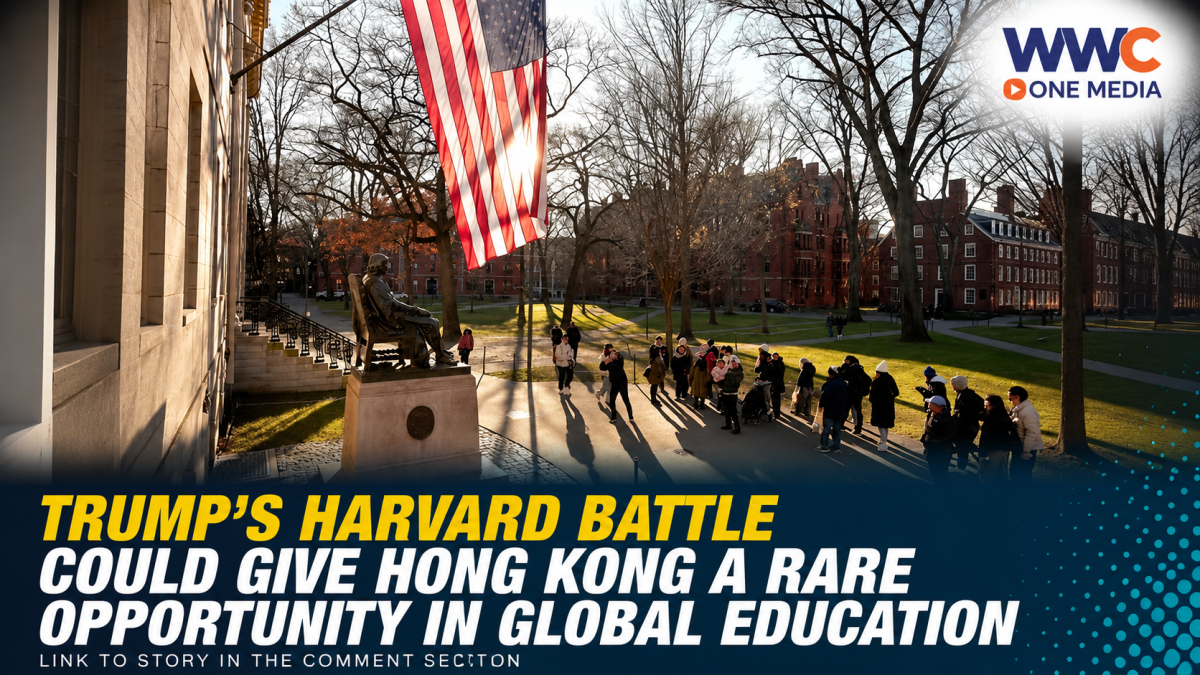
A growing political fight between the Trump administration and Harvard University is creating uncertainty for international students — and Hong Kong may be one of the places positioned to benefit.
The latest controversy erupted after U.S. Transportation Secretary Sean Duffy criticized Harvard during a government-linked family road-trip video. His daughter, who was considering universities including Harvard, said she might welcome the opportunity to study in a more liberal environment. Duffy responded that Harvard could negatively influence students’ views. The episode has become another flashpoint in the Trump administration’s broader confrontation with elite American universities.
But behind the political rhetoric is a much bigger issue: whether international students and researchers will continue to view the United States as the most predictable destination for a world-class education.
Harvard has become a battleground
The Trump administration’s dispute with Harvard is no longer limited to campus politics.
Washington has challenged Harvard over federal research funding, international student enrolment, admissions practices, campus antisemitism and the university’s foreign financial relationships. The Justice Department also opened a civil-rights investigation into Harvard’s financial-aid programmes after raising concerns about funding from China-based sources and possible nationality-based preferences. The department stressed that it had not reached a conclusion that Harvard violated the law. Harvard has rejected the suggestion that it unlawfully discriminates in financial aid.
The dispute has already produced uncertainty for international students.
In 2025, the administration attempted to restrict Harvard’s ability to enrol international students, but the policy was blocked in court. Harvard continues to fight the administration over funding and international enrolment, while additional federal investigations have followed.
And the uncertainty has continued into 2026. The administration recently issued guidance seeking tighter restrictions on certain internship authorisations for international students, warning universities that non-compliance could threaten their certification to enrol foreign students.
Yet Harvard’s global appeal has not disappeared
There is an important counterpoint.
Despite the political and immigration uncertainty, Harvard’s international appeal remains extremely strong.
CNA reported that the number of students from mainland China at Harvard actually rose 4.5 per cent, from 1,390 in autumn 2024 to 1,452 in autumn 2025. Hong Kong student enrolment also increased from 68 to 73. Overall, Harvard had 6,836 international students in autumn 2025, representing 28.1 per cent of its student population.
That suggests the situation is more complicated than simply saying students are abandoning American universities.
Elite American institutions still carry enormous global prestige. But prospective students and their families increasingly have to weigh that prestige against visa uncertainty, changing immigration policies and the possibility of sudden regulatory changes.
That is where Hong Kong enters the picture.
Hong Kong sees an opening
Hong Kong has spent years positioning itself as an international education and research hub.
The city currently has five universities ranked among the world’s top 100, according to Hong Kong government data based on major global rankings. The government has also been expanding its capacity for non-local students and promoting Hong Kong as an international education destination.
From the 2026-27 academic year, Hong Kong is raising the enrolment ceiling for non-local students in self-financing programmes at funded institutions to 50 per cent of local student places. The government is also expanding capacity for research postgraduate students.
The strategy is not purely theoretical.
When the Trump administration moved against Harvard’s international enrolment in 2025, Hong Kong University of Science and Technology (HKUST) openly invited Harvard undergraduate and postgraduate students to continue their studies in Hong Kong. The university offered unconditional admission offers, streamlined procedures and academic support for eligible students.
Other Hong Kong universities also received inquiries from students affected by the uncertainty surrounding Harvard, according to CNA.
Hong Kong is trying to turn uncertainty into opportunity
The timing is significant.
Hong Kong Chief Executive John Lee met with the University Grants Committee on September 2, with discussions focusing on strengthening Hong Kong’s position as an international education hub, attracting global talent and expanding international academic partnerships.
The city is therefore attempting to position itself as an alternative for students and researchers who want an internationally recognised university environment without necessarily committing to the growing uncertainties surrounding American higher education.
Hong Kong also has advantages that could appeal particularly to Asian students: proximity to mainland China, an internationally oriented economy, English-language university programmes and established links with institutions around the world.
Government figures show that non-local enrolment in UGC-funded programmes rose from 23,100 in the 2023-24 academic year to 26,600 in 2024-25, an increase of about 15 per cent, with students coming from more than 100 countries and regions.
But Hong Kong cannot simply “replace Harvard”
That would be an exaggeration.
Harvard’s brand, research ecosystem, alumni network and financial resources remain difficult for any single university or city to replicate.
Even CNA’s reporting found that many Chinese students continued to regard leading American universities as highly attractive despite the political uncertainty.
The more realistic opportunity for Hong Kong is different.
It can become one of the leading alternative destinations in a more diversified global education market.
If students begin to believe that studying in the US carries greater political, immigration or regulatory risk, universities in Hong Kong, Singapore, Britain, Australia, Japan and elsewhere could benefit.
The competition will not simply be about rankings. It will be about stability, academic freedom, research opportunities, immigration rules, career prospects and the confidence families have that their children’s education will not suddenly be disrupted by political decisions.
The bigger question for Hong Kong
The Harvard controversy has therefore created an unusual moment for Hong Kong.
The city is already expanding non-local student capacity and actively promoting itself as an international education hub.
The challenge now is converting that ambition into long-term credibility.
If Hong Kong can attract talented students and researchers who might otherwise have chosen American universities — while maintaining strong academic standards and international partnerships — the current turbulence in US higher education could become an unexpected strategic advantage.
But the crucial test will be whether Hong Kong can convince families that it offers not merely an alternative to Harvard, but a compelling international education destination in its own right.
The real story may not be Harvard losing students. It may be the global education map becoming more competitive — and Hong Kong positioning itself for a bigger share of that market.
WWC ONE MEDIA J.M.D




Leave a Reply