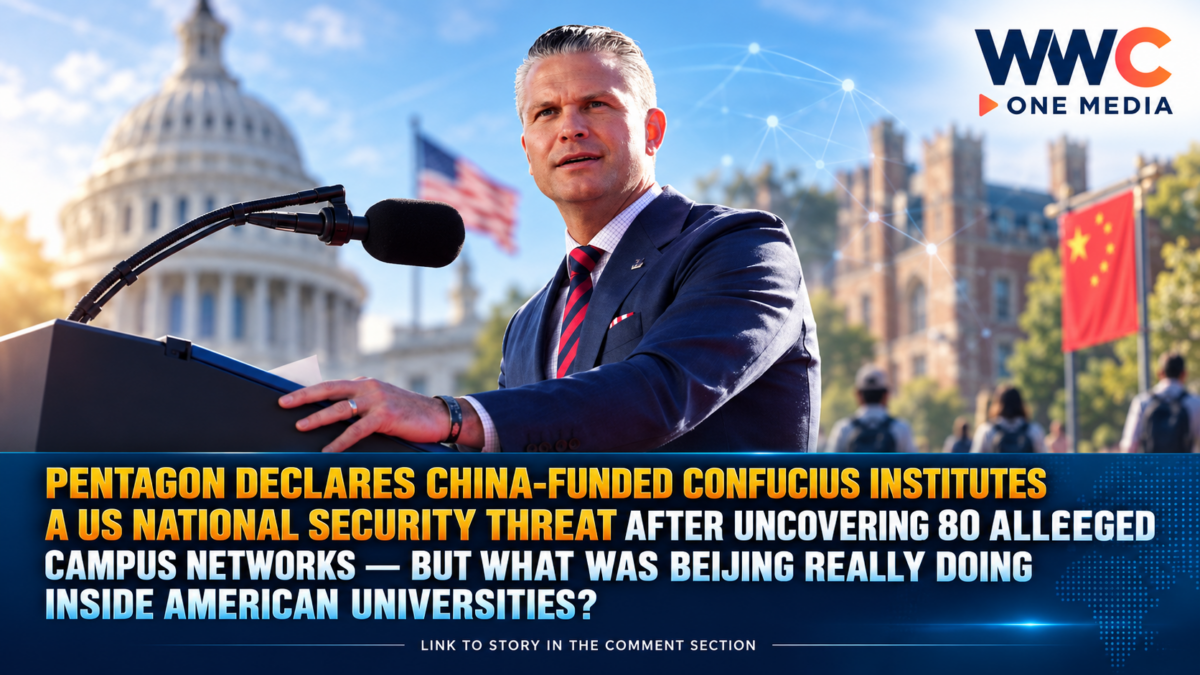
Washington, October 24, 2026 — A new confrontation between Washington and Beijing is unfolding inside American universities after the Pentagon designated Chinese-funded Confucius Institutes a national security threat, accusing organizations linked to the cultural education network of attempting to influence students and steal sensitive intellectual property.
US Defense Secretary Pete Hegseth announced the designation on Friday, October 23, claiming that dozens of organizations had resurfaced under new identities despite years of American efforts to restrict Beijing-backed educational programs.
The announcement intensifies a long-running dispute over Chinese influence in the United States, raising questions about academic freedom, foreign-funded educational partnerships and the increasingly tense rivalry between the world’s two largest economies.
Pentagon alleges 80 organizations operated across 30 universities
In a video published on social media, Hegseth alleged that 80 organizations linked to the Confucius Institute network had emerged across 30 American universities, using different names and organizational structures.
According to the defense secretary, these organizations continued pursuing activities that US officials consider threatening to national security, including intellectual property theft and attempts to influence American students.
Hegseth also claimed that the Defense Department had systematically dismantled all the identified organizations during the previous two months.
However, the Pentagon’s reported action does not, by itself, establish that every organization engaged in espionage or intellectual property theft.
The public reporting did not identify all 80 organizations, provide a university-by-university list or explain the precise legal and administrative mechanisms used to dismantle them.
Those unanswered questions are important because the allegations could affect university partnerships, research programs and legitimate Chinese-language education.
What are Confucius Institutes, and why are they controversial?
Confucius Institutes were established to support Chinese-language teaching, cultural activities and educational cooperation abroad.
Many operated through partnerships between universities and Chinese institutions, with support from organizations associated with Beijing.
For participating universities, the programs offered language teachers, educational resources and opportunities for students to learn about Chinese culture.
But American lawmakers and national security officials have long questioned whether some of these programs could serve as instruments of political influence.
Concerns have included the transparency of funding arrangements, Chinese government participation in program management and the potential for foreign pressure over sensitive subjects such as Taiwan, Tibet and human rights.
These issues have made Confucius Institutes a recurring flashpoint in US-China relations.
Almost all original US Confucius Institutes had already closed
The Pentagon’s latest announcement comes after years of restrictions on Chinese-funded university programs.
A US Government Accountability Office report published in October 2023 found that the number of Confucius Institutes at American colleges and universities had fallen from approximately 100 in 2019 to fewer than five.
The decline followed federal funding restrictions, political pressure and growing concerns about foreign influence in higher education.
Many universities closed their institutes partly because they feared losing access to federal funding.
Some subsequently pursued alternative arrangements to preserve Chinese-language instruction.
That history gives the Pentagon’s latest allegation additional significance: Washington now claims that organizations with similar underlying purposes continued operating under different names even after the original network largely disappeared.
The reported 80 organizations should not automatically be treated as 80 officially recognized Confucius Institutes. The Pentagon’s characterization of their affiliations requires further documentation.
Washington has targeted the network before
The latest designation is not the first major US government action against the Confucius Institute network.
On August 13, 2020, the US State Department designated the Confucius Institute US Center, a Washington-based coordinating organization, as a foreign mission of the People’s Republic of China.
The move placed the center under additional transparency requirements.
The State Department said the designation was intended to address concerns about the Chinese government’s role in the organization.
Importantly, the 2020 designation did not automatically force universities to close individual Confucius Institutes.
Subsequent restrictions and funding concerns nevertheless contributed to the network’s sharp contraction across the United States.
The 2026 Pentagon announcement represents another escalation in that campaign, although the full scope of its practical consequences remains unclear.
Academic freedom and national security collide
The latest controversy highlights a difficult question facing universities: how can institutions preserve international academic cooperation while protecting sensitive research and maintaining independence from foreign governments?
US authorities argue that foreign-funded organizations can present national security risks when their financing, management or activities are insufficiently transparent.
Universities, meanwhile, benefit from international language programs, academic exchanges and research partnerships.
Previous reviews by the Government Accountability Office found that Confucius Institute arrangements differed from one institution to another.
In a 2019 review, university officials at several institutions maintained that they controlled academic programming, while researchers and other observers raised concerns about potential pressure over classroom content and public discussion.
These findings suggest that individual arrangements should be examined on their own evidence rather than assuming that every language or cultural partnership presents identical risks.
The Pentagon’s allegation of intellectual property theft is particularly serious, but publicly available reports have not established the alleged wrongdoing for each institution named in Hegseth’s broader claims.
China-US tensions extend beyond trade and technology
The dispute is unfolding against the backdrop of wider strategic competition between Washington and Beijing.
For years, the two governments have clashed over advanced technologies, semiconductor restrictions, research security, military power and influence in the Indo-Pacific.
Universities have become part of that rivalry because they educate future scientists and engineers, conduct commercially valuable research and maintain international partnerships.
The US government has increasingly focused on protecting sensitive research from unauthorized foreign access.
At the same time, restrictions on academic cooperation have generated concerns that excessive suspicion could discourage legitimate scientific collaboration and cultural exchanges.
The Confucius Institute controversy illustrates how competition between the two powers has extended beyond military bases and corporate boardrooms into college classrooms.
Beijing’s response remains uncertain
As of the initial October 23 reports, the Chinese embassy in Washington had not immediately responded to requests for comment regarding the Pentagon’s announcement.
No new formal Chinese response to the specific designation was confirmed in those reports.
The absence of an immediate response leaves open questions about whether Beijing will challenge the accusations, seek further clarification or take diplomatic action.
What happens next?
The Pentagon’s announcement could prompt further scrutiny of university partnerships involving Chinese government-linked institutions.
However, whether additional restrictions, investigations or funding consequences will follow depends on the legal basis and implementation of the Pentagon’s designation.
Several major questions remain unresolved: which organizations were targeted, what evidence supports the allegations, how they were reportedly dismantled and whether any additional enforcement actions will follow.
For American universities, the controversy is no longer only about Chinese-language classes. It is about who funds international education programs, who controls them and whether foreign influence can compromise the independence of institutions.
The bigger question is whether Washington has uncovered an organized influence network or whether the latest designation will deepen an already damaging breakdown in US-China academic relations.
Either way, the controversy marks another chapter in a geopolitical rivalry now reaching directly into university campuses.