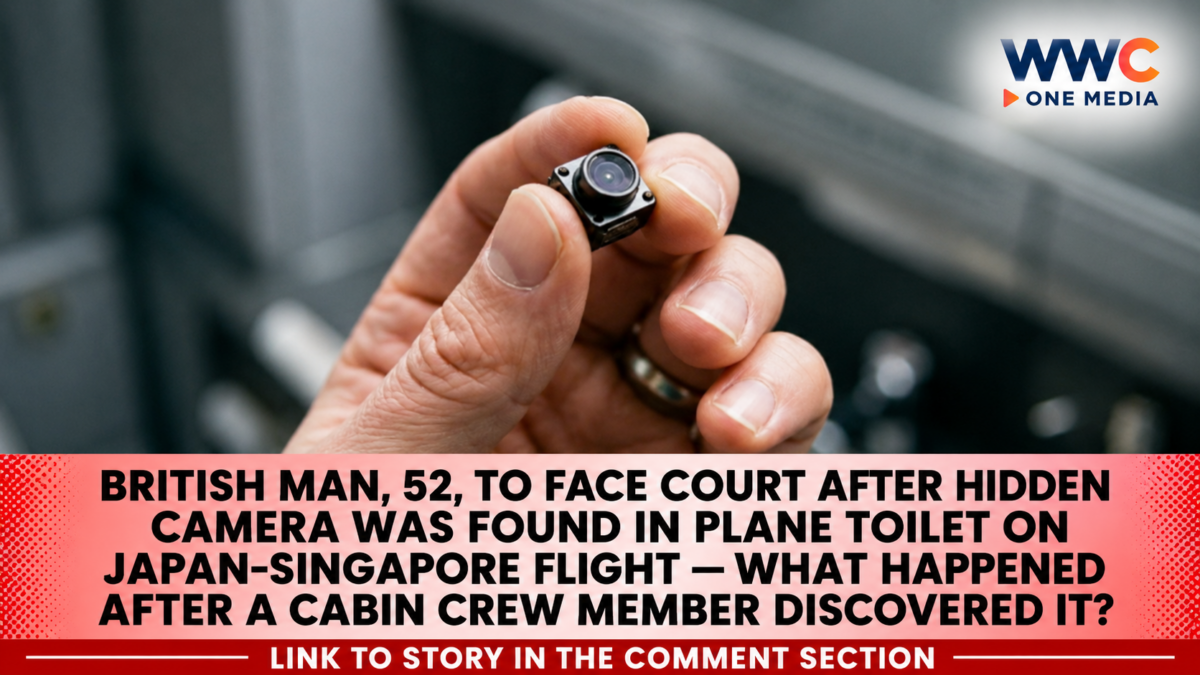
A flight from Japan to Singapore has become the subject of a criminal investigation after a 52-year-old British man allegedly concealed a camera inside an aircraft toilet and remotely activated its recording function.
The device was discovered by a cabin crew member who entered the toilet during the flight. She removed the camera and alerted a colleague, according to information released by the Singapore Police Force.
The man allegedly returned to retrieve the device but found that it was no longer there. Police said he subsequently deleted the mobile application used to operate the camera, along with related photographs stored on his phone.
The incident was reported to the Airport Police Division on October 7. After the aircraft arrived at Changi Airport, the man was detained for investigations, while his mobile phone and camera were seized as case exhibits.
He is scheduled to be charged in court on Thursday, November 5, with one count of voyeurism and one count of obstructing the course of justice on board an aircraft.
The allegations have raised renewed concerns about privacy and personal safety in confined public spaces, particularly on commercial flights where passengers and crew members share facilities.
However, the case remains before the courts, and the allegations should not be treated as proven unless established through legal proceedings.
How the hidden camera was allegedly discovered
According to preliminary police investigations, the incident happened aboard a flight travelling from Japan to Singapore.
The 52-year-old British national allegedly concealed a camera inside one of the aircraft’s toilets.
After leaving the toilet, he allegedly used an application on his mobile phone to activate the camera’s recording function remotely.
The device was subsequently discovered by a cabin crew member who used the same toilet.
She removed it and informed a colleague about what she had found.
The discovery appears to have disrupted the alleged plan because the man later returned to retrieve the camera and realised that it had already been removed.
Police said he then allegedly deleted the application and all related photographs from his phone in an attempt to avoid detection.
The cabin crew member’s discovery and decision to alert a colleague were important developments in the case. The device was no longer in the location where it had allegedly been concealed, and the incident was brought to the attention of authorities.
Police were alerted at approximately 5.35pm on October 7, according to reports citing the police statement.
The available reports do not identify the airline, the flight number, the exact route within Japan or the number of passengers who may have used the toilet.
They also do not establish whether any recordings were successfully made or how many people, if any, were captured.
What happened when the aircraft arrived at Changi Airport?
The investigation continued after the flight landed in Singapore.
The man was detained for investigations upon arrival at Changi Airport.
Police seized his mobile phone and the camera as case exhibits.
These items could be relevant to establishing how the device was operated, what material may have been recorded and whether any evidence was deleted.
The police have not publicly disclosed the identities of the cabin crew members involved or whether any passengers have been identified as potential victims.
It is also important to distinguish between the discovery of a concealed camera and confirmation that identifiable individuals were recorded.
Those details will depend on the evidence gathered during the investigation and any subsequent court proceedings.
The two charges the British man is expected to face
The man is scheduled to face two charges under Singapore law, read with the Tokyo Convention Act.
1. Voyeurism
The first charge concerns the alleged use of a concealed recording device.
Singapore’s Penal Code defines voyeurism to include intentionally recording another person performing a private act without that person’s consent, when the person responsible knows or has reason to believe that consent has not been given.
The law also covers operating equipment with the intention of enabling someone to observe another person during a private act without consent.
If convicted of the relevant voyeurism offence, the man could face up to two years’ imprisonment, a fine, caning or a combination of these punishments, as reported by Singapore media.
2. Obstructing the course of justice
The second charge concerns the alleged deletion of the mobile application and related photographs after the camera was discovered.
Under Section 204A of Singapore’s Penal Code, a person who intentionally obstructs, prevents, perverts or defeats the course of justice can face imprisonment of up to seven years, a fine or both.
The court will have to consider the specific charge and evidence before determining whether the alleged conduct amounts to the offence.
The potential penalties are significant, but they are maximum statutory punishments rather than predictions of the sentence the accused would receive if convicted.
Why the Tokyo Convention Act matters in this case
The alleged incident took place aboard an aircraft travelling internationally, rather than in an ordinary building or public facility in Singapore.
That makes the legal framework particularly relevant.
Singapore’s Tokyo Convention Act gives effect to the country’s obligations under the Convention on Offences and Certain Other Acts Committed on Board Aircraft.
The legislation provides a framework for dealing with certain offences and acts committed on aircraft, including circumstances in which Singapore exercises jurisdiction after an aircraft arrives in the country.
The fact that the alleged conduct happened during a flight from Japan to Singapore does not automatically place it outside Singapore’s legal process.
The authorities have indicated that the charges will be brought under the Penal Code read with the Tokyo Convention Act.
Hidden-camera cases have raised privacy concerns in Singapore
The aircraft incident is part of a broader issue involving the unauthorised recording of people in private or sensitive situations.
Singapore police describe voyeurism as the act of observing or filming another person engaged in a private act without permission.
Such conduct can occur in places where people reasonably expect privacy, including toilets, changing areas and private accommodation.
The Singapore Police Force advises members of the public to remain alert to suspicious behaviour and recording devices, and to report suspected sexual crimes promptly.
In a separate Singapore incident reported by WWC One Media, a social-media warning raised concerns about a man allegedly filming women at Yishun MRT station. The claims in that case had not been independently verified, and police had not confirmed that an offence had occurred.
Read more: Social Media Warning Raises Concern Over Man Allegedly Filming Women at Yishun MRT Station.
Another case involved a Singapore landlord who was jailed after surveillance footage captured him entering a tenant’s bedroom without permission and committing lewd acts involving her underwear.
That case was different from the aircraft investigation, but it also demonstrated how recording devices can become important evidence when privacy is violated.
A separate criminal case involved a man who secretly filmed couples and later used the recordings to threaten victims. He was sentenced to two years and 10 months in prison and three strokes of the cane.
Read more: Singapore Man Jailed and Caned After Filming Couples and Using Sex Videos to Threaten Victims.
Although these cases involve different circumstances and offences, they underline the serious consequences that can follow the unauthorised recording or misuse of private images.
What can passengers and cabin crew do if they discover a suspicious device?
The discovery of a concealed camera in an aircraft toilet also highlights the importance of reporting suspicious devices rather than attempting to investigate them alone.
A passenger or crew member who discovers something that appears to be a recording device in a private facility should alert cabin crew or the relevant authorities as soon as possible.
Where safe, preserving the location and circumstances of the discovery can help investigators understand what happened.
The Singapore Police Force encourages people who witness voyeurism or know someone who may have been victimised to report the matter promptly.
Its advice includes observing relevant details, protecting potential victims where safe and informing the police.
Early reporting can help authorities secure evidence, identify potential victims and investigate suspected offences.
What happens next in the case?
The next major development is the court appearance scheduled for November 5.
The accused is expected to face one charge of voyeurism and another charge of obstructing the course of justice on board an aircraft.
The court process should establish the formal charges and allow the case to proceed according to Singapore’s criminal procedure.
Several questions remain unanswered publicly:
- Was any footage successfully recorded by the concealed camera?
- Were any passengers or crew members recorded?
- What evidence was recovered from the seized phone and camera?
- What will the accused’s response to the charges be?
The available police information does not answer these questions.
Further details may emerge through court proceedings, but until then, it would be inaccurate to assume that recordings were successfully made or to speculate about the identities or number of potential victims.
The Bottom Line
A 52-year-old British man is due to face court in Singapore after allegedly hiding a camera in an aircraft toilet during a flight from Japan.
The device was discovered by a cabin crew member, who removed it and alerted a colleague. Police said the man later allegedly tried to retrieve the camera before deleting the application and related photographs from his phone.
The case highlights the importance of privacy and personal safety even in confined spaces such as aircraft cabins. It also demonstrates how the actions of alert crew members can help bring suspicious activity to the attention of authorities.
The accused faces potentially serious penalties if convicted, but the allegations must still be tested through the legal process.
The biggest unanswered question is whether the concealed camera successfully recorded anyone before it was discovered — and what investigators will uncover from the seized device and phone.