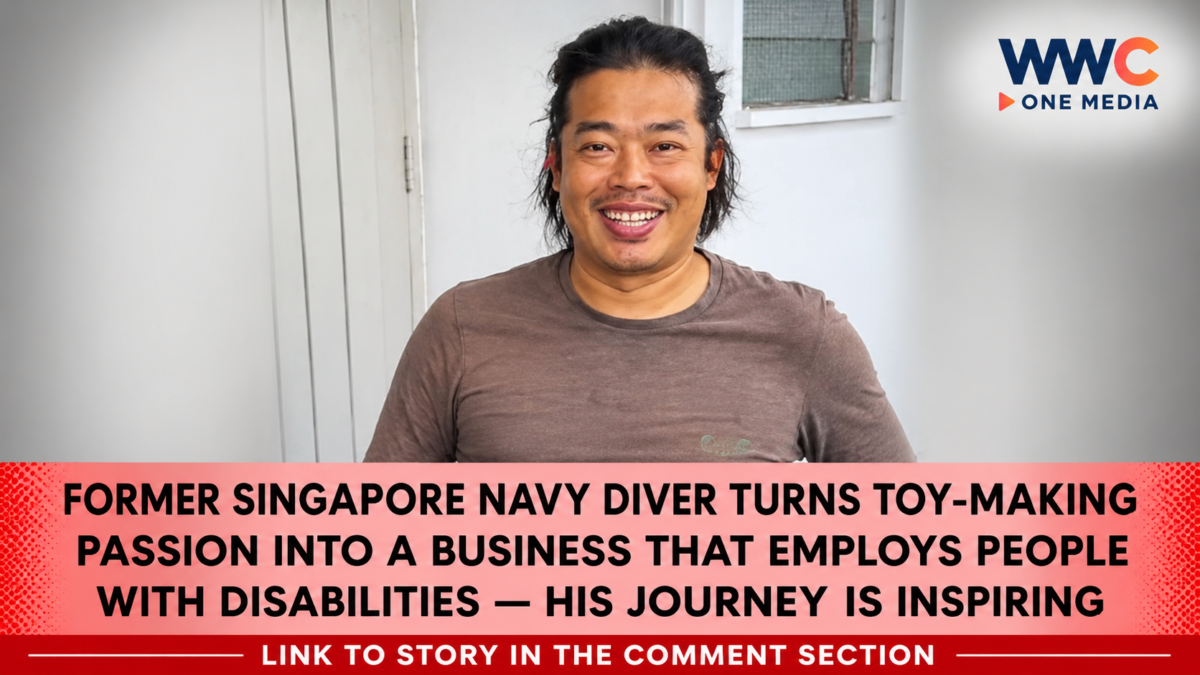
SINGAPORE — A former Singapore Navy diver who was forced to abandon his military career after being diagnosed with a rare neurological condition has found a new purpose in life — building a toy-making business that also provides employment opportunities for people with disabilities.
Chen Yuyang, 38, founder and art director of Moxbox, has experienced setbacks that could have ended his professional ambitions. Diagnosed with hereditary spastic paraplegia (HSP) in his twenties, he eventually had to leave his career as a naval diver. A serious motorcycle accident in 2016 then left him relying on a wheelchair for mobility.
But instead of allowing those experiences to define his future, Chen turned his passion for painting miniature models into a business.
Today, his toy brand, MoxMonsters, designs and produces customised models for companies and other clients. Its new factory in Singapore’s Yishun industrial area has also become a workplace where people with intellectual disabilities can contribute to the production process.
Through a partnership with the Movement for the Intellectually Disabled of Singapore (MINDS), the company has hired three people with intellectual disabilities on a part-time basis to help with packaging work.
His story is not simply about overcoming personal hardship. It also highlights how businesses can rethink their operations to create meaningful employment opportunities for people who are often overlooked in the workforce.
From Naval Diver to a Life-Changing Diagnosis
Chen’s professional journey began at a remarkably young age.
At 19, he was serving as a naval diver in Singapore, a demanding role that required physical fitness, discipline and the ability to work under challenging conditions.
However, his career took an unexpected turn when he was diagnosed with hereditary spastic paraplegia at the age of 26.
HSP is a group of inherited neurological disorders that primarily affect the nerves responsible for controlling movement in the legs. People living with the condition can experience progressive stiffness, muscle weakness and difficulties with walking.
The severity and progression vary from person to person.
For Chen, the condition eventually meant that continuing his military career was no longer practical. He had to leave the profession he had worked hard to build and find a different direction.
Rather than withdrawing from working life, he began exploring other employment opportunities.
He subsequently worked in areas such as social media management and graphic design, gradually developing skills that would later become useful in his own business.
During this period, he also met his wife, who became an important source of encouragement and support.
A Motorcycle Accident Made His Challenges Even Greater
Just as Chen was adjusting to life outside the military, another major setback followed.
In 2016, he was involved in a serious motorcycle accident that nearly cost him his life. After the accident, he needed a wheelchair to get around.
The experience added another layer of difficulty to an already challenging period.
For someone who had once worked in a physically demanding military environment, having to adjust to reduced mobility meant rebuilding not only his daily routine but also his sense of direction.
During this difficult period, Chen returned to something he had always enjoyed: painting miniature models.
What began as a personal hobby gradually became a way for him to regain confidence and rediscover his interest in creative work.
He eventually realised that the activity could become more than a pastime.
How Painting Miniature Models Became a Business
In 2017, Chen established a model-painting studio and began conducting classes.
The business gave him an opportunity to share his skills with other enthusiasts while earning an income from something he genuinely enjoyed.
However, teaching alone did not provide a sufficiently stable source of revenue.
He recognised that he needed to develop a business model with greater potential for growth.
The expansion of 3D-printing technology provided an opportunity.
Around 2024, he established the MoxMonsters toy brand, focusing on the design and production of customised models for businesses and other clients.
The company works on the process from design to manufacturing, allowing clients to develop customised figurines and other model products.
The move represented a significant change from the original painting studio. Instead of relying mainly on classes, Chen was building a production business with the potential to serve a wider customer base.
His experience in design and model painting became the foundation for a more sustainable commercial operation.
New Yishun Toy Factory Creates Jobs for People With Disabilities
One of the most significant developments in Chen’s business journey is the opening of its new toy factory in Yishun.
The company has partnered with MINDS to employ three people with intellectual disabilities on a part-time basis.
Their responsibilities include packaging work, with each worker scheduled to help approximately once every three months for an eight-hour shift when the factory has a need for additional packaging staff.
Although the arrangement is not a full-time employment programme, it provides an opportunity for the workers to participate in a real production environment and contribute to the company’s operations.
The partnership also demonstrates how businesses can make relatively practical adjustments to accommodate employees with different abilities.
Chen explained that the company has modified certain processes and tools to make tasks safer and more accessible.
For example, some model components have been redesigned so that employees can carry out steps such as removing finished pieces from their moulds more easily.
These changes allow workers to participate in production rather than being restricted to tasks that may not fully use their abilities.
The approach reflects an important principle of inclusive employment: sometimes, the workplace itself needs to change so that more people can contribute.
Why Inclusive Employment Matters Beyond a Paycheque
Employment can provide more than financial support.
For people with disabilities, having an opportunity to work can also help build confidence, independence, social connections and a sense of belonging.
It can also give families and caregivers reassurance that their loved ones have opportunities to participate in the wider community.
Chen hopes his company can demonstrate that people with disabilities have valuable abilities and can make meaningful contributions when workplaces provide suitable support.
His goal is not simply to offer occasional work. He wants employees and their families to experience the satisfaction of seeing people with disabilities contribute through their own capabilities.
The business model also challenges the assumption that inclusive employment is possible only in specialised organisations.
With appropriate job design, adapted tools and a willingness to understand individual needs, ordinary commercial businesses can create opportunities too.
Singapore Is Trying to Expand Employment Opportunities for People With Disabilities
Chen’s initiative comes at a time when Singapore is examining how to improve employment access and long-term career support for people with disabilities.
According to Ministry of Manpower figures reported in October 2026, the employment rate among residents with disabilities aged 15 to 64 increased from 33.6 per cent in 2024 to 34.7 per cent in 2025.
Although the improvement is encouraging, it also means that a substantial proportion of working-age residents with disabilities remain outside employment.
The government has set a target of reaching a 40 per cent employment rate for people with disabilities under the Enabling Masterplan 2030.
A new Employment Support Office, to be established by SG Enable, is expected to become fully operational in the second half of 2027. It will provide career advice, job placement, skills upgrading and longer-term employment support.
The office is also expected to help employers understand how to redesign jobs and provide suitable workplace accommodations.
WWC One Media previously reported on the initiative in Singapore’s New Employment Support Office to Expand Job Support for Persons With Disabilities.
The wider policy direction matters because securing a job is only one part of the challenge. Workers may also need continued coaching, accessible training and support when their responsibilities or workplace arrangements change.
More Than Hiring: Singapore Is Working to Make Public Spaces Inclusive
Employment is only one aspect of building a society in which people with disabilities can participate more independently.
Singapore has also introduced measures to improve access to public spaces and services.
From November 1, 2026, trained assistance dogs supporting people with physical, visual and hearing disabilities are allowed in the dining and refreshment areas, as well as toilets, of licensed food establishments under expanded guidelines.
The change allows more people who rely on assistance dogs to access everyday facilities with their trained companions.
Read WWC One Media’s related coverage: Singapore to Allow More Assistance Dogs in Eateries From November 1.
The expansion reflects a broader understanding of accessibility: inclusion is not achieved only through employment or financial assistance. It also requires people to be able to move around, participate in daily activities and access public services with dignity.
Special Education and Workplace Preparation Are Also Part of the Picture
Another challenge facing Singapore is helping young people with disabilities transition from education into employment.
In October 2026, a government task force recommended stronger work exposure, career guidance and employment support for students with disabilities.
The recommendations include more structured opportunities to develop workplace skills, job tasters and transition programmes for students moving from special education schools to further education or employment.
These measures are intended to address what families describe as the “post-18 cliff” — the uncertainty that can arise when young people with disabilities leave school and must navigate adult life, employment and independent living.
WWC One Media has also examined the pressures facing Singapore’s special education sector in 1 in 10 Special Education Teachers Resigned in Singapore From 2021 to 2025 — But Workforce Continues to Grow.
The availability of trained educators, job coaches and supportive employers can all influence whether students are able to turn their abilities into lasting employment.
Chen’s factory offers a practical example of what can happen when businesses take that responsibility seriously.
A Business Built Around Ability, Not Limitations
Chen’s story brings together two journeys: his own effort to rebuild a career after losing the ability to continue in the military, and his attempt to create opportunities for others facing barriers to employment.
The transition from naval diving to creative work was not straightforward. He had to adapt to a rare neurological condition, recover from a serious accident and find a way to turn a hobby into a viable business.
His experience has also given him a perspective on the importance of adjusting expectations and finding alternative ways to contribute.
The new factory does not solve every employment challenge faced by people with disabilities. Its part-time arrangement is limited, and the long-term growth of the programme remains to be seen.
Nevertheless, it offers an example of how inclusive employment can be built into an ordinary business operation.
Rather than asking only what a person cannot do, employers can examine the tasks involved, identify individual strengths and make practical adjustments that allow more people to participate.
The Bottom Line
Former Singapore naval diver Chen Yuyang has turned a difficult personal journey into an opportunity to build a business with a wider social purpose.
After being diagnosed with hereditary spastic paraplegia and later surviving a serious motorcycle accident, he rebuilt his career through miniature model painting, eventually establishing MoxMonsters and opening a toy factory in Yishun.
His partnership with MINDS has created part-time packaging opportunities for three people with intellectual disabilities, with the company adapting its tools and production processes to make the work more accessible.
The initiative comes as Singapore works toward increasing employment among people with disabilities and strengthening support for workers and employers.
Chen’s story is a reminder that inclusion does not always require a massive programme or a dramatic intervention. Sometimes, it begins when a business owner looks at an ordinary job and asks how more people can be given the chance to do it.
Could more Singapore businesses follow Chen’s example and redesign everyday jobs to give people with disabilities a fair opportunity to work, earn and contribute?