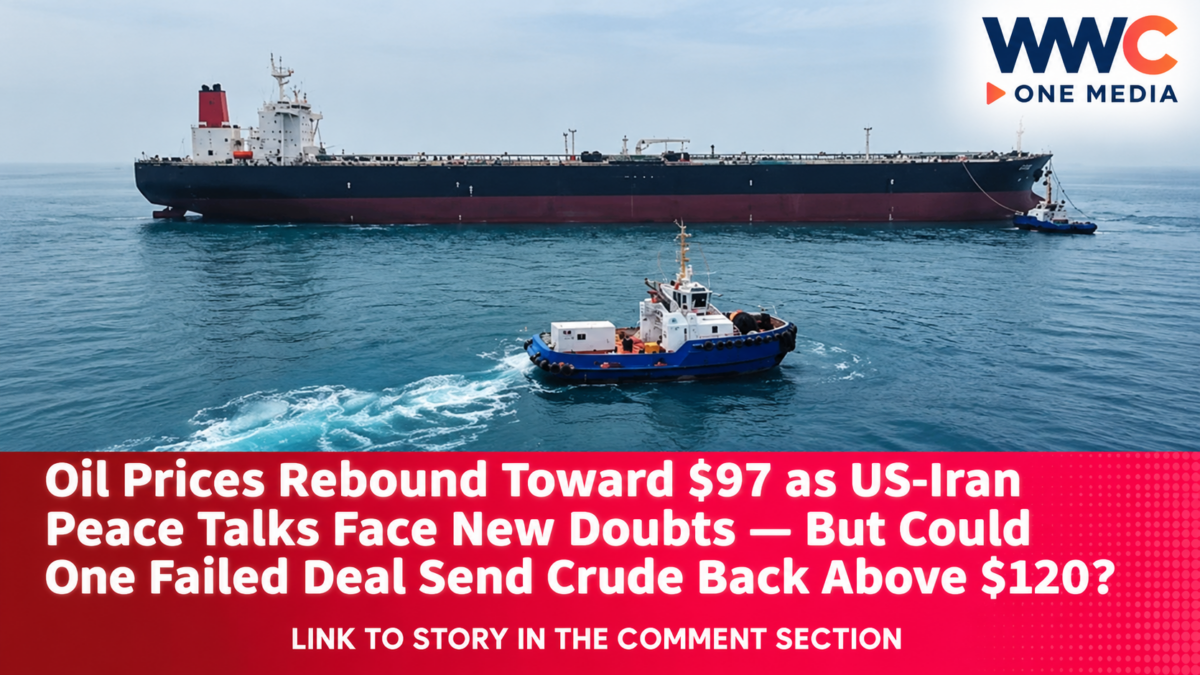
SINGAPORE / NEW YORK / MANILA — Global oil markets are entering another dangerous period of uncertainty as crude prices edged higher in early Wednesday trading, November 4, following two consecutive sessions of losses driven by hopes that Washington and Tehran could negotiate an end to their conflict.
US West Texas Intermediate (WTI) crude moved toward $97 per barrel, while international benchmark Brent had closed the previous session below $104, according to Bloomberg.
But the modest recovery masks a much bigger problem: negotiations between the United States and Iran remain unresolved, military tensions persist around the Persian Gulf, and traders are struggling to determine whether the global oil crisis is easing or preparing for another explosive reversal.
The latest developments underscore how sensitive energy markets have become to even small changes in diplomatic signals.
For oil-importing economies, including the Philippines, the stakes extend far beyond financial markets. Higher crude prices can increase transportation costs, raise business expenses and add pressure to household budgets.
The question now confronting traders is whether negotiations can produce a lasting settlement—or whether renewed military confrontation could wipe out recent price declines.
Oil Prices Recover After Dramatic Two-Day Decline
Oil markets experienced significant volatility during the opening days of November as traders reacted to contradictory developments surrounding the US-Iran conflict.
On November 2, Brent crude plunged approximately 7.6% to settle at $104.77 per barrel, while WTI dropped about 7.4% to $96.46.
The selloff followed reports suggesting that diplomatic negotiations could eventually reduce military tensions and restore more reliable energy shipments through the Middle East.
But the market remained unsettled.
On November 3, Brent declined further to $103.60 per barrel, while WTI settled at $96.09, their lowest settlement levels in nearly four weeks.
By early November 4, WTI was recovering toward $97 as investors reassessed whether hopes for a diplomatic breakthrough had moved ahead of the actual negotiations.
The sharp price swings show how traders are attempting to price two sharply different scenarios: a negotiated settlement that restores energy supplies, and renewed conflict that could disrupt shipments again.
WWC ONE MEDIA previously examined the dramatic selloff and its potential consequences in Oil Prices Crash Nearly 8% as Iran Peace Talks Send Brent to $104 — But Could One Failed Deal Trigger a $140-a-Barrel Shock?.
That earlier plunge demonstrated how quickly the geopolitical risk premium built into oil prices can disappear when traders anticipate a diplomatic breakthrough.
However, a decline in crude futures does not necessarily mean that disrupted production, transport routes and physical inventories have returned to normal.
Washington and Tehran Remain Far Apart Despite New Peace Proposals
According to Bloomberg’s November 4 market coverage, Washington and Tehran are reviewing proposals transmitted by diplomatic intermediaries.
A diplomat familiar with the discussions indicated that efforts to narrow differences remain active.
However, Iran’s national security leadership has publicly expressed dissatisfaction with the American response.
These contradictory signals illustrate why investors remain hesitant to assume that an agreement is imminent.
Qatar has played an important mediation role, but the negotiating parties still face substantial disagreements concerning regional security, military operations and the conditions for ending hostilities.
Reuters separately reported that an Iranian official considered the two sides far from a comprehensive agreement.
The diplomatic uncertainty has created an unusual situation in which reports of progress can send oil prices sharply lower, while a negative political statement can rapidly revive fears of another supply shock.
For additional context, see WWC ONE MEDIA’s report, Iran Says Peace Contacts With US Are Still Alive After Qatar Talks Fail — But Is Another Attack Now More Likely Than a Deal?.
The central issue remains unchanged: talks are continuing, but neither side has announced a comprehensive settlement that would guarantee an end to the conflict.
US Strikes on Iran’s Qeshm Island Complicate the Outlook
While diplomats pursue negotiations, military developments continue to threaten regional stability.
US forces carried out limited strikes against targets on Iran’s Qeshm Island on November 2, according to Reuters.
American officials characterized the operation as defensive and linked it to threats against US military assets.
The operation renewed concerns that even a limited military encounter could undermine diplomatic progress.
Qeshm Island is strategically important because of its location near the Strait of Hormuz, one of the world’s most critical maritime energy corridors.
Additional fighting in this area could affect shipping confidence, insurance costs and the willingness of commercial operators to transport crude through the region.
Nevertheless, the latest strikes should not automatically be interpreted as the beginning of another full-scale military offensive.
American officials described the operation as limited, while diplomatic discussions remained active.
WWC ONE MEDIA covered the incident in US Carries Out ‘Defensive’ Strikes on Iran’s Qeshm Island as Trump Talks Down Renewed War — But Is the Strait of Hormuz Heading Toward Another Escalation?.
The combination of negotiations and military operations helps explain why crude prices have struggled to establish a stable direction.
Strait of Hormuz Remains the World’s Biggest Oil-Market Flashpoint
At the center of the crisis is the Strait of Hormuz, the narrow passage connecting the Persian Gulf with international shipping routes.
Under normal conditions, the waterway handles roughly one-fifth of global petroleum liquids consumption.
That concentration makes it one of the most strategically significant points in the global energy system.
Even when oil producers maintain production, transportation problems can prevent barrels from reaching overseas buyers efficiently.
Shipping disruptions can also increase freight rates, insurance premiums and delivery times.
Saudi Aramco has been expanding its pipeline capacity to provide an alternative route for some crude exports that would otherwise rely on passage through Hormuz.
However, alternative transportation arrangements cannot necessarily replace all volumes normally shipped through the strait.
A durable peace agreement could improve commercial confidence and eventually reduce the extraordinary costs associated with moving crude through the region.
But restoring normal operations would require more than diplomatic announcements.
Tankers must be able to travel safely, logistical networks must operate reliably, and disrupted production facilities must be capable of delivering oil into international markets.
Until those conditions are established, supply-related concerns are likely to remain a significant influence on prices.
OPEC+ Holds Production Targets Steady as Traders Watch Supply
The Organization of the Petroleum Exporting Countries and its partners, commonly known as OPEC+, are another important factor shaping the market.
Seven participating producers agreed in early November to maintain their existing production targets for December 2026.
The decision provides some policy continuity during a period of geopolitical uncertainty.
However, production targets and actual exports are not the same thing.
Countries may have permission to produce particular volumes while shipping disruptions, infrastructure limitations or operational problems prevent those barrels from reaching customers.
Consequently, the absence of a new OPEC+ production cut does not guarantee that global oil markets will experience an immediate increase in available supplies.
Investors are also monitoring US petroleum inventory reports for evidence of changes in supply and consumption.
Analysts surveyed ahead of the November 4 Energy Information Administration report expected US crude inventories to rise by approximately 900,000 barrels.
That figure was a forecast, not a confirmed inventory increase at the time of reporting.
A larger-than-expected build could add pressure to prices, while an unexpected decline could support the market.
For now, geopolitics remains a major driver of short-term volatility.
Could Crude Oil Return to $120—or Even $140?
The possibility of another sharp increase remains a concern among energy analysts.
According to reporting by The Wall Street Journal, Goldman Sachs has examined scenarios in which prolonged Middle East supply disruptions could push Brent crude toward $140 per barrel in 2027.
Conversely, a durable diplomatic settlement restoring energy flows could result in much lower prices.
These scenarios represent conditional forecasts, not guaranteed outcomes.
A sustained recovery in exports would increase available supply and could help reduce the premium investors currently demand for geopolitical risk.
A breakdown in negotiations, another serious maritime incident or prolonged production disruption could produce the opposite result.
ANZ has also warned of continuing supply pressure.
The bank raised its year-end Brent crude forecast to $105 per barrel, reflecting concerns that physical supply constraints could persist even if diplomatic efforts continue.
WWC ONE MEDIA explored that assessment in ANZ Raises Oil Forecast to $105 as Iran War Tightens Supply — But Could Brent Surge Beyond $120 and Trigger Another Fuel Shock?.
The important distinction is that $120 and $140 are possible risk scenarios rather than established market targets.
Oil prices will depend heavily on the actual availability of crude, the pace of negotiations, global demand and the security of major shipping routes.
Philippines Faces Another Fuel-Price Test
For the Philippines, instability in international oil markets represents a direct economic risk.
The country depends heavily on imported petroleum and refined fuel products, leaving domestic consumers exposed to global crude prices, Asian fuel benchmarks, shipping expenses and the peso-dollar exchange rate.
Recent retail-price adjustments already illustrate the pressure.
For the November 3 pricing cycle, major Philippine oil companies announced a gasoline increase of up to ₱3.50 per liter, alongside reductions of approximately ₱1.00 per liter for diesel and ₱1.90 per liter for kerosene.
The mixed adjustments show that individual petroleum products do not always move in the same direction.
Refining margins, regional demand, inventories and product-specific supply conditions can influence local prices.
The latest decline in international crude does not automatically mean Philippine gasoline and diesel prices will immediately fall by comparable amounts.
Retail adjustments generally reflect earlier trading periods and other market factors.
A weaker peso can also offset part of the benefit from lower dollar-denominated crude prices.
WWC ONE MEDIA detailed the latest local adjustments in Gasoline Jumps Up to ₱3.50 a Liter on Nov. 3 as Diesel and Kerosene Roll Back.
If global crude prices remain volatile, motorists and transport operators may continue facing unpredictable weekly adjustments.
The consequences can extend across food distribution, agriculture, public transportation, aviation and manufacturing.
What Happens Next? Three Critical Factors to Watch
The immediate direction of the global oil market will depend on three major developments.
First, US-Iran negotiations. Traders will look for evidence of a concrete agreement rather than statements suggesting only that discussions are continuing. Clear commitments concerning military activity and maritime security could reduce uncertainty.
Second, the security of the Strait of Hormuz. Commercial shipping conditions will remain crucial. A meaningful improvement in tanker movements and delivery reliability would be stronger evidence of easing supply constraints than diplomatic optimism alone.
Third, physical supply and inventory data. OPEC+ production, actual Gulf exports and US petroleum inventories will help investors determine whether the global market is becoming better supplied.
A combination of diplomatic progress and improving physical supplies could support a sustained decline in oil prices.
But if negotiations fail while regional security deteriorates, the market could quickly reverse course.
The Bigger Picture: Is the Oil Crisis Really Ending?
The oil market’s modest recovery on November 4 underscores a difficult reality.
Investors want to believe that months of geopolitical uncertainty could finally give way to negotiations and more reliable energy trade.
Yet the fundamental risks have not disappeared.
Brent has fallen below $104, and WTI has moved back toward $97, but the regional conflict remains unresolved.
Military tensions persist near a strategically vital shipping corridor, while producers and refiners continue adjusting to disrupted energy flows.
For major importing economies, particularly across Asia, the difference between a lasting agreement and another escalation could determine the direction of inflation, transport costs and economic growth in the months ahead.
The coming days may provide stronger evidence of whether diplomatic momentum can translate into tangible improvements in oil supply.
Until then, traders face a market in which a single political announcement—or another military confrontation—could produce another dramatic price swing.
With crude struggling to stabilize, peace talks showing conflicting signals and the Strait of Hormuz still exposed to security threats, is the global oil crisis finally approaching its end—or could one failed agreement unleash another surge beyond $120 per barrel?