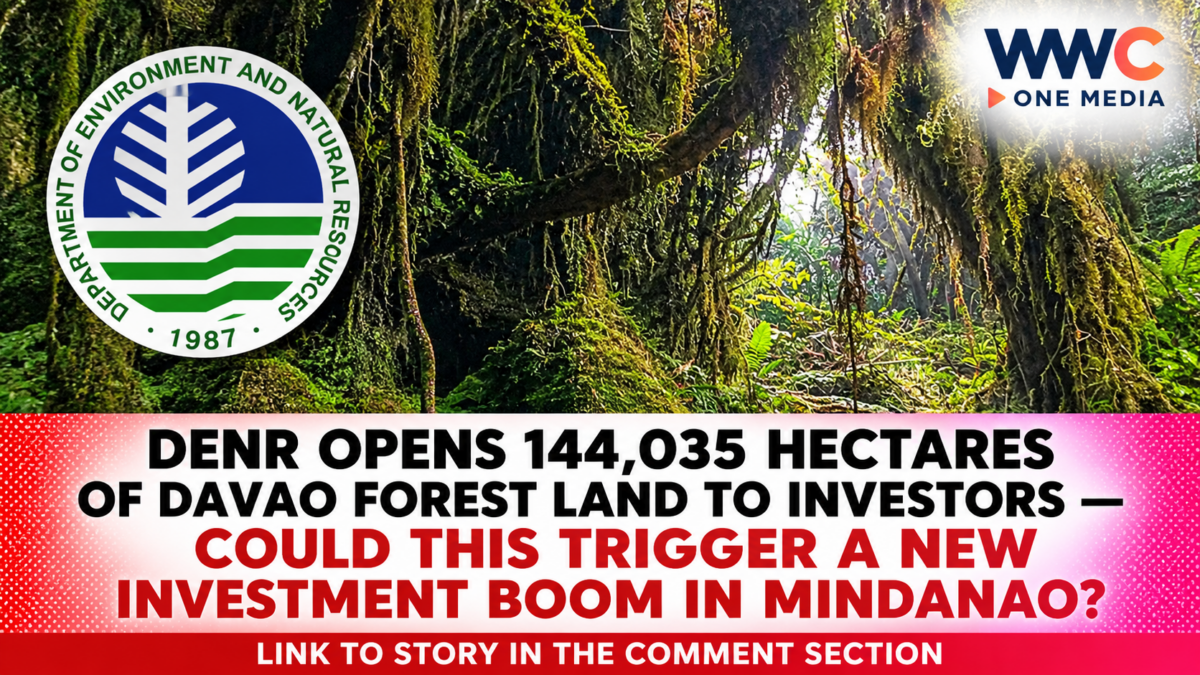
DAVAO REGION, Philippines — More than 144,000 hectares of forest land in the Davao Region have been identified for potential private-sector investment, as the Department of Environment and Natural Resources (DENR) pushes to turn underutilized production forests across Mindanao into opportunities for agriculture, timber production, ecotourism and renewable energy.
The initiative forms part of a much larger government plan covering approximately 500,011 hectares of production forest land across Mindanao, divided into 2,451 parcels.
Davao Region accounts for 144,035 hectares, or approximately 28.8 percent of the total area identified by the DENR.
The proposal could attract businesses interested in growing cacao, coffee and rubber, establishing commercial tree plantations, developing ecotourism destinations and building solar and wind energy facilities.
But the announcement comes with an important distinction: the government is not offering protected forests or selling pristine natural forest land to private companies. The areas identified are production forests outside protected areas, critical watersheds and existing forest tenures.
Presented during the Mindanao Development Forum 2026, the initiative raises a significant question for the region: Can private investment generate new economic opportunities while ensuring that Mindanao’s remaining forests, watersheds and Indigenous communities are protected?
DENR IDENTIFIES 144,035 HECTARES OF DAVAO PRODUCTION FOREST
DENR Undersecretary for Field Operations-Mindanao Joselin Marcus Fragada presented the investment figures during the second day of the Mindanao Development Forum 2026 on October 28 at Dusit Thani Davao.
Speaking on behalf of Environment Secretary Juan Miguel Cuna, Fragada explained that the Forest Management Bureau had delineated 500,011 hectares across Mindanao for potential development under the government’s Sustainable Forest Land Management Agreement (SFLMA).
Davao Region represents 144,035 hectares, accounting for 28.8 percent of the total.
It also has the largest number of identified parcels among the regions, with 1,195 separate areas.
The regional breakdown shows that Caraga has the largest land area available for potential investment, followed by Davao and Soccsksargen.
The figures are:
- Caraga: 177,201 hectares
- Davao Region: 144,035 hectares
- Soccsksargen: 105,124 hectares
- Zamboanga Peninsula: 39,130 hectares
- Northern Mindanao: 34,522 hectares
The DENR described the identified properties as open, brush and production forest lands that could support sustainable economic activities.
Fragada stressed that the initiative does not include the island’s remaining natural forests, protected areas or critical watersheds.
This distinction matters because the proposal is intended to develop designated production forest areas rather than open ecologically sensitive landscapes to unrestricted commercial activity.
WHERE WILL THE 500,000 HECTARES BE USED?
The DENR’s presentation identified several potential uses for the production forest areas, depending on their suitability and approved management plans.
The largest allocation is for agroforestry, followed by commercial tree plantations, with smaller areas identified for pasture and ecotourism.
The proposed distribution includes:
- 272,057 hectares for agroforestry.
- 216,081 hectares for commercial tree plantations.
- 11,873 hectares for pasture and ecotourism.
The categories point to a strategy that seeks to generate economic activity through renewable agricultural production and managed forest resources rather than relying exclusively on conventional land development.
For Mindanao, where agriculture and natural-resource industries remain important economic sectors, the proposal could attract investors looking for long-term production opportunities.
However, actual projects will still depend on land suitability, environmental requirements, regulatory approval and the terms of the agreements issued by the DENR.
CACAO, COFFEE AND RUBBER COULD DRIVE AGROFORESTRY INVESTMENT
Agroforestry accounts for the largest portion of the identified production forest land, covering approximately 272,057 hectares.
The DENR identified crops such as cacao, coffee and rubber as potential commercial activities, alongside other high-value perennial crops.
These commodities are particularly relevant to Mindanao because the island already has established agricultural production areas and businesses connected to domestic and international markets.
Expanding agroforestry could create opportunities for farmers, agricultural cooperatives, processing companies and investors seeking to develop plantations and supply chains.
The potential economic benefits could extend beyond the farms themselves.
Additional investment may create demand for nurseries, agricultural inputs, transportation, processing facilities, storage services and export logistics.
However, successful agroforestry requires more than allocating land.
Projects must consider soil conditions, water availability, appropriate crop selection, environmental limitations and the needs of communities that depend on surrounding forest resources.
The long-term objective should be productive land management without undermining the ecological functions that make these areas valuable.
COMMERCIAL TREE PLANTATIONS COULD REDUCE WOOD IMPORT DEPENDENCE
Another 216,081 hectares have been identified for commercial tree plantations.
The DENR sees potential for timber production, wood processing and biomass-related industries.
One of the broader objectives is to strengthen the country’s domestic wood supply and reduce dependence on imported wood products.
For investors, commercial plantations could create opportunities in timber production, processing facilities, furniture manufacturing and other wood-based industries.
For local communities, the development of these industries could potentially generate employment in plantation management, harvesting, transportation and processing.
However, commercial forestry must operate under sustainable management rules.
Plantation development should not become a justification for clearing natural forests or damaging watersheds.
The distinction between planted commercial trees and naturally grown forest ecosystems is essential.
The government’s challenge will be ensuring that commercial production supports a sustainable timber industry while preserving the biodiversity and environmental functions of the surrounding landscape.
132,896 HECTARES ALSO IDENTIFIED FOR SOLAR AND WIND ENERGY
The DENR is also exploring opportunities to connect forest land investment with the country’s renewable energy expansion.
Working with the Department of Energy, the agency identified 132,896 hectares across 431 parcels that meet technical screening requirements for utility-scale solar and wind projects.
According to Fragada’s presentation, the identified sites are within 20 kilometers of National Grid Corporation of the Philippines substations and have slopes below 20 percent.
These technical considerations are important because renewable energy developers need suitable land and access to electricity transmission infrastructure.
The identified areas could attract companies interested in developing solar farms, wind energy facilities and related infrastructure.
For the Philippines, additional renewable energy investment could help diversify electricity generation and support the country’s long-term energy transition.
But the availability of technically suitable land does not mean that every parcel is automatically approved for construction.
Developers must still comply with applicable environmental rules, secure necessary permits and demonstrate that proposed facilities are compatible with the approved land-management plans.
The government will also need to consider the cumulative environmental effects of large-scale projects, especially where developments could affect forest ecosystems, local communities and water resources.
DENR INTRODUCES ONE AGREEMENT FOR FOREST LAND INVESTMENT
A major part of the initiative is the use of the Sustainable Forest Land Management Agreement.
The SFLMA is intended to consolidate and simplify the government’s forest land management arrangements.
According to the DENR presentation, the framework replaces older tenure instruments, including community-based forest management agreements and Integrated Forest Management Agreements, with a more unified system.
The objective is to make it easier for qualified private companies, institutions and local government units to work with the DENR while establishing clearer management responsibilities.
Applicants are required to submit documents that include:
- A letter of intent.
- Securities and Exchange Commission or Cooperative Development Authority registration, where applicable.
- Geographic information system maps of the proposed area.
- Proof of financial capability.
- Other applicable application documents and supporting requirements.
The reported application fee is a flat ₱10,000.
The framework is governed by DENR Administrative Order No. 2025-22, together with subsequent amendments and related administrative issuances.
The rules establish the process through which applicants seek authority to manage and develop eligible forest land.
Importantly, an SFLMA is not equivalent to purchasing the land. It provides a regulated management and use arrangement subject to government approval, conditions and continuing compliance.
HOW MUCH WILL INVESTORS PAY?
The DENR has presented a fee structure based on the intended use of the land.
The reported charges include:
- Agroforestry and plantations: 3 percent of gross revenue.
- Pasture: ₱200 per hectare.
- Renewable energy: ₱7,200 per hectare annually, with a 10 percent annual increase.
- Ecotourism: ₱85,000 per hectare.
- Protection forest restoration: No user fee for qualifying protection activities.
The structure is intended to establish predictable charges while encouraging different forms of investment.
For agroforestry and plantation operators, the 3-percent gross revenue arrangement links the government’s share to the commercial performance of the project.
Renewable energy developers, meanwhile, face an annual land-use charge that increases over time.
The zero-fee provision for qualifying forest protection activities is particularly significant because it recognizes that environmental restoration can provide public benefits even when it does not generate direct commercial revenue.
The detailed application of these charges must still follow the applicable DENR administrative orders and the conditions of individual agreements.
INDIGENOUS COMMUNITIES AND FOREST PROTECTION REMAIN CENTRAL ISSUES
One of the biggest questions surrounding large-scale forest investment is how development will affect people who already depend on the land.
Mindanao is home to Indigenous communities whose ancestral domains, cultural practices and livelihoods are closely connected to forests and natural resources.
Any investment programme involving forest land must therefore consider existing rights, community participation and the potential consequences of commercial activities.
Fragada emphasized that enterprises operating in Mindanao must uplift Indigenous communities, secure the necessary social acceptance and restore the land responsibly.
These commitments are especially important in areas where agricultural expansion, timber production or renewable energy developments could affect traditional livelihoods.
The issue has also been highlighted by Indigenous leaders around Mount Apo.
WWC ONE MEDIA previously reported on the five-year agenda unveiled by Mount Apo Indigenous leaders to protect ancestral lands and preserve tribal heritage.
The agenda identified ancestral domain protection, biodiversity conservation, Indigenous governance and sustainable livelihoods as major priorities.
These concerns are directly relevant to forest investment because economic development cannot be considered sustainable if it disregards the rights and participation of communities living in or around project areas.
The DENR’s regulatory process and applicable Indigenous peoples’ rights protections will therefore be critical to determining whether proposed investments can proceed responsibly.
WHY FOREST RESTORATION MUST BE MORE THAN A BUSINESS COMMITMENT
The government’s investment push also raises a broader environmental challenge.
Forest land is not simply an area that can be assigned to a commercial activity. Forest ecosystems provide watershed protection, biodiversity habitat, soil stability and other environmental services that support communities and economic activities.
Poorly managed projects could undermine these benefits.
That is why the distinction between production forests and protected forests must be supported by effective monitoring and enforcement.
WWC ONE MEDIA previously covered the Monkayo forest restoration project in Davao de Oro, which earned ASEAN recognition after more than 22,000 native trees were planted.
The project demonstrates how restoration can involve native tree planting, biodiversity protection and long-term management.
Another example is the Green Samar Project, which targets 120,000 hectares of degraded forest for restoration.
Both initiatives highlight an important principle: forest programmes should be evaluated not only by the amount of land covered or the number of trees planted, but also by the condition of the ecosystem over time.
For the proposed Mindanao investments, that means environmental safeguards must be built into project planning, implementation and monitoring.
THE BIGGER ECONOMIC OPPORTUNITY FOR MINDANAO
The scale of the DENR’s proposal suggests that the government wants to make forest resources a more significant part of Mindanao’s investment landscape.
The opportunities extend across several industries.
Agroforestry could strengthen agricultural production and processing. Commercial plantations could support the domestic timber industry. Ecotourism could create opportunities for local businesses, guides and community enterprises. Renewable energy projects could attract capital for solar and wind development.
The programme could also complement wider efforts to attract investment into Mindanao.
However, the availability of land alone will not guarantee commercial success.
Investors will consider transportation access, electricity connections, financing, regulatory certainty, workforce availability and the long-term stability of local communities.
Environmental compliance and social acceptance will also influence whether projects can move from proposals to actual operations.
WWC ONE MEDIA has previously examined the region’s investment prospects in its report on the Philippine investment approvals surge to ₱900 billion in the first nine months of 2026.
The report highlighted the importance of turning investment commitments into completed projects and actual employment opportunities.
The same challenge applies to forest land development.
The DENR may identify hundreds of thousands of hectares for potential investment, but the real economic impact will depend on how many projects secure approval, attract financing and operate successfully.
THE BOTTOM LINE: 144,000 HECTARES COULD ATTRACT BILLIONS IN INVESTMENT — BUT CAN THE DENR PROTECT MINDANAO’S FORESTS?
The DENR’s decision to present 144,035 hectares of Davao Region production forest as potential investment areas marks a major development in Mindanao’s effort to attract private capital.
The broader programme covers 500,011 hectares across the island, with opportunities involving cacao, coffee, rubber, commercial tree plantations, ecotourism, pasture and renewable energy.
For businesses, the proposal could create new opportunities in agriculture, timber processing, tourism and clean energy.
For local communities, responsible development could bring employment, infrastructure and additional sources of livelihood.
But the environmental and social responsibilities are just as significant as the economic opportunities.
The areas identified are not being sold to investors, and protected forests, critical watersheds and existing tenures are excluded from the stated investment inventory.
Projects must still comply with the Sustainable Forest Land Management Agreement framework, environmental regulations and applicable protections for Indigenous communities.
The government must also ensure that commercial activities do not undermine the forests, water systems and biodiversity that make Mindanao valuable in the first place.
Ultimately, the success of the programme should not be measured only by the number of hectares offered or the amount of private capital attracted.
It should also be measured by the jobs created, communities supported, ecosystems protected and forests responsibly managed.
And as investors begin examining the opportunities across Mindanao, one major question remains:
Can the DENR turn 500,000 hectares of production forest into a new engine of economic growth without sacrificing the natural resources and Indigenous communities that depend on the land?