MANILA, Philippines — November 4, 2026 | WWC ONE MEDIA | Philippine News, Consumer Protection & Animal Welfare
A disturbing controversy involving a pet cremation business in Cavite has escalated into a major investigation, with hundreds of grieving Filipino pet owners demanding answers after animal remains were discovered abandoned in Bulacan.
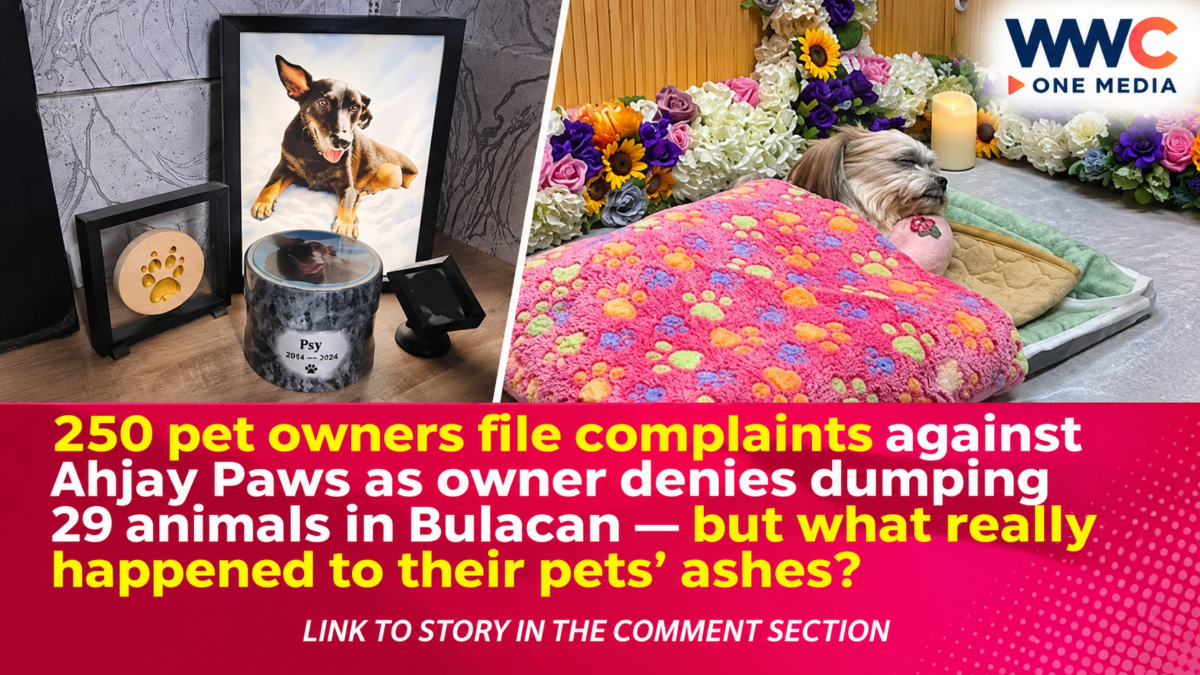
At least 250 pet owners have lodged complaints with Bacoor police concerning Ahjay Paws Aftercare Pet Crematorium, according to a November 4 report by GMA News citing Bacoor Mayor Strike Revilla.
The growing number of complaints follows the discovery of 29 deceased animals—initially reported as 26 dogs and three cats—in a vacant area in San Jose del Monte, Bulacan.
Some pet owners say they recognized their deceased companions among the recovered animals despite having already paid for cremation services.
But Ahjay Paws owner Jonathan Legaspi has denied responsibility for dumping the remains, according to Bilyonaryo’s November 3 report.
During a confrontation with customers in Bacoor, Legaspi reportedly offered refunds to clients who had used the service in October while disputing the accusations against him.
The controversy has now reached the National Bureau of Investigation, prompted forensic examination of cremation ashes and triggered calls in the Senate for stronger regulation of pet aftercare services.
The biggest question is no longer just who abandoned the animals—but whether families who received urns from the crematorium were actually given the remains of their beloved pets.
Ahjay Paws Owner Denies Responsibility and Reportedly Offers Refunds
According to Bilyonaryo, Legaspi faced angry customers during a meeting concerning the handling of deceased pets entrusted to his business.
Pet owners alleged that he offered refunds but did not acknowledge responsibility for the dumping incident.
Legaspi reportedly argued that there was insufficient evidence connecting the recovered animals to his establishment.
A pet owner quoted him as saying:
“Wala kaming kasalanan! Pwede namang sa iba kayo nagpa-cremate.”
The statement was attributed to Legaspi by a customer and was not independently authenticated as a complete recording of the meeting.
The owner’s denial is an important part of the case.
Authorities have not yet publicly established who physically transported and abandoned all the recovered animal remains.
Nor has a final court determination established that Legaspi committed fraud or another criminal offense.
However, pet owners’ complaints, documentary discrepancies and the discovery of the animals have prompted authorities to investigate whether cremation services were actually performed as represented.
29 Dead Animals Found in Bulacan Spark National Outrage
The controversy began after residents and animal welfare volunteers discovered decomposing animal remains along a roadside in Barangay Minuyan Proper, San Jose del Monte City, Bulacan.
Initial reports described 26 dogs and three cats placed inside plastic bags.
Some bags reportedly carried identifying information, including pet names and weights.
Photographs circulated on social media, prompting families who had recently arranged cremations to examine whether any of the animals could be theirs.
The discoveries raised immediate concerns about the handling, transportation and disposal of deceased pets.
For families who paid for private cremation, the possibility that their animals had not received the requested service was particularly distressing.
Several pet owners subsequently approached local officials and law enforcement agencies.
The controversy quickly expanded beyond a possible sanitation violation into questions about consumer deception and the handling of cremated remains.
Ivy’s Family Says They Recognized Their Dog
One of the most widely reported cases involves Ivy, a dog who died on October 23, 2026.
According to GMA News and SPOT.ph, Ivy’s family had entrusted her remains to Ahjay Paws Aftercare.
The family later received an urn bearing Ivy’s name.
However, after images of the abandoned animals appeared online, a family member noticed a plastic bag marked with a name and weight matching Ivy’s details.
The family subsequently retrieved the dog’s remains and brought them to another cremation provider, according to GMA News.
The family reported spending more than ₱10,000 for Ivy’s cremation.
The incident raised a painful question: if Ivy’s body had remained intact, what had the family originally received inside the urn?
Other pet owners, including families associated with dogs named Caesar and Milo, have also questioned the handling of animals entrusted to the establishment.
These accounts are central to the investigation, but identification claims and the contents of returned urns must still be assessed through appropriate evidence.
Complaints Climb From Dozens to 250
The number of people seeking answers has increased rapidly.
During the initial investigation, Bacoor officials met with more than 30 pet owners.
By November 2, police had recorded 130 complainants, according to a Daily Tribune report citing a regional police incident summary.
That report stated that seven complainants had located animals they believed were their pets among the recovered remains.
On November 4, GMA News reported that the number of complaints had reached at least 250, citing Bacoor police chief PLTCOL Alexie Desamito and Mayor Strike Revilla.
Authorities also reported that nine recovered animals had been positively identified by their respective owners.
These figures represent different stages of a developing investigation.
The number of complainants is not the same as the number of animals recovered, and not every complaint has necessarily been substantiated.
But the sharp increase demonstrates the scale of public concern surrounding the crematorium.
For investigators, establishing how many customers may have received services that were not actually performed will be an important part of the case.
20 Containers of Ashes Undergo Forensic Examination
Another major development concerns the ashes returned to customers.
According to GMA News’ November 4 report, authorities received 20 containers of ashes from complainants for forensic examination by the Philippine National Police Forensic Group.
The examination is intended to help determine whether the materials correspond to what customers were told they were receiving.
However, no conclusive results from those examinations were publicly reported in the source reviewed.
The investigation also faces potential scientific challenges.
Depending on cremation conditions, identifying an individual animal from cremated material may be difficult.
Investigators may need to combine forensic results with service records, transportation logs, identification labels, witness statements and other evidence.
The absence of a conclusive test result would not automatically establish wrongdoing, just as an unverified cremation certificate would not necessarily prove that a service was performed correctly.
For affected families, the findings could be essential to understanding what happened to their pets.
Bacoor Mayor Strike Revilla Orders Crematorium Closure
Bacoor City Mayor Strike Revilla ordered the closure of Ahjay Paws Aftercare on October 31 following mounting complaints.
The city government said the establishment had failed to provide sufficient documentary evidence supporting its claims that cremation services had been performed for the affected customers.
Reports indicated that Legaspi acknowledged transporting some pets to another cremation facility in Caloocan City.
However, local officials said he was unable to present adequate supporting records for certain cremations.
Questions also emerged about the scope of the company’s business permits.
PhilSTAR reported that an initial investigation found an existing business permit, while GMA News reported concerns about whether the permit specifically covered animal cremation services.
These accounts require a distinction between possessing a business permit and holding all approvals necessary for a particular regulated activity.
Authorities are examining the establishment’s permits and operational arrangements.
The closure is an administrative measure during the investigation, not a final criminal conviction.
NBI Launches Investigation Into Possible Estafa
The National Bureau of Investigation has ordered a broader examination of the case.
On November 2, NBI Director Melvin Matibag directed the bureau’s Environmental Crimes Division and supporting regional offices to investigate complaints connected with the discovery of the animal remains.
The investigation focuses on several issues.
First, authorities are determining whether customers paid for cremation services that were not actually performed.
Second, investigators are examining the crematorium’s permits, operating equipment, records, security footage and procedures for handling animal remains.
Third, agencies are coordinating to determine whether the incident involved sanitation, environmental or other regulatory violations.
Possible estafa under Article 315(2)(a) of the Revised Penal Code is among the legal issues being examined.
However, an allegation of estafa requires proof of the applicable elements of deceit and resulting damage.
A refund offer, incomplete records or a business closure does not automatically establish criminal guilt.
The results of the investigation will determine whether the evidence supports particular charges.
PAWS Calls for Legal Accountability
The Philippine Animal Welfare Society has condemned the alleged mishandling of deceased pets and encouraged affected families to preserve evidence.
PAWS has argued that customers who paid for cremation services may have grounds to pursue complaints if they were deliberately misled.
The organization has emphasized the emotional significance of pets to their families.
For many Filipino households, companion animals are treated as members of the family, and cremation is chosen as a way of providing a respectful farewell.
PAWS has recommended preserving payment receipts, cremation certificates, messages, photographs and other documents.
The organization has also urged authorities to investigate whether the dumping of the animal remains violated sanitation and environmental requirements.
The case highlights an important distinction in Philippine law.
Existing animal welfare legislation primarily addresses the treatment of living animals, while alleged deception involving aftercare services may also raise consumer, contractual and criminal-law questions.
Determining which laws apply will depend on the established facts.
Senate Considers Tougher Rules for Pet Crematoriums
The controversy has also drawn attention from Philippine lawmakers.
According to The Philippine Star’s November 4 reporting, Senators Pia Cayetano, Francis Pangilinan and other legislators have called for stronger scrutiny of pet aftercare services.
Cayetano is pursuing an inquiry into possible animal welfare, environmental and sanitation violations.
Pangilinan has proposed strengthening animal welfare legislation to address facilities handling deceased pets.
The senator’s proposed revisions would seek to close perceived gaps in how the law treats pet crematoriums and related services.
Other lawmakers have expressed support for a Senate investigation.
However, proposed legislative changes have not yet become law.
Any new regulatory requirements would need to pass through the legislative process.
The incident nevertheless raises a broader policy question: should businesses offering pet cremation services face more specific licensing, documentation and inspection requirements?
Pet Aftercare Raises Consumer Protection Concerns
For pet owners, paying for cremation involves trust.
Most customers cannot independently observe every part of the process.
They depend on the service provider to identify the animal correctly, perform the requested procedure and return the appropriate remains.
That makes accurate records and transparent service descriptions particularly important.
Consumer protection is a broader issue in the Philippines, including in industries where customers must rely on representations made by businesses.
WWC ONE MEDIA previously examined these questions in TikTok Shop and DTI Push Safer Online Shopping After 208 Million Listings Blocked — But Are Filipinos Truly Protected From Digital Scams?.
That separate report examined seller accountability, misleading representations and consumer complaint procedures in digital commerce.
Although pet cremation is a different service industry, both situations illustrate why customers need accurate information and accessible remedies when transactions are disputed.
The Ahjay Paws investigation will test whether available laws can effectively address the complaints raised by pet owners.
Animal Welfare and Sanitation Rules Under Scrutiny
The handling of animal remains can also raise environmental and public health concerns.
Improper disposal may create sanitation problems, particularly when decomposing remains are left in areas accessible to residents or other animals.
WWC ONE MEDIA has previously examined animal-related regulatory concerns in Japan Launches First Nationwide Survey of Animal Cafes Over Welfare and Disease Concerns.
The Japanese case concerns living animals and commercial animal cafes, not cremation services.
However, it demonstrates how governments can review commercial animal-related businesses when existing oversight appears insufficient.
In the Philippines, the Bulacan incident is prompting lawmakers and enforcement agencies to examine whether pet aftercare providers should face clearer operational standards.
These could include documentation of individual cremations, secure identification procedures, records retention and appropriate disposal methods.
The exact requirements remain a matter for regulators and legislators.
A Wider Debate About Responsible Pet Services
As pet ownership becomes more visible in Filipino urban life, businesses are facing growing expectations about animal-related services.
Restaurants, hotels, transportation providers and specialty businesses increasingly encounter issues involving pet accommodation and customer responsibilities.
For example, WWC ONE MEDIA covered Pizza Hut Philippines’ Response to a Pet Dog Seen in a Restaurant Baby High Chair.
That incident involved restaurant hygiene and pet-friendly policies rather than deceased animals.
The common theme is the need for businesses to establish appropriate standards when their services involve animals.
Pet cremation requires particularly careful procedures because families are often making arrangements while grieving.
Clear identification, documentation and communication can help protect customers and legitimate providers.
The Ahjay Paws controversy illustrates the damage that can occur when customers lose confidence in whether promised services were delivered.
International Animal Welfare Oversight Offers Lessons
The Philippine controversy also connects to wider debates over the regulation of businesses dealing with animals.
WWC ONE MEDIA previously reported on Singapore Cabby’s Moving Aquarium Sparks Animal Welfare Concerns After Viral Video Raises Questions Over Fish Safety.
That case concerned the treatment of living fish in a commercial vehicle, making it substantially different from the current crematorium investigation.
Nevertheless, both demonstrate how public scrutiny can prompt questions about appropriate animal-handling standards.
For Philippine authorities, the immediate priority is determining what happened in Bulacan and whether the affected customers were deceived.
Longer-term policy changes should be based on the findings rather than assumptions about individual guilt.
Why Refunds May Not Resolve Every Complaint
The reported refund offer is an important development, but it does not necessarily settle all potential disputes.
A refund could address the cost of a service that a customer believes was not properly performed.
However, depending on the circumstances, consumers may also pursue other remedies available under applicable law.
For example, customers could seek legal advice about contractual obligations, alleged deception and possible damages.
Whether any particular claim succeeds depends on the evidence and relevant legal requirements.
Importantly, accepting or offering a refund does not automatically determine criminal liability.
The allegations against Ahjay Paws must still be examined through the proper investigative and judicial process.
For many affected owners, the principal concern may not be the amount they paid.
It may be determining what actually happened to their pets and whether the ashes they received can be authenticated.
What Other News Outlets Confirm
Bilyonaryo reported on November 3 that owner Jonathan Legaspi denied responsibility for dumping animal remains and allegedly offered refunds without apologizing to customers.
PhilSTAR separately confirmed the temporary closure of the Bacoor crematorium and the initial concerns about inadequate documentation.
GMA News reported the experience of Ivy’s family and subsequently documented the NBI investigation.
Daily Tribune reported that police had recorded 130 complainants as of November 2.
GMA News then published the newer figure of 250 complaints on November 4.
The Philippine Star also reported that lawmakers were considering an investigation and stronger rules governing pet crematoriums.
These developments establish that the controversy has expanded beyond a social media dispute.
However, the available reporting does not establish who was responsible for dumping all the remains, whether every disputed cremation was fraudulent or what the forensic examinations will ultimately show.
Five Questions Investigators Must Answer
Several issues remain central to the case.
First: Who transported and abandoned the 29 deceased animals in Bulacan?
Second: Which animals can be reliably matched to customers who paid Ahjay Paws for cremation?
Third: What materials were placed inside the urns returned to affected families?
Fourth: Did the establishment possess all required permits and maintain adequate records of the services it provided?
Fifth: Will the evidence support criminal, civil or administrative proceedings against any responsible individuals?
These questions can only be answered through a combination of documentary evidence, witness accounts, official inspections and forensic findings.
The outcome remains uncertain.
The Bottom Line: A Test of Trust, Consumer Rights and Accountability
The Ahjay Paws controversy has become one of the most troubling animal aftercare disputes reported in the Philippines in recent days.
What began with the discovery of 29 deceased animals in Bulacan has led to hundreds of complaints, the closure of a cremation business and investigations involving local police and the NBI.
The owner has denied responsibility for the dumping.
Pet owners have questioned the cremation services they received.
Authorities are attempting to establish what happened and whether any laws were violated.
Meanwhile, lawmakers are considering whether stronger oversight of pet aftercare businesses is necessary.
For grieving families, the case is about more than receipts, refunds or business permits.
It concerns the trust they placed in a company to provide a dignified farewell to their animals.
And as forensic examinations continue and more families demand answers, the most important question remains: will investigators establish what happened to the pets entrusted to Ahjay Paws—or will grieving owners be left with refunds, unanswered questions and doubts about the ashes they brought home?