GENEVA, Switzerland — November 4, 2026 | WWC ONE MEDIA | Global Business, Employment & Gender Equality
Women are more educated than ever, more are reaching corporate boardrooms, and businesses increasingly acknowledge the financial benefits of diverse leadership.
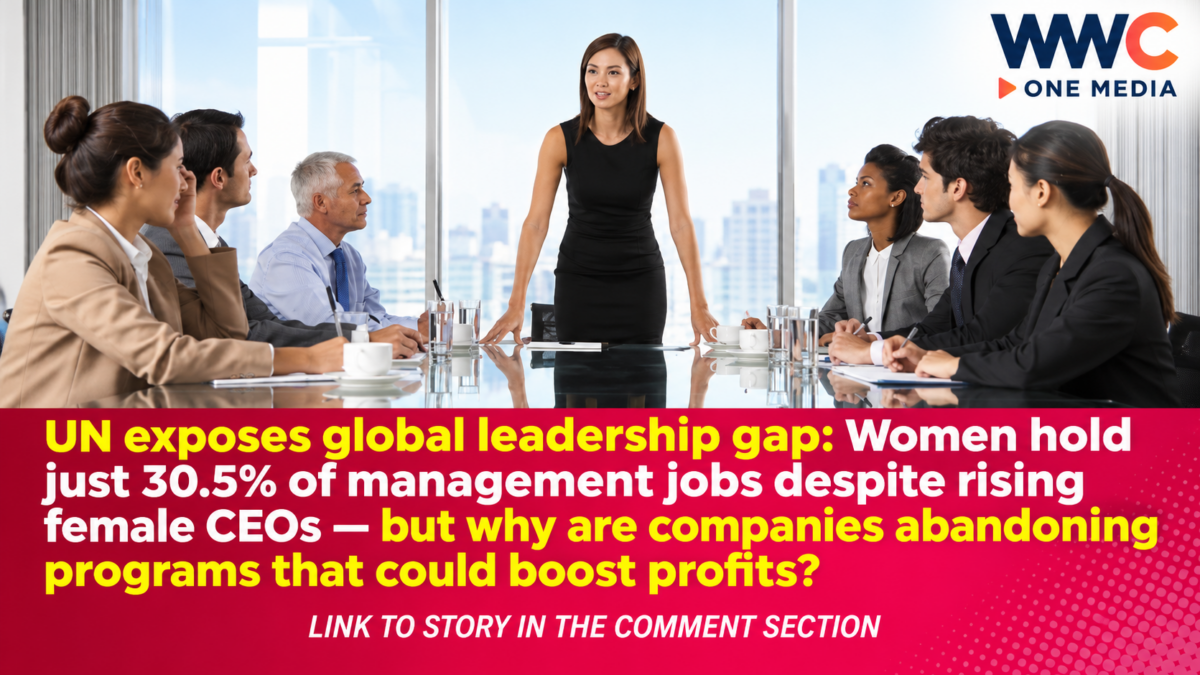
Yet a new United Nations report reveals a troubling reality: women still hold only 30.5% of management positions worldwide, while corporate initiatives designed to improve gender equality are losing momentum.
The findings, released November 3 by the International Labour Organization (ILO), expose a widening disconnect between corporate promises and the actual opportunities available to women seeking leadership positions.
The ILO’s Women in Business and Management: Scaling Success report combines three decades of labour-market information with enterprise surveys conducted in 2013, 2018 and 2025.
Its latest survey included 11,957 enterprises across 99 countries.
Although the proportion of companies with female chief executives and board chairs has increased since 2013, the study reveals that women remain underrepresented in management overall, particularly in positions that provide important pathways to corporate leadership.
The report also contains a striking contradiction.
Nearly seven in ten surveyed enterprises said gender equality and diversity initiatives had improved their business outcomes.
Yet the proportion of businesses implementing these initiatives declined significantly between 2018 and 2025.
If gender equality can benefit businesses financially, why are so many companies retreating from the very measures that could strengthen their performance?
Women Hold Just 30.5% of Management Jobs Worldwide
According to the ILO, women occupy approximately 30.5% of managerial positions globally.
That means men continue to hold roughly seven out of every ten management jobs.
The improvement has been painfully slow.
Three decades ago, women accounted for approximately 24% of management positions.
Despite major progress in women’s education and participation in the workforce, their representation in management has increased by only about six percentage points over that period.
ILO senior specialist Jae-Hee Chang described the continuing imbalance as evidence that considerable female talent remains underused.
The report also highlights an important distinction between entering the workforce and advancing into positions of authority.
A woman may have the qualifications and professional experience necessary for leadership but still face obstacles in promotion, networking, career development and access to influential business functions.
The data suggest that educational progress alone has not eliminated those barriers.
More Female CEOs, But the Leadership Pipeline Is Weakening
The report contains encouraging developments at the highest levels of business.
The proportion of surveyed enterprises reporting a female CEO increased from 23.4% in 2013 to 28.2% in 2025.
Companies with a woman serving as board chair also increased substantially, from 13.1% to 30.9%.
These improvements demonstrate that more women are reaching senior decision-making positions.
However, the trend is less encouraging further down the management structure.
The ILO found that gender balance improved in senior and top management roles but deteriorated in junior and middle management between 2013 and 2025.
That creates a potential problem for future corporate leadership.
Companies need qualified managers who can advance through successive levels of responsibility.
If fewer women are progressing through intermediate positions, businesses may struggle to develop a sufficiently broad pool of candidates for future executive appointments.
The report also identifies occupational segregation as a continuing challenge.
Women remain concentrated in functions such as human resources, finance and administration while being less represented in some operational, research and profit-and-loss management roles commonly associated with promotion to chief executive positions.
The challenge is therefore not simply appointing more female CEOs.
It is ensuring that women can access the professional experiences necessary to compete for those positions.
Nearly Seven in Ten Companies Say Gender Equality Benefits Business
One of the ILO’s strongest findings concerns the commercial value of workplace inclusion.
Approximately 68.5% of surveyed enterprises reported that their gender equality and diversity initiatives had improved business outcomes.
That represented an improvement of 11.1 percentage points compared with 2018.
Among businesses reporting increased profitability associated with initiatives promoting women in management, 87.4% said the profit improvement was at least 5%.
These results support the argument that improving gender diversity can contribute to stronger organizational performance.
Businesses can potentially benefit from broader perspectives, improved employee retention, better talent utilization and more inclusive decision-making.
However, the findings require careful interpretation.
The results are based on enterprise survey responses and reported associations.
They do not prove that appointing a woman to management automatically raises corporate profits by a specific percentage.
Financial performance also depends on market conditions, business strategy, competition, governance and many other factors.
Nevertheless, the findings suggest that companies may be overlooking valuable business opportunities by failing to develop female leadership talent.
The Most Alarming Finding: Equality Programs Are Disappearing
Despite the reported benefits, implementation of workplace gender equality programs is declining.
In 2018, 37.4% of surveyed enterprises reported implementing gender equality and diversity initiatives.
By 2025, that figure had fallen to 26.5%.
The decline is particularly concerning because many companies continue to maintain formal commitments to gender equality.
The ILO found that 74.8% of surveyed enterprises reported having a gender equality and diversity policy or an equivalent commitment in 2025.
However, having a written policy is not the same as actively implementing programs that change workplace outcomes.
Some companies may publicly support equal opportunities while failing to establish practical recruitment, promotion, parental support or compensation measures.
The ILO identified declines in initiatives involving maternity support and equal pay, even though businesses had recognized these approaches as effective.
The findings raise questions about whether corporate commitments are being translated into measurable changes.
For employees, the difference between a policy statement and a functioning program can determine whether career progression becomes genuinely accessible.
Why Unequal Caregiving Responsibilities Matter
The report also emphasizes that workplace inequality cannot be understood separately from responsibilities outside employment.
Across many societies, women continue to perform a disproportionate share of unpaid household work and caregiving.
This can affect the amount of time available for professional training, networking, extended work assignments and leadership development.
The United Nations’ Sustainable Development Goals reporting shows that women and girls globally spend approximately two and a half times as many hours on unpaid domestic and care work as men and boys.
These differences can create additional barriers even when workplace rules appear neutral.
For example, promotion systems that reward uninterrupted career histories or extensive after-hours availability may disadvantage workers with substantial caregiving responsibilities.
The ILO recommends addressing these broader structural barriers alongside workplace reforms.
Potential measures include more equitable parental support, accessible childcare, fair promotion systems and flexible working arrangements implemented without career penalties.
The objective is to ensure that leadership opportunities reflect professional capability rather than unequal access to time and resources.
What the UN Findings Mean for the Philippines
The new global findings have important implications for Philippine businesses, although the worldwide management figure should not be mistaken for a Philippine-specific statistic.
The Philippines has a visible community of women entrepreneurs, executives, professionals and community leaders.
Yet women’s participation in entrepreneurship does not necessarily mean they enjoy equal representation in management across all sectors or corporate levels.
Access to financing, leadership development, technology and professional networks can remain important challenges.
WWC ONE MEDIA previously reported on President Ferdinand Marcos Jr.’s call for greater women’s leadership across ASEAN.
Speaking at the fourth ASEAN Women Leaders’ Summit in September 2026, Marcos emphasized expanding women’s participation in decision-making and strengthening opportunities for women-led enterprises.
He also highlighted the need for improved digital financial inclusion and investment in care infrastructure.
Those priorities closely resemble several issues identified in the ILO report.
Both emphasize that meaningful economic participation requires more than declarations of support.
Women need access to leadership pathways, market opportunities and systems that help them balance professional and caregiving responsibilities.
Filipina Entrepreneurs Are Already Driving Business Innovation
The Philippines offers examples of women building businesses and developing new sources of income through technology.
WWC ONE MEDIA previously examined the growing role of digital tools in TECNO Targets Filipina Entrepreneurs With AI Tools Designed to Cut Daily Business Friction.
The article explored how technology can assist women entrepreneurs with administrative work, business communication and customer engagement.
However, access to digital technology does not automatically remove barriers to business growth.
Entrepreneurs must still manage financing, training, market competition and household responsibilities.
The ILO’s findings reinforce the need to treat women’s economic participation as a broader structural challenge.
Programs that improve digital access can help, but they must be supported by opportunities for financing, commercial expansion and professional development.
Siargao Women Show How Digital Training Can Open Doors
Another Philippine example comes from Siargao Island.
WWC ONE MEDIA reported on Siargao Women Ride the AI Wave Into the Digital Economy.
The report covered 20 women from Del Carmen who completed the Elevate AIDA digital livelihood program supported by the Aboitiz Foundation and Connected Women.
Participants received training in AI data annotation and practical digital tools.
The program aims to improve access to remote work and technology-related income opportunities.
While such initiatives are not direct substitutes for corporate promotion systems, they can help women acquire skills relevant to changing labour markets.
The broader challenge is ensuring that training opportunities translate into sustainable employment, business growth and pathways to positions with greater responsibility.
This distinction is important because the ILO report specifically identifies weaknesses in the progression from employment into management.
Women-Led Community Projects Offer Another Path to Leadership
Leadership development also extends beyond large corporations.
Local government initiatives can provide opportunities for women to manage projects, participate in economic activity and strengthen practical decision-making skills.
WWC ONE MEDIA previously covered Quezon City’s Women-Led Urban Farming Initiative at Quezon City University.
The program places women at the forefront of urban farming activities while offering training and agricultural learning opportunities.
Such initiatives can strengthen community participation and develop practical leadership experience.
However, the success of community programs should not be equated automatically with equal representation in corporate management.
They address different parts of the wider economic opportunity gap.
The ILO’s findings suggest that efforts at every level—from community enterprises to multinational corporations—need to be supported by systems that allow women to progress into greater responsibility.
A Filipina Business Leader Appears in the ILO’s Global Discussion
The ILO’s latest findings also include insights from Philippine business leadership.
Rosemarie Rafael, founder and chairperson of logistics company Airspeed, is among the business leaders featured in the report’s enterprise case studies.
Her contribution emphasizes the importance of fair recruitment, promotion, compensation and supportive company culture.
The example provides a Philippine connection to the international discussion.
It illustrates how businesses can approach gender equality as part of their organizational strategy rather than simply as a public relations initiative.
For other Philippine firms, the practical lesson is that building a stronger leadership pipeline requires consistent management decisions.
Recruitment, training, promotion and remuneration systems all influence who gets the opportunity to lead.
A Filipina Entrepreneur’s Journey Highlights the Value of Education
Women’s economic advancement also involves the opportunity to continue learning at different stages of life.
WWC ONE MEDIA recently reported on Filipina Entrepreneur Abby Watabe Graduating at 49 After Building a Business Career in Japan.
Watabe, a Tarlac-born businesswoman involved in Japan’s karaoke industry, completed her college degree after returning to formal education.
Her experience reflects the importance of continuing education and professional ambition.
However, individual success stories should not obscure the structural barriers revealed by international labour data.
The presence of successful women entrepreneurs does not prove that career opportunities are equally distributed across the economy.
The challenge is to ensure that opportunities become more accessible to a wider population rather than remaining exceptional achievements.
Global Research Confirms That Promotion Barriers Persist
The ILO’s findings are consistent with other major studies examining workplace advancement.
The 2025 Women in the Workplace report by McKinsey and LeanIn.Org identified continuing obstacles in women’s progression to management in corporate America.
Its research highlighted the first promotion into management as a particularly important barrier.
Women were less likely to receive some forms of sponsorship and managerial advocacy that help employees advance.
These findings cannot simply be applied to every country because the study focuses on the United States.
However, they reinforce the ILO’s broader warning that formal qualifications and ambition do not always translate into equal promotion opportunities.
The challenge becomes particularly serious when businesses fail to examine their management pipelines.
A company may report an increase in female executives while overlooking unequal advancement rates in the positions directly beneath them.
What Businesses Can Do to Close the Leadership Gap
The ILO recommends moving beyond broad promises toward measurable organizational action.
Companies can begin by examining recruitment, promotion and compensation data to determine where barriers exist.
They can also expand opportunities for women to gain experience in operational leadership, research and development, and profit-and-loss management.
Transparent promotion criteria can help reduce arbitrary decision-making.
Mentorship and executive sponsorship programs may strengthen career development when access is equitable and performance is measured.
Family-support measures, including maternity protection, caregiving assistance and fair flexible-work policies, can also help employees remain in the workforce and progress professionally.
Crucially, companies should evaluate whether these measures produce real improvements.
The objective should not simply be increasing the number of policies announced.
It should be creating workplaces where qualified employees have fair opportunities to develop, compete and advance.
Could the World Take Another Century to Reach Management Parity?
The latest findings arrive after previous United Nations research warned that gender equality in management was progressing at an extremely slow pace.
The UN’s 2025 Sustainable Development Goals report estimated that women held around 30% of managerial positions in 2023.
It warned that, at the observed pace of improvement, reaching parity could take nearly 100 years.
That estimate is a projection based on historical progress, not a guaranteed timetable.
Future outcomes could improve if governments and employers strengthen effective policies.
They could also deteriorate if existing initiatives continue to lose momentum.
The ILO’s November 2026 report adds another warning: progress in top corporate leadership may prove difficult to sustain without a stronger pipeline of women managers.
The issue therefore concerns both present inequalities and the future composition of business leadership.
The Bottom Line: Companies Know the Benefits, So Why Are They Pulling Back?
The International Labour Organization’s latest findings reveal a contradiction at the heart of the global corporate economy.
Women are achieving higher levels of education and making progress into top leadership roles.
More companies are reporting benefits from gender equality and diversity measures.
Yet women still hold less than one-third of management positions worldwide.
Meanwhile, implementation of workplace equality initiatives has fallen substantially.
For businesses, the issue is not simply one of representation.
It concerns access to skills, the effective use of talent, management succession and long-term organizational performance.
For governments, it raises questions about care infrastructure, labour protections and equal access to economic opportunities.
For the Philippines, the findings provide another reason to strengthen pathways for women entrepreneurs, professionals and future business leaders.
The ILO’s report shows that the corporate world increasingly understands the value of women’s leadership. The problem is that awareness has not consistently translated into action.
And as companies continue to compete for talent in an increasingly demanding global economy, will they finally remove the barriers preventing more women from reaching management—or could another generation spend its working life waiting for equality that businesses already know how to support?