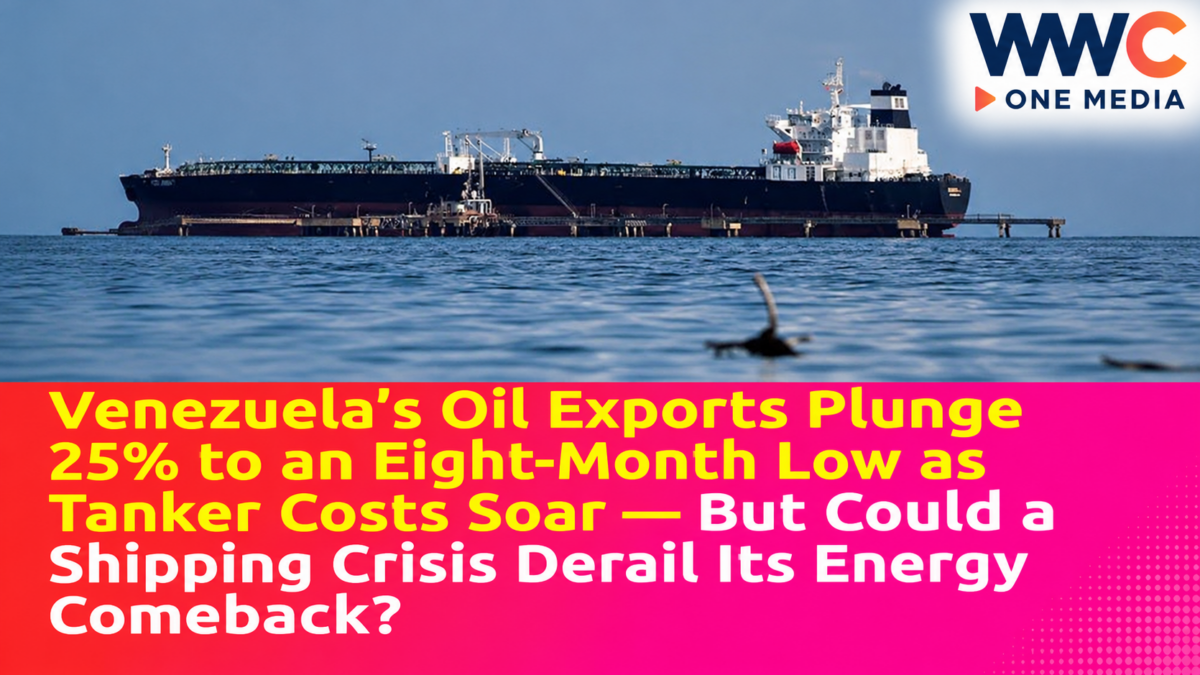
CARACAS, VENEZUELA / MANILA — November 3, 2026. Venezuela’s oil recovery has encountered a major obstacle after crude shipments plunged 25% in October, falling to their lowest level in eight months as soaring tanker costs, weaker refinery demand and difficult pricing negotiations disrupted exports.
According to Bloomberg’s November 2 report, tankers loaded approximately 809,000 barrels of Venezuelan crude per day in October, compared with roughly 1.08 million barrels per day in September.
The decline represents a significant reversal for a country attempting to rebuild its oil industry and capitalize on renewed access to international energy markets.
But the latest disruption is not primarily about a sudden collapse in crude production.
Instead, Venezuela is discovering that producing oil and delivering it profitably to overseas customers are two increasingly different challenges.
Global tanker freight costs have surged amid military conflict, longer shipping routes and restrictions affecting vessel availability.
At the beginning of October, the cost of transporting Venezuelan crude to major US Gulf Coast buyers reached approximately $13.85 per barrel, according to freight data cited by Bloomberg.
Although rates subsequently eased to about $9.41 per barrel, they remained historically elevated.
Meanwhile, seasonal refinery maintenance reduced buying interest in the United States, Europe and Asia.
The result was a sharp fall in crude loadings despite Venezuela’s efforts to expand production and attract foreign investment.
As Venezuela struggles to ship its oil at competitive prices, could rising freight costs undermine the country’s energy revival — and give rival producers an unexpected advantage?
Venezuelan Oil Shipments Hit an Eight-Month Low
Bloomberg reported that crude loadings fell to approximately 809,000 barrels per day during October.
The calculation draws on shipping reports and US customs data.
The decline followed weakness in September, when Reuters reported Venezuelan oil exports of approximately 1.08 million barrels per day, down nearly 9% from August.
The latest October figures suggest that the slowdown became substantially more severe.
But export loadings should not be confused with crude production.
A producer can continue pumping oil while shipments fall because buyers delay purchases, loading terminals become congested or available storage fills.
That distinction is important for understanding Venezuela’s difficulties.
The country’s export system faces logistical and commercial problems that could persist even if oilfields remain operational.
For state-owned Petróleos de Venezuela SA, commonly known as PDVSA, the challenge is converting produced crude into reliable international sales.
Why Tanker Freight Costs Are Hurting Venezuela
The most immediate problem is the cost of transporting crude to buyers.
Oil cargoes are priced according to their quality, delivery location and prevailing market conditions.
The cost of moving a barrel from an export terminal to a refinery can significantly influence whether a transaction is commercially attractive.
Bloomberg reported that freight rates for Aframax tankers carrying Venezuelan crude to major customers in Texas, Louisiana and Mississippi reached approximately $13.85 per barrel in early October.
Rates later declined to $9.41 per barrel.
Even at the lower level, shipping remained expensive by historical standards.
Aframax tankers are commonly used to move crude between ports where very large tankers may be impractical.
Their availability and charter costs can influence deliveries to the US Gulf Coast.
The freight surge has reduced the attractiveness of Venezuelan oil relative to competing crude grades.
For buyers, a discounted purchase price means little if transportation costs erase the savings.
PDVSA Resists Deeper Discounts
One of the main commercial disputes involves the price Venezuelan exporters are willing to accept.
Bloomberg reported that PDVSA resisted lowering crude prices enough to compensate buyers for higher freight costs.
Earlier reporting by Reuters identified global trading companies Vitol and Trafigura among the firms seeking steeper discounts.
These companies have played important roles in marketing Venezuelan crude under the country’s changing commercial arrangements.
Traders must consider purchase prices, tanker charter expenses, financing, insurance and potential resale values.
If delivered Venezuelan crude becomes more expensive than competing supplies, buyers may reduce orders or seek alternative sources.
Bloomberg previously reported that Venezuelan oil was offered at a discount of approximately $14 per barrel to Brent for some October-loading cargoes.
But even discounted crude could become less attractive after freight expenses.
That helps explain why a rise in shipping costs can disrupt oil exports without an equivalent decline in global energy demand.
Canada Could Benefit From Venezuela’s Shipping Problems
Canadian oil producers are among the potential beneficiaries of Venezuela’s difficulties.
Both countries supply heavy crude used by refineries configured to process denser, higher-sulfur oil.
Canada benefits from established pipeline connections to the United States.
For some Gulf Coast refiners, Canadian supplies may become more competitive when ocean freight costs rise.
Bloomberg’s earlier reporting indicated that the delivered cost of some Venezuelan crude had become less attractive than competing Canadian barrels.
However, refinery purchasing decisions depend on more than transportation prices.
Crude quality, pipeline access, contractual commitments and refinery equipment all matter.
A particular refinery cannot necessarily replace every Venezuelan barrel with Canadian oil.
Nevertheless, higher tanker costs can strengthen the competitive position of producers with more reliable or less expensive delivery routes.
US Demand for Venezuelan Crude Weakens
Another factor behind October’s decline was lower US refinery demand.
Bloomberg reported that US demand for Venezuelan crude fell 27% from the preceding month.
Seasonal refinery maintenance played a significant role.
Refineries periodically reduce operations to inspect equipment, perform repairs and prepare for changes in fuel demand.
When processing units are unavailable, operators may temporarily purchase less crude.
The slowdown also followed refinery disruptions that had previously complicated buying patterns.
September’s figures had shown a different trend.
Reuters reported that shipments to the United States increased to approximately 629,000 barrels per day in September from 553,000 in August.
The October decline therefore represents a reversal in US buying interest, rather than evidence that American refiners had been continuously reducing Venezuelan purchases throughout the year.
China’s Absence Adds Another Challenge
The change in Venezuela’s export destinations is also important.
Bloomberg reported that China had gone 10 consecutive months without purchasing Venezuelan crude.
That development reflects the dramatic restructuring of Venezuela’s oil trade following political and commercial changes earlier in 2026.
China was previously a major destination for Venezuelan barrels.
The United States, India and other markets have since assumed greater importance.
But losing access to a large buyer can reduce exporters’ commercial flexibility.
When remaining customers demand deeper discounts or postpone purchases, sellers have fewer alternatives.
India and Europe also reduced their Venezuelan purchases in September, according to Reuters.
Whether those markets increase buying again will depend on freight costs, refinery demand and the competitiveness of Venezuelan crude.
Venezuela’s Energy Revival Faces an Infrastructure Test
The shipping downturn comes as international energy companies examine opportunities to expand Venezuelan production.
Chevron has outlined significant investment plans aimed at increasing output over the coming years.
WWC ONE MEDIA previously examined the company’s strategy in Chevron Makes US$7 Billion Bet on Venezuela Oil as US Pushes Major Energy Expansion.
The report discussed Chevron’s planned investment of more than $7 billion over five years and its ambition to increase production substantially.
Those investments are important because Venezuela possesses enormous oil resources but faces longstanding infrastructure challenges.
Oilfields require drilling equipment, electricity, processing facilities, pipelines, storage tanks and trained workers.
Even if production expands, the country must also maintain functioning export terminals and secure reliable transportation.
Reuters previously reported that congestion at PDVSA terminals and crude-quality issues contributed to shipping delays during August.
The October decline demonstrates why improving production alone will not guarantee stronger export revenue.
Global Conflict Is Making Oil More Expensive to Transport
Venezuela’s difficulties are part of a wider disruption in international energy logistics.
Military conflict affecting the Middle East and Russia has altered shipping routes and increased uncertainty for tanker operators.
Some vessels have been forced to travel longer distances.
Insurance costs have risen in dangerous areas.
Sanctions enforcement has also reduced the availability of certain vessels for international trade.
WWC ONE MEDIA examined the problem in Saudi Aramco Warns Global Oil Stocks Could Take Two Years to Rebuild — But Hormuz Is Only Part of the Crisis.
That report explored why tanker availability and transport costs have become increasingly important to global energy security.
A country may have oil available for export, but buyers still need suitable ships, insurance coverage and dependable routes.
The disruption can raise delivered fuel costs even when crude remains physically available.
For Venezuela, that problem is especially serious because its export strategy depends heavily on maritime transport.
The Middle East’s Shipping Crisis Affects the Americas
The consequences of disrupted shipping are not limited to producers located near conflict zones.
When tankers are diverted to longer journeys, fewer vessels may be available for other routes.
Shipowners can demand higher charter rates.
Traders may need to pay additional costs or wait longer for vessels.
WWC ONE MEDIA previously examined an example in Saudi Arabia Is Offering More Oil to Asia Through Oman — But the Crude Still Has to Survive the Strait of Hormuz First.
The article illustrated how alternative shipping arrangements can add complexity without eliminating exposure to the original transport bottleneck.
Venezuela faces a different geographic problem.
Its crude is not exported through the Strait of Hormuz.
But global tanker markets are interconnected.
Disruptions elsewhere can increase the cost of hiring vessels for Venezuelan routes.
This is why a conflict thousands of kilometers away can influence oil sales from South America to the United States.
Expensive Freight Could Delay Venezuela’s Recovery
The latest export decline creates uncertainty for Venezuela’s wider oil-recovery strategy.
The country is attempting to attract capital, rebuild infrastructure and increase production.
But investors need confidence that additional crude can be sold profitably.
High shipping costs can reduce the amount exporters receive after transportation expenses.
Weak refinery demand can delay shipments.
Port congestion can increase operating costs.
And uncertainty about future sanctions or commercial arrangements can complicate long-term investment planning.
These challenges do not prove that Venezuela’s recovery will fail.
Freight rates could decline, refinery demand could recover and export logistics could improve.
However, the October figures show that the recovery depends on more than the number of barrels produced.
It also requires a reliable system for moving those barrels to paying customers.
What This Means for Global Oil Prices
A reduction in Venezuelan exports can affect the availability of certain crude grades, particularly the heavier oil used by specialized refineries.
But it does not automatically mean global crude prices will increase by a particular amount.
International prices depend on production, inventories, refinery demand, shipping availability and geopolitical developments across numerous countries.
The current market is particularly complex.
Some regions face shortages or delivery disruptions, while others have crude available but struggle to transport it economically.
Reuters has described a growing imbalance in heavy-crude trade across the Americas.
That imbalance can create situations in which physical oil is available but relatively expensive to deliver.
For refiners, delivered costs may matter more than headline benchmark prices.
Could Higher Shipping Costs Affect Philippine Fuel Prices?
The Philippines is heavily dependent on imported petroleum products.
That makes the country vulnerable to global energy-price and freight-cost movements.
Higher transportation costs can affect the price of crude and refined fuel delivered to international markets.
WWC ONE MEDIA previously examined the implications in ANZ Raises Oil Forecast to $105 as Iran War Tightens Supply — But Could Brent Surge Beyond $120 and Trigger Another Fuel Shock?.
The article explained why oil-price volatility, tanker risks and transport bottlenecks matter to Asian energy importers.
However, Venezuela’s October export decline does not establish that Philippine pump prices will rise immediately.
Local gasoline and diesel prices depend on regional refined-product benchmarks, the peso-dollar exchange rate, taxes, distribution costs and domestic pricing decisions.
The relevance to the Philippines is the broader warning about shipping costs and energy security.
Even countries far from major oil conflicts can experience economic pressure when international transport becomes more expensive.
What Happens Next for Venezuelan Oil Exports?
Several developments will determine whether exports recover during November.
The first is tanker freight pricing.
A sustained decline in shipping costs could make Venezuelan crude more competitive.
The second is demand from US Gulf Coast refineries.
Purchases may improve as seasonal maintenance ends and facilities return to normal operations.
The third is PDVSA’s pricing strategy.
If the company offers discounts sufficient to offset freight costs, traders may become more willing to arrange cargoes.
The fourth is the availability of alternative buyers in India, Europe and other markets.
Finally, the condition of Venezuela’s export terminals and domestic production infrastructure will remain important.
The country must ensure that physical shipments can keep pace with its ambitions to increase output.
The Bigger Question: Can Venezuela Produce More Oil Than It Can Sell?
Venezuela’s October export figures reveal a major weakness in its energy recovery.
The country’s crude loadings fell to approximately 809,000 barrels per day, a 25% decline from September and the lowest level in eight months.
Soaring tanker freight costs made some sales less attractive.
Refinery maintenance reduced demand.
And commercial disagreements over discounts complicated negotiations between PDVSA and major traders.
Meanwhile, Venezuela continues seeking investment to expand its oil industry.
That creates a difficult contradiction.
Increasing production may support economic growth, but additional barrels have limited value if exporters cannot move them to buyers at competitive prices.
As Venezuela attempts to rebuild its petroleum industry, will falling shipping costs and recovering refinery demand revive exports — or could expensive tankers, limited buyers and aging infrastructure derail one of the world’s most closely watched oil comebacks?