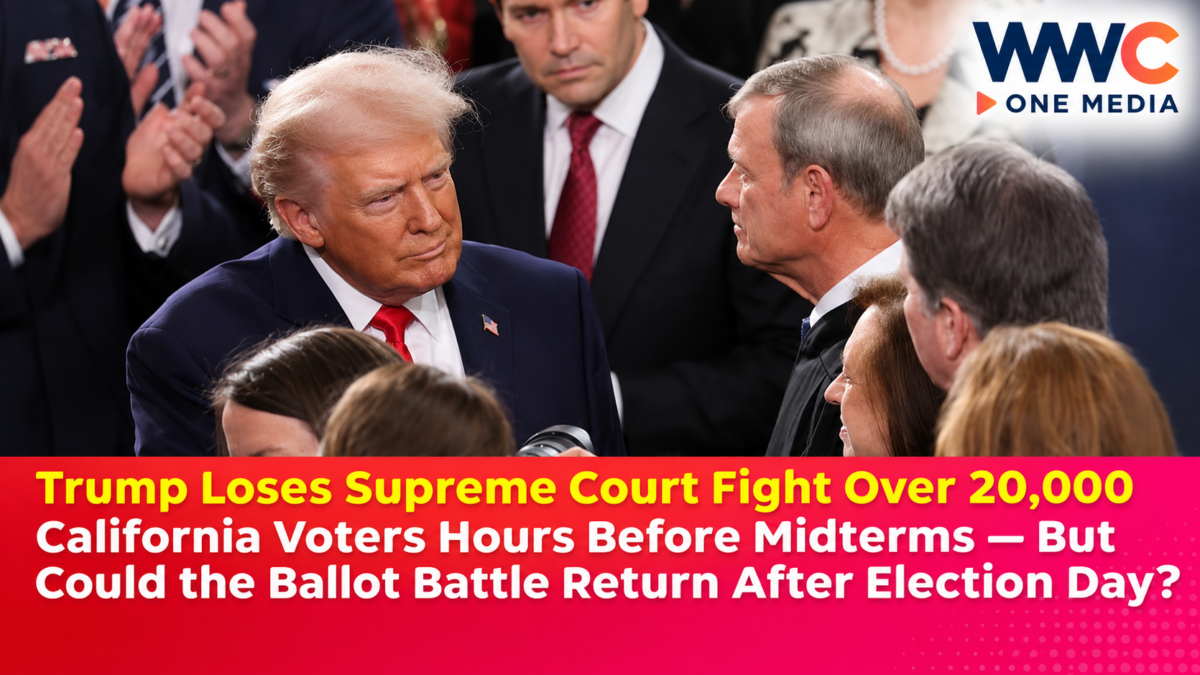
WASHINGTON / LOS ANGELES — November 3, 2026. President Donald Trump’s administration suffered a major legal setback on the eve of the US midterm elections after the Supreme Court rejected an emergency Justice Department request to force California to separate mail-in ballots linked to more than 20,000 registered voters whose citizenship status federal officials had questioned.
The decision, issued November 2, allows California election officials to continue processing ballots under existing state procedures just hours before voters head to the polls in an election that could determine control of Congress.
According to Reuters and the Associated Press, the Supreme Court issued a brief order denying the administration’s request without providing an explanation or recording any public dissent.
The ruling follows two earlier defeats for the Justice Department in federal courts, where judges warned that imposing new ballot-processing requirements immediately before Election Day could disrupt the vote count and prevent eligible Americans from exercising their constitutional rights.
But the legal battle is not necessarily over.
The Justice Department continues to argue that California’s voter rolls include individuals who may not be US citizens, while state officials maintain that the federal government’s evidence is unreliable.
With control of Congress at stake and millions of Americans already voting, could the Supreme Court’s decision protect the election from last-minute disruption — or set the stage for another political and legal showdown after the ballots are counted?
Supreme Court Rejects Trump’s Emergency Ballot Request
The Trump administration sought emergency intervention from the Supreme Court after failing to persuade lower courts to require California to segregate disputed mail ballots.
Solicitor General D. John Sauer argued that federal authorities had identified more than 20,000 individuals who appeared to be registered California voters and whose citizenship status raised concerns.
The Justice Department wanted ballots associated with those individuals kept separate from other votes until election officials could verify their eligibility.
Administration lawyers argued that the requested procedure would protect election integrity and prevent potentially unlawful votes from being counted.
However, the Supreme Court declined to issue the requested emergency order.
The justices offered no explanation for their decision, and no public dissent was recorded.
The order leaves California’s existing ballot-processing rules in place.
Importantly, the decision does not establish that every individual on the Justice Department’s list is eligible to vote.
Nor does it prevent authorities from investigating credible evidence of illegal voting through lawful procedures.
Its immediate significance is that the federal government failed to obtain the extraordinary last-minute intervention it sought.
Why the Justice Department Targeted More Than 20,000 Voter Records
The dispute began when federal officials compiled a list of individuals they suspected might be noncitizens registered to vote in California.
The administration said the list resulted from comparisons involving voter information and federal citizenship or immigration records.
Under federal law, noncitizens generally cannot vote in federal elections.
The Justice Department argued that California should take additional steps to prevent ballots associated with potentially ineligible individuals from being included in the count.
The administration filed its lawsuit against California in October.
But state officials challenged the accuracy of the data.
California argued that the list appeared to include people whose registrations were inactive or canceled, along with individuals who may be US citizens.
Another critical issue involved the distinction between voter registration and actual voting.
Being included in a voter database does not establish that an individual received, returned or successfully cast a ballot.
The administration’s identification of more than 20,000 questionable records therefore should not be presented as proof that 20,000 illegal votes were cast.
Federal Judge Warned of Election Disruption
Before the dispute reached the Supreme Court, US District Judge David O. Carter rejected the administration’s emergency request on October 28.
Carter raised serious concerns about the reliability of the federal government’s method for identifying potentially ineligible voters.
He also emphasized constitutional principles governing the administration of elections.
California argued that identifying and segregating particular ballots so close to Election Day would be exceptionally difficult.
Once mail ballots have been processed and separated from identifying information to protect ballot secrecy, linking individual votes to particular voters may be impossible under established procedures.
Requiring election officials to create a new segregation process could therefore affect the wider counting system.
Carter concluded that the government had not demonstrated sufficient grounds for the extraordinary relief it requested.
The administration appealed.
WWC ONE MEDIA previously examined the lower-court dispute in Trump Loses California Ballot Battle as Court Rejects Bid to Block 20,000 Suspected Voters — But Could the Fight Reach the Supreme Court?.
At the time of that earlier report, the question of Supreme Court intervention remained unresolved.
The November 2 order now answers that immediate question: the justices declined to grant the administration’s emergency request.
Ninth Circuit Also Sided Against the DOJ
The administration’s legal setback followed a divided ruling by the US Court of Appeals for the Ninth Circuit on October 30.
Judges Mark J. Bennett and Gabriel P. Sanchez formed the majority rejecting the Justice Department’s emergency request.
Judge Patrick J. Bumatay dissented.
The majority raised concerns that altering California’s procedures could create serious practical difficulties and risk disenfranchising eligible voters.
The ruling also reflected longstanding legal principles governing the division of authority between state and federal governments.
The US Constitution gives states primary responsibility for establishing the procedures used to administer congressional elections, subject to laws enacted by Congress.
Federal law also protects election integrity and prohibits voting by ineligible noncitizens.
The legal dispute therefore involves two important principles: enforcing voter eligibility requirements and ensuring that eligible voters are not improperly excluded.
The courts did not rule that election integrity is unimportant.
Rather, they concluded that the administration had not justified the particular emergency measures it sought under the circumstances.
California Officials Challenge Federal Citizenship Data
California officials argued that the federal voter list contained significant discrepancies.
In Los Angeles County, an examination of a sample of 200 records found that more than half were associated with canceled or inactive voter registrations.
County officials also reported that a substantial proportion of individuals who provided birthplace information identified the United States as their birthplace.
Federal immigration officials disputed aspects of those findings and maintained that their review supported concerns about citizenship status.
That disagreement highlights the importance of distinguishing preliminary database matches from verified individual findings.
Records can contain outdated information, inconsistent names, incomplete citizenship details or registration entries that are no longer active.
A person who was previously a noncitizen may also have subsequently become a naturalized American citizen.
For that reason, an automated or administrative data match may require further investigation before it can reliably establish eligibility.
The disagreement over the federal list was central to the courts’ concerns about imposing ballot restrictions immediately before the election.
Governor Gavin Newsom Welcomes the Supreme Court Decision
California Governor Gavin Newsom welcomed the Supreme Court’s rejection of the administration’s request.
California Attorney General Rob Bonta had argued that the federal intervention threatened to deprive eligible residents of their voting rights.
State officials maintained that California already has safeguards intended to prevent unlawful voting.
They also emphasized that the state’s election procedures must remain consistent and predictable as voting concludes.
The Trump administration continued defending its position, arguing that federal authorities have a responsibility to enforce laws prohibiting noncitizens from voting in federal elections.
The disagreement reflects a wider political debate about election administration.
Republicans supporting stricter citizenship verification emphasize the importance of preventing unlawful ballots from affecting election outcomes.
Critics of last-minute restrictions emphasize the importance of reliable evidence, due process and protecting legitimate voters from wrongful exclusion.
Both election integrity and access for eligible voters are legitimate public interests.
The legal question is whether the specific measures requested by the administration were justified and lawful.
Record Early Voting Raises the Stakes
The Supreme Court’s decision comes amid exceptionally high early-voting participation in the 2026 midterm elections.
WWC ONE MEDIA previously reported that nearly 48 million Americans had already voted by October 30, surpassing the early-vote total recorded during the entire 2022 midterm election.
Read the related story: Record 48 Million Americans Vote Early in 2026 Midterms as Democrats Surge in Key Battlegrounds — But Could Election Day Change Everything?.
Participation continued increasing during the final days before November 3.
High early-voting turnout creates additional pressure for election administrators because millions of ballots may already be in different stages of processing.
A last-minute court order changing counting procedures could require election offices to modify systems that have been operating for weeks.
This practical concern was central to the California dispute.
But high early turnout does not automatically indicate which political party will win.
Early-voting patterns can vary significantly across states, demographic groups and election cycles.
Trump Administration’s Election Investigations Extend Beyond California
The California case is part of a wider series of disputes involving the Justice Department and election officials.
In Washington state, federal officials also raised questions about hundreds of voter records they believed might involve noncitizens.
State election officials disputed the reliability of the information.
Separately, the Justice Department pursued legal and investigative action involving the Alaska Senate race.
That controversy centered on allegations that a candidate with a name similar to incumbent Republican Senator Dan Sullivan may have entered the race to confuse voters.
WWC ONE MEDIA examined the investigation in DOJ Issues New Subpoenas in Alaska Senate Race as ‘Spoiler Candidate’ Allegations Escalate — Could the Investigation Reshape the Election?.
The existence of subpoenas or allegations does not establish that a crime occurred.
These disputes involve different facts and legal issues, but together they illustrate the heightened scrutiny surrounding US election administration in 2026.
Could the Supreme Court Decision Affect the Midterm Results?
The immediate consequence is that California can continue processing ballots without implementing the emergency segregation procedure requested by the Justice Department.
The decision does not itself determine the outcome of any congressional race.
It also does not establish whether any particular ballot was cast unlawfully.
The administration sought to restrict the processing of ballots associated with a list of voter records, but the actual number of returned ballots affected by that list remains uncertain.
California officials previously indicated that many records did not correspond to active registrations.
The state’s election results will depend on votes lawfully cast and counted under applicable election procedures.
Any subsequent legal challenge would require its own factual and legal basis.
For voters, the important distinction is between allegations about eligibility and verified evidence of improper voting.
Claims about suspicious records should not be treated as certified findings of fraud.
Election Confidence Faces a Broader Test
The California dispute comes amid wider debate about public confidence in American elections.
Social media, partisan commentary and competing interpretations of legal decisions can influence how voters understand the electoral process.
Prediction markets have also become increasingly prominent in election coverage.
WWC ONE MEDIA recently examined research showing that some election prediction contracts can experience large price movements following relatively small trades.
That story concerns financial speculation rather than the legality of California ballots.
Nevertheless, both developments underscore the importance of separating verified election results from allegations, forecasts and other information that has not been independently established.
A prediction-market price is not a certified result.
A disputed voter list is not proof of illegal voting.
And the denial of an emergency court request is not necessarily a final judgment resolving every underlying issue.
Could the Legal Fight Continue After Election Day?
The Supreme Court has declined to intervene on an emergency basis, but the administration may continue pursuing legal arguments through available proceedings.
Federal authorities also retain the ability to investigate credible evidence of unlawful voting within the limits of applicable law.
However, any new challenge would need to satisfy relevant legal standards.
The November 2 decision does not guarantee that another Supreme Court ruling will occur.
Nor does it provide evidence that the election’s final result will be overturned.
For now, California election officials can proceed under the rules already in effect.
The bigger legal issue concerns how far federal authorities can go in demanding changes to state election procedures, especially when voting has already begun.
That question may remain politically contested even after the immediate emergency dispute has ended.
The Bigger Picture: A Supreme Court Defeat With National Implications
The Supreme Court’s decision represents a significant setback for the Trump administration’s attempt to alter California’s mail-ballot processing procedures immediately before the November 3 midterms.
The Justice Department argued that suspected noncitizen voter records justified additional verification before ballots were counted.
California countered that the federal government’s evidence was unreliable and that the proposed intervention could prevent eligible voters from participating.
A federal district court rejected the emergency request.
The Ninth Circuit also refused to grant it.
The Supreme Court has now declined to intervene.
The ruling preserves California’s existing procedures for the immediate election, but it does not settle every legal issue involving citizenship verification and federal election enforcement.
For the country, the dispute illustrates the difficult balance between preventing unlawful voting and protecting the rights of eligible citizens.
Trump’s Justice Department has lost its emergency Supreme Court bid to set aside ballots associated with more than 20,000 California voter records. But as Americans vote in one of the year’s most consequential elections, will the administration accept the court’s decision — or could another legal challenge reignite the ballot battle after Election Day?