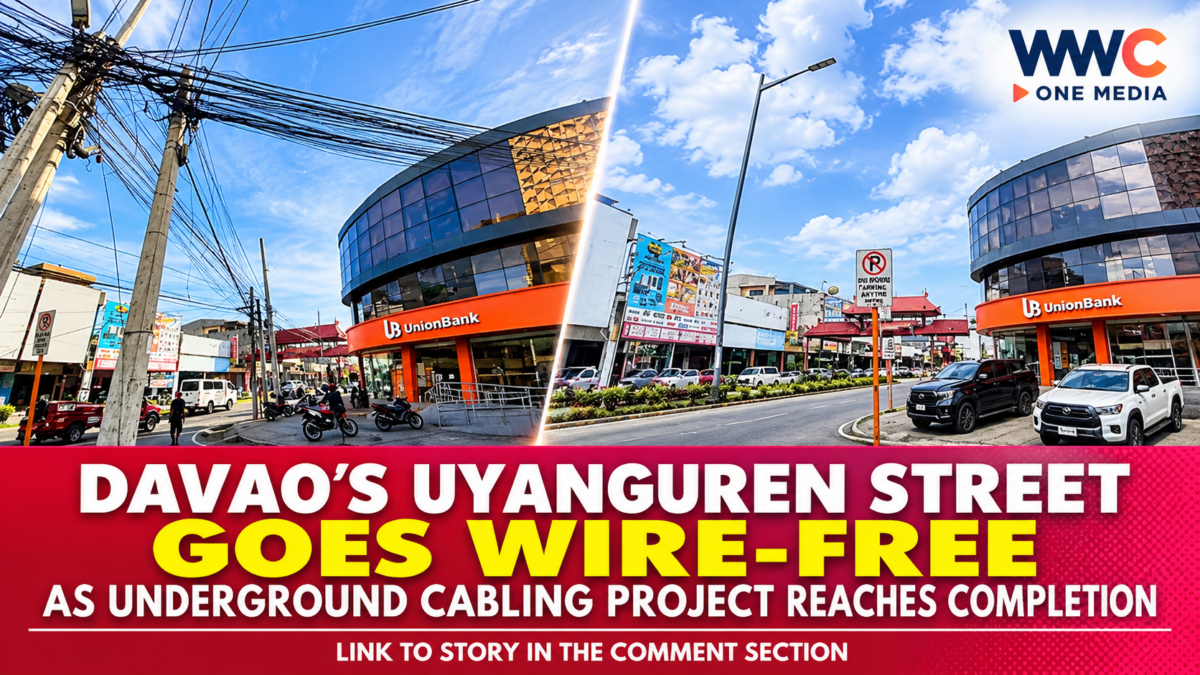
DAVAO CITY, Philippines — Ramon Magsaysay Avenue, popularly known as Uyanguren Street, has undergone a major transformation following the completion of an underground cabling project that removed overhead electrical and telecommunications wires along the busy downtown thoroughfare.
Located within Davao City’s 44-hectare Chinatown, the more than one-kilometer avenue serves as an important residential and commercial area for the city’s Chinese-Filipino community.
The completed project has given the street a cleaner appearance, with utility lines transferred underground and overhead cables and poles removed from the covered sections.
Davao Light and Power Company (DLPC) and the City Government of Davao worked with telecommunications providers, government offices, private organizations, businesses, and residents to carry out the initiative.
Project completed in two phases
The underground cabling project along Ramon Magsaysay Avenue was completed in June 2026.
The first phase covered a 700-meter stretch from the Davao City Central Post Office toward the corner of Chavez Street. It was completed in March 2025.
The second phase, which began in 2023, covered another 700-meter section extending from the corner of Suazo Street to the corner of Quezon Boulevard near Magsaysay Park. This phase was completed in June 2026.
The combined work has helped remove overhead utility lines from the covered sections, changing the appearance of one of Davao City’s recognizable commercial districts.
Public-private partnership drives the project
The initiative required coordination among multiple organizations, including the Davao City Mayor’s Office, City Administration Office, City Engineer’s Office, City Transport and Traffic Management Office, Public Safety and Security Command Center, and the Department of Public Works and Highways-Davao Region.
Davao Light also worked with telecommunications companies and other utility providers, including PLDT Smart, Globe Telecom, Eastern Communications, Converge ICT Solutions, DITO Telecommunity, and the Davao City Water District.
Davao Light President Enriczar Tia said the initiative reflects the long-running partnership between government and private organizations in improving the city’s infrastructure.
He noted that the underground cabling program traces its beginnings to an earlier ordinance in 2014 covering a pilot project around San Pedro Square.
Underground lines expected to improve power reliability
Aside from improving the streetscape, underground cabling is expected to strengthen the reliability of the electrical distribution network.
According to Davao Light, underground electrical lines are less exposed to certain external factors that can cause temporary faults, including lightning surges and objects or birds coming into contact with overhead wires.
The utility said this could help reduce emergency or unscheduled power interruptions over the long term.
The project is also intended to make the area more attractive to residents, visitors, and potential investors while supporting the city’s broader urban modernization efforts.
More Davao streets targeted for underground cabling
The city is looking to extend the underground cabling initiative to other major roads.
Quirino Avenue and C. Bangoy Sr. Street have been identified as the next target areas for the conversion of overhead utility lines into underground systems.
The program is being implemented under City Ordinance No. 0152-17, Series of 2017, which requires telecommunications companies, Davao Light, and other concerned parties to convert overhead lines into underground installations.
Davao Light said other local government units, government agencies, and academic institutions have visited Davao City to learn from its underground cabling efforts.
The completion of the Uyanguren project marks another stage in the city’s infrastructure modernization program. The next challenge will be extending similar improvements to other busy streets while coordinating construction, utility operations, and the needs of affected communities.