NEW YORK / DHAKA / KATHMANDU — October 31, 2026
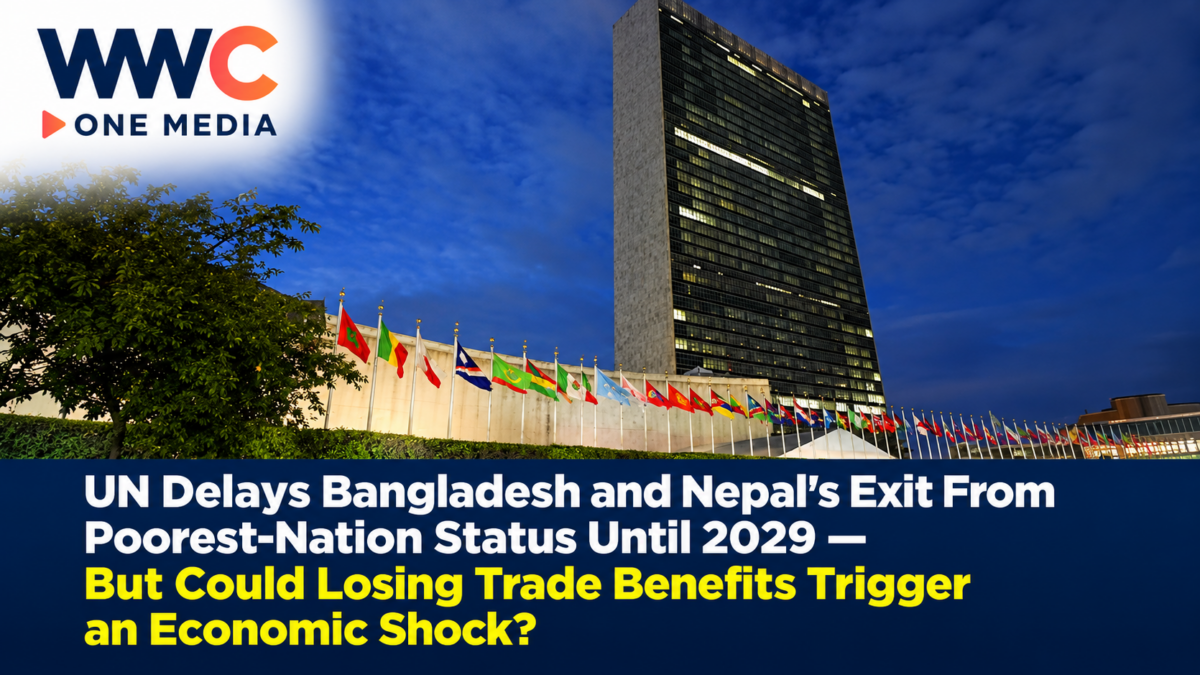
Bangladesh and Nepal have secured a major economic lifeline after the United Nations postponed their graduation from Least Developed Country (LDC) status by three years, giving both South Asian nations more time to protect export industries, strengthen their economies and prepare for the eventual loss of international trade benefits.
The United Nations General Assembly adopted the decision on October 29, 2026, extending the two countries’ graduation deadline from November 24, 2026, to November 24, 2029.
The resolution was adopted without a recorded vote during the General Assembly’s 81st session in New York.
According to Bloomberg, The Kathmandu Post and Bangladesh’s state news agency BSS, the extension follows months of diplomatic efforts by both governments, which warned that global economic instability, energy disruptions, natural disasters and persistent structural weaknesses could undermine their ability to graduate successfully.
The decision is especially significant for Bangladesh’s export-dependent garment industry, which relies heavily on preferential access to international markets.
For Nepal, the additional time provides an opportunity to strengthen trade infrastructure, reduce exposure to climate disasters and prepare for the withdrawal of special development support.
But the UN’s decision is not an unconditional promise of continued assistance.
Bangladesh must demonstrate progress on domestic economic reforms, while Nepal must implement a credible, time-bound transition plan.
The question is no longer whether the countries have earned the right to graduate. It is whether three additional years will be enough to ensure their economies can withstand the financial consequences of leaving the LDC category.
UN Extends Graduation Deadline to November 24, 2029
The UN General Assembly’s decision provides Bangladesh and Nepal with an additional three-year preparatory period.
Both countries had been scheduled to leave the LDC category in November 2026 under an earlier resolution adopted in 2021.
Their original five-year preparation period had already been unusually long, reflecting the disruption caused by the COVID-19 pandemic.
Yet new pressures have emerged since that decision.
Global trade uncertainty, conflicts affecting energy markets, natural disasters and shifting supply chains have complicated economic planning.
Bangladesh and Nepal separately requested extensions under the UN’s enhanced monitoring framework.
The UN Committee for Development Policy assessed their circumstances and concluded that additional preparation time was justified, provided that each government pursued appropriate reforms.
The General Assembly subsequently approved the new deadline.
The decision applies specifically to Bangladesh and Nepal. It should not be interpreted as automatically changing the graduation timetable for every other country preparing to leave the LDC category.
Why Leaving Least Developed Country Status Can Be Financially Difficult
Graduation from the UN’s Least Developed Country category is generally considered a development achievement.
It signals progress in economic conditions, human development or resilience to structural vulnerabilities.
The UN evaluates countries using three principal indicators:
- Gross national income per capita.
- The Human Assets Index, covering aspects of health and education.
- The Economic and Environmental Vulnerability Index.
Countries can qualify for graduation after meeting the relevant criteria and completing the UN review process.
But the LDC classification is also associated with special international support measures.
These can include preferential market access, technical assistance, capacity-building programs and certain forms of development cooperation.
Losing eligibility for these measures can create new challenges for governments and businesses.
The economic impact depends on the country’s export structure, international agreements, institutional capacity and the transition rules applied by individual trading partners.
That is why the difference between qualifying for graduation and being fully prepared for it matters.
Bangladesh’s Garment Industry Receives a Crucial Reprieve
Bangladesh has one of the world’s most important ready-made garment industries.
Its factories produce clothing for international retailers, generating export revenue and employment across the economy.
The sector has benefited from preferential trade arrangements available to LDCs.
One of the most important is duty-free access to the European Union under its Everything But Arms framework, subject to applicable product and origin rules.
The UN extension gives Bangladesh additional time to prepare for changes in these arrangements.
However, exporters should not assume every trade preference automatically disappears the day a country graduates.
The EU, for example, has its own post-graduation transition rules, while other destination markets apply different conditions.
For Bangladesh’s manufacturers, the practical challenge is ensuring they remain competitive when preferential treatment eventually ends or changes.
That could require improving productivity, diversifying exports, negotiating new trade arrangements and reducing production costs.
Without those improvements, exporters may face increased competition from suppliers in countries operating under more favorable tariff agreements.
Energy Disruptions Add Pressure to Bangladesh’s Economy
The graduation delay arrives during a period of major uncertainty in Bangladesh’s energy sector.
Disruptions to traditional liquefied natural gas suppliers have increased pressure on electricity generation and industrial operations.
Reliable energy is particularly important for export-oriented manufacturing, where factory output depends on continuous power supplies.
WWC ONE MEDIA previously examined the issue in Bangladesh Seeks More US LNG as Qatar Supply Crisis Deepens — But Will American Gas Rescue Its Energy-Hungry Economy?.
That report explored Bangladesh’s efforts to diversify energy imports amid disruptions involving Middle Eastern suppliers.
For the garment sector, expensive or unreliable energy can reduce competitiveness even when tariff preferences remain available.
This illustrates why the UN’s extension cannot be treated as a complete economic solution.
Bangladesh must use the additional period to address the structural problems affecting industrial growth.
Bangladesh Faces Conditions on Its Three-Year Extension
The UN Committee for Development Policy concluded that Bangladesh’s request justified consideration of an extension, but it also emphasized the need for significant domestic reform.
The country’s challenges include financial-sector weaknesses, export concentration, macroeconomic pressures and vulnerability to external shocks.
The extension is intended to provide additional time to address those problems.
Bangladesh’s government, led by Prime Minister Tarique Rahman, sought the postponement shortly after taking office in February 2026.
The government argued that additional preparation was necessary to protect the country’s development progress.
Authorities are also pursuing trade negotiations and measures designed to strengthen the competitiveness of domestic industries.
The effectiveness of the extension will depend on whether those efforts deliver measurable improvements before 2029.
Simply delaying the graduation date without strengthening the economy could leave businesses exposed to many of the same problems three years from now.
Nepal’s Economy Faces a Different Set of Risks
For Nepal, the extension addresses challenges that differ substantially from Bangladesh’s.
The Himalayan nation is landlocked and depends heavily on transport connections through neighboring countries.
Its economy is also influenced by tourism, remittances, agriculture and hydropower.
Geography creates additional costs for international trade.
Goods must move through mountain roads, border crossings and transport networks that can be vulnerable to landslides and flooding.
The country’s trade infrastructure has already experienced severe disruption during 2026.
Nepal formally requested an extension in May, citing global uncertainty, economic vulnerability and insufficient readiness for the loss of LDC-related support measures.
The UN Committee for Development Policy supported additional preparation time linked to a clear implementation plan.
The new deadline gives Nepal an opportunity to build stronger foundations for long-term economic growth.
Nepal’s Flood Disasters Reveal Why Resilience Matters
Natural disasters have exposed major weaknesses in Nepal’s infrastructure and economic resilience.
Catastrophic flooding in 2026 damaged communities, roads, bridges and other essential facilities, creating enormous reconstruction requirements.
WWC ONE MEDIA documented the country’s vulnerability in UN Unlocks Historic $20 Million Climate Aid for Nepal After Catastrophic Floods Kill Over 1,400 — But Why Is the Money Still Out of Reach?.
The earlier report examined a UN-backed decision to reserve emergency recovery assistance for Nepal and the gap between available support and estimated reconstruction needs.
Such events show why development cannot be measured by income statistics alone.
A country may demonstrate substantial improvements in education and health while remaining highly exposed to environmental shocks.
When floods destroy transport infrastructure, international trade can become more expensive and less reliable.
That can undermine the competitiveness of businesses already facing significant structural disadvantages.
Nepal’s Trade Routes Remain Vulnerable
Disruptions along the Nepal–China border provide another example.
Flooding and landslides have damaged important trade corridors, affecting the movement of imported goods.
The resulting difficulties have increased transportation costs and disrupted commercial activity.
Nepal’s planned investment in disaster preparedness also includes projects intended to reduce the risks from dangerous glacial lakes.
WWC ONE MEDIA examined those efforts in Nepal Plans to Drain Four Glacial Lakes After Deadly Floods.
The initiative reflects the long-term investment required to protect communities, transportation networks and economic infrastructure.
For Nepal, strengthening resilience is directly connected to readiness for graduation.
An economy facing repeated infrastructure damage may struggle to compete internationally, even after achieving important development milestones.
The new UN deadline offers an opportunity to strengthen these systems before special international support measures change.
Nepal Must Deliver a Time-Bound Transition Plan
Nepal has already adopted a Smooth Transition Strategy.
The plan covers six priority areas: macroeconomic stability, trade and investment, economic transformation, productive capacity, climate and disaster resilience, and social inclusion.
Under the UN’s latest decision, Nepal is expected to adjust and implement a clear, time-bound version of the strategy.
The objective is to ensure that the country is better prepared for the financial consequences of graduation.
That will require more than policy announcements.
Progress will depend on infrastructure investment, improved institutions, productive industries, better trade access and effective disaster-risk management.
Nepal’s preparation may also be influenced by international discussions about climate financing.
WWC ONE MEDIA previously covered these concerns in Nepal Challenges World Leaders at COP31 — Will Climate Justice Finally Mean More Than Promises?.
The report explored Nepal’s efforts to secure stronger international responses to climate-related losses.
Although climate assistance and LDC graduation are separate policy mechanisms, both involve the challenge of financing development in a country exposed to significant environmental risks.
Does the UN Decision Mean Bangladesh and Nepal Have Failed?
No.
The postponement does not mean either country has been stripped of its development achievements.
Both have satisfied the relevant UN graduation criteria.
The issue is whether their economies are sufficiently prepared for the consequences of leaving the category.
The UN’s extension recognizes that economic progress can coexist with major structural vulnerabilities.
Bangladesh has developed a globally significant manufacturing industry but remains exposed to trade and energy shocks.
Nepal has made advances in human development but continues to face geographic and environmental obstacles.
The additional three years are intended to help make graduation sustainable.
That distinction matters because leaving LDC status should reflect durable progress rather than merely meeting a formal deadline.
What Does the Decision Mean for Asian Trade?
The implications extend beyond Bangladesh and Nepal.
International clothing manufacturers, importers and competing export economies may need to consider how trade preferences change after 2029.
Bangladesh’s extended preparatory period can provide additional certainty to some suppliers and international buyers.
However, the precise effect on future tariffs will depend on the rules applied by individual trading partners.
Nepal’s extra preparation time could improve its ability to diversify exports and reduce dependence on vulnerable transport corridors.
For neighboring economies, stronger infrastructure and more reliable trade networks could create additional commercial opportunities.
The decision does not automatically change tariff rates for the Philippines or other countries outside the affected UN classification process.
Nevertheless, it illustrates how trade preferences and development policies can influence competition across international markets.
What Happens Before November 2029?
Both countries face a defined period in which to turn the UN extension into practical progress.
Bangladesh will need to demonstrate meaningful reforms that address economic weaknesses and support export competitiveness.
Nepal will need to implement its revised transition strategy while strengthening institutions and productive capacity.
International development partners and trade organizations will continue to play important roles.
The UN’s Committee for Development Policy will monitor developments through the applicable framework.
The new graduation date is November 24, 2029.
That deadline provides greater planning certainty, but the economic outcomes will depend on decisions made over the next three years.
The Bigger Question: Will Three More Years Be Enough?
The UN has provided Bangladesh and Nepal with a rare opportunity to prepare more carefully for a major development transition.
For Bangladesh, the challenge is ensuring that its garment industry and broader economy can compete after preferential trade treatment changes.
For Nepal, the priority is building an economy resilient enough to withstand climate disasters, infrastructure disruptions and global economic shocks.
Both countries have achieved meaningful development progress.
But neither can rely on the extension alone to guarantee long-term economic stability.
The postponement buys time. It does not automatically deliver growth, stronger institutions or more competitive industries.
The Bottom Line
Bangladesh and Nepal will remain in the UN’s Least Developed Country category until November 24, 2029, after the General Assembly approved a three-year extension on October 29, 2026.
The decision protects additional preparation time and allows the countries to continue benefiting from applicable LDC support measures while they pursue reforms.
For Bangladesh, the greatest immediate concern is protecting export competitiveness and preparing for changes to international trade preferences.
For Nepal, the priorities include trade infrastructure, productive capacity and climate resilience.
The extension represents recognition of their continuing vulnerabilities, not a reversal of their development achievements.
But as both nations receive three more years to prepare for life beyond LDC status, one question will determine whether the UN’s decision becomes a lasting success: Can Bangladesh and Nepal build strong enough economies before 2029 — or will the next deadline expose the same weaknesses that forced this historic postponement?