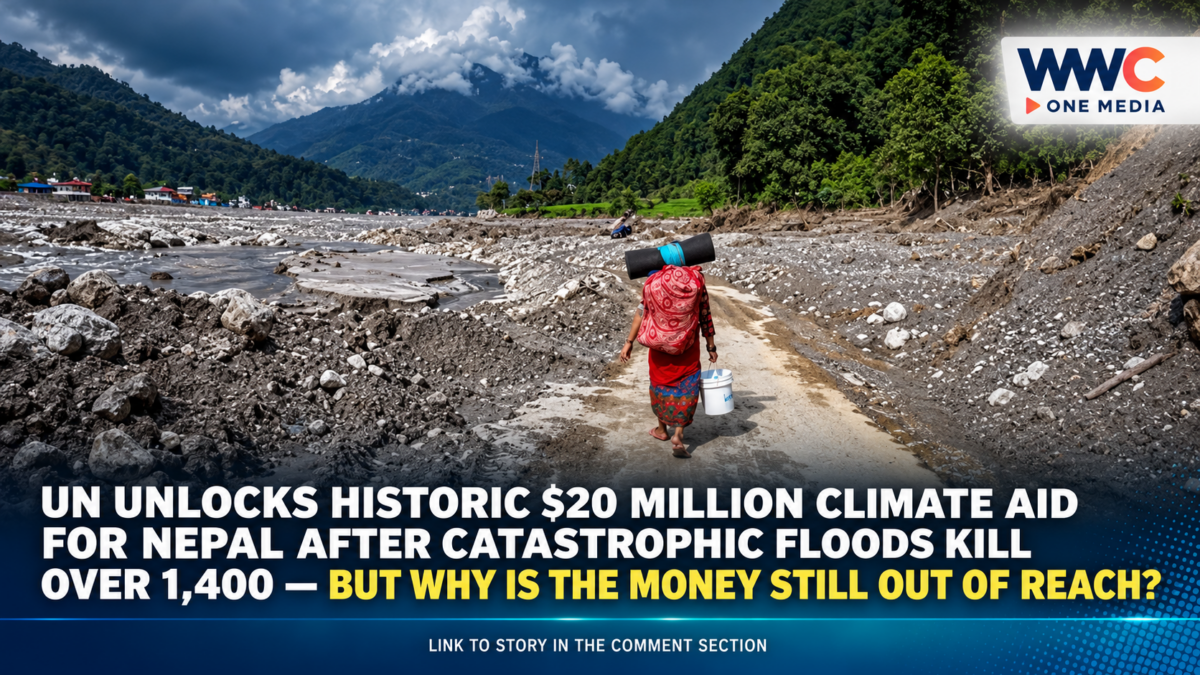
KATHMANDU, NEPAL | October 23, 2026 — The United Nations-backed climate disaster fund has taken a historic step toward delivering $20 million in emergency recovery support to Nepal following catastrophic flooding that killed more than 1,400 people, left thousands missing and devastated communities across the Himalayan nation.
But behind the landmark decision lies a troubling reality: The promised funding represents less than half of one percent of Nepal’s estimated $4.78 billion reconstruction bill, raising urgent questions about whether the international climate finance system can respond fast enough when disaster strikes.
On October 22, the board of the Fund for Responding to Loss and Damage (FRLD) agreed during an extraordinary meeting to reserve $20 million for Nepal, marking the first time the fund has set aside financial support for a country.
The decision is historic, but the money has not yet been released.
Nepal must submit a formal funding proposal for subsequent approval, and no definitive disbursement date has been announced.
A Deadly Himalayan Disaster Leaves Thousands of Families Devastated
The unprecedented flooding began on August 26, 2026, when a massive avalanche of ice and rock triggered destructive flooding across parts of northern Nepal near the border with China’s Tibet region.
The disaster sent enormous volumes of water, mud and debris through vulnerable mountain communities, damaging homes, roads, bridges and essential infrastructure.
According to Reuters, approximately 1,500 people were killed, more than 5,000 remained missing, and around 60,000 people from 15,000 families were affected.
Damage extended beyond residential communities into critical economic infrastructure, including schools and 13 hydropower plants.
Initial estimates placed physical damage and economic losses at approximately $2.7 billion, while broader reconstruction requirements could exceed $4.7 billion.
For a country heavily dependent on mountain infrastructure, hydropower generation and climate-sensitive livelihoods, the destruction presents an immense economic and humanitarian challenge.
Why $20 Million May Not Be Enough
Although the UN-backed fund’s decision has been welcomed internationally, the enormous mismatch between the financial assistance and Nepal’s recovery costs has prompted fresh scrutiny of global climate financing.
The $20 million provision represents approximately 0.42% of the government’s $4.78 billion reconstruction estimate.
That means the country faces a multibillion-dollar rebuilding burden even if the entire allocation is ultimately approved and released.
The $20 million amount is also the maximum that countries can request through a single application under the fund’s current arrangements.
The challenge is therefore not simply how much money is available, but whether the financing structure can adequately respond to disasters that overwhelm the resources of developing economies.
First Historic Test for the UN Climate Loss and Damage Fund
The Fund for Responding to Loss and Damage emerged from years of difficult international negotiations over the financial consequences of climate change.
Developing countries pushed for a mechanism to assist nations suffering devastating impacts despite contributing comparatively little to historical greenhouse gas emissions.
The breakthrough came during the UN climate conferences in 2022 and 2023, when governments agreed to establish and operationalize the mechanism.
However, the fund has struggled to move from international commitments to actual financial assistance.
According to AFP, wealthy countries had pledged approximately $822 million to the fund by October 2026, but it had not yet disbursed money.
Nepal’s disaster has become a critical test of whether the international system can turn climate diplomacy into meaningful recovery support.
Developed and Developing Nations Clash Over Future Climate Payments
The decision also revealed disagreements over how the fund should respond to future disasters.
Representatives of some developed countries cautioned that the Nepal allocation should be treated as an exceptional decision rather than an automatic precedent for future emergency funding.
Developing-country representatives resisted attempts to narrow the significance of the decision, arguing that Nepal’s experience should help shape a more responsive system.
The disagreement highlights a fundamental issue in international climate negotiations: Should vulnerable countries receive rapid financial support following climate-related catastrophes, or should funding remain dependent on lengthy assessments and approval procedures?
For nations facing increasing climate risks, delayed assistance could deepen the human and economic consequences of disaster.
UN Launches Separate $49.6 Million Humanitarian Appeal
Beyond the loss and damage fund, the United Nations and humanitarian partners launched a separate $49.6 million emergency appeal on September 4 to support relief operations in flood-affected communities.
That appeal aimed to reach more than 84,000 people with humanitarian assistance, including support for urgent needs as winter approached in high-altitude areas.
The United States also announced $31 million in additional flood recovery assistance in September.
These funding initiatives address related but distinct needs. Humanitarian appeals focus on immediate survival and relief, while the loss and damage fund is intended to support countries coping with the broader consequences of climate-related harm.
Neither initiative, by itself, can meet Nepal’s estimated multibillion-dollar recovery requirements.
Why Nepal’s Disaster Matters to the Rest of Asia
Nepal’s catastrophe carries lessons far beyond its borders.
Across Asia, communities face growing exposure to extreme rainfall, floods, landslides and other climate hazards. Mountain regions face additional risks associated with glaciers, unstable slopes and changing environmental conditions.
The Himalayan disaster illustrates how a sudden event can destroy essential infrastructure, displace thousands and overwhelm national resources.
It also raises questions relevant to the Philippines and other disaster-prone Asian countries, where typhoons, flooding and landslides regularly create enormous demands for relief and reconstruction.
The handling of Nepal’s application could influence international expectations for how quickly climate-related financial support should reach vulnerable nations after future catastrophes.
Climate Justice Debate Intensifies
Supporters of stronger international climate financing argue that countries historically responsible for the largest share of greenhouse gas emissions should shoulder greater financial responsibility for climate-related losses.
Others emphasize that the loss and damage fund must establish reliable, transparent and financially sustainable procedures rather than attempt to replace existing humanitarian response systems.
Nepal’s case brings these arguments into sharper focus.
The board’s decision demonstrates that the fund can respond to a catastrophic event through an extraordinary process. But it has not yet demonstrated how quickly money can move from a board commitment to communities rebuilding their lives.
What Happens Next?
Nepal must now prepare and submit its funding proposal, after which the fund’s board will decide whether to give final approval.
Even if the application proceeds successfully, the allocation will cover only a small fraction of the country’s estimated reconstruction needs.
Further international funding, domestic resources and long-term recovery investments will be necessary.
The bigger question is no longer whether the international community recognizes Nepal’s climate disaster. It is whether that recognition can translate into timely, substantial assistance before vulnerable communities suffer even greater losses.
For Nepal, $20 million represents a historic breakthrough. For the global climate finance system, the real test is only beginning.