WARSAW, Poland — October 31, 2026
Poland’s political and judicial crisis has reached a dramatic new stage after a disputed attempt to suspend the country’s top constitutional court officials sparked protests, a heavy police presence and accusations of an attempted takeover of one of Europe’s most important judicial institutions.
The confrontation became so serious that President Karol Nawrocki cut short an official journey to Senegal and ordered his aircraft to return to Poland.
At the center of the dispute is the Constitutional Tribunal, where an October 30 announcement declared that court president Bogdan Święczkowski and deputy president Bartłomiej Sochański had been suspended from their duties.
Judge Anna Korwin-Piotrowska, whose own judicial appointment is contested, announced that she was assuming provisional leadership.
However, Święczkowski and opposition leaders rejected the move, maintaining that the court’s existing leadership remains legally in office.
According to Bloomberg, Reuters and the Associated Press, the events represent a major escalation in the long-running confrontation between Prime Minister Donald Tusk’s pro-European governing coalition and the opposition Law and Justice party, known as PiS.
The extraordinary showdown raises a question reaching far beyond the courtroom: Is Poland finally correcting years of disputed judicial reforms, or could the struggle to restore the rule of law create a deeper constitutional crisis?
Poland’s Top Court Becomes the Center of a Political Power Struggle
The crisis erupted on Friday evening when a statement appeared on the Constitutional Tribunal’s website announcing that Święczkowski and Sochański were being suspended.
The announcement followed months of disagreements over whether judges appointed by Poland’s current parliamentary majority should be allowed to perform their duties.
Korwin-Piotrowska said she had ordered the suspensions and would temporarily lead the institution.
The existing court leadership challenged her authority, claiming the tribunal’s website had been taken over unlawfully.
That created an extraordinary situation: competing sides were claiming the legal right to direct the same constitutional institution.
The dispute is not simply about which judge occupies the court’s highest office.
It concerns the legitimacy of judicial appointments, the limits of executive power and the authority of institutions responsible for interpreting Poland’s constitution.
President Nawrocki Abandons Senegal Trip as Tensions Escalate
The developments prompted an immediate response from President Karol Nawrocki.
Nawrocki, who has political ties to the opposition Law and Justice camp, was traveling to Senegal when the crisis intensified.
He announced that he was cutting short his journey and returning to Poland.
His decision highlighted the seriousness of the conflict between the presidency and Tusk’s government.
Nawrocki has previously opposed efforts to change the composition of judicial institutions, including refusing to administer oaths to several judges selected by parliament.
The government argues that these refusals have contributed to the paralysis of the Constitutional Tribunal.
The president’s supporters maintain that his actions are necessary to protect constitutional procedures.
Those competing interpretations have made judicial reform one of the most contentious issues in Polish politics.
Riot Police Secure Court as Three Protesters Are Detained
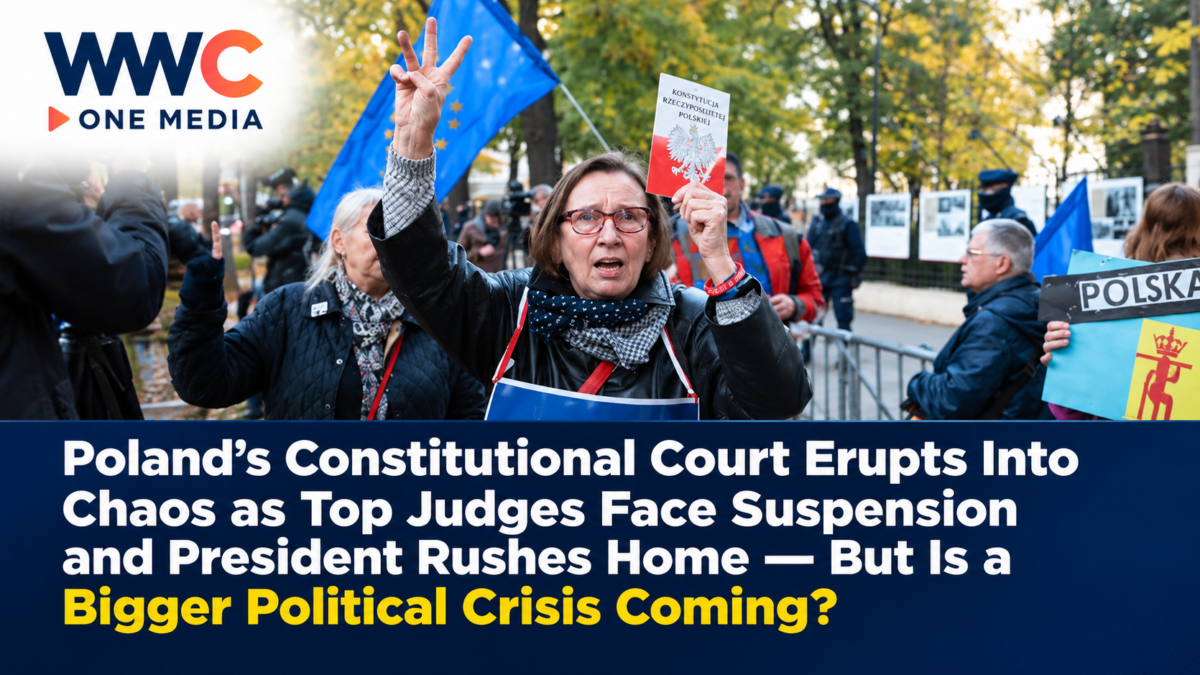
As the confrontation unfolded, opposition supporters gathered outside the Constitutional Tribunal in Warsaw.
Leading Law and Justice politicians, including Jarosław Kaczyński, joined the protests.
Police reported that demonstrators breached security barriers and that objects were thrown at officers.
Three people were detained.
The police intervention became another source of controversy, with opposition politicians describing the events as an attack on the judiciary.
Police said their presence was connected to security incidents and the need to maintain public order.
The deployment demonstrated how a legal disagreement had become an immediate public-security issue.
However, the protests and police action do not establish that a political coup occurred.
That description remains an allegation made by the opposition and the disputed court leadership.
Why Tusk Says Judicial Reform Cannot Wait
Prime Minister Donald Tusk has defended his coalition’s efforts to change Poland’s judicial institutions.
His government came to power in December 2023 promising to restore judicial independence after eight years of Law and Justice rule.
During that period, PiS introduced controversial changes to judicial appointments and oversight.
European Union institutions criticized several measures, arguing that they threatened the independence of the courts.
The disputes contributed to legal proceedings and restrictions involving European funding.
Tusk’s coalition argues that reform is essential to bring Poland’s legal system back into compliance with constitutional and European standards.
But restoring judicial independence is proving difficult because the government and presidency disagree over the legitimacy of existing judicial appointments.
The result is a system in which rival political camps challenge not only each other’s decisions but also the authority of the institutions making them.
The Legal Problem: Can the Court’s President Actually Be Suspended?
One of the most important questions concerns the legal basis for suspending Święczkowski and Sochański.
Polish legal reporting indicates that the attempted suspensions relied on a provision governing the temporary removal of judges from official duties in certain circumstances.
However, legal experts have questioned whether that provision can be applied to the Constitutional Tribunal.
Constitutional law scholar Marcin Matczak, a critic of earlier PiS judicial reforms, has questioned the legal grounds for the intervention.
This criticism is especially significant because it does not come exclusively from government opponents.
It demonstrates that doubts about the suspension procedure extend beyond party politics.
Justice Minister Waldemar Żurek has also requested the removal of the two officials’ judicial immunity to allow potential criminal proceedings concerning their alleged obstruction of other judges.
Those requests are separate from any determination of criminal guilt.
The officials retain the right to contest the allegations and the legal procedures directed against them.
As of October 31, the available reporting does not establish a final, uncontested legal resolution of the tribunal’s leadership dispute.
How Poland’s Judicial Crisis Began in 2015
The current confrontation has roots in Poland’s political transition more than a decade ago.
When PiS took power in 2015, a dispute developed over appointments to the Constitutional Tribunal.
Critics argued that some new appointments involved positions that had already been lawfully filled.
The controversy expanded into disagreements over how judges should be selected, disciplined and supervised.
Polish authorities under PiS maintained that their reforms were intended to improve accountability.
European courts and institutions found serious problems with aspects of the country’s judicial arrangements.
The Constitutional Tribunal consequently became a central battleground between supporters and opponents of the previous government.
Tusk’s return to power created expectations that these disputes would be resolved.
Instead, resistance from the presidency and existing judicial leadership has prolonged the confrontation.
Why This Crisis Matters to the European Union
Poland is a major member of the European Union and NATO.
Its judicial system must operate within Poland’s constitutional framework and applicable European legal obligations.
The European Union has long argued that judicial independence is necessary to ensure the effective application of EU law.
The current confrontation could therefore attract renewed scrutiny from European institutions.
However, criticism of Poland’s previous judicial arrangements does not automatically establish that every measure adopted by the current government is legally justified.
That is the central challenge facing Tusk.
His administration must demonstrate that its reforms comply with the same rule-of-law standards it says were previously undermined.
Without a legally sustainable process, the struggle over judicial independence could create additional uncertainty rather than resolve it.
Poland’s Political Stability Matters Beyond Its Borders
The constitutional confrontation is unfolding while Poland plays a major role in European security.
Warsaw has been an important supporter of Ukraine and a significant contributor to NATO’s eastern defense.
WWC ONE MEDIA previously examined that role in Poland Joins Ukraine’s Missile Shield Coalition — But Europe’s Bigger Defense Plan Is Only Beginning.
The report described Poland’s participation in an international initiative intended to strengthen European missile defense.
Although the defense initiative is unrelated to the Constitutional Tribunal dispute, it illustrates the country’s strategic importance.
A prolonged institutional confrontation could complicate domestic decision-making, although there is no confirmed evidence that the latest court dispute has disrupted Poland’s NATO responsibilities.
Tusk’s Government Already Faces Mounting Domestic Challenges
The judicial dispute is occurring as Poland’s government manages other domestic security and governance concerns.
Earlier in October, Tusk addressed a series of violent incidents at educational institutions.
WWC ONE MEDIA reported on those developments in Poland’s School Attacks Leave One Dead as PM Blames Online Glorification of Violence.
The incidents are separate from the judicial confrontation.
Nevertheless, they provide context for the political pressures facing Tusk’s administration.
With parliamentary elections expected in 2027, both the government and opposition face increasing incentives to strengthen their public positions.
That political environment could make negotiations over the tribunal’s future more difficult.
Other Countries Have Faced Similar Battles Over Constitutional Authority
Disputes involving constitutional courts are not unique to Poland.
In Indonesia, questions concerning the authority of the Constitutional Court have generated major political controversy.
WWC ONE MEDIA recently covered one case in Indonesia Court Dismisses Challenge to Gibran’s Education Credentials — But Its Ruling Raises a Bigger Legal Question.
The case involved a legal challenge concerning Vice President Gibran Rakabuming Raka’s eligibility and the court’s authority to provide the requested remedy.
Although Indonesia’s legal circumstances are very different, the case illustrates the importance of judicial jurisdiction and public confidence.
The relationship between constitutional courts and government institutions is also relevant in the Philippines.
WWC ONE MEDIA previously examined that relationship in Comelec Ready to Act if Supreme Court Intervenes in BSKE Postponement.
That article concerns election administration rather than judicial leadership, but it highlights how constitutional rulings can affect government decisions.
Across different legal systems, the common issue is whether political institutions respect established judicial procedures even when they disagree with the outcome.
Could Poland’s 2027 Elections Make the Crisis Worse?
Poland’s parliamentary elections are expected in 2027.
The approaching vote could intensify disagreements between Tusk’s coalition and Law and Justice.
Judicial appointments may become a major campaign issue, alongside economic policy, European integration and national security.
A Constitutional Tribunal whose membership and leadership remain disputed could create further uncertainty if politically sensitive cases reach the court.
However, the current confrontation does not establish that the upcoming election will be postponed, canceled or invalidated.
Those outcomes would require separate developments and legal decisions.
The immediate priority is determining who has lawful authority to lead the tribunal and how disputes over judicial appointments should be resolved.
What Happens Next?
Several developments will determine whether Poland can contain the crisis.
The disputed suspensions may face legal challenges, while Justice Minister Żurek’s requests concerning judicial immunity could lead to further proceedings.
President Nawrocki may pursue additional constitutional or political responses.
Tusk’s government must also determine whether its proposed reforms can survive legal scrutiny.
Meanwhile, European institutions and Poland’s legal community will continue assessing the implications for judicial independence.
The most important question is whether the parties can restore the tribunal’s functioning through procedures that command legal legitimacy.
Without that, rival claims to judicial authority could prolong the paralysis.
The Bottom Line: Is Poland Restoring the Rule of Law — or Deepening Its Constitutional Crisis?
Poland’s latest judicial showdown represents one of the most dramatic episodes in its long-running struggle over constitutional authority.
The disputed suspensions of the Constitutional Tribunal’s president and deputy, President Nawrocki’s abrupt return to Warsaw and protests outside the court reveal the depth of the country’s political divisions.
Tusk’s government insists that reform is necessary to restore judicial independence.
The opposition argues that the intervention amounts to an unlawful takeover.
Legal experts have raised serious questions about the suspension procedure itself.
Neither political narrative resolves the underlying legal dispute.
As Poland’s government and opposition battle for control of its most important constitutional court, the defining question is whether the country can restore judicial independence without undermining the constitutional principles it is trying to protect — or whether the confrontation will escalate into an even greater crisis before the 2027 elections.