NEW YORK — October 31, 2026
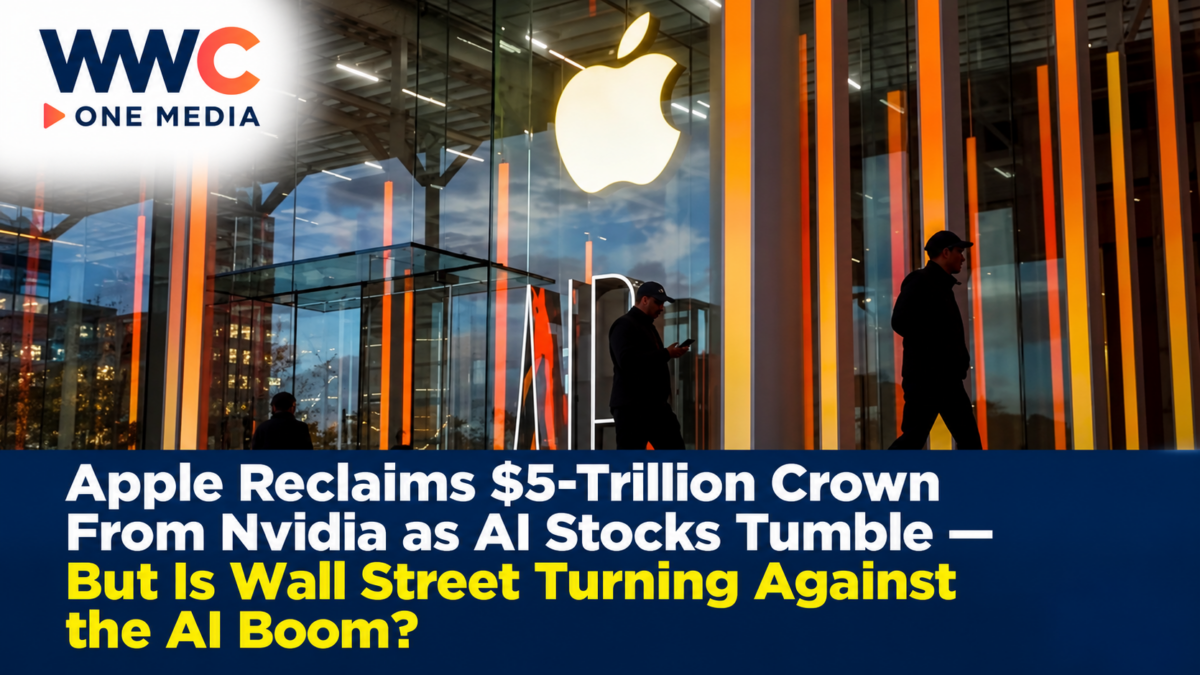
Apple has reclaimed its position as the world’s most valuable publicly traded company, overtaking artificial intelligence chip giant Nvidia in a dramatic Wall Street reshuffle that reveals just how quickly investors are losing patience with the enormous cost of the AI revolution.
The iPhone maker ended Friday’s trading session with a market capitalization of approximately $5.03 trillion, surpassing Nvidia’s $4.93 trillion as a technology-sector selloff punished companies heavily exposed to the artificial intelligence infrastructure boom.
According to Bloomberg’s October 30 report, Apple achieved the milestone despite its own shares declining 1.2% during the session.
Nvidia suffered a significantly steeper fall of 4.2%, allowing Apple to reclaim the top position by approximately $100 billion in market value.
The reversal comes as investors question whether hundreds of billions of dollars being committed to AI data centers, advanced processors and cloud computing infrastructure will generate sufficiently attractive financial returns.
It also marks a striking turnaround for Apple, which had previously faced criticism for moving more cautiously than rivals in developing artificial intelligence.
Now, that caution is increasingly being interpreted as financial discipline.
But as Apple celebrates its return to the top of the corporate valuation rankings, a bigger question is emerging: Has Wall Street finally begun rewarding companies that generate cash instead of those spending enormous sums to dominate the AI race?
Apple Overtakes Nvidia in a $5-Trillion Market Capitalization Showdown
Apple and Nvidia have spent much of 2026 competing for the title of the world’s most valuable publicly traded company.
On October 30, that competition shifted decisively in Apple’s favor.
Apple finished the session with a valuation of approximately $5.03 trillion, while Nvidia closed near $4.93 trillion.
The result gave Apple a lead of roughly $100 billion.
The achievement did not come from an Apple share-price rally on Friday.
Instead, the iPhone maker declined less sharply than Nvidia during a broad technology selloff.
Apple shares fell 1.2%, while Nvidia retreated 4.2%.
This distinction matters because the ranking reflects the relative market valuations of two companies, not an announcement that Apple’s revenue or earnings have suddenly exceeded Nvidia’s.
Market capitalization is calculated by multiplying a company’s share price by its shares outstanding.
It changes continuously as investors buy and sell stocks.
Therefore, Apple’s return to first place represents an important financial-market milestone, but not a permanent guarantee of leadership.
Nvidia’s AI Dominance Faces a New Wall Street Reality Check
Nvidia has been one of the biggest beneficiaries of the generative artificial intelligence boom.
Its graphics processing units power advanced AI applications, including large language models, research systems and enterprise computing platforms.
As demand for AI infrastructure expanded, Nvidia’s revenue and market valuation rose dramatically.
The company became the first publicly traded business to cross the $5 trillion valuation threshold.
Earlier in October, investors were again discussing the possibility that Nvidia could approach $6 trillion.
But the latest selloff demonstrates how quickly market expectations can change.
Investors are increasingly scrutinizing the companies purchasing Nvidia’s processors.
Microsoft, Amazon, Alphabet and Meta have committed vast resources to AI infrastructure.
Their spending has supported demand for specialized chips, servers, networking equipment and data centers.
However, recent earnings announcements have raised questions about the financial burden of those investments.
If major technology companies become more cautious about expanding infrastructure, investors may reassess expectations for future semiconductor demand.
That does not mean Nvidia’s existing business has collapsed.
It means the stock’s valuation remains highly sensitive to assumptions about how long the AI investment cycle will continue growing.
Apple Becomes the Best-Performing Magnificent Seven Stock of 2026
One of the most striking developments is Apple’s relative stock performance.
According to Bloomberg, Apple shares have gained approximately 27% in 2026 through October 30.
That makes Apple the strongest-performing member of the so-called Magnificent Seven technology companies during the period.
Its advance was more than twice Nvidia’s year-to-date gain.
The Magnificent Seven generally refers to Apple, Microsoft, Alphabet, Amazon, Nvidia, Meta and Tesla.
These companies have enormous influence over US stock indexes because of their market capitalizations.
For much of the AI boom, investors favored companies most directly connected to advanced computing.
But 2026 has increasingly demonstrated that exposure to AI spending can create financial risks as well as opportunities.
Apple’s more restrained infrastructure investment strategy has become an advantage in the eyes of investors seeking stronger cash flow and more predictable capital requirements.
The shift suggests that Wall Street is becoming more selective about how it values technology companies.
Apple’s Biggest Advantage May Be What It Has Not Spent
Apple has pursued artificial intelligence differently from several of its largest competitors.
Microsoft, Alphabet, Amazon and Meta are investing heavily in cloud capacity, advanced processors and data-center construction.
Apple has generally avoided committing comparable amounts of capital to building a vast proprietary AI computing infrastructure.
Instead, its strategy emphasizes integrating artificial intelligence into consumer devices, software and services.
This approach does not eliminate Apple’s need for computing resources, partnerships or advanced technology.
But it allows the company to maintain a different capital spending profile.
That distinction has become increasingly important as investors reassess the cost of the AI boom.
According to Bloomberg, Apple is projected to generate approximately $142 billion in free cash flow for fiscal 2026, representing an estimated 38% increase.
Apple’s fiscal year ended in September, and the figure cited in the October 30 report is an analyst projection rather than a newly finalized annual figure.
Free cash flow generally measures the cash a company generates after accounting for capital expenditure.
Strong free cash flow can give businesses greater flexibility to finance investments, repurchase shares, pay dividends or withstand economic uncertainty.
In Apple’s case, investors increasingly view its established consumer ecosystem as a source of financial stability.
Big Tech’s $750-Billion AI Gamble Is Changing Investor Priorities
Apple’s resurgence comes amid growing doubts about the financial economics of artificial intelligence infrastructure.
Some of the world’s largest technology companies are collectively planning enormous investments in data centers, processors, networking equipment and electricity infrastructure.
WWC ONE MEDIA examined the issue in Big Tech’s $750-Billion AI Gamble Shakes Wall Street as Core Businesses Slow — But Will the Spending Ever Pay Off?.
The report detailed how Amazon, Alphabet, Microsoft, Meta and Oracle are expanding infrastructure while investors question the timing of commercial returns.
Estimates of combined spending vary because companies have different fiscal years, accounting methods and investment categories.
Not every dollar of capital expenditure is exclusively attributable to artificial intelligence.
Nevertheless, the size of the investment program is extraordinary.
The market’s concern is straightforward.
Building infrastructure requires money immediately.
Generating enough revenue to justify that infrastructure can take years.
If customer demand falls short of expectations, companies may face lower returns on capital or pressure on cash flow.
Apple’s comparatively restrained spending strategy has made it less directly exposed to this particular financial risk.
Alphabet, Amazon and Meta Face Intensifying Cash Flow Pressure
The October 30 market reversal followed disappointing investor reactions to major technology companies’ financial reports.
Alphabet and Amazon have faced scrutiny over rising infrastructure expenses.
Meta has also encountered increasing concern about its capital commitments.
According to financial reporting reviewed by Bloomberg and Investing.com, Alphabet recorded negative free cash flow of approximately $9.1 billion in the third quarter.
Amazon’s trailing 12-month free cash flow was approximately negative $42.4 billion.
These figures do not mean the companies stopped generating revenue or became insolvent.
They illustrate how substantial investment expenditures can absorb cash produced by otherwise successful businesses.
Meta’s financial position has also drawn attention from credit-rating agencies.
The broader issue is that exceptionally high investment spending can reduce the cash available for other corporate purposes.
For investors, this changes how technology companies are evaluated.
Revenue growth remains important, but capital efficiency is becoming more prominent.
Apple’s valuation recovery suggests shareholders are increasingly willing to reward companies with strong established businesses and less immediate exposure to infrastructure financing risks.
The AI Stock Selloff Has Been Brutal Across Wall Street
The October 30 trading session was part of a broader technology-market correction.
The Nasdaq 100 fell approximately 3.5% during Friday’s trading.
The S&P 500 declined 1.8%, while the Nasdaq Composite lost approximately 2.9%.
Intel plunged 28.6% following disappointing earnings guidance.
Nvidia’s 4.2% decline contributed to the weakness.
According to Bloomberg, the Nasdaq 100 lost approximately 6.7% during October, its worst monthly performance since March 2025.
Some AI infrastructure companies suffered even deeper losses.
CoreWeave and Nebius Group, which provide computing infrastructure and services, declined more than 30% during the month.
Intel lost more than 45% in October, according to Bloomberg’s historical price data.
The scale of these declines illustrates how quickly investor sentiment has changed.
WWC ONE MEDIA previously examined the semiconductor selloff in AI Stocks Plunge 16% Despite Record Profits and $600 Billion Spending Spree — But Is Wall Street’s Biggest Tech Bubble About to Burst?.
The report analyzed how AI-related companies could face stock-market losses even while underlying demand and corporate earnings remained strong.
The distinction remains essential.
A falling stock price does not automatically mean a company’s technology or business model has failed.
It may instead indicate that investors previously assigned a valuation that is no longer supported by their expectations.
Apple Still Faces Its Own Artificial Intelligence Challenges
Apple’s improved stock-market position does not mean its AI strategy is without risks.
The company has faced criticism over delays in introducing more advanced versions of its Siri digital assistant.
It must also compete with companies developing sophisticated generative AI models and consumer assistants.
Apple’s advantages include its large installed base of devices, operating-system integration, consumer loyalty and established services ecosystem.
These assets could help it introduce AI capabilities to hundreds of millions of users without relying on the same business model as a cloud infrastructure provider.
However, success is not guaranteed.
Consumers must find Apple’s AI features useful enough to influence device purchases, services engagement or other business outcomes.
The company also faces privacy expectations that can limit how customer information is used for AI development.
Apple’s approach could prove financially efficient, but it could also create competitive challenges if rivals deliver substantially better AI experiences.
The iPhone Ecosystem Remains Apple’s Financial Foundation
Unlike businesses whose valuations depend heavily on future AI infrastructure demand, Apple already operates a substantial consumer products ecosystem.
Its principal products include iPhones, Mac computers, iPads, Apple Watches and other devices.
It also generates revenue from digital services, subscriptions and platform-related activities.
That combination provides multiple sources of income.
Apple’s services business is particularly important because it can generate recurring revenue from an established customer base.
The company benefits from customers who use multiple Apple products and services together.
This creates switching costs and supports customer retention.
However, Apple is not immune to economic uncertainty.
Higher consumer prices, slower economic growth and competition from other smartphone makers could affect device demand.
The company must also manage regulatory pressure, supply-chain concentration and changing technology requirements.
The current market leadership therefore reflects investor confidence in Apple’s financial characteristics, not an absence of commercial risk.
Nvidia Could Retake First Place if AI Sentiment Recovers
The difference between Apple and Nvidia’s October 30 valuations was approximately $100 billion.
That is substantial in absolute terms but relatively small compared with the companies’ multitrillion-dollar market values.
A modest change in their relative share prices could reverse the ranking.
Nvidia remains one of the most important suppliers of the computing hardware used to develop and operate artificial intelligence.
Demand for AI processors could remain strong even as investors become more selective about stock valuations.
Cloud providers, enterprises and AI developers still require high-performance computing capacity.
If future earnings confirm sustained demand and attractive profitability, Nvidia could regain investor confidence.
Apple, meanwhile, would need to continue demonstrating strong product demand, services growth and disciplined financial management.
The title of world’s most valuable company is therefore likely to remain competitive.
A one-day change in market capitalization should not be interpreted as proof that one business has permanently surpassed the other economically or technologically.
Wall Street’s New Concern: Can AI Spending Be Financed Sustainably?
As major technology companies expand their capital programs, financing has become an increasingly important issue.
Some companies are turning to debt markets to support infrastructure development.
Microsoft recently announced a $25 billion bond offering amid strong institutional investor demand.
WWC ONE MEDIA analyzed the transaction in Microsoft Raises $25 Billion in Massive Bond Sale as AI Spending Explodes — But Is Big Tech’s Debt Gamble Getting Dangerous?.
The report explored how AI investment is changing corporate borrowing requirements.
Debt financing can help a profitable business expand without immediately consuming all its cash reserves.
However, it also creates interest and repayment obligations.
Higher borrowing costs can make some infrastructure projects less attractive.
The crucial consideration is whether the resulting investments can generate returns that justify their financing expenses.
Apple’s comparatively lighter AI infrastructure spending may therefore appeal to investors seeking lower exposure to the financing demands of the sector.
Nevertheless, companies with significant cloud businesses may ultimately generate substantial returns from their own investments.
The market is still determining which approach will be most financially successful.
Asian Semiconductor Companies Feel the Pressure
The selloff in US artificial intelligence shares has also affected Asian technology markets.
Taiwan, South Korea and Japan play central roles in the global semiconductor supply chain.
Their companies manufacture advanced chips, memory products, testing equipment and other components used in AI infrastructure.
WWC ONE MEDIA examined the regional fallout in Asian Chip Stocks Plunge as Amazon’s AI Spending Sparks Funding Fears — But Could the $2.1-Trillion Data Center Boom Be at Risk?.
The report documented losses among major Asian semiconductor companies as investors reassessed American technology spending plans.
The link to Nvidia is particularly important.
Nvidia depends on a global network of manufacturing and technology partners to produce its advanced processors.
Changes in expectations for AI spending can therefore influence investor sentiment toward companies throughout the supply chain.
However, declining semiconductor share prices do not automatically indicate that customer orders have been canceled.
Some companies continue to report strong demand for advanced memory and other specialized AI components.
The long-term impact will depend on actual purchasing commitments, production capacity and future profitability.
Wall Street Analysts Have Also Questioned Apple’s Valuation
Despite its recent stock-market leadership, Apple has not received uniformly positive assessments from investment analysts.
Its share price and growth prospects remain subject to debate.
Earlier in October, some analysts expressed concern about iPhone demand and whether expectations for Apple’s consumer products business had become too optimistic.
WWC ONE MEDIA covered these developments in SpaceX Draws Wall Street Bullish Calls as Apple Gets Downgraded, BlackRock Upgraded — But Analysts See a Bigger Risk Behind the AI Boom.
The report examined divergent analyst recommendations, including a downgrade of Apple.
This provides an important counterpoint to the October 30 valuation milestone.
Being the world’s most valuable company does not necessarily mean a stock is attractively priced.
A company’s share price can reflect substantial expectations for future earnings.
Investors still need to evaluate business fundamentals, valuation, competitive risks and growth prospects.
Apple’s rise above Nvidia therefore represents a change in market preference rather than universal agreement that the company offers the best investment opportunity.
What the Apple–Nvidia Showdown Means for Global Investors
The competition between Apple and Nvidia illustrates two different ways technology companies can create shareholder value.
Nvidia represents the infrastructure side of the AI revolution.
Its business benefits from demand for advanced computing hardware.
Apple represents a consumer technology ecosystem supported by established products, services and customer relationships.
Both companies can benefit from artificial intelligence, but their financial exposure differs.
Nvidia’s growth is more directly linked to spending on AI computing infrastructure.
Apple may benefit through improved devices, software experiences and ecosystem engagement without requiring the same scale of data-center investment.
For investors, the distinction highlights the importance of understanding how a company actually earns money.
Excitement surrounding a new technology does not guarantee attractive returns for every participant.
Likewise, a company investing more cautiously can sometimes outperform peers when market priorities change.
The October 30 reversal is an example of how financial discipline can influence valuations during periods of uncertainty.
What This Means for the Philippines and Southeast Asia
The shifting rankings of America’s largest technology companies have implications for investors and businesses across Asia.
International equity funds and retirement portfolios may hold substantial investments in Apple, Nvidia and other major US technology companies.
Changes in their share prices can influence portfolio values.
The broader semiconductor market also affects Asian electronics manufacturers and exporters.
For the Philippines, demand for electronic components and technology services can be influenced by global computing investment.
However, the country’s technology-related industries do not all have the same exposure to Apple’s consumer devices or Nvidia’s AI processors.
The impact depends on each company’s customers, products and supply-chain relationships.
The recent selloff demonstrates why investors should avoid assuming that a company associated with artificial intelligence will necessarily deliver continuous stock-market gains.
Is Apple Becoming Wall Street’s New Defensive Technology Stock?
Apple’s improved relative performance suggests that some investors increasingly view the company as a comparatively defensive choice among large technology businesses.
That does not make Apple a traditional defensive stock.
Its shares remain exposed to technology-sector volatility, consumer spending and high valuation expectations.
However, its established cash generation and more restrained infrastructure spending provide a different financial profile from companies heavily committed to expanding AI computing capacity.
During periods of uncertainty, investors may favor businesses that offer stronger current cash flow and fewer large future financing requirements.
The October 30 market action is consistent with that preference.
Yet investor sentiment can change quickly.
If the AI investment cycle strengthens or Apple encounters weaker consumer demand, the relative performance of the two companies could reverse.
The Bigger Question: Is Wall Street Redefining What Makes a Technology Giant Valuable?
Apple’s return to the top of the corporate valuation rankings represents more than a competition between two stock tickers.
It reflects a changing debate about how investors should value the artificial intelligence revolution.
For much of the boom, companies promising greater AI infrastructure investment attracted enormous attention.
Their valuations rose as the market anticipated years of rapid growth.
But recent earnings reports have increased scrutiny of cash flow, financing costs and capital efficiency.
Apple’s comparatively measured strategy has become appealing precisely because it avoids some of the financial pressures affecting its peers.
That does not mean the AI infrastructure boom is over.
Nvidia continues to play a central role in advanced computing, and major technology companies remain committed to expanding artificial intelligence capabilities.
But the latest market action suggests that investors are no longer willing to reward spending without asking harder questions about profitability.
The Bottom Line
Apple reclaimed the title of world’s most valuable publicly traded company on October 30, 2026, closing with a market capitalization of approximately $5.03 trillion.
Nvidia fell to second place at approximately $4.93 trillion after suffering a sharper decline during a broad technology-market selloff.
The reversal highlights growing investor concern over the enormous cost of AI infrastructure investment.
Apple’s stronger year-to-date stock performance and projected cash flow have made it comparatively attractive as Wall Street reassesses the risks facing technology giants.
Yet Nvidia remains a major beneficiary of AI computing demand, and the valuation rankings could change again.
As Apple retakes the $5-trillion crown while Nvidia and other AI-related companies face mounting scrutiny, one question now hangs over Silicon Valley: Is Wall Street finally rewarding financial discipline over aggressive AI spending — or could Nvidia’s next wave of growth put the chipmaker back on top?