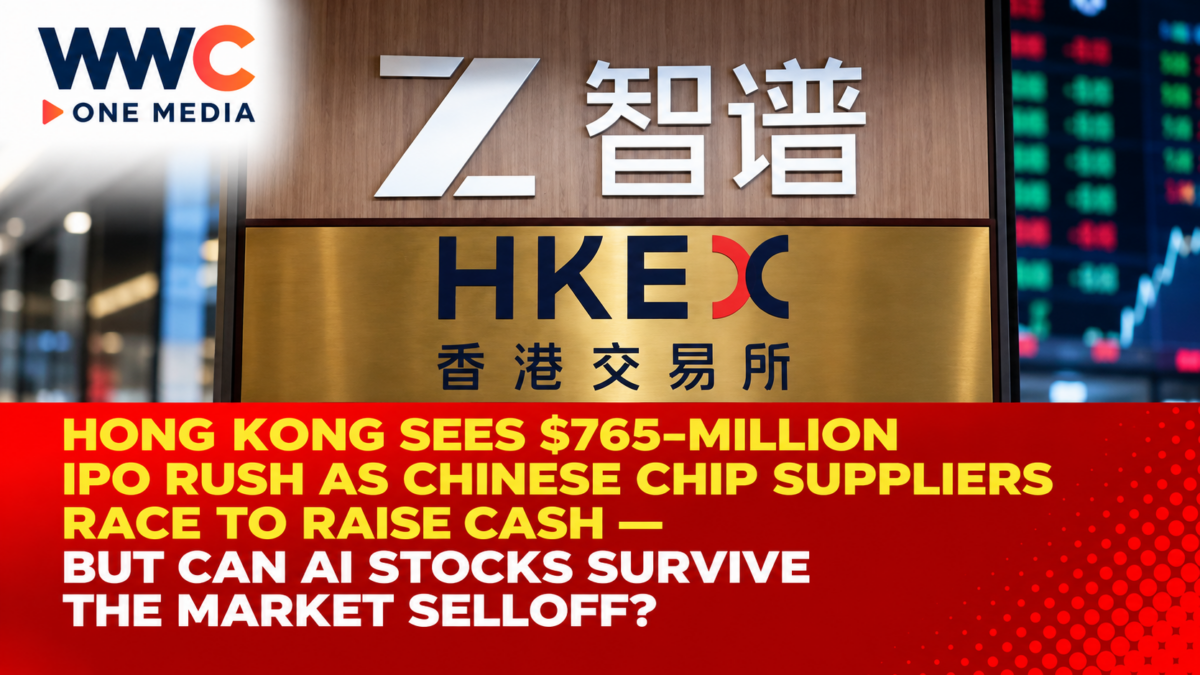
HONG KONG — October 30, 2026. Hong Kong’s stock market is witnessing a late-month rush of new share offerings as six companies seek to raise approximately US$765 million, led by Chinese semiconductor businesses hoping to capitalize on investor interest in artificial intelligence.
The offerings launched on Friday, the final trading day of October, despite a sharp downturn in technology stocks and mounting questions about the sustainability of the global AI investment boom.
Suzhou Denglin Technology, a Chinese developer of graphics processing units used in computing and AI applications, is seeking as much as HK$1.76 billion through its initial public offering.
Hosin Electronics, a company specializing in memory products and related semiconductor technology, is targeting up to HK$1.22 billion.
Four additional companies also launched global share offerings, bringing the combined targeted proceeds to approximately HK$6 billion, or US$765 million.
The transactions demonstrate that Hong Kong remains an important fundraising destination for China’s technology industry.
But they also arrive at a difficult moment.
Recent Hong Kong listings have experienced weak demand and disappointing trading debuts, while AI and semiconductor shares across China and Asia have fallen sharply.
The question is whether the latest offerings will revive confidence in Hong Kong’s IPO market—or become another test of investors’ willingness to finance China’s increasingly expensive technology ambitions.
Six companies launch Hong Kong IPOs in a single day
Hong Kong Exchanges and Clearing’s official disclosure system recorded six global offering documents released on October 30.
The companies include Suzhou Denglin Technology, Hosin Electronics, Jiangsu Xinde Semiconductor Technology, RelyEZ Energy Storage Technology, Sichuan Neautus Traditional Chinese Medicine and Ganzhou Hemay Pharmaceutical.
Their businesses span semiconductors, energy storage, traditional Chinese medicine and pharmaceutical development.
The clustering of offerings highlights how issuers are attempting to access capital before the end of the month despite weaker stock-market conditions.
The approximately US$765-million total represents the amount companies are seeking, based on indicated offering sizes.
It should not be described as cash already received.
Final proceeds will depend on offer prices, investor subscriptions, allotments and any changes to the offering arrangements.
Some share sales could ultimately raise less than initially targeted.
Suzhou Denglin leads the fundraising drive
Suzhou Denglin Technology is the largest company in the October 30 offering group by indicated maximum fundraising.
The semiconductor developer is offering approximately 6.125 million H shares at an indicative price range of HK$231 to HK$288 per share.
At the upper end of that range, the offering could raise approximately HK$1.76 billion.
The company plans to begin trading on November 10 under stock code 9917, subject to the completion of the offering process.
Denglin develops general-purpose graphics processing units, or GPGPUs, designed for enterprise computing and AI-related workloads.
The company is seeking capital as Chinese businesses increase their efforts to develop domestic alternatives to foreign semiconductor technology.
That opportunity is substantial.
But it also involves high research costs, rapid technological change and intense competition.
Investors will need to evaluate whether Denglin can translate growing demand for domestic AI processors into sustainable earnings.
Denglin’s AI chip strategy faces a difficult competitive environment
Denglin’s products target applications including AI inference, enterprise systems, industrial computing and private cloud services.
Inference refers to the process of using a trained artificial-intelligence model to produce outputs or make predictions.
It is increasingly important as AI applications move from research environments into commercial products.
Industry specialist Jon Peddie Research reported that Denglin sold approximately 10,344 processors during the first four months of 2026, generating about US$25.1 million in product revenue.
The company is also developing more advanced products involving high-bandwidth memory.
However, growing revenue does not automatically guarantee profitability.
Chip developers face substantial spending on research, software compatibility, manufacturing arrangements and customer support.
They must also compete against companies with larger engineering resources and established technology ecosystems.
For a newly listed semiconductor business, success will depend on more than investor enthusiasm for AI.
Customers must be convinced that its products offer dependable performance and competitive economics.
Hosin Electronics seeks up to HK$1.22 billion
Hosin Electronics is another important participant in the October 30 offering wave.
The company is offering approximately 14.72 million H shares at a price range of HK$72.29 to HK$82.90.
At the top of the range, the offering would raise approximately HK$1.22 billion.
The company is expected to begin trading on November 12 under stock code 2681, subject to completion of the offering.
Hosin supplies memory-related products and develops technology involving controller chips, firmware and storage solutions.
Its customers include manufacturers of smartphones, tablets, wearables, automobiles and computers.
The company intends to direct proceeds toward memory-product development, controller-chip research, testing capabilities and general corporate purposes.
The listing reflects increasing investor attention to semiconductor supply chains beyond advanced AI processors alone.
Memory technology and controllers are essential components of many modern electronic devices.
But they are exposed to demand cycles, competitive pricing and changes in manufacturing costs.
Chinese semiconductor independence is driving investment
A major theme behind the IPO rush is China’s effort to strengthen its domestic semiconductor industry.
Chinese technology companies face restrictions on access to certain advanced foreign processors and manufacturing technologies.
These restrictions have encouraged greater investment in domestic chip design, production and supporting infrastructure.
The government’s industrial priorities have also helped maintain interest in local semiconductor suppliers.
Companies developing GPUs, memory products and specialized electronics may benefit from growing demand for Chinese alternatives.
However, government support and strategic importance do not automatically ensure commercial success.
Investors still need evidence of customer demand, product competitiveness, production capacity and sustainable profitability.
The latest IPOs provide access to additional financing.
They do not establish that domestic semiconductor companies have already matched the technological capabilities or market positions of the world’s largest chip suppliers.
Hong Kong remains a major source of funding for China’s AI ambitions
Hong Kong’s capital market experienced an exceptional fundraising surge earlier this year.
Bloomberg data showed that initial public offerings, placements and block trades raised approximately US$47.5 billion during July through September 2026.
That was the highest amount recorded for the third quarter.
The activity helped push year-to-date fundraising above US$92 billion by early October.
Artificial intelligence and related technology businesses played a significant role in the expansion.
The city attracted major offerings from companies seeking to finance AI infrastructure, semiconductor development and manufacturing expansion.
Hong Kong provides access to international capital while maintaining strong commercial connections with mainland China.
That position makes it important for companies seeking financing outside mainland exchanges.
But the strong fundraising figures do not guarantee equally strong investment returns.
A company can successfully sell new shares while its stock subsequently trades below the issue price.
Biren’s share sale reveals the opportunities and risks
China’s AI-chip financing boom has already produced major transactions involving other semiconductor developers.
WWC ONE MEDIA examined one example in China’s AI Chip Challenger Biren Raises $515 Million Again — But Its New Share Sale Comes With a Big Warning.
The report covered Shanghai Biren Technology’s October equity placement, which targeted roughly HK$4.04 billion in gross proceeds.
The shares were offered at a discount to the prevailing market price.
That arrangement illustrates a common feature of equity fundraising.
Selling additional shares can provide money for expansion, research and manufacturing.
But it can also dilute existing shareholders’ ownership if they do not participate.
Discounted placements may place short-term pressure on share prices.
For investors considering Denglin, Hosin and other new listings, the important question is whether access to capital will lead to profitable growth rather than repeated fundraising requirements.
China’s AI hardware stocks are already facing a correction
The October 30 offerings are being launched into a much weaker market than the one that supported earlier AI enthusiasm.
Chinese technology shares have fallen sharply as investors reassess high valuations and the financial returns expected from AI investment.
Reuters reported on October 26 that China’s STAR50 index had declined approximately 40% in less than four months.
The selloff erased hundreds of billions of dollars in market value.
Semiconductor manufacturers, AI developers and other technology suppliers were among the affected businesses.
WWC ONE MEDIA examined this trend in China’s AI Hardware Selloff Deepens as Valuation Fears Hit Tech Darlings — But the Earnings Boom Isn’t Over Yet.
That article explored the gap between strong expectations for AI-related industries and the valuations assigned to individual companies.
The distinction matters for new listings.
A business may operate in a rapidly growing industry while still being too expensive at its proposed IPO price.
Investors must assess company fundamentals rather than assuming every AI-related offering will deliver strong returns.
Dongshan Precision’s weak debut underscores investor caution
An important warning came just two days before the latest offering rush.
Chinese electronics and printed-circuit-board manufacturer Suzhou Dongshan Precision made its Hong Kong trading debut on October 28.
The company raised approximately HK$9.88 billion, equivalent to US$1.26 billion, in its offering.
But its shares closed at HK$86.15, approximately 0.75% below the HK$86.80 offer price.
Reuters reported that demand was weaker than expected, particularly among retail investors.
The company’s retail offering was subscribed at only about 0.52 times the available allocation.
That is a significant contrast with the enthusiasm surrounding many earlier AI-related transactions.
Dongshan plans to use much of its offering proceeds to expand production capacity for high-speed optical chips, optical modules and advanced circuit boards.
The company’s ambitions remain substantial.
But its subdued debut demonstrated that investors are becoming more selective.
The market is no longer automatically rewarding every company associated with the AI supply chain.
Hong Kong’s IPO market is also under regulatory scrutiny
Investor confidence depends not only on company prospects but also on the integrity of the listing process.
Hong Kong regulators have been investigating suspected market manipulation and other misconduct involving securities offerings.
WWC ONE MEDIA previously reported on Hong Kong Freezes Nearly $600 Million in IPO-Rigging Crackdown — But Secret Deals and Fake Investor Demand Could Threaten Asia’s Biggest Listing Boom.
The article examined enforcement action involving alleged manipulation and concerns about market transparency.
That investigation is separate from the October 30 offerings.
There is no evidence in the reviewed reporting that Denglin or Hosin was involved in the alleged misconduct.
However, the wider issue remains relevant.
A healthy IPO market requires accurate disclosures, reliable pricing, meaningful due diligence and investor confidence that allocations and transactions follow applicable rules.
Stronger oversight may improve long-term credibility even if it adds scrutiny to some offering processes.
The global AI spending debate creates another risk for chip suppliers
Technology companies are spending enormous amounts on AI data centers and supporting infrastructure.
That spending has generated demand for advanced processors, memory products, electrical equipment and networking components.
But investors are increasingly questioning whether such investment can continue at its current pace.
A slowdown in spending by major cloud providers could affect businesses supplying AI hardware.
The consequences would vary by company.
Some semiconductor suppliers have established customers and strong earnings.
Others are early-stage developers that need further investment to commercialize products.
For new Hong Kong listings, the distinction is critical.
A strong long-term market opportunity does not guarantee that a small semiconductor developer will become profitable.
Nor does a broad technology-stock decline automatically mean that demand for every semiconductor product is shrinking.
The challenge is identifying companies whose business models can withstand changing industry conditions.
What the IPO rush means for Hong Kong’s financial market
The launch of six offerings in one day suggests that companies continue to regard Hong Kong as an important source of financing.
But the success of the listings will be tested in the weeks ahead.
Investors will watch the level of subscription demand, final offer prices and participation by institutional buyers.
They will also examine whether shares perform well after trading begins.
Strong demand for new offerings could support confidence in Hong Kong’s fundraising market.
Weak subscriptions or disappointing debuts could make future issuers more cautious.
The city may therefore experience substantial fundraising activity while its broader stock market remains volatile.
These are not contradictory developments.
Capital markets can raise large amounts of money even when investors are becoming more selective.
What this means for the Philippines and Southeast Asia
The Hong Kong listing wave reflects the continuing importance of semiconductor investment across Asia.
The Philippines participates in international electronics manufacturing and semiconductor supply chains.
New financing for chip development and related technologies could eventually influence regional investment decisions and competition.
However, the October 30 Hong Kong offerings do not establish any specific new investment commitment in the Philippines.
For Filipino investors, the broader lesson concerns the relationship between a company’s growth prospects and the price of its shares.
Emerging technology companies may offer significant opportunities, but they can also face dilution, uncertain profitability and volatile market valuations.
Foreign IPOs may involve additional currency, regulatory and liquidity risks.
A successful offering does not guarantee a successful long-term investment.
What investors should watch next
Suzhou Denglin’s subscription period is scheduled to close on November 5, with trading expected to begin November 10.
Hosin Electronics has a longer application period, with trading expected to start November 12.
Investors will examine the final pricing and allocation results.
The performance of these companies after listing may offer useful evidence about demand for Chinese semiconductor shares.
Another important indicator will be the market’s reaction to other AI-related companies preparing Hong Kong offerings.
If valuations remain under pressure, some issuers may reduce deal sizes, accept lower prices or delay transactions.
Conversely, strong demand for carefully priced businesses could encourage further listings.
The market’s direction will depend on both individual financial performance and broader investor sentiment toward AI.
The bigger question: Can Hong Kong sustain its AI-driven listing boom?
Hong Kong is approaching the end of October with a renewed burst of fundraising activity.
Six companies are targeting approximately US$765 million, led by Chinese semiconductor suppliers seeking capital for technology development and expansion.
The offerings follow a period of remarkable fundraising growth.
But the financial environment has become more challenging.
Chinese AI shares have suffered heavy losses, recent IPO debuts have disappointed some investors and international markets are questioning whether enormous technology investments will generate adequate returns.
The result is a major test of Hong Kong’s capital market.
Companies still need financing to build advanced technologies.
Investors still want exposure to industries with long-term growth potential.
But neither side can afford to ignore valuation, profitability and risk.
Hong Kong’s latest US$765-million IPO rush shows that China’s semiconductor ambitions continue attracting capital. But as the global AI trade loses momentum, the critical question is whether these new chip suppliers can turn investor funding into sustainable businesses—or whether another wave of disappointing stock-market debuts will undermine the city’s listing revival.