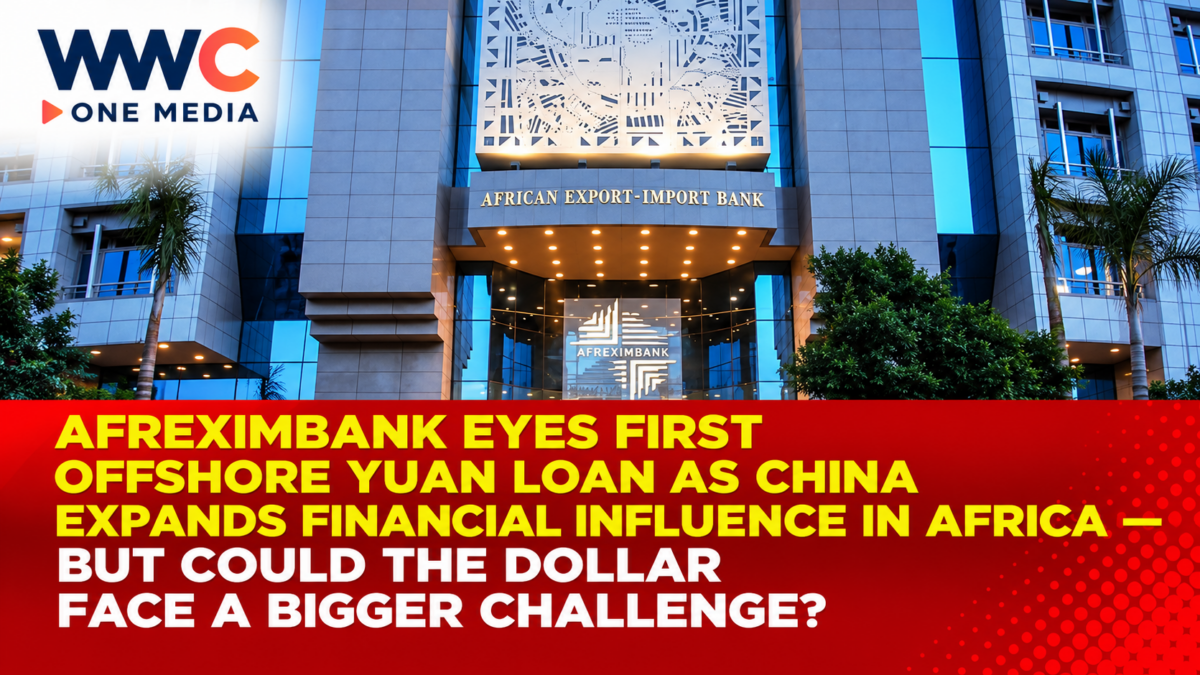
CAIRO / HONG KONG — October 30, 2026. The African Export-Import Bank, widely known as Afreximbank, is considering its first offshore Chinese yuan loan, marking a potentially significant step in the continent’s efforts to diversify borrowing and deepen financial links with China.
The proposal, reported by Bloomberg on October 30, comes as African banks, governments and businesses increasingly explore alternatives to financing international transactions exclusively in US dollars.
For Afreximbank, the move could open another source of funding to support trade, investment and economic development.
For China, it represents another opportunity to expand the international role of the renminbi, the official name of its currency.
But the proposed transaction also raises an important question: Will greater use of the yuan give African borrowers cheaper and more flexible financing, or expose them to a new set of currency and geopolitical risks?
Afreximbank considers a first offshore yuan-denominated loan
Bloomberg reported that Afreximbank is exploring its first offshore yuan borrowing arrangement.
An offshore yuan loan is financing denominated in Chinese currency but arranged or provided outside mainland China’s domestic financial system.
Such financing is generally associated with the offshore renminbi market, commonly represented by the currency code CNH.
Hong Kong is one of the world’s most important centers for offshore yuan transactions, although offshore renminbi financing can also take place through other financial hubs.
For a borrower such as Afreximbank, offshore yuan funding could expand the pool of banks and investors available to provide capital.
It may also create opportunities to match financing more closely with transactions involving Chinese suppliers and businesses.
However, the reported proposal has not been independently verified as a completed borrowing.
The final loan size, participating lenders, borrowing rate, maturity and intended allocation of proceeds remain unconfirmed in the material reviewed.
That distinction is essential: considering a loan is not the same as signing or drawing down a loan facility.
The bank already raised 2.2 billion yuan in China
Afreximbank is not new to renminbi financing.
On March 28, 2025, the institution issued a three-year panda bond worth 2.2 billion yuan, equivalent at the time to approximately $303 million.
The bond carried a coupon rate of 2.99%.
The transaction was announced by Afreximbank on April 8, 2025, and arranged with the participation of major Chinese financial institutions.
Bank of China served as lead underwriter and bookrunner, while the Export-Import Bank of China and Industrial and Commercial Bank of China were joint lead underwriters.
The deal established an important precedent for African development finance institutions seeking access to China’s domestic bond market.
The money raised was intended to support eligible activities under Afreximbank’s mandate, including trade and economic cooperation involving Africa and China.
But a panda bond and an offshore yuan loan are different financial instruments.
The panda bond was a security issued inside mainland China’s financial market.
The contemplated new loan would involve borrowing Chinese currency offshore.
Afreximbank’s 2025 success therefore demonstrates previous access to yuan funding, but it does not confirm that the 2026 offshore loan has been arranged.
Why African borrowers are looking beyond the US dollar
The US dollar has long dominated international borrowing, commodity trade and cross-border payment systems.
Many African companies need dollars to purchase imports, repay foreign loans or settle international transactions.
However, obtaining dollars can be expensive when local currencies weaken or global interest rates rise.
Borrowers may also face currency-conversion fees and financing constraints.
China’s relatively low interest-rate environment has created opportunities for some institutions to borrow in renminbi at potentially competitive rates.
WWC ONE MEDIA previously examined the growing importance of alternative currency funding in Asian Bond Sales Slow as Yields Surge — But America’s AI Debt Boom Is Raising the Cost of Capital for Everyone.
That report discussed the expansion of local-currency bond markets and the appeal of yuan-denominated financing when international dollar borrowing becomes expensive.
The same financial logic is relevant to African lenders.
Having more than one funding currency can allow institutions to compare borrowing costs and avoid excessive dependence on a single market.
But any savings depend on the actual contract terms and exchange-rate exposure.
Lower interest rates do not always mean cheaper debt
The strongest argument for borrowing in yuan is the possibility of lower interest expenses.
But comparing a Chinese-currency loan with a dollar loan requires more than looking at their headline interest rates.
A borrower must also consider arrangement fees, maturity, currency-conversion costs and the risk that the renminbi appreciates before repayment.
If a bank raises yuan but lends the proceeds to customers whose revenues are mainly in dollars or African currencies, it may need to hedge the exposure.
Those hedges can have costs.
Conversely, if proceeds are used to finance imports from China and repayments are generated in yuan, borrowing in Chinese currency can create a closer match between assets and liabilities.
The Reserve Bank of Australia noted in its August 2026 analysis that yuan-denominated lending by Chinese banks had grown dramatically, supported by policy changes and lower financing costs.
However, access to financing does not eliminate credit or exchange-rate risks.
Whether Afreximbank’s proposed facility proves economical will depend on the terms eventually agreed.
China’s financial influence in Africa continues to expand
China has become one of Africa’s most important commercial partners.
Its companies supply machinery, telecommunications equipment, vehicles, solar panels, batteries and other manufactured goods.
Chinese banks and state-backed institutions have also financed major infrastructure, mining and energy projects across the continent.
As those relationships deepen, African businesses have more reasons to use Chinese currency directly.
A transaction involving a Chinese supplier may otherwise require an African importer to acquire dollars before converting them into yuan.
That two-stage process can add expense and delay.
Banks are increasingly developing services that allow more direct yuan settlement.
For Beijing, these initiatives also support its wider ambition to expand the renminbi’s international role.
The result is not necessarily an immediate abandonment of the dollar.
Instead, Africa’s financial system may gradually become more diversified, with different currencies used for different transactions.
Ecobank joins the push for yuan payments
Afreximbank’s contemplated financing comes after another significant development in October.
Ecobank, one of Africa’s largest pan-regional banking groups, announced steps toward joining China’s Cross-Border Interbank Payment System, known as CIPS.
Reuters reported on October 9 that Ecobank was working to facilitate yuan-denominated payments for customers trading with China.
The institution operates across 34 African countries and has also explored cooperation with Bank of China.
CIPS supports cross-border renminbi clearing and settlement.
Using the system can help banks settle eligible yuan payments more directly.
But the existence of a yuan payment channel does not mean that all transactions will be settled in Chinese currency or that dollar payments will disappear.
Companies will continue selecting currencies based on contracts, availability, pricing and commercial preferences.
African banks are building new payment infrastructure
The shift extends beyond Ecobank.
Standard Bank, one of Africa’s largest financial institutions, has developed direct connections to China’s cross-border yuan payment infrastructure.
In June, China’s central bank approved an arrangement involving Standard Bank and Industrial and Commercial Bank of China to provide renminbi clearing services across 19 African countries.
Other banks, including Rwanda’s Bank of Kigali, have also taken steps toward closer integration.
These developments suggest that yuan financing and yuan settlement may increasingly reinforce one another.
Financial institutions need mechanisms to obtain, transfer and repay the currency efficiently.
For Afreximbank, wider availability of yuan infrastructure could potentially make Chinese-currency lending more practical.
However, payment-network participation is different from raising a loan.
The two developments are related but should not be treated as the same transaction.
Kenya’s debt conversion shows why yuan financing is gaining attention
Kenya has become an important example of the practical benefits that may arise from changing the currency of existing debt.
The country converted three Chinese railway loans from dollars into yuan, alongside changes to repayment terms.
Reuters reported that the restructuring reduced Kenya’s annual debt-service costs by approximately $215 million.
The outcome has attracted interest from other countries looking for ways to manage expensive international borrowing.
Research group AidData identified Ethiopia, Mozambique, Zambia, Pakistan and Indonesia as potential candidates for similar arrangements.
But Kenya’s experience cannot simply be applied to every African borrower.
Its savings reflected a specific combination of loan conversion, maturity changes and additional grace periods.
A new yuan loan at Afreximbank would have its own contractual terms and financial risks.
The Kenyan example demonstrates what may be possible, not what Afreximbank has already secured.
Afreximbank’s strong 2026 earnings provide important context
Afreximbank reported a 24% increase in group net income for the first nine months of 2026.
Net income reached approximately $813.5 million, compared with $654.3 million during the corresponding period in 2025.
The institution also reported assets and contingencies totaling approximately $54.1 billion.
Net loans and advances rose to $36.2 billion from $33.5 billion at the end of 2025.
The figures indicate continuing demand for trade and development financing.
They also show that Afreximbank is seeking alternative funding sources while operating a substantial lending portfolio.
But the numbers should be interpreted accurately.
The $54.1-billion total includes contingent items and should not be described simply as cash available for new loans.
Net income is also not identical to the cash available for immediate disbursement.
Afreximbank’s borrowing capacity depends on liquidity, capital, credit exposure and market access.
The bank has also returned to the dollar bond market
Afreximbank’s interest in yuan financing does not mean it has abandoned dollar-denominated borrowing.
In July 2026, the bank completed a $1.5-billion dual-tranche US dollar bond offering.
The transaction included two $750-million tranches, maturing in January 2032 and July 2036.
The securities carried final yields of 6.25% and 7.125%, respectively.
Afreximbank said investor demand reached approximately $3.8 billion at its peak.
That was an important demonstration of continued access to international capital markets.
The contrast with the proposed yuan loan reveals the bank’s broader approach.
Rather than replacing one currency with another, Afreximbank appears to be expanding the range of available financing options.
Dollar bonds, yuan instruments and other funding arrangements can serve different purposes.
A diversified funding strategy may help the institution manage financing costs and liquidity more effectively.
China has already opened the door to offshore yuan borrowing
Beijing has been working to expand offshore renminbi financing.
In February 2026, the People’s Bank of China introduced rules intended to support cross-border yuan lending between domestic banks and overseas financial institutions.
The measures linked lending capacity to the financial strength of participating banks and aimed to support stable offshore yuan liquidity.
Hong Kong has also expanded facilities intended to strengthen the offshore renminbi market.
The Hong Kong Monetary Authority announced in October that it would increase liquidity available under its offshore yuan market-support framework from 20 billion yuan to 22 billion yuan.
Those measures help explain why more international borrowers are considering financing in Chinese currency.
A market with deeper liquidity and more participating banks can offer additional options.
But regulatory support does not guarantee that a proposed loan will be approved or priced attractively.
The Philippines is part of the broader currency-diversification debate
The growing use of yuan funding also has relevance for Southeast Asia.
Asian companies and financial institutions have increasingly accessed local-currency bond markets as an alternative to international dollar borrowing.
WWC ONE MEDIA explored the financing environment in China-US Bond Yield Gap Nears Record as Global Debt Rout Sends Shockwaves Through Markets.
The report examined differences between borrowing conditions in the United States and China.
Those conditions can influence the relative appeal of financing in different currencies.
For Philippine businesses trading with China, yuan payments or funding may offer advantages in certain circumstances.
However, companies must still evaluate currency exposure, local regulations, banking access and the commercial terms of their contracts.
A financing structure suitable for an African multilateral lender would not automatically be appropriate for every Philippine borrower.
The yuan’s expansion also supports China’s trade strategy in Africa
The financial relationship between China and Africa extends beyond banks and debt markets.
Chinese companies are expanding the sale of solar panels, batteries, electric vehicles and other energy technologies across the continent.
WWC ONE MEDIA examined this commercial shift in China’s Green-Tech Push Is Challenging Trump’s ‘Drill, Baby, Drill’ Energy Strategy in Africa.
The report discussed the growth of China’s clean-technology exports and Africa’s demand for affordable energy infrastructure.
Such commercial activity can increase the need for efficient payment and trade-financing arrangements.
A business importing Chinese equipment may benefit from financing matched to the currency used by its supplier.
But that advantage depends on the final financing cost, repayment arrangements and currency risks.
The broader trend is that trade relationships and financial infrastructure are becoming more closely connected.
Other Asian lenders are also pursuing Africa
China is not the only Asian economy expanding financial links with Africa.
South Korea has also intensified engagement with African governments and businesses through development financing.
WWC ONE MEDIA previously covered the initiative in Korea Eximbank Deepens Africa Push as Seoul Targets 10 Nations for New Development Deals.
The report examined South Korea’s efforts to support infrastructure, technology and business partnerships across the continent.
The Korean initiative is separate from Afreximbank’s proposed yuan financing.
However, it illustrates a broader competition to provide capital and strengthen trade relationships with African economies.
More financing partners could give African institutions additional choices, although those opportunities must still be assessed against borrowing costs and repayment obligations.
Could the yuan challenge the US dollar in African finance?
The increasing use of renminbi financing raises questions about the future of the dollar’s role in Africa.
For decades, international borrowing and trade settlement have relied heavily on dollar-based financial infrastructure.
China’s expanding trade relationships and financial networks are creating alternatives for some transactions.
But a rapid displacement of the dollar is not established by the evidence.
The US currency remains central to international trade, reserves, debt issuance and commodity markets.
Yuan transactions still face limitations involving liquidity, convertibility and capital controls.
For African borrowers, the objective may be less about replacing the dollar entirely than avoiding excessive reliance on any one funding source.
Afreximbank’s consideration of an offshore yuan loan fits that more measured interpretation.
What investors should watch next
Several developments will determine whether the proposed financing becomes a significant milestone.
The first is whether Afreximbank formally announces an agreement with participating lenders.
The second is the loan’s size, tenor, interest rate and currency-conversion arrangements.
The third is how the proceeds would be used to support trade or development financing.
The fourth is whether the bank can match its yuan liabilities with yuan-denominated assets or appropriate hedging arrangements.
Finally, the transaction’s attractiveness will depend on how its complete financing cost compares with alternatives in dollars, euros and other currencies.
Without those details, it would be premature to conclude that the new facility will save a particular amount of money.
The bigger question: Is Africa building a more independent financial future?
Afreximbank’s proposed offshore yuan loan illustrates an important shift in the international financing landscape.
African lenders are gaining greater access to alternative currencies, payment systems and international investors.
China is using its financial markets and expanding commercial relationships to promote broader use of the renminbi.
And institutions such as Afreximbank are seeking ways to fund trade and development without depending entirely on one currency.
But diversification is not without risks.
Borrowers must manage currency volatility, financing costs, debt obligations and changing geopolitical relationships.
The proposed loan has not yet been confirmed as completed, and its economic benefits cannot be determined without the final terms.
Afreximbank may be preparing another landmark yuan transaction. But the decisive question is whether Africa can use new financing options to lower borrowing costs and strengthen its trade system—without simply exchanging dependence on the US dollar for new financial vulnerabilities.