
BEIJING/WASHINGTON — A dramatic divergence between Chinese and U.S. government bond markets is putting a fresh spotlight on global capital flows, monetary policy and the growing cost of government borrowing.
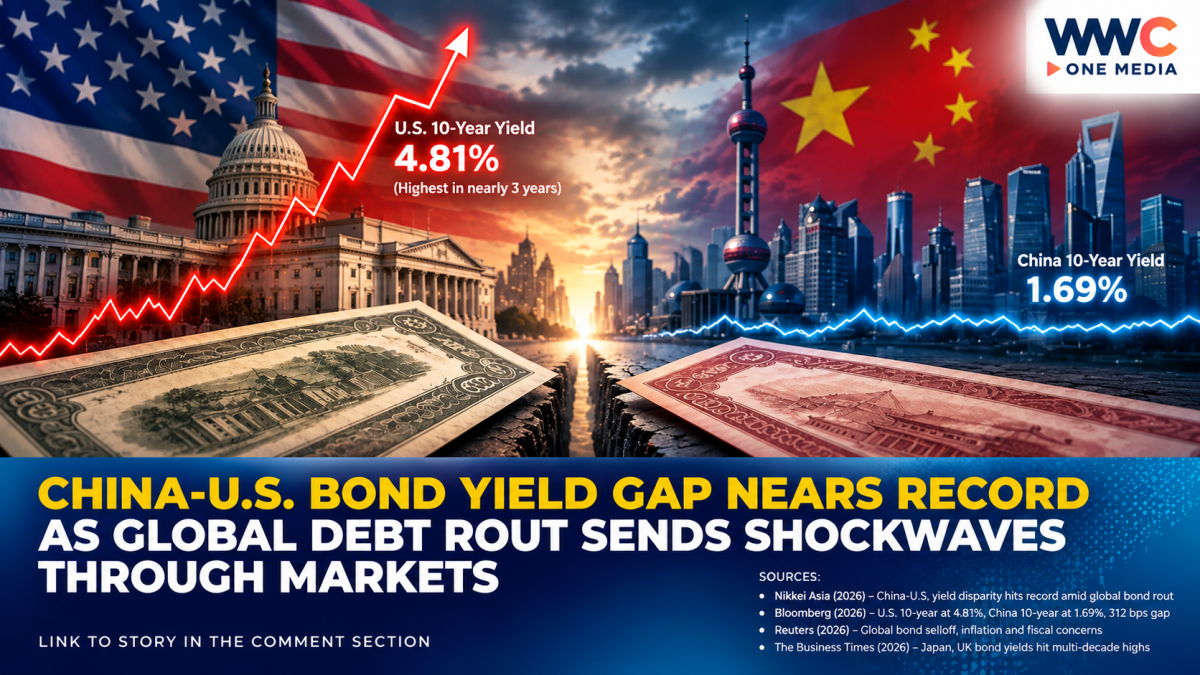
The yield spread between 10-year U.S. Treasuries and Chinese government bonds widened to about 312 basis points this week, approaching the roughly 315-basis-point record reached early last year, according to Bloomberg data cited by multiple financial reports.
The move comes as bond markets around the world have been hit by a broad selloff, with investors demanding higher returns to compensate for inflation, fiscal pressures and geopolitical risks.
But China is behaving very differently.
U.S. yields surge while China stays near record lows
The benchmark 10-year U.S. Treasury yield climbed as high as 4.81%, its highest level in nearly three years, while China’s comparable 10-year government bond yield remained around 1.69%.
That created a gap of approximately 3.12 percentage points, or 312 basis points.
The distinction is important: the spread was approaching the previous record rather than clearly establishing a new record in the latest data available. That makes “near-record” more accurate than saying the record had already been broken.
The divergence reflects two very different economic environments.
The U.S. is confronting persistent inflation concerns and elevated government borrowing costs, while China continues to wrestle with weak domestic demand, property-sector problems and deflationary pressures.
Why China’s bond yields are so low
China’s unusually low bond yields may initially appear surprising.
After all, China carries substantial government and quasi-government debt, and its economy is dealing with structural challenges.
But Reuters columnist Jamie McGeever notes that China’s bond market is supported by a combination of very high domestic savings, capital controls and limited alternative destinations for those savings.
China’s gross domestic savings rate is estimated at around 43% of GDP, according to the Reuters analysis—more than twice the U.S. equivalent.
With capital controls restricting the movement of money abroad, a significant pool of domestic savings remains inside China’s financial system.
That creates persistent demand for government bonds.
China’s property crisis is still part of the story
Another crucial factor is China’s prolonged property downturn.
The property crisis that began in 2021 has weighed on household confidence, consumption and local-government finances.
At the same time, China has spent years battling weak price growth.
Reuters reported that China’s producer-price inflation had remained negative for almost four years before turning positive earlier this year, while the GDP deflator also returned to positive territory in the second quarter.
That backdrop gives Beijing and the People’s Bank of China more reason to maintain relatively accommodative financial conditions.
The result is a striking contrast with the United States, where investors are demanding significantly higher yields on long-term government debt.
Meanwhile, the global bond market is under pressure
China’s low yields stand out even more because major bond markets elsewhere have been selling off.
The 10-year U.S. Treasury yield reached 4.81%, while Japan’s 10-year government bond yield moved above 3%, a level not seen in roughly three decades. British government bond yields also reached their highest levels since 2008.
The pressure is being driven by several forces at once.
Investors are concerned about:
- Persistent or renewed inflation
- Higher energy prices
- Large government deficits
- Heavy sovereign debt issuance
- Rising long-term borrowing costs
- Geopolitical uncertainty
- Increasing competition for capital from large technology and AI investments
Reuters described the global bond selloff as being driven by concerns about inflation, fiscal sustainability and government borrowing costs.
The Middle East is adding another layer of uncertainty
Energy prices have become an important part of the latest bond-market turbulence.
Oil prices have risen amid the ongoing Middle East conflict, creating fears that higher energy costs could reignite inflation.
That matters enormously for government bonds.
If investors believe inflation will remain elevated, they may expect central banks to keep interest rates higher for longer—or even raise them. Higher expected rates can push bond yields upward and prices downward.
The effect can spread across currencies, stocks, mortgages and corporate borrowing.
Could money flow away from China?
A widening U.S.-China yield differential theoretically makes U.S. bonds more attractive relative to Chinese government debt.
That raises the possibility of capital moving away from Chinese bonds.
But analysts caution against assuming that a sudden exodus of money from China is inevitable.
Foreign investors held only about 4.6% of China’s government bond market at the end of July, according to Bloomberg calculations cited in the reporting. China’s capital controls also limit the speed and scale of potential outflows.
The yuan has also remained relatively resilient.
Bloomberg reported that the yuan was trading around 6.72 per U.S. dollar during the latest period and had gained nearly 4% against the dollar this year, supported in part by strong Chinese exports and corporate currency conversions.
Japan could become an important piece of the puzzle
The bond-market story is not only about China and the United States.
Japan’s rising yields could potentially have major consequences for global capital flows.
Japan has historically been one of the world’s biggest sources of overseas investment. As domestic Japanese bond yields become more attractive, investors could have greater incentive to bring capital home instead of buying foreign bonds.
Reuters reported that the rise in Japanese yields could begin reversing a long-standing flow of Japanese money into global fixed-income markets.
That creates another potential source of pressure for U.S. Treasuries and other sovereign debt markets.
But this is not another 2022-style bond crash—at least not yet
Despite the alarming headlines, the latest selloff should not automatically be compared with the historic 2022 bond-market rout.
Bloomberg data cited by BusinessMirror show global government bond yields had risen about 17 basis points on a rolling 20-day basis, compared with approximately 62 basis points during the comparable 2022 episode.
Global government bonds were down around 4.2% this year, compared with a roughly 23% plunge in 2022.
The difference is significant.
The current market is under pressure, but the scale remains far below the extraordinary losses seen when central banks aggressively raised rates to defeat the post-pandemic inflation surge.
The bigger warning may be the divergence itself
The most important development may therefore not be the exact number of basis points separating Chinese and U.S. yields.
It is the fact that the world’s two largest economies are operating under increasingly different financial conditions.
The U.S. is dealing with higher inflation risks, elevated fiscal borrowing and rising long-term yields.
China, meanwhile, is facing weak demand, property-sector weakness and deflationary pressures, keeping its government bond yields unusually low.
That divergence could influence currency markets, global investment decisions, bond allocations and the future direction of capital flows.
And there is another complication.
China’s low yields do not necessarily mean its economy is healthier than those of countries experiencing higher borrowing costs. Reuters’ analysis argues that China’s exceptionally low yields are partly a consequence of money remaining inside the domestic financial system rather than a straightforward reflection of strong economic fundamentals.
What happens next?
For investors, the critical question is whether U.S. yields continue climbing while Chinese yields remain depressed.
If that happens, the China-U.S. yield gap could surpass its previous peak, potentially putting greater pressure on the relative attractiveness of Chinese bonds.
But if U.S. inflation concerns ease and Treasury yields retreat, the spread could narrow again.
There are already signs of some relief in U.S. markets: Reuters reported on September 4 that dovish comments from Federal Reserve Governor Christopher Waller helped push down expectations of an imminent rate hike and eased some pressure on Treasuries.
For now, the message from the bond market is unmistakable: China and the United States are moving in very different directions—and investors are increasingly being forced to decide which side of that divide offers the better risk-adjusted opportunity.




Leave a Reply