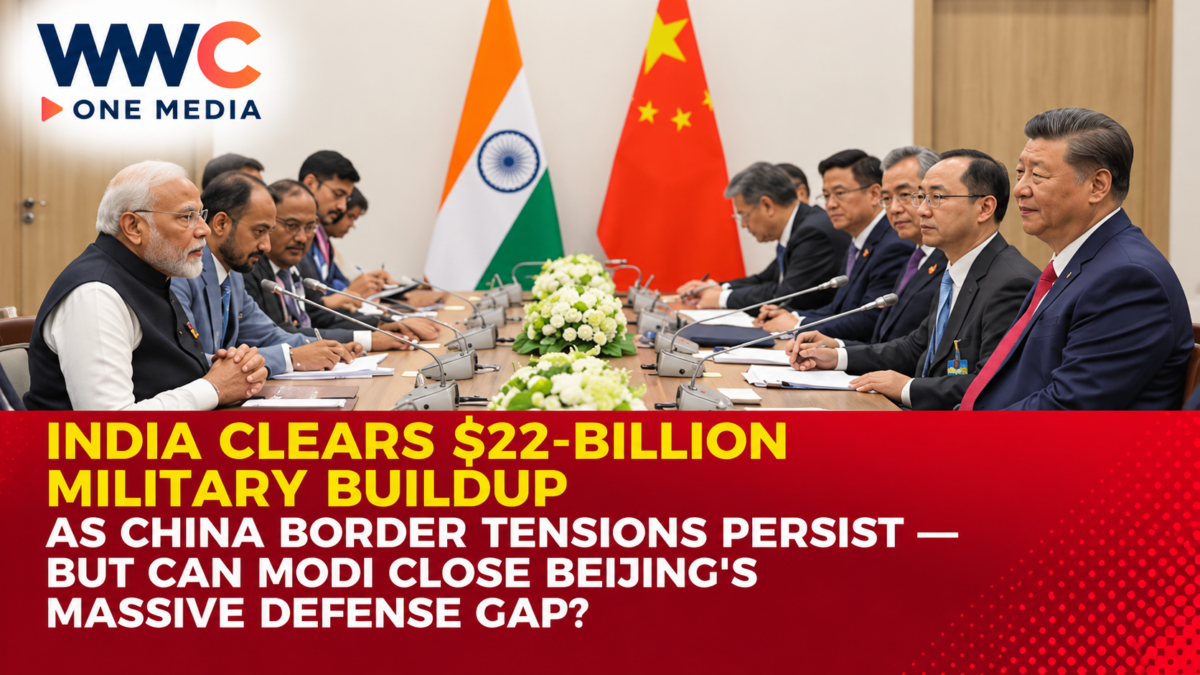
NEW DELHI, India — October 30, 2026. India has approved one of its most significant military procurement packages of the year, authorizing approximately ₹2.12 trillion ($22.27 billion) in proposed defense acquisitions as New Delhi seeks to strengthen its armed forces amid persistent tensions with China and growing concerns about the changing nature of modern warfare.
The decision, announced by India’s Ministry of Defence on October 26, covers an extensive range of equipment, including long-range drones, counter-drone systems, air-defense weapons, helicopters, artillery and naval platforms.
For Prime Minister Narendra Modi’s government, the new approvals represent another step toward modernizing the Indian military while expanding the country’s domestic defense manufacturing industry.
But beneath the multibillion-dollar announcement lies a significant strategic challenge.
India’s military expenditure remains far below China’s, raising questions about whether new procurement approvals can translate into the capabilities needed to counter Beijing’s technological and military advantages.
The United States, Israel, Russia and other international defense suppliers could benefit from India’s modernization plans, although the government intends to obtain most of the equipment’s procurement value from Indian industry.
India approves ₹2.12 trillion in military acquisitions
India’s Defence Acquisition Council (DAC), chaired by Defence Minister Rajnath Singh, granted Acceptance of Necessity approval to proposed military acquisitions valued at approximately ₹2.12 trillion.
The announcement covers equipment requirements across the Indian Army, Navy and Air Force.
Acceptance of Necessity is an initial administrative approval under India’s defense procurement framework.
It authorizes the government to proceed with further acquisition procedures but does not constitute a completed purchase contract.
This distinction is important because the approved amount has not necessarily been paid to manufacturers or allocated to specific finalized contracts.
Actual procurement will depend on subsequent negotiations, technical evaluations, contracting decisions and implementation.
Nevertheless, the size of the approval demonstrates the government’s continuing determination to modernize its defense capabilities.
The announcement also reflects an emphasis on technologies that have become increasingly important in modern conflicts, particularly drones, surveillance systems, electronic warfare and integrated air defense.
Drones and counter-drone weapons become a major priority
One of the clearest themes in India’s procurement package is the growing importance of unmanned military systems.
The Army received approval to pursue several types of drones and related equipment.
These include long-range surveillance unmanned aerial vehicles, integrated surveillance-and-strike systems, long-range kamikaze drones and platforms designed to counter hostile unmanned aircraft.
Such systems can perform different military functions.
Surveillance drones help armed forces observe difficult terrain and monitor activity over extended distances.
Counter-drone equipment is designed to detect or respond to unauthorized or hostile unmanned aircraft.
Other unmanned systems are intended for strike missions.
India’s procurement priorities reflect a broader change in military planning as countries invest in more technologically sophisticated equipment.
However, approving drones and counter-drone systems does not automatically establish that they will be successfully delivered, integrated or deployed.
Their operational value will depend on technical performance, training, maintenance, communications infrastructure and coordination with other military systems.
Indian Army seeks advanced artillery and air-defense systems
The proposed acquisitions also include additional equipment intended to strengthen ground-force mobility and protection.
Among the systems approved for procurement are high-mobility vehicles, self-propelled tracked artillery, gunshot-response systems, light multi-role helicopters and very short-range air-defense systems.
High-mobility vehicles can support logistics and movement across difficult terrain.
Artillery systems provide ground forces with additional firepower, while air-defense equipment is intended to protect personnel and installations against airborne threats.
The procurement package reflects India’s need to prepare for challenging geographical conditions.
Its disputed frontier with China includes mountainous regions where altitude, weather and infrastructure limitations complicate military operations.
The new equipment proposals form part of India’s wider effort to improve readiness across difficult operating environments.
But the government has not published a complete breakdown of how much of the ₹2.12 trillion will be allocated to each equipment category.
Nor has it announced finalized delivery schedules for every proposed purchase.
Indian Navy and Air Force also receive modernization approvals
India’s maritime and aviation forces are included in the latest modernization package.
For the Navy, the council approved proposals involving active offboard decoy systems and additional naval platforms.
Offboard decoys are designed to help protect warships against certain missile threats by creating alternative targets.
The proposed naval acquisitions also include domestically designed platforms intended to strengthen maritime capabilities.
For the Air Force, the approved proposals include helicopters, air-defense equipment, weapons and mobile X-band Doppler weather radar systems.
The weather radars are intended to improve localized weather monitoring, particularly in forward operational areas.
These investments demonstrate the broad scope of India’s modernization plans.
Rather than concentrating exclusively on one service, New Delhi is seeking upgrades across its land, maritime and aviation forces.
The effectiveness of this strategy will depend on how the different capabilities are integrated and supported over time.
China’s defense budget remains more than three times India’s
The scale of India’s challenge becomes clearer when comparing its military expenditure with China’s.
According to the Stockholm International Peace Research Institute, India spent approximately $92.1 billion on its military in 2025, placing it fifth globally.
China spent an estimated $336 billion during the same year.
That means China’s military expenditure was approximately 3.65 times India’s.
The United States remained the world’s largest military spender, at approximately $954 billion, followed by China, Russia and Germany.
The comparison also reveals an important difference between annual military spending and procurement approvals.
India’s newly approved $22.27-billion acquisition package is not equivalent to a $22.27-billion increase in its annual military expenditure.
The procurement projects could extend across multiple years, with expenditure depending on actual contract awards and deliveries.
Furthermore, total spending alone cannot establish the relative effectiveness of two armed forces.
Military capability also depends on equipment, training, logistics, technology, geography and operational readiness.
Nevertheless, the size of China’s defense investment helps explain why Indian policymakers are prioritizing modernization.
India-China border tensions continue despite diplomatic progress
The defense approvals arrive as India and China continue managing one of Asia’s longest-running territorial disputes.
The two countries share an extensive disputed Himalayan frontier, where differing territorial claims have repeatedly produced military confrontations.
Relations deteriorated sharply after the deadly June 2020 Galwan Valley clash.
Indian and Chinese troops subsequently maintained significant deployments along portions of the disputed border.
Although the countries reached a disengagement agreement in October 2024 and resumed high-level diplomatic engagement, the territorial dispute remains unresolved.
In September 2026, Prime Minister Modi and Chinese President Xi Jinping sought to strengthen economic and diplomatic relations.
WWC ONE MEDIA examined these developments in Modi and Xi Push to Revive India-China Ties With Business, Trade and Border Peace.
The report highlighted how both governments are attempting to stabilize relations while dealing with longstanding security concerns.
More recently, Indian security officials have warned about the technological challenges associated with border defense.
China, meanwhile, maintains that its forces comply with applicable border arrangements and bilateral understandings.
The two governments’ differing assessments illustrate why diplomatic progress has not eliminated military mistrust.
India’s latest procurement decision should therefore be understood within a continuing security rivalry rather than as proof that a new military confrontation is inevitable.
Diplomatic talks and military modernization are happening simultaneously
India’s strategic approach involves strengthening its defenses while preserving diplomatic channels.
External Affairs Minister Subrahmanyam Jaishankar has outlined efforts to improve relations with major powers without abandoning India’s strategic autonomy.
This includes engagement with Washington, cooperation with Europe, continued relations with Russia and selective efforts to stabilize ties with Beijing.
WWC ONE MEDIA covered this strategy in India Unveils Five-Part Foreign Policy Strategy as Jaishankar Eyes US Deal and China Border Progress.
The approach reflects India’s desire to maintain flexibility in an increasingly competitive geopolitical environment.
New Delhi seeks access to international technology and defense equipment while pursuing stronger domestic manufacturing capabilities.
It also wants to avoid becoming completely dependent on any single foreign supplier.
This creates opportunities for several countries to participate in India’s defense procurement pipeline.
US, Israeli and Russian defense companies could benefit
Although India plans to source approximately 82% of the newly approved procurement value from Indian industry, international manufacturers may still play an important role.
Some advanced systems depend on foreign-designed engines, sensors, electronics and other specialized components.
Analysts cited by CNBC identified opportunities for suppliers from the United States, Israel, Russia, France and South Korea.
Foreign companies could participate through direct supply arrangements, technology partnerships or cooperation with Indian manufacturers.
However, the October 26 approval does not establish that named foreign manufacturers have already won contracts.
No comprehensive list of successful bidders has been announced.
For overseas suppliers, the opportunity will depend on India’s procurement rules, technical requirements and negotiations with prospective partners.
For India, the challenge is obtaining advanced technology while strengthening its domestic industrial capabilities.
Modi’s Make in India strategy faces another major test
India’s defense industry has been expanding domestic production under the government’s self-reliance initiatives.
The latest procurement approvals indicate that approximately 82% of the proposed acquisitions are expected to be sourced from Indian industry.
This represents a substantial opportunity for domestic defense manufacturers.
But sourcing equipment locally does not necessarily mean every component or technology is developed in India.
Indian manufacturers may still depend on international suppliers for advanced engines, electronics, sensors and specialized materials.
A September 2026 analysis reported by Financial Express, citing Jefferies, highlighted India’s continuing technological challenges relative to China.
It noted that capital expenditure represents a comparatively limited share of India’s overall defense budget.
A significant proportion of defense expenditure must also cover personnel, pensions, operations and maintenance.
These commitments reduce the amount immediately available for purchasing new equipment.
The success of India’s domestic defense strategy will therefore depend not only on procurement approvals but also on industrial capacity, research, manufacturing quality and technology transfer.
Military spending is rising globally
India’s modernization plans are unfolding during a period of exceptionally high global military expenditure.
According to SIPRI, worldwide military spending reached approximately $2.887 trillion in 2025, an increase of 2.9% in inflation-adjusted terms.
The figure represented the 11th consecutive annual increase and the highest spending level recorded by the research institute.
The five largest spenders accounted for approximately 58% of global military expenditure.
These developments reflect a wider international environment marked by conflicts, geopolitical rivalry and increased investment in advanced military technology.
However, defense budgets must also be considered alongside competing public spending requirements.
Governments must balance national security priorities with education, healthcare, infrastructure and other economic needs.
For India, large procurement commitments introduce questions about financing, economic efficiency and long-term affordability.
India’s naval concerns extend beyond its China border
Although attention often focuses on the Himalayan frontier, India’s security interests also include the Indian Ocean and its relationship with Pakistan.
New Delhi has invested in maritime surveillance, naval modernization and other capabilities associated with protecting sea lanes and responding to regional security developments.
In September 2026, India and Pakistan accused each other of violating maritime safety arrangements following a reported collision involving naval vessels.
WWC ONE MEDIA examined the incident in Indian and Pakistani Warships Collided in the Arabian Sea — But Both Sides Say the Other Broke the Same 1991 Rule.
The dispute illustrates the broader security environment affecting India’s defense planning.
However, the October 26 procurement announcement did not attribute every proposed acquisition to one specific country or confrontation.
The equipment requirements cover the overall modernization needs of the Indian armed forces.
What does India’s military expansion mean for Southeast Asia?
India’s expanding defense capabilities could have implications beyond South Asia.
New Delhi participates in regional security arrangements and defense dialogues involving Southeast Asian countries.
These relationships include maritime security, defense cooperation and regional stability.
The Philippines, for example, hosted senior Southeast Asian defense officials and international partners for meetings in Cebu in late October.
WWC ONE MEDIA covered those preparations in Lapu-Lapu Prepares for ASEAN Defense Chiefs as the Philippines’ Maritime Security Agenda Takes Center Stage.
India also maintains defense and diplomatic relationships with various ASEAN members.
But increased Indian military procurement should not automatically be interpreted as an indication of future conflict involving Southeast Asian countries.
Its regional significance will depend on diplomatic engagement, defense partnerships and changing security conditions.
Can India close the gap with China?
India’s latest military procurement package demonstrates a strong commitment to modernization.
The proposed equipment would strengthen several areas of military capability if successfully procured, delivered and integrated.
Greater domestic manufacturing could also support India’s defense industry and reduce some dependence on foreign suppliers.
But the country’s challenge is substantial.
China maintains a much larger military spending base and has invested heavily in military technology, infrastructure and industrial capacity.
India must also address limitations involving procurement timelines, research and development, manufacturing capacity and its existing financial commitments.
Approving ₹2.12 trillion in equipment is therefore an important administrative milestone, but it is only the beginning of the process.
The real measure of progress will be whether the proposed systems enter service, perform reliably and contribute to sustainable military readiness.
India has authorized a major modernization drive as its strategic competition with China continues. But whether the $22-billion package can meaningfully narrow the gap with Beijing will depend on far more than the size of the announcement — and the race to turn procurement plans into operational capability is only beginning.