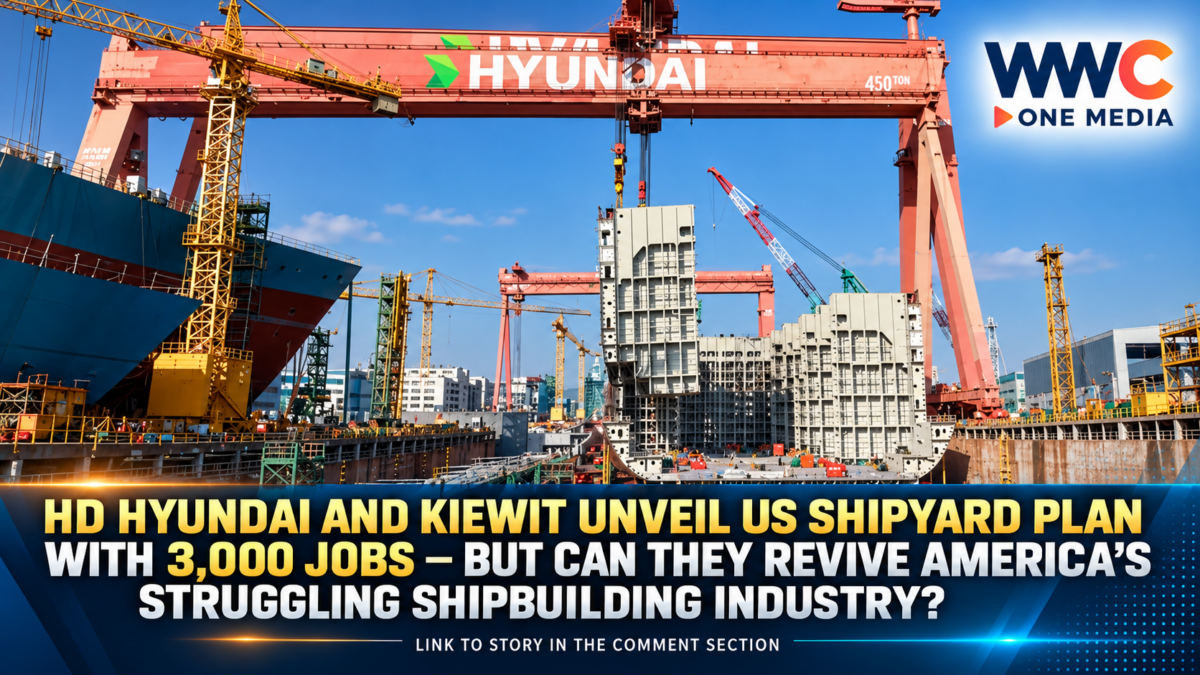
SEOUL, South Korea — October 23, 2026 — South Korean industrial giant HD Hyundai is joining forces with American construction powerhouse Kiewit Corporation to build an advanced shipyard in the United States, a major industrial expansion expected to create approximately 3,000 American jobs and strengthen the country’s domestic shipbuilding capabilities.
The ambitious project comes as Washington pushes to revive its maritime manufacturing industry and reinforce its ability to produce commercial vessels and ships supporting military operations.
HD Hyundai announced Friday that it had reached an agreement with Kiewit to construct the facility, with construction planned to begin in 2027 and operations targeted for 2029.
The development could mark a significant milestone in the growing industrial partnership between South Korea and the United States, particularly as global competition intensifies over maritime manufacturing capacity and naval supply chains.
A Major Boost for America’s Shipbuilding Industry
The proposed shipyard is designed to expand US shipbuilding capacity while helping rebuild the country’s maritime industrial base.
According to HD Hyundai, the collaboration will explore opportunities involving commercial ships and military support vessels, potentially supporting both civilian maritime transportation and defense-related shipbuilding requirements.
The partnership brings together two established industrial players with complementary strengths.
HD Hyundai contributes experience in ship design, advanced manufacturing, engineering, procurement and shipbuilding technology. Kiewit offers American construction expertise, large-scale industrial fabrication capabilities and experience delivering complex infrastructure projects.
Together, the companies aim to establish additional manufacturing capacity on US soil rather than relying exclusively on overseas shipyards.
The projected 3,000 jobs could provide an economic boost through shipyard employment and related industrial activity, although the precise distribution of positions has not yet been publicly detailed.
The Partnership Began Months Before the Announcement
The October agreement builds on an existing relationship between the two companies.
On July 16, 2026, representatives of HD Hyundai and Kiewit Offshore Services signed a strategic partnership agreement in Ingleside, Texas.
That earlier agreement established a framework for cooperating on US shipbuilding projects, including the fabrication of ship blocks and modules.
These components are essential to modern vessel construction because large ship sections can be manufactured separately and subsequently assembled into completed vessels.
By combining South Korean production technology with American industrial infrastructure, the partnership could help address manufacturing bottlenecks and improve domestic production capabilities.
The October announcement represents a more concrete step toward creating new US shipbuilding capacity.
Why the United States Is Turning to South Korean Shipbuilders
The project comes amid growing concern over America’s limited share of global commercial shipbuilding.
South Korea and China have long maintained substantial shipbuilding industries, while US commercial ship construction has operated on a comparatively smaller scale.
Washington has been exploring ways to strengthen its domestic industrial base, particularly as geopolitical competition increases the importance of maritime logistics, strategic shipping capacity and military support infrastructure.
South Korean shipbuilders have emerged as potential partners because of their experience building sophisticated commercial vessels and implementing efficient manufacturing systems.
HD Hyundai’s latest agreement with Kiewit reflects that broader industrial cooperation.
In September 2025, Reuters reported that HD Hyundai Heavy Industries was exploring the acquisition of a US shipyard as part of its expansion strategy.
The company’s new construction plans suggest that its American ambitions are moving beyond preliminary market exploration toward physical manufacturing investment.
Commercial Opportunities Meet National Security Priorities
The planned facility could serve two strategically important markets.
The first is commercial shipping, where additional American manufacturing capacity could support domestic maritime transportation and industrial customers.
The second involves military support vessels, an area increasingly important to defense logistics, fleet readiness and national security.
However, military support vessel opportunities should not be confused with confirmed contracts to build US Navy combat warships.
The companies have described potential markets, but specific vessel orders and defense contracts have not been announced as part of the October 23 development.
For the United States, expanding shipbuilding capacity involves more than constructing new facilities. It also requires skilled workers, dependable suppliers, advanced fabrication technology and the ability to deliver vessels efficiently.
The HD Hyundai–Kiewit project could help address some of those requirements if construction, workforce recruitment and production development proceed as planned.
A Wider Maritime Expansion With Implications for Asia
HD Hyundai has also been developing relationships with American maritime and defense industry participants as it explores opportunities in the US market.
Its strategy reflects a broader trend of South Korean manufacturing expertise becoming increasingly important to international shipbuilding partnerships.
The development is also relevant to Southeast Asia, particularly the Philippines, where South Korean shipbuilding companies have been exploring workforce training initiatives.
In September 2026, the Philippine Department of Labor and Employment reported discussions with HD Hyundai Heavy Industries and the Korea Marine Equipment Research Institute regarding a proposed training center for environmentally friendly shipbuilding specialists in Zambales.
Although that Philippine initiative is separate from the US shipyard project, both highlight HD Hyundai’s interest in developing maritime industry capabilities through international partnerships.
There is no announced direct recruitment link between the proposed Philippine training initiative and the 3,000 US jobs.
The Biggest Questions Remain
Despite the scale of the announcement, several important details have yet to be publicly established.
The companies have not disclosed a final construction budget, a confirmed site for the new facility or a detailed production-capacity target in the October 23 report.
The 3,000-job figure is a projection rather than a count of positions already filled.
Meanwhile, the planned 2029 operational launch leaves the partners with substantial work ahead, including construction, equipment installation, workforce development and preparation for commercial production.
The crucial test will be whether HD Hyundai and Kiewit can turn their agreement into a competitive shipbuilding operation capable of producing vessels at scale.
Could This Change America’s Shipbuilding Future?
For decades, the global shipbuilding industry has been shaped by competition among major Asian manufacturing economies.
Now, HD Hyundai’s planned investment with Kiewit could help the United States rebuild a stronger role in maritime production.
The proposed facility promises thousands of jobs, new manufacturing capabilities and opportunities in both commercial and military support shipbuilding.
But the announcement is only the beginning.
With construction targeted for 2027 and operations expected in 2029, the bigger question is whether this ambitious partnership can deliver the ships, skilled workforce and industrial capacity needed to make America’s shipbuilding revival a reality.