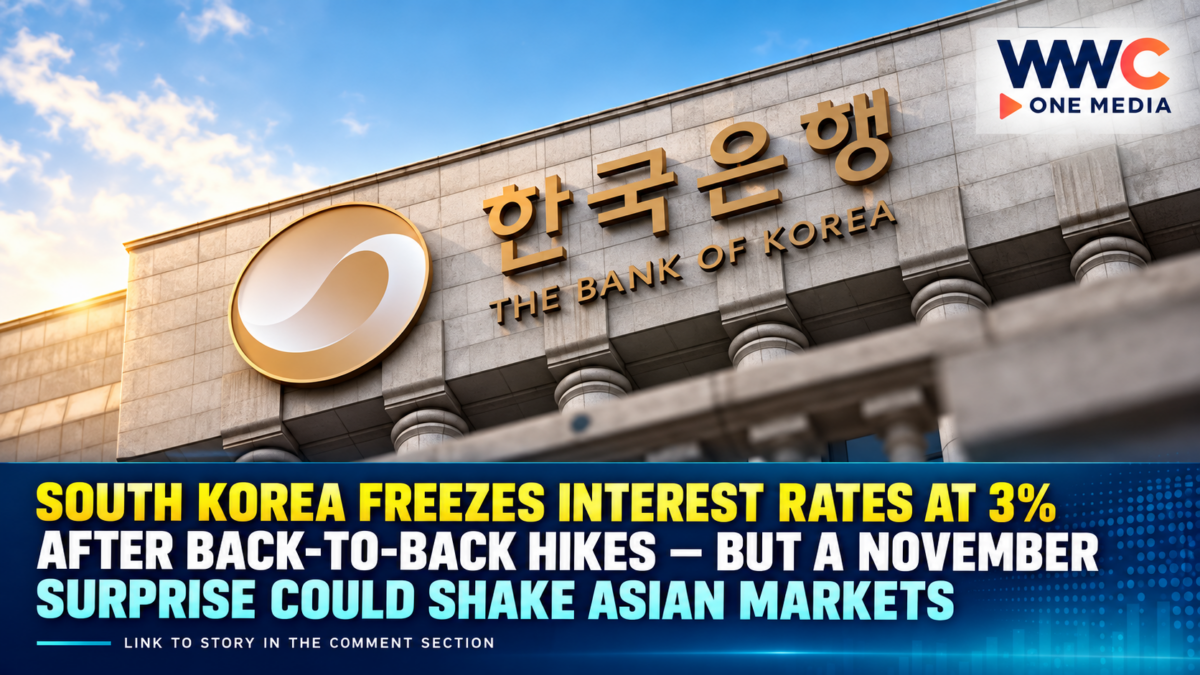
SEOUL, SOUTH KOREA — South Korea’s central bank has hit the pause button on interest-rate increases, keeping borrowing costs unchanged after two consecutive hikes as policymakers weigh persistent inflation against growing uncertainty in financial markets.
The Bank of Korea (BOK) announced on Thursday, October 22, that its seven-member Monetary Policy Board had voted to maintain the benchmark seven-day repurchase rate at 3.00%.
The widely expected decision follows back-to-back increases of 25 basis points in July and August, the country’s first consecutive rate hikes in more than three years.
But the pause does not necessarily signal the end of South Korea’s monetary tightening campaign.
With consumer prices still rising faster than the central bank’s target, strong semiconductor exports supporting economic growth, and geopolitical tensions keeping energy costs elevated, economists believe another rate increase could arrive as soon as November.
In a Reuters survey, all 34 economists correctly anticipated the October hold, while the median forecast pointed to a possible increase to 3.25% at the next meeting.
The decision offers temporary relief to borrowers and financial markets, but it also exposes a difficult balancing act for policymakers: controlling inflation without placing excessive pressure on households, businesses and investors.
The central bank’s decision was unanimous among analysts surveyed by Reuters, who had anticipated a temporary pause following the two earlier increases.
The July and August hikes were intended to prevent persistent inflation from becoming more deeply embedded in the economy.
Governor Shin Hyun Song had previously indicated that a gradual approach would allow policymakers to assess how higher interest rates were affecting businesses, consumers and the financial system.
The October decision reflects that approach.
However, leaving rates unchanged does not mean borrowing costs are falling. The benchmark remains higher than before the July and August increases.
Why South Korea Is Still Worried About Inflation
The Bank of Korea’s biggest challenge remains consumer-price inflation.
South Korea’s annual inflation rate eased slightly in September, but it continued to exceed the central bank’s 2% target.
South Korea’s inflation remains above target
Annual consumer price inflation, compared with the Bank of Korea’s target.
0%1%2%3%4%BOK targetAug 2026Sep 2026
Source: Reuters’ October 22 monetary policy report and September inflation data.
Consumer prices rose 2.9% from a year earlier in September, down from 3.1% in August.
Although that represents an improvement, inflation remained 0.9 percentage points above the central bank’s target.
For ordinary households, persistent inflation can mean higher living costs across food, transportation, utilities and other essential goods.
For policymakers, the concern is that reducing interest rates too soon — or maintaining borrowing costs at an insufficiently restrictive level — could allow price pressures to become more persistent.
At an International Monetary Fund event on October 13, Governor Shin reiterated that monetary policy would remain restrictive until inflation moved sustainably toward its target.
AI and Semiconductor Exports Are Fueling South Korea’s Economy
One of the most significant factors behind South Korea’s resilience is the global boom in artificial intelligence.
The country is home to major semiconductor producers, including Samsung Electronics and SK Hynix.
Demand for advanced memory chips, AI infrastructure and related technologies has helped strengthen exports despite uncertainty in other sectors of the global economy.
According to Reuters, South Korea’s exports from January through September exceeded US$800 billion for the first time.
The export performance supports manufacturing, investment and national economic growth.
But rapid expansion can also contribute to inflation when higher business activity increases demand for workers, equipment, services and other resources.
This creates a dilemma for the Bank of Korea.
Strong semiconductor growth provides a reason for economic optimism, but it also gives policymakers less room to relax their stance on inflation.
Middle East Conflict Adds Another Risk to Inflation
Global energy prices are another major concern.
South Korea depends heavily on imported energy, making its economy sensitive to international oil-price movements and supply disruptions.
Continuing tensions in the Middle East have increased uncertainty over energy costs.
Higher crude oil and petroleum-product prices can raise transportation and production expenses, potentially affecting consumer prices even when domestic demand remains stable.
In an October 20 report, Korean media noted that the central bank was closely examining how geopolitical tensions and the AI investment boom were influencing the inflation outlook.
These forces can operate simultaneously: semiconductor exports support growth, while energy costs increase pressure on consumers and businesses.
The central bank must assess how long those pressures are likely to persist before determining whether another rate hike is warranted.
The Korea Herald
+1
Could South Korea Raise Rates Again in November?
Economists surveyed by Reuters expect the BOK to raise its benchmark rate to 3.25% at its November 26 meeting.
Some also anticipate a further increase to 3.50% in early 2027.
Interest-rate outlook: Actual vs forecasts
October is the confirmed rate; November and early 2027 are Reuters survey expectations, not BOK commitments.
2.5%2.875%3.25%3.625%4%Oct 2026 actualNov forecastEarly 2027 forecast
Forecasts can change as new economic data emerge.
A rate hike in November would increase the benchmark by another 25 basis points.
However, such an increase is not guaranteed.
Governor Shin and the Monetary Policy Board will consider incoming inflation data, economic growth, financial-market volatility and risks to household borrowing.
The pause gives the central bank time to determine whether the earlier increases are already beginning to restrain price growth.
South Korea’s Stock Market Volatility Complicates the Decision
The policy announcement also comes amid heightened financial-market uncertainty.
South Korean equities have experienced sharp swings as international investors reassess technology valuations, global interest rates and geopolitical risk.
A stronger-than-expected monetary tightening signal could create additional pressure on stock valuations, particularly for companies sensitive to financing costs.
Bond markets may also react to changes in expectations for future rates.
Analyst Kang Seung-won of NH Investment & Securities told Reuters before the decision that recent stock-market volatility could make the central bank more cautious about delivering an aggressively hawkish message.
Nevertheless, the rate hold should not be interpreted as a guarantee of higher stock prices or a sustained market recovery.
Equities respond to many factors beyond monetary policy, including corporate earnings and global investor sentiment.
Investing.com
What This Means for Korean Households and Businesses
Higher interest rates influence the economy through borrowing costs.
For households with variable-rate debt, higher benchmark rates can eventually increase repayments, depending on loan terms and bank pricing.
For businesses, more expensive credit can affect expansion plans, investment decisions and cash flow.
A decision to keep rates unchanged can prevent an additional immediate increase in the policy rate.
But it does not automatically reduce existing loan repayments or guarantee that commercial banks will maintain all lending rates.
The Bank of Korea must also consider risks linked to housing prices and household debt.
Those concerns were among the issues economists identified ahead of the October meeting.
Reuters
Why This Matters for ASEAN and the Philippines
South Korea is an important economic partner for Southeast Asia through trade, manufacturing, investment and technology.
Its monetary policy decisions can influence the Korean won, regional bond yields, foreign investment flows and financing conditions.
For the Philippines, changes in South Korean interest rates may matter to companies trading with Korean manufacturers, investors holding Korean assets and businesses exposed to currency movements.
However, the October 22 decision does not directly change interest rates set by the Bangko Sentral ng Pilipinas.
The Philippine central bank makes its own decisions based on domestic inflation, economic conditions and financial stability.
What Other International News Outlets Are Reporting
| News outlet | Additional verified information |
|---|---|
| Reuters / Channel NewsAsia — October 22 | Confirmed the 3.00% hold and that all 34 surveyed economists correctly predicted the decision. |
| The Korea Herald — October 22 | Explained the central bank’s decision to pause after consecutive hikes amid inflation and Middle East tensions. |
| Korea Economic Daily — October 22 | Highlighted the balance between persistent inflation, economic growth and financial-market conditions. |
| The Chosun Daily — October 20 | Examined the possibility of a hawkish pause and the importance of the governor’s guidance. |
| Asia Economy — October 22 | Reported the central bank’s intention to assess the effects of previous rate increases while maintaining its tightening stance. |
The Bigger Question: Is South Korea Preparing for Another Rate Hike?
The Bank of Korea has chosen to pause rather than press ahead with a third consecutive increase.
That provides policymakers with an opportunity to assess the effects of earlier tightening while monitoring inflation, exports and financial stability.
But the wider monetary policy challenge remains unresolved.
If inflation stays stubbornly above target and the technology-driven economy continues expanding, the central bank could face renewed pressure to raise rates.
If financial markets weaken or economic growth becomes less balanced, policymakers may have reasons to move more cautiously.
The bottom line: South Korea has kept interest rates at 3.00%, but the decision represents a pause, not a commitment to end monetary tightening. November 26 is now the next major date investors will be watching.