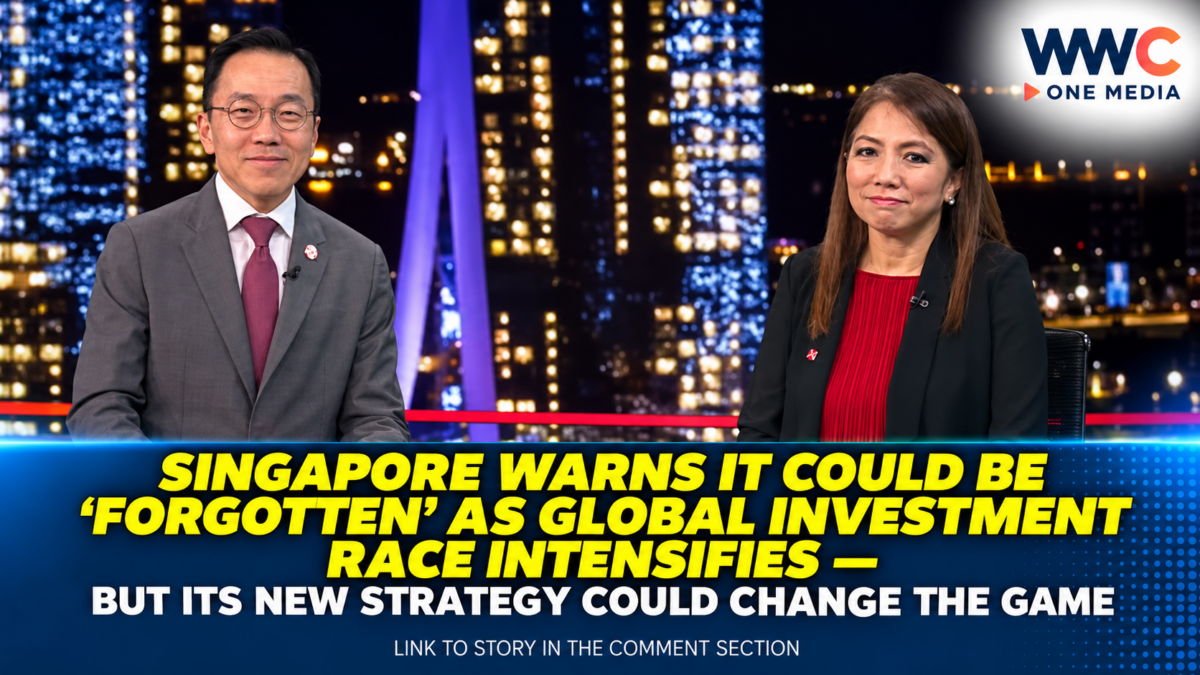
SINGAPORE — Singapore is stepping up efforts to defend its position as a leading global business and investment hub, warning that even an economy known for political stability, reliability and efficiency risks being overlooked as international competition intensifies.
The warning came from Beh Swan Gin, Permanent Secretary for Energy, Trade and Industry, who said Singapore must actively promote its advantages instead of assuming that decades of economic success will continue attracting investors, international companies and skilled professionals.
Speaking alongside DBS Group chief executive Tan Su Shan on CNA’s Singapore Tonight on October 20, Beh highlighted the importance of Singapore’s refreshed international branding initiative, “When You’re Ready.”
The multi-year campaign, first launched on September 22, aims to strengthen the country’s international visibility and position Singapore as a trusted partner for businesses navigating geopolitical uncertainty, economic fragmentation and rapid technological change.
The message is especially significant as countries compete more aggressively for investment, tourists, talent and opportunities in emerging industries such as artificial intelligence.
According to Beh, if Singapore fails to tell its own story, it risks being forgotten or allowing competitors to shape how the country is perceived internationally.
Why Singapore Is Worried About Being Overlooked
Singapore has spent decades building a global reputation for efficient infrastructure, transparent institutions, strong connectivity and a business-friendly environment.
But officials argue that these established advantages are no longer sufficient on their own.
Across the world, major cities and competing economies are investing in advertising, national branding, financial incentives and business development programs to attract international companies.
Singapore therefore faces a challenge: maintaining its established reputation while convincing a new generation of businesses and investors that it remains relevant.
Beh’s warning reflects the growing importance of visibility in economic competition.
Even countries with strong fundamentals can struggle to attract investment if businesses perceive other destinations as more innovative or better positioned for future growth.
The government’s refreshed campaign seeks to address that risk by explaining not only what Singapore has achieved, but also what it can help international companies accomplish.
‘When You’re Ready’: Singapore’s New Global Branding Strategy
Singapore launched the campaign on September 22, 2026, through its Ministry of Trade and Industry, now known as the Ministry of Energy, Trade and Industry (METI).
The initiative is designed to position Singapore as more than a convenient destination for setting up regional headquarters.
Instead, it presents the country as a place where international businesses, innovators and skilled professionals can form partnerships, develop new solutions and pursue long-term growth.
The campaign is built around three central attributes:
Trusted to Deliver
Singapore emphasizes its reputation for dependable institutions, policy consistency, effective execution and business confidence.
Globally Central
The campaign highlights Singapore’s ability to connect companies, capital, ideas and talent across Asia and other international markets.
Better Together
Singapore seeks to attract partners who want to collaborate on technological, economic and environmental challenges.
The campaign is intended to run over several years rather than serve as a short-term tourism advertisement.
DBS CEO Tan Su Shan: Branding Alone Is Not Enough
During the interview, DBS CEO Tan Su Shan highlighted another important reality: successful national branding must be supported by actual performance.
She argued that Singapore’s international credibility rests on years of reliable execution, transparent business practices and institutional consistency.
In an increasingly unpredictable global economy, these qualities are especially valuable.
Companies making substantial investments need confidence that regulations, business conditions and government policies will remain sufficiently predictable for long-term planning.
Tan said businesses are now navigating a world where trade, technology, currency markets, semiconductor supply chains and artificial intelligence have become major sources of geopolitical uncertainty.
Against this background, she believes Singapore’s reputation for stability gives it an important competitive advantage.
However, her message was not that Singapore can rely exclusively on its past achievements.
The country must continue adapting to the changing needs of international companies.
Artificial Intelligence and Workforce Training Become Major Selling Points
The rapid development of AI is reshaping international competition for investment.
Businesses increasingly evaluate potential investment destinations not only by their physical infrastructure or tax environment, but also by the capabilities of their workforces.
Tan pointed to Singapore’s emphasis on preparing workers for technological change through education, retraining and skills development.
This approach is intended to help employees adapt as businesses introduce AI-powered tools and automated processes.
For multinational companies, access to a skilled and adaptable workforce can influence decisions about where to establish operations, expand research activities or develop new products.
Singapore is therefore seeking to make workforce development part of its broader international investment proposition.
However, training initiatives alone do not guarantee that technological disruption will be painless. Companies and workers will still face difficult adjustments as AI changes job requirements.
From Singapore’s ‘Little Red Dot’ to a New Global Brand Identity
Beyond economic messaging, the campaign introduces a major visual change in Singapore’s international branding.
According to marketing publication MARKETING-INTERACTIVE, the refreshed identity was designed by branding practice Anak, which reimagined Singapore’s familiar Little Red Dot symbol through a new graphic concept known as the SG sphere.
The sphere represents Singapore’s role in connecting people, ideas, investments and partnerships.
The wider brand refresh introduces updated typography, motion graphics and a new visual language.
Independent creative agency The Secret Little Agency developed the accompanying “When You’re Ready” campaign.
This represents one of the country’s most significant international brand developments in nearly a decade.
The objective is not simply to create a new logo, but to communicate Singapore’s relevance to an increasingly competitive global audience.
New York Climate Week Becomes First Major Campaign Showcase
The first major activation of the refreshed branding initiative took place in New York during Climate Week from September 21 to 23.
Called The Zero Parlour, the event provided a space for international participants to discuss climate challenges and explore opportunities for collaboration.
The activation reflected Singapore’s desire to present itself as a country that helps develop solutions with international partners.
Its climate-related focus also demonstrated how the campaign intends to move beyond traditional advertising into real-world engagement.
Rather than concentrating entirely on attracting companies to relocate, Singapore is attempting to build relationships around shared economic and environmental priorities.
The September event was a campaign launch activity, not evidence that any specific amount of investment had already been secured.
Haze, Formula One and a Test of Singapore’s Reputation
One of the more revealing parts of Beh’s interview concerned Singapore’s response to regional haze.
The city-state recently faced transboundary haze affecting major public and business activities, including the Singapore Formula One Grand Prix period.
Beh acknowledged that international visitors were familiar with the recurring environmental problem.
His emphasis, however, was on how Singapore responds when conditions deteriorate.
Authorities distributed N95 masks and issued health guidance for schools, workplaces and event organizers.
From Beh’s perspective, effective crisis management is part of what gives a country credibility.
The incident highlights a wider branding challenge: reputation is not determined solely by positive advertising, but also by how governments respond when events do not go according to plan.
The haze was not presented as something the branding campaign could eliminate. Rather, the response to the problem was cited as an example of institutional reliability.
What This Means for ASEAN and the Philippines
Singapore’s refreshed international branding is relevant to other Southeast Asian economies competing for foreign investment and skilled workers.
Countries such as the Philippines, Malaysia, Thailand, Indonesia and Vietnam are also seeking opportunities in advanced manufacturing, digital services, tourism and technology.
Singapore’s strategy illustrates the growing importance of combining investment promotion with clear positioning, reliable institutions and workforce development.
For the Philippines, this raises practical policy and business questions: how can the country communicate its competitive advantages more effectively, and how can investment promotion be supported by infrastructure, regulatory predictability and skills development?
These are regional implications of Singapore’s campaign, not policies announced by the Philippine government in connection with the initiative.
The broader lesson is that national branding may influence investor perceptions, but economic fundamentals ultimately determine whether promotional promises can be delivered.
Can Singapore Maintain Its Global Advantage?
Singapore’s new campaign arrives during a period of intense competition and uncertainty.
Trade tensions, AI disruption, supply-chain shifts and changing investment patterns are forcing businesses to reconsider where they operate.
A trusted national reputation offers an advantage, but it does not make a country immune to these pressures.
The success of “When You’re Ready” will depend on whether its message translates into deeper business relationships, sustained international attention and new opportunities.
The bottom line: Singapore is investing in a stronger global identity because officials believe its past economic achievements are no longer enough to guarantee continued attention from investors, businesses and international talent.
The central question is whether the country’s reputation for reliability, combined with its renewed focus on innovation and global partnerships, will be sufficient to sustain its competitiveness.