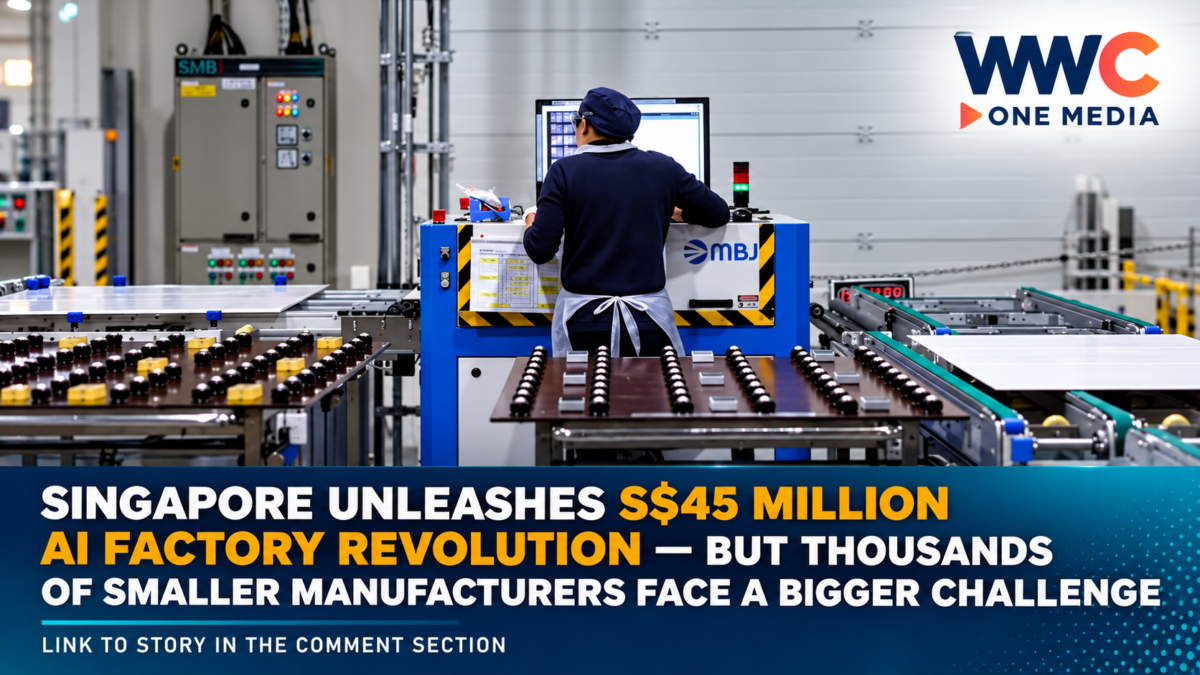
SINGAPORE, October 21, 2026 — Singapore is accelerating its artificial intelligence revolution with more than S$45 million (approximately US$35 million) in funding over the next three years to help manufacturers adopt AI-powered technologies, potentially transforming how factories design products, manage production and maintain industrial equipment.
The announcement represents another major step in Singapore’s ambition to strengthen its position as an advanced manufacturing hub in Asia, where automation, robotics and artificial intelligence are increasingly reshaping industrial competitiveness.
But behind the multimillion-dollar initiative lies a critical challenge: Can Singapore’s smaller manufacturers embrace the AI revolution quickly enough to compete with larger, better-funded industrial players?
Government Commits Over S$45 Million to Transform Manufacturing
Minister of State for Energy, Trade and Industry Gan Siow Huang announced the funding on Wednesday, October 21, during Industrial Transformation Asia-Pacific 2026.
The investment will support Enterprise Singapore’s Catalytic AI Solutions initiative for advanced manufacturing, designed to overcome the financial and technical challenges that frequently prevent small and medium-sized enterprises (SMEs) from adopting sophisticated AI technologies.
Rather than forcing individual manufacturers to develop expensive systems from scratch, the initiative will give eligible businesses access to ready-to-deploy AI solutions.
Enterprise Singapore will also co-fund eligible companies adopting solutions under the programme.
The objective is to lower implementation barriers while helping factories improve productivity, operational efficiency and long-term competitiveness.
From Product Design to Predictive Maintenance: Where AI Will Make a Difference
The programme targets several manufacturing operations where AI could deliver measurable improvements.
Product and component design: AI-powered software can help manufacturers evaluate designs and identify potential improvements before production begins.
Quotation processing: Automated systems can process requests for quotation, potentially reducing administrative workloads and shortening response times.
Production scheduling: AI tools can help factories allocate resources, coordinate production activities and respond to changing operational requirements.
Predictive maintenance: By analysing machine performance and operating data, AI systems can identify warning signs of equipment problems before breakdowns interrupt production.
Enterprise Singapore says these solutions could help companies minimise repetitive work, improve equipment reliability and maintain consistent product quality.
The available suite of technologies is expected to expand as additional manufacturing needs and suitable solutions are identified.
Singapore’s Smaller Manufacturers Face the Biggest Test
Although multinational manufacturers can invest heavily in proprietary technology, smaller businesses often operate with tighter budgets, limited technical expertise and less room for expensive experimentation.
According to Enterprise Singapore, common barriers include AI development costs, a shortage of industry-specific solutions and uncertainty over whether investments will produce meaningful business results.
The new initiative aims to address these problems by connecting manufacturers with technology providers, system integrators and industry associations.
This collaborative approach could make AI deployment faster and less complicated for participating companies.
However, government support alone does not guarantee successful digital transformation.
Manufacturers will still need suitable data, trained employees, reliable systems and clear business objectives to turn AI adoption into measurable productivity gains.
AI Already Making Inroads Into Singapore’s Factories
Singapore’s AI transformation is not starting from zero.
The country’s AI Centre of Excellence for Manufacturing, known as AIMfg, has already worked with 30 manufacturers and completed 23 AI deployment projects across industries including aerospace, semiconductors, pharmaceuticals and energy.
Established in 2024 by the Agency for Science, Technology and Research (A*STAR) and the Ministry of Trade and Industry, the centre is preparing for its next development phase with support from Singapore’s Research, Innovation and Enterprise 2030 plan.
Its expanded mission will involve solving more complicated manufacturing problems, developing industry-ready solutions and helping more manufacturers move beyond limited AI pilot projects.
For Singapore, the broader objective is to turn experimental applications into technologies that can be deployed throughout industrial operations.
AI Adoption Accelerates Across Singapore Businesses
The manufacturing announcement follows a broader increase in AI adoption throughout Singapore’s economy.
Government figures cited by Channel NewsAsia show that nearly one in four Singapore businesses adopted AI in 2025, compared with roughly one in seven in 2024.
Earlier data from Singapore’s Infocomm Media Development Authority showed that AI adoption among SMEs had already climbed from 4.2% in 2023 to 14.5% in 2024.
Among larger enterprises, adoption rose from 44% to 62.5% over the same period.
A separate IMDA report found that SMEs adopting AI-enabled solutions through the Productivity Solutions Grant recorded average cost savings of 52% in 2024.
These findings suggest that AI can deliver substantial business benefits, although the savings reported under an existing grant programme should not be interpreted as guaranteed returns for manufacturers participating in the newly announced initiative.
Singapore Launches Embodied AI Challenge With Micron
Singapore is also expanding its ambitions beyond conventional AI software.
Gan announced the Singapore Embodied AI Challenge for Manufacturing, an initiative bringing together researchers, start-ups, industrial companies and international talent.
Unlike software-based AI applications, embodied AI combines artificial intelligence with robotics and physical machinery, allowing systems to perceive their surroundings, make decisions and perform actions in real-world environments.
The inaugural challenge will focus on a semiconductor manufacturing use case provided by Micron, the global memory chip manufacturer.
The competition is intended to encourage practical technological solutions with potential pathways to commercial deployment.
The initiative highlights Singapore’s ambition to become a location where advanced robotics and intelligent manufacturing systems are not only researched but also applied in real industrial settings.
A Bigger Strategy to Protect Singapore’s Industrial Competitiveness
Manufacturing contributes nearly one-fifth of Singapore’s gross domestic product, making the sector strategically important to economic growth.
The new AI funding forms part of Singapore’s wider national effort to accelerate AI adoption in advanced manufacturing, connectivity, finance and healthcare.
Additional government measures announced in Budget 2026 include expanding the Enterprise Innovation Scheme to qualifying AI expenditure and broadening access to digital and AI-enabled solutions under the Productivity Solutions Grant.
Singapore has also introduced the Champions of AI programme to support deeper business transformation.
Together, these measures show that the country is treating AI as more than another technology upgrade.
It is increasingly becoming a core element of Singapore’s industrial and economic strategy.
What This Means for Asia’s Manufacturing Competition
Singapore’s latest commitment could have implications beyond its borders.
Across Asia, manufacturers face pressure to increase productivity, address labour shortages, strengthen supply-chain resilience and remain competitive in sophisticated industries such as electronics, pharmaceuticals and semiconductors.
Singapore’s approach offers one possible model: combine government co-funding, applied research, commercial AI providers and industry partnerships to help smaller manufacturers modernise.
For neighbouring economies, including the Philippines, Malaysia, Thailand, Indonesia and Vietnam, the initiative highlights the growing importance of AI readiness in the regional manufacturing landscape.
However, whether Singapore’s programme becomes a regional model will depend on results rather than funding announcements alone.
The most important indicators will include how many companies deploy AI successfully, whether manufacturing productivity improves and whether smaller firms can sustain those benefits without continuous financial assistance.
The Real Question: Will AI Funding Deliver a Manufacturing Breakthrough?
Singapore’s S$45 million-plus commitment creates another opportunity for factories to modernise, automate repetitive tasks and build more competitive industrial operations.
Yet the most difficult phase of the AI revolution is not necessarily developing the technology. It is integrating that technology into everyday business processes and proving that it works.
For smaller manufacturers, challenges involving workforce skills, equipment integration, cybersecurity and investment returns may remain significant.
Singapore has committed the funding and established the framework. Now the real test begins: Can its manufacturers turn AI investment into lasting industrial advantages before global competition moves further ahead?