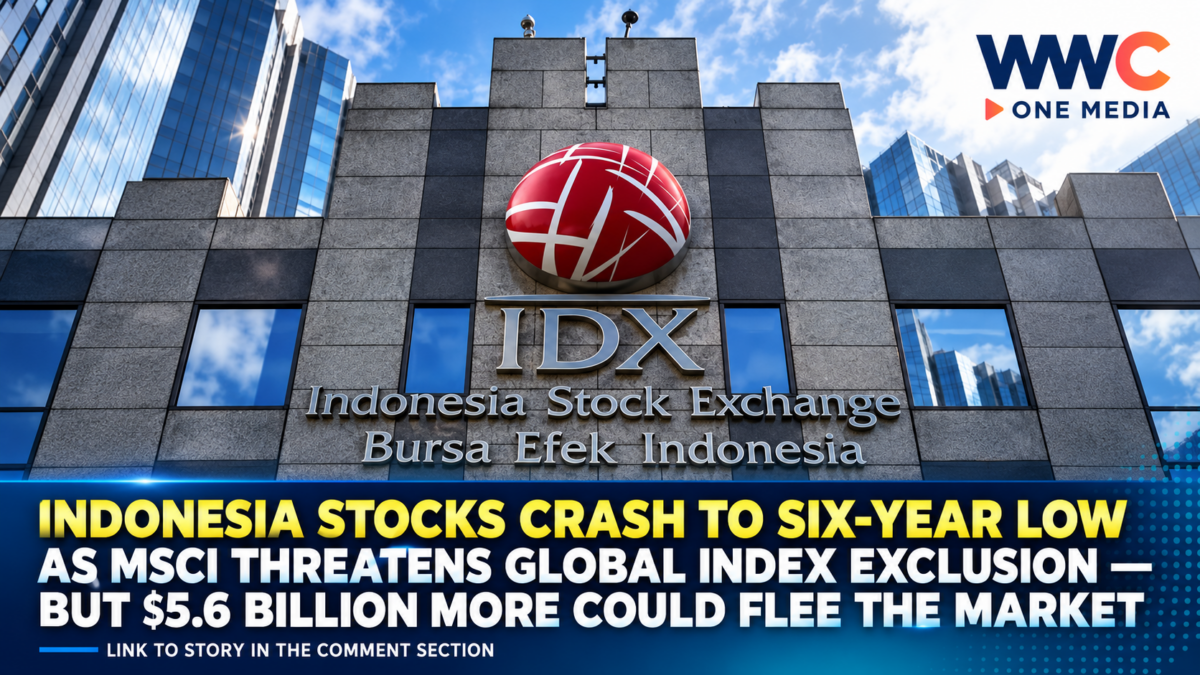
Indonesia’s stock market has plunged to its lowest level in six years, triggering fresh fears of a prolonged financial selloff after global index provider MSCI warned that the country could lose its emerging-market classification and be excluded from major international investment benchmarks.
The warning has intensified a crisis that has already wiped billions of dollars from Indonesian equities, weakened the rupiah and raised serious questions about whether Jakarta can restore global investor confidence before a potentially historic downgrade in 2027.
On Monday, October 19, the Jakarta Composite Index fell more than 5% in early trading, extending an extraordinary 11.6% collapse on Friday, October 16 — its worst single-day performance since the Asian financial crisis of 1998.
That Friday crash erased approximately US$65 billion in market value, according to Reuters, underscoring the scale of the selloff sweeping Indonesia’s financial markets.
MSCI warning threatens Indonesia’s global investment status
At the center of the market turmoil is MSCI, the international index provider whose emerging-market benchmarks influence how institutional investors allocate capital worldwide.
MSCI has warned that Indonesia could be reclassified from an emerging market to a standalone market, a far more severe outcome than the frontier-market downgrade previously under consideration.
The concerns include opaque share ownership, concentrated control of publicly traded companies, questionable trading practices and insufficient improvements in market transparency.
A standalone designation could remove Indonesian stocks from major MSCI indexes followed by international investment funds.
Indonesia could consequently find itself in the same market-classification category as Lebanon and Zimbabwe, a damaging setback for a country seeking to attract long-term international investment.
MSCI has not finalized the downgrade. Indonesia still has an opportunity to demonstrate meaningful reforms before a decision expected in 2027.
Reuters
+2
Billions of dollars could leave Indonesian stocks
The potential financial consequences extend well beyond the initial market collapse.
According to Goldman Sachs estimates reported by Reuters and Channel News Asia, full removal from MSCI benchmarks could trigger approximately US$5.6 billion in passive investment outflows.
Funds actively managed against those indexes also hold more than US$8 billion in Indonesian equities, creating additional selling risks, although those managers would not automatically be required to exit their positions.
Foreign investors have already sold a net US$4.88 billion in Indonesian shares during 2026, putting the market on course for its largest annual foreign investment outflow in at least 16 years.
The distinction is critical: the US$5.6 billion figure is a forecast of potential passive selling, not money that has already left the market. Actual outflows will depend on MSCI’s eventual decision and investor responses.
Jakarta moves to stop the bleeding
Indonesian authorities are scrambling to demonstrate that the country’s stock market can operate with stronger transparency, improved enforcement and fairer conditions for investors.
The Indonesia Stock Exchange reduced its lower automatic price-rejection threshold from 15% to 7% on October 19, a measure intended to slow extreme downward price movements and allow investors more time to assess developments.
Regulators also announced sanctions totaling 2.1 trillion rupiah, equivalent to approximately US$116.4 million, against parties linked to alleged trading manipulation involving three listed companies.
The penalties represent an important enforcement step, but market observers caution that investors will want evidence of sustained regulatory action rather than isolated penalties.
Goldman Sachs strategists have indicated that announced reforms must translate into measurable improvements in how the market functions.
For Jakarta, the challenge is no longer simply introducing new rules. It is convincing international investors that those rules will be consistently enforced.
Rupiah under pressure as financial contagion fears grow
Indonesia’s currency is also showing signs of stress.
The rupiah weakened to approximately 18,040 against the US dollar, approaching the record low of 18,190 reached in June, according to the October 19 Reuters report.
A sustained currency decline could increase imported inflation, raise the local-currency cost of dollar-denominated obligations and complicate monetary policy.
Investors are particularly concerned that a stock-market selloff could spill into Indonesia’s government bond market.
If capital flight drives bond yields higher, borrowing could become more expensive for businesses and the government, potentially weighing on investment and economic growth.
The pressure comes as President Prabowo Subianto faces growing scrutiny over economic management, while Moody’s and Fitch have already revised Indonesia’s sovereign credit-rating outlooks to negative earlier in 2026.
A weaker currency, higher borrowing costs and falling equity valuations could create a difficult combination for policymakers.
Financial Times: Strong companies remain, but market structure is the problem
Additional reporting and analysis from the Financial Times highlights an important distinction between Indonesia’s stock-market problems and the financial health of some of its leading businesses.
Major Indonesian banks, including Bank Central Asia and Bank Mandiri, remain profitable, with reported returns on equity in the 18%–20% range.
However, the market continues to face structural problems, including concentrated ownership, limited freely tradable shares and questions about price discovery.
Indonesia has introduced changes aimed at improving its market, including a higher minimum public free-float requirement and tougher shareholder disclosure standards.
The Indonesia Stock Exchange has also moved to remove closely held companies from its benchmark index, representing roughly 18% of its market capitalization, according to the Financial Times.
These measures demonstrate a willingness to reform, but the underlying question remains whether investors believe the improvements are substantial enough to reduce manipulation risks and improve liquidity.
Why the crisis matters beyond Indonesia
The selloff has broader significance for Southeast Asia.
Indonesia is the region’s largest economy, and its financial markets are an important destination for global investment capital.
A prolonged crisis could make international investors more selective about emerging-market exposure, particularly in countries where share ownership, regulatory enforcement and trading liquidity are difficult to assess.
However, pressure on Indonesia does not automatically mean that other ASEAN stock markets will experience similar declines. The extent of any regional spillover will depend on investor positioning, currency movements and domestic fundamentals.
For Indonesia, the immediate danger is a negative feedback loop: falling stock prices encourage foreign withdrawals, currency depreciation reinforces investor caution, and higher financing costs weaken confidence further.
Restoring trust will therefore require more than a temporary rebound in the Jakarta Composite Index.
The bigger question: Can Indonesia save its emerging-market status?
Indonesia’s market crisis has become a test of financial credibility.
MSCI’s potential downgrade threatens to reshape international investment flows, while domestic regulators face mounting pressure to demonstrate that the country’s financial system can protect investors and support transparent trading.
The coming months will be crucial as authorities attempt to rebuild confidence, strengthen market supervision and convince MSCI that meaningful changes are underway.
For investors, the stakes are substantial: Indonesia could retain its place in global emerging-market benchmarks if reforms succeed, or face an extended period of reduced international investment if the downgrade goes ahead.
The question is no longer whether Indonesia’s stock market has suffered a major shock. It is whether Jakarta can rebuild investor trust before the country’s access to global capital becomes even more restricted.