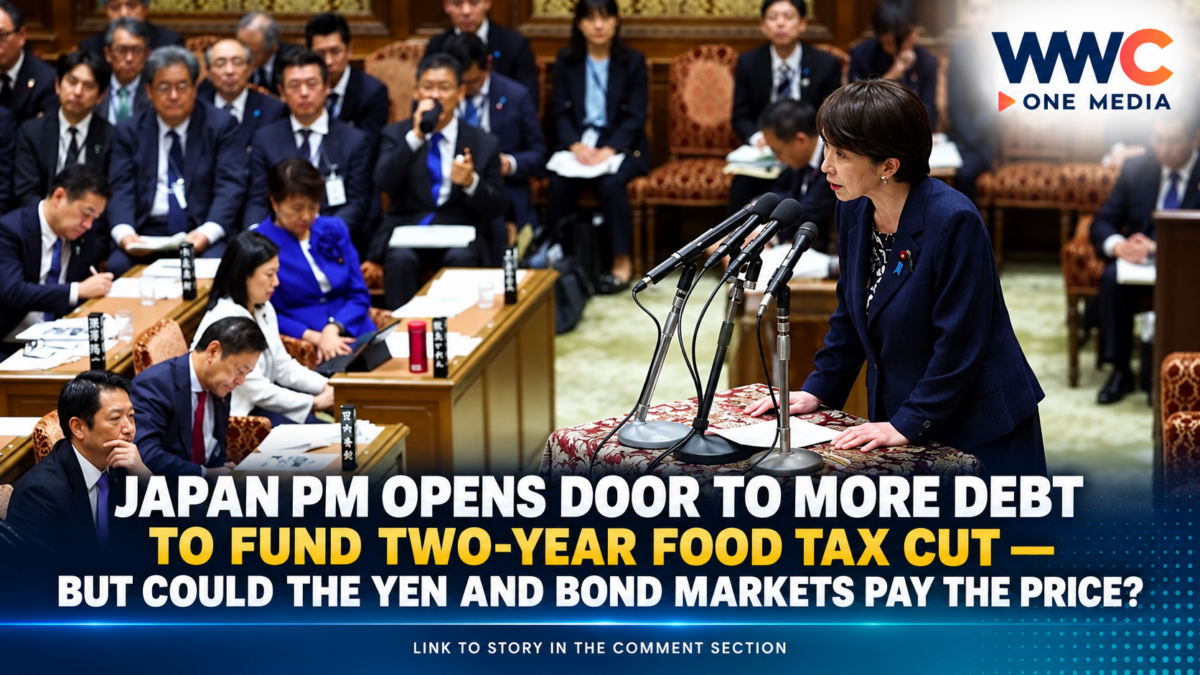
TOKYO, Japan — Japanese Prime Minister Sanae Takaichi has opened the door to issuing additional government bonds to finance a proposed two-year consumption tax cut on food, signaling that Tokyo may be prepared to take on more borrowing to protect households struggling with rising living costs.
Speaking before parliament on Monday, October 19, Takaichi acknowledged that her administration could turn to debt financing to support the tax relief program, even as the government pledges to maintain fiscal discipline and gradually reduce Japan’s debt burden relative to the size of its economy.
The announcement highlights a growing dilemma for the world’s fourth-largest economy: how to ease pressure on consumers without undermining confidence in government finances, Japanese bonds and the yen.
Japan Plans Two-Year Food Tax Relief Beginning April 2027
Under the government’s proposed policy, Japan would temporarily eliminate the 8% consumption tax currently imposed on food items for two years, with implementation planned for April 2027.
The measure is intended to provide direct relief to consumers who have faced persistent price increases on groceries and other household essentials.
For Japanese families, eliminating the food consumption tax could reduce the cost of eligible purchases, potentially freeing up income for other necessities.
However, the reduction would also deprive the government of tax revenue at a time when Japan faces mounting spending pressures from an aging population, social security commitments and higher borrowing costs.
The proposal has not yet become law, and its final financing arrangements remain uncertain.
Takaichi Refuses to Rule Out More Borrowing
During her parliamentary remarks, Takaichi emphasized that her administration intends to manage annual government bond issuance while working to reduce the debt-to-GDP ratio over time.
Nevertheless, she acknowledged that borrowing remains a possible source of financing for the proposed tax cut.
The comments suggest that the government may prioritize short-term household relief even if it requires additional borrowing.
Japan has long relied on government bonds to finance public spending, making changes in its fiscal strategy particularly important to investors monitoring the country’s debt sustainability.
For financial markets, the crucial question is not simply whether Japan can issue more bonds, but whether investors will continue financing that borrowing at manageable interest rates.
Japan’s Debt Problem Could Complicate the Plan
Japan already carries one of the largest public debt burdens among advanced economies.
The challenge could become more expensive as interest rates rise and existing government bonds mature.
According to a February 2026 Reuters report citing Japanese Finance Ministry estimates, annual government bond issuance could increase from approximately ¥29.6 trillion in fiscal 2026 to ¥38 trillion by fiscal 2029.
Debt-servicing costs were also projected to reach around ¥40.3 trillion by fiscal 2029, potentially absorbing a substantial share of government spending.
Those projections underscore the financial pressure facing policymakers even before the proposed food tax reduction is implemented.
Any additional borrowing could complicate efforts to stabilize public finances, particularly if bond yields continue rising.
Bank of Japan Faces a Difficult Inflation Balancing Act
The government’s plans come as the Bank of Japan navigates its own economic challenges.
Japan’s central bank raised its benchmark interest rate to 1.25% in September 2026, its highest level in more than three decades, as policymakers attempted to contain persistent inflationary pressures.
Reports indicate that the Bank of Japan may lift its inflation forecasts amid elevated energy prices, although it is widely expected to keep interest rates unchanged at its October 30 policy meeting.
Higher interest rates can help contain inflation and support the yen, but they can also increase the government’s cost of borrowing.
This creates a delicate balancing act between providing fiscal stimulus to consumers and maintaining monetary stability.
IMF Warns Against Losing Fiscal Discipline
The International Monetary Fund has also expressed concern about the potential consequences of Japan’s tax-cut and spending plans.
In remarks reported by Reuters on October 17, IMF officials stressed the importance of a credible medium-term fiscal framework as Japan continues adjusting monetary policy.
The international lender warned that additional spending and consumption tax reductions could heighten investor concerns about Japan’s debt sustainability.
The IMF also indicated that the Bank of Japan may need to accelerate monetary tightening if inflation proves stronger than expected.
Together, these developments illustrate how Japan’s fiscal and monetary policies are becoming increasingly interconnected.
What Happens to the Japanese Yen?
Takaichi has argued that strengthening Japan’s economic fundamentals can help reinforce market confidence in the yen.
However, financial markets may react differently depending on how the tax cut is funded.
If additional borrowing leads investors to demand higher yields on Japanese government bonds, borrowing costs could rise.
Conversely, stronger domestic spending and improved economic growth could help offset some of the fiscal pressures.
Currency movements will also depend on the Bank of Japan’s interest rate decisions, global capital flows and broader economic conditions.
A weaker yen could increase import costs, particularly for energy and food-related products, potentially reducing some of the purchasing-power benefits the government hopes to deliver.
That remains a risk, rather than a confirmed consequence of the tax-cut proposal.
Why Japan’s Decision Matters Across Asia
Japan remains a major financial and trading partner for economies throughout Asia, making its fiscal decisions important beyond its borders.
Changes in Japanese interest rates, bond yields and currency values can influence regional investment flows, borrowing conditions and trade competitiveness.
For Asian economies, including the Philippines, significant movements in the yen could affect import prices, Japanese investment decisions and the cost of yen-denominated financial obligations.
However, these outcomes depend on how financial markets respond and are not automatic consequences of the proposed tax cut.
The Bigger Question: Can Japan Cut Taxes Without Undermining Its Finances?
The Japanese government’s immediate objective is straightforward: give households relief from rising food costs.
The financial challenge is considerably more complicated.
While eliminating the food consumption tax for two years could provide tangible savings to consumers, financing the measure through additional borrowing may intensify scrutiny of Japan’s debt trajectory.
Takaichi now faces the task of convincing voters that her administration can deliver meaningful economic relief while reassuring investors that Japan remains committed to responsible fiscal management.
The next major test will be whether Tokyo can finalize and fund the April 2027 tax cut without destabilizing confidence in Japanese government bonds or the yen.
For now, Japan’s proposed tax relief offers households the prospect of lower grocery bills — but leaves financial markets questioning who will ultimately pay for it.