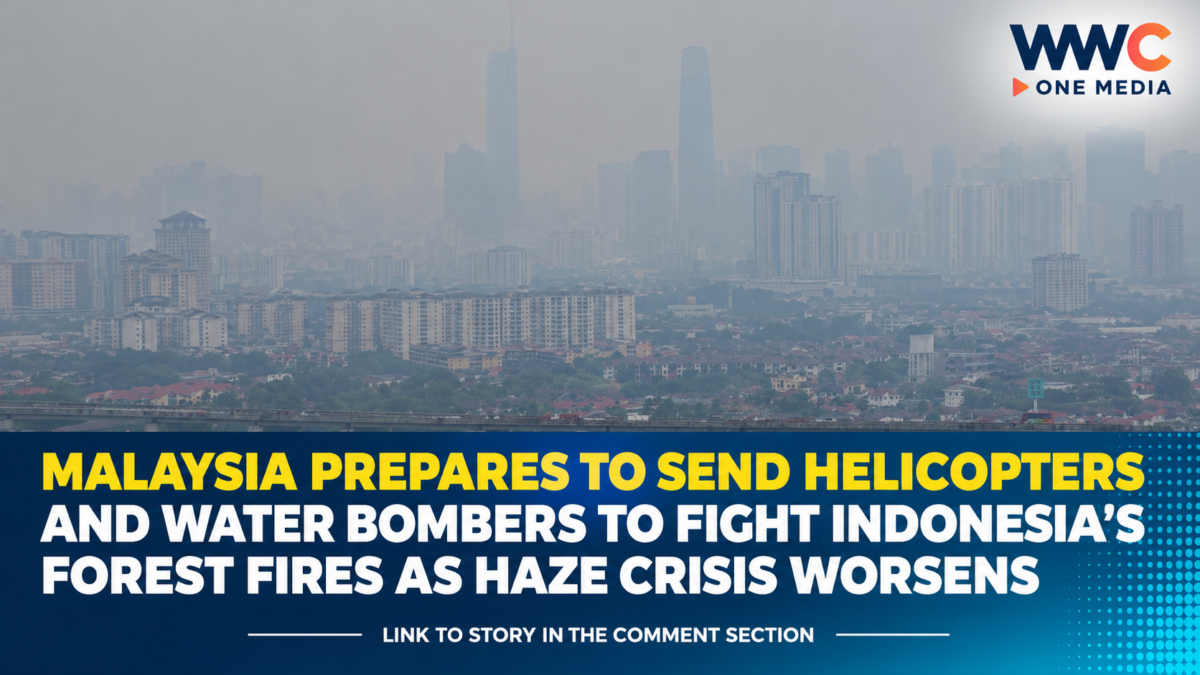
Malaysia is preparing to step up efforts to help Indonesia battle widespread forest and land fires that have sent thick haze across Southeast Asia, with helicopters and specialised water-bombing aircraft among the assets being considered for deployment.
The proposed assistance comes as prolonged fires across Indonesia’s Sumatra and Kalimantan regions continue to threaten air quality, public health and regional economic activity. Malaysia’s Foreign Minister Mohamad Hasan said on October 18 that discussions were underway between officials from both countries to determine how the assistance could be delivered safely and effectively.
The deployment is still subject to further coordination and Malaysian Cabinet approval, despite Indonesia’s broader decision to accept offers of assistance from neighbouring countries.
The situation marks a significant development in the region’s recurring transboundary haze crisis, which has forced school closures in parts of Malaysia and raised concerns about the environmental and health consequences of prolonged exposure to polluted air.
Malaysia Considers Water-Bombing Aircraft and Helicopters
Malaysia’s proposed assistance includes a Bombardier CL-415MP amphibious aircraft capable of collecting water from suitable bodies of water and releasing it over fire-affected areas. Three helicopters and 52 personnel from relevant Malaysian agencies were also included in the earlier assistance offer.
Deputy Prime Minister Ahmad Zahid Hamidi first announced the offer in September, saying Malaysia wanted to help Indonesia contain the fires before they caused further cross-border damage.
The assistance would involve personnel and resources from Malaysia’s National Disaster Management Agency, Malaysian Maritime Enforcement Agency and Royal Malaysian Air Force.
However, Foreign Minister Mohamad Hasan said the operational arrangements were still being discussed, with officials from the Foreign Ministry, disaster management agency and National Security Council coordinating with their Indonesian counterparts.
The proposed deployment must also account for difficult conditions on the ground, particularly in remote areas where fires are difficult to reach by road.
Thick smoke has severely reduced visibility in some affected locations, making aerial firefighting operations hazardous for pilots and crew. Malaysian authorities have stressed that any deployment must prioritise personnel safety.
The final decision on the timing, location and scope of the mission will depend on the outcome of bilateral discussions and the necessary approvals.
Indonesia Accepts Foreign Aid as Firefighting Efforts Intensify
Indonesia’s decision to accept assistance from neighbouring countries has opened the door to greater regional cooperation in tackling the fires.
On October 15, Indonesian Foreign Ministry official Arrmanatha Nasir said President Prabowo Subianto had approved offers of foreign assistance, with technical discussions underway to determine how the support would be implemented.
Malaysia subsequently reiterated its readiness to contribute firefighting equipment and personnel.
The development follows weeks of uncertainty over whether Indonesia would accept outside help. Earlier in October, Indonesian officials had said discussions on Malaysia’s offer had not yet taken place, even as fires continued to burn in parts of the country.
Indonesia has meanwhile deployed tens of thousands of personnel, alongside aircraft and helicopters, to fight the blazes and conduct water-bombing and weather-modification operations.
Authorities have also intensified enforcement efforts against individuals and companies suspected of starting fires.
Despite these measures, the scale of the emergency has made firefighting particularly difficult in remote forest and peatland areas, where flames can spread quickly and underground fires may continue smouldering even after surface flames appear to have been extinguished.
Forest Fires Trigger Severe Haze Across Southeast Asia
The fires have created a regional environmental emergency, with smoke and airborne pollutants spreading beyond Indonesia’s borders.
According to Reuters reporting published on October 15, fires in Indonesia have contributed to severe haze affecting Malaysia and Singapore, with some areas experiencing hazardous air pollution.
In Malaysia, authorities closed schools in several states and federal territories on October 9 after air quality deteriorated. The haze has raised concerns about respiratory health, particularly among children, older adults and people with existing respiratory sensitivities.
Singapore has also experienced a deterioration in air quality, with its one-hour PM2.5 concentration reaching 284 micrograms per cubic metre in the western part of the island on October 14.
The scale of the fires has been substantial. Environmental monitoring organisations estimated that hundreds of thousands of hectares of land had been affected in Indonesia during the first eight months of 2026, although estimates vary depending on the monitoring methods and definitions used.
The prolonged dry season and unusually hot conditions associated with a strong El Niño phenomenon have contributed to the risk of fires spreading across forests and peatlands.
Why Indonesia’s Peatland Fires Are Difficult to Control
Peatlands present a particular challenge because they contain layers of partially decomposed organic material that can remain dry and combustible during extended periods without rain.
When ignited, peat fires can burn below the surface, making them difficult to detect and extinguish using conventional firefighting methods. They can also produce substantial amounts of smoke and carbon emissions.
Forest and land clearing practices, including the use of fire to prepare agricultural land, have also been identified as contributing factors in recurring fire outbreaks.
Indonesian authorities have pledged stronger enforcement against illegal burning and companies suspected of violating environmental regulations. However, environmental groups have continued to call for more effective prevention, stronger accountability and improved protection of vulnerable forest areas.
The situation highlights why firefighting alone may not be sufficient to prevent future haze crises. Long-term solutions will also require effective land management, fire prevention and restoration of degraded peatlands.
Malaysia Calls for Regional Cooperation to Address Haze
Malaysia has emphasised that its proposed assistance is intended to support Indonesia rather than interfere in its domestic affairs.
The two countries are working within the broader framework of regional cooperation on transboundary haze, including the ASEAN Agreement on Transboundary Haze Pollution, which provides for assistance subject to the receiving country’s request and consent.
Malaysia has also pushed for greater regional coordination as the haze crisis affects communities and businesses across national borders.
The issue is expected to receive further attention in regional diplomatic discussions ahead of the ASEAN summit scheduled for November in the Philippines.
The recurring nature of the crisis has prompted calls for ASEAN members to strengthen early-warning systems, improve coordination between firefighting agencies and establish more effective arrangements for responding to fires before they spread across borders.
For Malaysia, helping Indonesia contain the current fires could reduce the immediate threat to public health while strengthening cooperation between neighbouring countries.
What Happens Next?
The immediate priority is to finalise the operational arrangements for any Malaysian deployment, including the location of firefighting teams, the equipment required and the safety conditions for aerial operations.
The effectiveness of the response will depend on several factors: access to fire-affected areas, visibility for aircraft, coordination between national agencies and whether weather conditions improve sufficiently to support firefighting.
Sustained rainfall could help reduce the intensity of the fires, although the timing and distribution of rain remain important uncertainties.
For millions of people across Southeast Asia, the outcome matters well beyond the forests themselves. Prolonged haze can disrupt education, transport, tourism and economic activity while increasing health risks for exposed communities.
Malaysia’s offer of assistance represents an important step towards a coordinated regional response. However, the longer-term challenge remains preventing the annual cycle of fires and haze from returning.
Until the fires are brought under control and preventive measures become more effective, Indonesia and its neighbours will continue to face the environmental, economic and public-health consequences of transboundary haze.
SEO keywords: Malaysia helps Indonesia forest fires, Indonesia forest fires 2026, Southeast Asia haze crisis, Malaysia water-bombing aircraft, Indonesian forest fire assistance, transboundary haze pollution, El Niño Indonesia fires, Kalimantan forest fires, Sumatra wildfires, ASEAN haze cooperation.