NEW YORK, United States — October 14, 2026 — Wall Street’s record-breaking rally is facing renewed pressure as surging oil prices, growing skepticism over artificial intelligence investments and uncertainty about US interest rates create sharp divisions across the stock market.
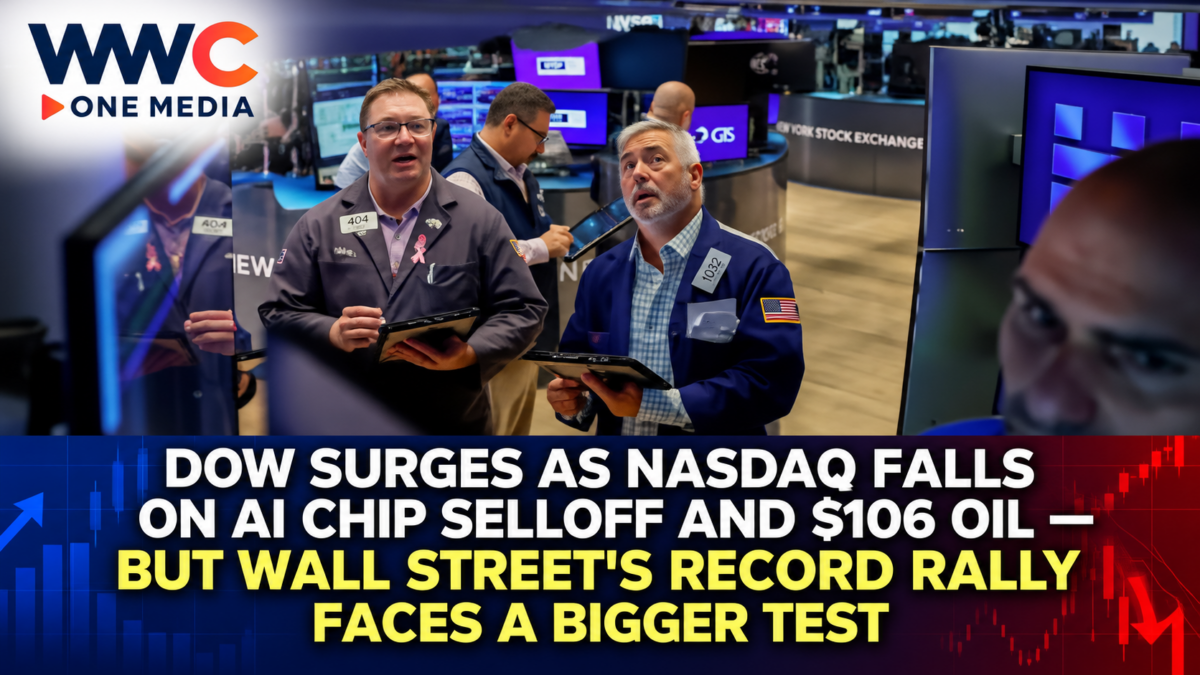
The Dow Jones Industrial Average rose nearly 200 points on Monday, October 12, even as the technology-heavy Nasdaq Composite declined and the S&P 500 finished slightly lower.
The mixed performance followed deadly attacks on Saudi Arabia’s international airport, which sent Brent crude above $106 a barrel and renewed concerns about inflation.
Semiconductor stocks suffered particularly sharp losses as investors questioned the sustainability of massive investments in AI computing infrastructure.
Meanwhile, traders were preparing for the start of third-quarter corporate earnings season, with major Wall Street banks scheduled to report results.
By Tuesday, October 13, the mood had become more cautious.
All three major US indexes closed lower as chipmakers weakened again and stronger-than-expected earnings from several large banks failed to generate a sustained market rally.
The S&P 500 nevertheless remained close to its historic peak.
Wall Street is still near record territory. But the bigger question is whether strong corporate profits can keep the rally alive while oil prices, borrowing costs and concerns about AI spending threaten investor confidence.
Dow Rises Nearly 200 Points While Nasdaq Slides
The October 12 trading session revealed a growing divide between technology shares and other sectors.
The Dow Jones Industrial Average climbed 195.60 points, or 0.38%, to close at 51,850.55.
The S&P 500 slipped 0.06% to 7,807.24.
The Nasdaq Composite fell 0.44% to 27,245.90.
Smaller companies also struggled, with the Russell 2000 losing approximately 0.45%.
US stock-market closing figures — October 12
| Index | Closing level | Daily change |
|---|---|---|
| Dow Jones Industrial Average | 51,850.55 | +0.38% |
| S&P 500 | 7,807.24 | -0.06% |
| Nasdaq Composite | 27,245.90 | -0.44% |
| Russell 2000 | 2,794.48 | -0.45% |
The figures show that the market was not experiencing a widespread collapse.
Instead, investors were rotating among sectors while reassessing the risks associated with expensive technology stocks.
Energy-related shares benefited from higher oil prices, while parts of the semiconductor industry came under pressure.
Wall Street Falls Again on October 13
The weakness extended into Tuesday’s session.
The Dow declined 180.45 points to close at 51,670.10.
The S&P 500 edged down to 7,805.45, a loss of just 0.02%.
The Nasdaq dropped 41.52 points, or 0.15%, to 27,204.38.
The Russell 2000 fell 0.40% to 2,783.37.
The relatively small index movements masked considerable volatility in individual stocks.
Some financial companies advanced following quarterly results, while several semiconductor and healthcare shares declined.
The Dow also ended a three-session winning streak.
Investors were increasingly reluctant to take large positions before the release of additional economic data.
Oil Above $106 Raises Inflation Fears
One of the most important developments behind Monday’s market performance was the rise in crude oil prices.
Brent crude climbed 1.8% on October 12 to settle at approximately $106.65 a barrel.
The increase followed deadly strikes against King Khalid International Airport in Riyadh over the weekend.
The attacks heightened concerns about the security of Saudi Arabia’s energy infrastructure and major Middle Eastern shipping routes.
Saudi Arabia remains one of the world’s most important oil producers and exporters.
Any prolonged disruption to its production or transportation systems could affect international crude supplies.
Higher oil prices also place pressure on consumers and businesses.
Transportation costs can increase, while manufacturers and logistics companies face higher operating expenses.
Those costs may eventually contribute to inflation.
However, oil-market volatility does not automatically translate into an equivalent increase in consumer prices.
The impact depends on how long prices remain elevated and how much companies pass on to customers.
Russia Diesel Deal Creates Further Uncertainty
Oil traders were also evaluating President Donald Trump’s announcement involving Russian diesel exports.
The arrangement was intended to provide additional fuel supplies at a time of elevated international energy prices.
However, the deal has generated political controversy because of Western sanctions associated with Russia’s war in Ukraine.
Trump also discussed a possible agreement to halt attacks on energy infrastructure.
The details remained disputed, and there was no independently established comprehensive cessation of strikes.
The situation left markets balancing the prospect of improved fuel availability against continued conflict-related supply risks.
For equity investors, the concern is that expensive energy could keep inflation elevated.
That could reduce the Federal Reserve’s ability to ease monetary conditions.
AI Chip Stocks Face a New Confidence Test
Technology shares were among the weakest areas of the market on October 12.
The Philadelphia Semiconductor Index fell approximately 2.7%.
Investors were responding to concerns about the future profitability of AI infrastructure investments and increasing competition.
Companies around the world are spending heavily on processors, memory chips, cloud computing and data centers.
Those investments have helped support semiconductor demand.
But they have also encouraged higher valuations based on expectations of rapid future growth.
When investors begin questioning those assumptions, share prices can become volatile.
The latest selloff does not prove that global demand for AI has disappeared.
Instead, it reflects uncertainty about which companies will capture the greatest financial benefits and whether their current market valuations are justified.
Chinese Chip Developments Add to Semiconductor Pressure
A second issue affecting sentiment involves technological progress in China.
Reuters reported that developments at Chinese memory-chip manufacturer ChangXin Memory Technologies, or CXMT, raised concerns about increasing international competition.
Memory technology is an important part of the global semiconductor industry.
Advances by new competitors can affect expectations for pricing, supply and profit margins.
The news added to selling pressure on certain US and Asian chip-related stocks.
South Korea’s stock market also experienced substantial volatility.
However, reports of technological progress at one company do not establish that Chinese suppliers have replaced all leading global semiconductor manufacturers.
The competitive implications depend on actual production capability, product performance and customer adoption.
Microsoft and Salesforce Help Offset Tech Weakness
Not every technology company declined during the October 12 session.
Microsoft shares gained approximately 1.1% following developments involving its AI-chip strategy.
Salesforce rose around 2% after receiving an analyst upgrade.
The gains illustrate the uneven nature of market sentiment.
Investors are not necessarily abandoning every business associated with artificial intelligence.
They are becoming more selective.
Some companies may benefit from improved earnings expectations or new products.
Others face pressure because their valuations assume exceptionally strong future growth.
The divergence demonstrates why the technology sector should not be treated as one uniform investment category.
Big Bank Earnings Fail to Lift Wall Street
Major US banks began reporting third-quarter results on October 13.
JPMorgan Chase, Goldman Sachs, Citigroup and Wells Fargo were among the institutions releasing results.
The earnings season opened against a complicated financial backdrop.
Higher interest rates can benefit certain banking activities but may also pressure borrowers and the value of some financial assets.
Investment banking and trading revenues depend on market activity and client demand.
Reuters reported that results were mixed, even as several financial institutions showed resilience.
Goldman Sachs benefited from strong trading performance.
Other banks faced questions about revenue trends and the impact of higher borrowing costs.
The broader market reaction was subdued.
Positive earnings alone were not enough to overcome caution about inflation and technology valuations.
Treasury Yields Become Another Major Threat
US Treasury yields remain an important factor shaping stock-market performance.
The benchmark 10-year Treasury yield stood near 5.24% around the October 12 trading session.
By October 13, Reuters reported a yield near 5.22%.
These are dated market observations, not permanent interest rates.
Higher Treasury yields can create pressure for equity valuations.
Government bonds offer investors income with relatively low credit risk, especially when held to maturity, though market prices and inflation remain important risks.
When bond yields rise, investors may demand greater potential returns to justify holding more volatile stocks.
That can make expensive growth companies particularly sensitive to interest-rate expectations.
Higher yields also raise financing costs for businesses and consumers.
For Wall Street, the concern is that borrowing costs may remain elevated even if corporate earnings continue growing.
BlackRock Downgrades Its US Stock-Market View
The rise in Treasury yields has already influenced major investment institutions.
On October 12, BlackRock’s investment research arm moved its tactical view of US equities from overweight to neutral.
It also upgraded short-term US Treasuries to overweight.
The change reflects BlackRock’s assessment that bonds now offer more attractive income and that equity markets face increased volatility.
However, neutral is not the same as bearish.
BlackRock has not advised investors to abandon US equities entirely.
The firm remains constructive on selected AI-related opportunities.
Its announcement illustrates a broader reassessment of the relative attractiveness of stocks and bonds after a substantial increase in government yields.
Investors Await Critical US Inflation Data
The next major test for financial markets is inflation.
The September Consumer Price Index report is scheduled for October 14.
Investors will examine whether higher energy prices and other costs are pushing consumer inflation further above the Federal Reserve’s target.
The Producer Price Index is expected on October 15.
These reports could influence expectations for future interest-rate decisions.
If inflation exceeds expectations, investors may anticipate tighter monetary policy.
That could increase borrowing costs and pressure stock valuations.
If inflation is more moderate, markets may become less concerned about additional tightening.
The outcome should not be assumed before the official data are released.
Wall Street’s Earnings Expectations Remain Strong
Despite the market’s cautious behavior, corporate earnings expectations remain relatively optimistic.
Reuters reported that analysts expected S&P 500 companies to record approximately 30.6% year-over-year earnings growth for the third quarter.
That is a substantial forecast.
However, the figure represents analysts’ expectations at the start of the reporting season rather than verified results for all companies.
The final outcome will depend on the earnings actually released.
Technology companies face particularly high expectations because of the AI investment boom.
Even strong reported profits may disappoint investors if they fall short of unusually optimistic forecasts.
The market will therefore focus not only on quarterly earnings but also on corporate guidance for future demand, costs and capital expenditure.
The S&P 500 Remains Near Record Territory
One reason investors are monitoring these developments closely is the market’s already substantial gains.
As of October 13, the S&P 500 was up approximately 14% for 2026.
The Nasdaq had gained about 17%.
The Dow was higher by approximately 7.5%.
These advances demonstrate that the market remains strong on a year-to-date basis.
But they also mean expectations may be elevated.
When stock prices reflect optimistic forecasts, unexpected increases in interest rates or disappointing earnings can produce sharper corrections.
A market near record highs is not inherently unstable.
Its resilience depends on whether corporate profits and economic conditions continue supporting valuations.
Why Asian Markets Are Watching
The movements in US technology stocks have implications across Asia.
Taiwan and South Korea are major suppliers of semiconductors and electronic components.
Their companies are linked to demand from US and global technology businesses.
A slowdown in AI infrastructure spending could affect export orders and investor expectations.
At the same time, higher US Treasury yields can influence capital flows and currency markets.
Asian investors may reassess the relative attractiveness of dollar-denominated assets and domestic securities.
The effects differ by country and industry.
A decline in US chip stocks does not guarantee an identical decline in every Asian technology company.
But the growing international integration of technology supply chains increases the potential for market volatility to spread.
What the Philippines Should Watch
For Philippine investors, US market developments can influence international portfolio allocations and investor sentiment.
Higher US Treasury yields may affect global borrowing conditions and capital flows.
A stronger or weaker US dollar can also influence the peso and the local cost of imported goods.
Elevated international oil prices are particularly relevant because the Philippines imports much of its petroleum requirements.
Sustained fuel-price pressure could affect transportation, business costs and inflation.
However, US index movements do not mechanically determine the Philippine Stock Exchange Index’s daily performance.
Domestic corporate earnings, interest rates and economic policy remain important local factors.
The broader lesson is that overseas market risks can affect the Philippine investment environment through several channels simultaneously.
What Could Trigger the Next Wall Street Rally?
A stronger rally could develop if corporate earnings exceed expectations and inflation shows signs of stabilizing.
Lower Treasury yields could also improve the relative appeal of stocks.
Encouraging evidence that AI investments are generating sustainable profits might restore confidence in semiconductor companies.
Reduced geopolitical tension could help lower energy prices and ease inflation concerns.
However, none of these developments is guaranteed.
Markets may remain volatile as investors evaluate changing information.
What Could Cause a Deeper Correction?
The risks include another rise in oil prices, unexpectedly strong inflation, higher Treasury yields and disappointing technology earnings.
Evidence of slower AI infrastructure spending could affect semiconductor suppliers and related companies.
A major geopolitical escalation could also discourage risk-taking.
These risks may reinforce one another.
For example, higher oil prices could increase inflation expectations, contributing to tighter monetary policy and pressure on stock valuations.
But identifying possible scenarios is different from predicting that a market crash will occur.
The available evidence shows increasing caution, not a confirmed systemic financial collapse.
What Happens Next?
The most important near-term developments include the October 14 US consumer inflation report, October 15 producer inflation figures, continuing bank earnings and later announcements from major technology companies.
Investors will also monitor Treasury yields, Middle Eastern security developments and crude oil prices.
Further information about Chinese semiconductor technology may influence the chip sector.
The Federal Reserve’s response to incoming economic data will shape expectations for future borrowing costs.
Together, these developments will determine whether the market’s recent weakness remains limited or becomes a more substantial correction.
The Bigger Question: Is Wall Street’s Record Rally Running Out of Momentum?
Wall Street’s October 12 trading session illustrated a market facing competing forces.
The Dow advanced while the Nasdaq fell.
Oil prices increased, raising inflation concerns.
Semiconductor shares weakened despite continued interest in artificial intelligence.
And investors prepared for a crucial week of corporate earnings and economic data.
A day later, the major indexes closed lower again.
Yet the S&P 500 remained close to its record peak, and corporate earnings expectations were still strong.
The market has not entered a confirmed broad-based crash.
Instead, investors are confronting a more difficult environment in which high valuations, expensive energy and elevated bond yields require greater confidence in future earnings.
The Dow’s October 12 gain briefly masked weakness in AI chip stocks, while rising oil prices reminded investors that inflation remains a serious threat. But the bigger test is still ahead: Can strong corporate earnings and resilient economic growth keep Wall Street near record highs — or will the combination of higher interest rates, geopolitical shocks and AI-market doubts finally bring the rally to an end?