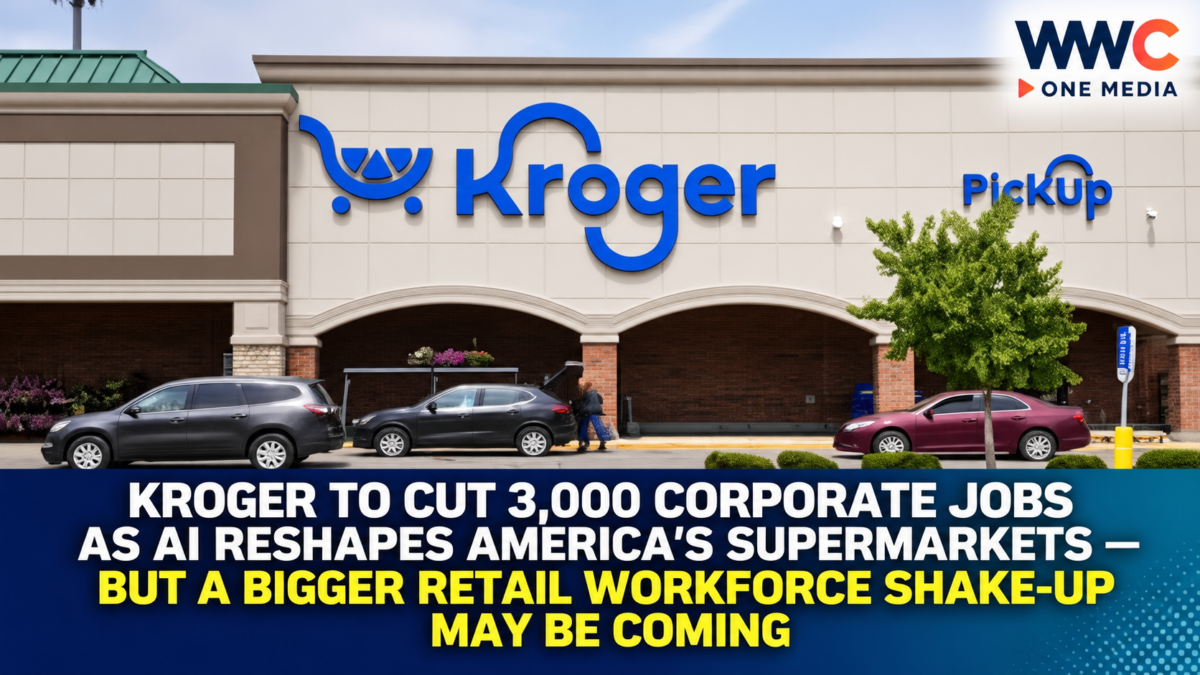
CINCINNATI, Ohio — October 14, 2026 — One of America’s largest supermarket operators is preparing to eliminate more than one-third of its corporate workforce in a sweeping restructuring that could become a defining example of how artificial intelligence is changing the future of retail employment.
Kroger announced plans to remove approximately 3,000 corporate positions over the next three years, cutting about 37% of the 8,200 employees working across its corporate organization.
The decision was announced by chief executive Greg Foran during an October 12 companywide meeting and in a memorandum to employees obtained by Bloomberg News.
The reductions rank among the largest corporate workforce cuts in the company’s 143-year history.
Foran, the former Walmart US chief executive who took over Kroger in February 2026, said the company needs to simplify its organizational structure, reduce duplicated work and make decisions faster.
The restructuring is linked to Kroger’s broader effort to deploy artificial intelligence, lower grocery prices and improve customer service.
But it arrives during a challenging period for America’s supermarket industry.
Rising household expenses have made consumers more price-sensitive, while Walmart, Costco, Aldi, Lidl and Amazon continue competing aggressively for grocery spending.
Kroger is also rebuilding its strategy following the collapse of its proposed merger with Albertsons, a transaction blocked by regulators in 2024.
For employees, the announcement introduces years of uncertainty.
For investors, it raises questions about how much money Kroger can save and whether leaner corporate operations will translate into better sales and profitability.
Kroger says artificial intelligence and a simpler corporate structure will help it compete. But the bigger question is whether eliminating thousands of office jobs will revive the supermarket giant — or accelerate an even broader transformation of white-collar employment across the retail industry.
Kroger Confirms Plan to Eliminate 3,000 Corporate Positions
The layoffs will take place over approximately three years.
According to Bloomberg, the company has about 8,200 corporate employees.
Removing 3,000 positions would reduce that workforce by approximately 36.6%, commonly rounded to 37%.
The affected positions span multiple corporate functions.
However, Kroger has not publicly identified a complete list of departments, job titles or office locations that will be affected.
Foran told employees that more information about the reductions will be shared in the coming months.
The timing indicates that the restructuring will unfold gradually rather than as a single immediate round of 3,000 dismissals.
That distinction is important for employees and communities concerned about the consequences.
While Kroger has confirmed the overall target, it has not announced that all 3,000 employees have already lost their jobs.
Key Numbers Behind Kroger’s Restructuring
| Indicator | Verified figure |
|---|---|
| Planned corporate job reductions | Approximately 3,000 |
| Current corporate employees | Approximately 8,200 |
| Corporate workforce reduction | Approximately 37% |
| Implementation period | Three years |
| Employees across Kroger’s business | Approximately 409,000 |
| Supermarket locations | More than 2,700 |
| Q2 2026 identical sales growth, excluding fuel | +0.2% |
| Q2 operating profit | $971 million |
| Q2 adjusted e-commerce sales growth | +20% |
The figures show that Kroger’s workforce reduction is concentrated in its corporate organization, while the wider company remains a massive national employer.
Its stores operate under several familiar brands, including Kroger, Ralphs, Fred Meyer, King Soopers and Smith’s.
CEO Greg Foran Says Kroger Has Too Many Management Layers
Foran’s internal memorandum focused on organizational complexity.
He argued that Kroger has too many management layers, administrative handoffs and overhead expenses.
The company wants to remove duplicative tasks and make decision-making faster.
That strategy reflects an operational approach Foran previously used at Walmart.
At Kroger, he wants a greater share of resources directed toward customers, stores and employees serving shoppers.
The restructuring is designed to create a leaner corporate organization.
However, cutting management layers can produce mixed outcomes.
Fewer approval stages may help teams make decisions more quickly.
But excessive reductions can also create operational bottlenecks if employees inherit responsibilities without adequate staffing or training.
The effectiveness of the plan will depend on which roles are eliminated and how remaining work is redistributed.
Artificial Intelligence Becomes Central to Kroger’s Turnaround
Technology is one of the major factors behind the new restructuring.
Kroger is expanding its use of artificial intelligence to improve internal operations and customer-facing services.
The company has identified opportunities for AI to reduce repetitive tasks, simplify workflows and improve the shopping experience.
Potential applications include inventory analysis, forecasting, product recommendations and administrative automation.
AI tools may also assist employees in retrieving information and completing routine work.
But the exact relationship between individual layoffs and particular AI systems has not been disclosed.
It would be inaccurate to claim that a specific AI tool has already replaced all 3,000 positions.
The company is pursuing organizational changes and technology adoption together.
Some work may be automated, while other responsibilities may be reassigned or eliminated through simplification.
Kroger Wants AI to Improve the Grocery Shopping Experience
Kroger’s AI strategy is not limited to reducing office expenses.
The company has outlined plans to make digital shopping more convenient.
Technology can help customers find products, discover promotions and receive recommendations.
AI-supported tools may also assist workers with complex tasks.
For example, better demand forecasts can help supermarkets maintain appropriate stock levels.
Improved inventory planning can reduce waste and missed sales opportunities.
For a grocery chain with thousands of locations, relatively small efficiency gains can have substantial effects.
However, AI investment introduces its own costs.
New systems require development, integration, security and employee training.
Kroger will need to demonstrate that the productivity gains justify those expenses.
Why Kroger Is Cutting Jobs While Promising to Invest in Workers
Foran has said the corporate restructuring will enable greater investment in frontline employees.
That creates an important distinction between two workforce categories.
Corporate employees work in functions such as administration, strategy, finance, technology and other office-based operations.
Frontline employees work directly in supermarkets and related operations.
Kroger wants to redirect more resources toward store execution and customer service.
The company has not announced that it intends to eliminate 37% of its store-level workers.
Nevertheless, the commitment to support frontline operations has not yet been accompanied by a detailed, comprehensive breakdown of how much money will be redirected from corporate job cuts to wages, hiring or training.
The effectiveness of that commitment will become clearer as the restructuring progresses.
Kroger Is Under Pressure to Lower Grocery Prices
Affordability is one of the central challenges facing US retailers.
Consumers have become more cautious about household spending as food, energy and other living costs remain elevated.
Grocery chains face strong competition from discount retailers and large general-merchandise companies.
Walmart has a powerful grocery business and significant scale advantages.
Aldi and Lidl attract consumers seeking lower prices.
Amazon continues developing its grocery and delivery operations.
Kroger is responding through promotional efforts, pricing initiatives and operational savings.
Foran has emphasized the need to make the company more price-competitive.
Lower prices may help attract shoppers and protect market share.
However, they can also pressure profit margins if costs are not reduced sufficiently.
That is one reason the corporate workforce restructuring is commercially significant.
Kroger’s Same-Store Sales Growth Slows to Just 0.2%
The company’s latest quarterly results illustrate the pressure.
On September 11, Kroger reported that identical sales excluding fuel increased just 0.2% in the second quarter of fiscal 2026.
The company also lowered its full-year identical-sales growth outlook.
The result suggests relatively weak sales momentum in the existing store base.
However, Kroger remained profitable.
It reported operating profit of $971 million and adjusted earnings per share of $1.09.
Adjusted e-commerce sales also increased 20%, excluding specified portfolio changes.
These numbers show that Kroger is not experiencing a complete business collapse.
Instead, the company is trying to strengthen an established and profitable operation whose growth has become more difficult.
Foran’s turnaround must translate operational changes into better customer traffic, sales performance and sustainable earnings.
E-Commerce Growth Presents Both Opportunity and Expense
Digital grocery shopping is another important part of Kroger’s strategy.
Customers increasingly expect convenient delivery, pickup and digital ordering.
Kroger’s adjusted e-commerce growth indicates that demand for these services remains strong.
But grocery delivery can be expensive.
Retailers must manage picking, packaging, transportation, technology and customer-service costs.
Profitability depends on order density, fulfillment efficiency and pricing.
AI may improve the economics by helping optimize inventory, labor scheduling and delivery operations.
However, the company will still need to demonstrate that digital growth produces sustainable financial returns.
Increasing online orders does not automatically guarantee higher profits.
Kroger Already Eliminated Nearly 1,000 Corporate Jobs in 2025
The new plan follows an earlier round of corporate reductions.
In 2025, Kroger eliminated approximately 1,000 corporate positions as part of previous cost-cutting measures.
The latest plan to remove another 3,000 positions is substantially larger.
It demonstrates that the company’s effort to reduce administrative expenses has intensified.
However, the two figures should not be automatically combined to claim that exactly 4,000 currently employed workers will lose their jobs.
The earlier reductions have already occurred, while the new target relates to positions to be removed over the coming three years.
Workforce changes, hiring and role reclassifications can affect the eventual cumulative employment picture.
The confirmed development is a new, distinct target of approximately 3,000 corporate positions.
Former Walmart Executive Faces His Biggest Kroger Test
Greg Foran became Kroger’s chief executive in February 2026.
He previously led Walmart’s US business, where he developed a reputation for operational improvements and stronger store execution.
Kroger recruited him during a period of strategic uncertainty.
The company had experienced leadership changes and the collapse of a major merger proposal.
Foran has moved quickly to emphasize cost control, customer service, pricing and organizational simplicity.
The scale of the workforce restructuring indicates how aggressively he intends to pursue change.
But his performance will be judged by more than the number of positions removed.
Investors will want evidence of improved sales, profitability and market share.
Employees and customers will also judge whether stores become easier to operate and shop in.
Failed Albertsons Merger Still Casts a Shadow
Kroger’s turnaround comes after a major setback in its expansion plans.
The company announced a proposed acquisition of Albertsons in October 2022.
The transaction, valued at approximately $24.6 billion including debt, was intended to create a larger grocery competitor.
However, US regulators argued that the merger could reduce competition and harm consumers and workers.
A federal court blocked the proposed combination in December 2024.
The companies subsequently abandoned the transaction.
Instead of pursuing the anticipated benefits of a merger, Kroger has been forced to focus on improving its existing business.
The failed deal also triggered litigation between the two companies.
That legal dispute remains an important financial and strategic uncertainty.
Albertsons Is Seeking Billions in Damages From Kroger
Albertsons has sued Kroger over the collapsed merger.
The dispute concerns whether Kroger complied with its contractual obligations in attempting to obtain regulatory approval.
Albertsons is seeking substantial damages, including claims relating to a $600-million termination fee.
Recent reporting has placed the total potential claims, including interest and other damages, at up to approximately $9.3 billion.
Kroger disputes the allegations.
The case is scheduled for trial beginning October 19, 2026, in Delaware.
The legal outcome has not yet been determined.
This dispute is separate from the corporate layoffs, although both developments affect the company’s financial outlook.
It would be inaccurate to treat Albertsons’ damages claims as liabilities already awarded by a court.
Albertsons Is Also Cutting Costs
Kroger is not the only supermarket group facing restructuring pressure.
On October 13, Albertsons announced an accelerated business review and withdrew its full-year guidance.
The company is seeking to reduce costs, improve pricing and strengthen operational performance.
Albertsons also plans to simplify its management structure and expand private-label offerings.
The developments illustrate how broader competitive pressure is affecting major traditional supermarket operators.
Both companies are trying to make their businesses more efficient after their planned merger failed.
However, their restructuring strategies and financial circumstances are different.
Albertsons’ decision should not be interpreted as confirmation that it has adopted Kroger’s exact 37% corporate workforce reduction.
Could Kroger’s Layoffs Signal a Bigger White-Collar Employment Trend?
The decision may become a prominent example of how AI and corporate simplification affect office-based employment.
Businesses across industries are examining ways to automate repetitive tasks.
Financial analysis, customer support, administrative processing and reporting are among the functions where technology may improve efficiency.
For companies with large corporate organizations, automation can change staffing requirements.
But the broader economic impact remains uncertain.
New technologies can eliminate certain tasks while creating demand for other skills.
Companies may need more employees in cybersecurity, systems engineering, AI oversight and customer-experience design.
The Kroger announcement illustrates the direction of one major employer.
It does not establish that 37% of all US white-collar jobs are about to disappear.
Employees Face Three Years of Uncertainty
For workers, the most immediate issue is the lack of clarity about which roles will disappear.
Kroger has said details will be communicated in the coming months.
That means some employees may face prolonged uncertainty about their positions.
The company has not publicly provided a complete severance package or detailed transition timetable covering every affected role.
Workers may also face changes in responsibilities as functions are consolidated.
Managing the transition will be important for retaining experienced staff and preserving operational knowledge.
Poorly executed restructuring can reduce morale and productivity.
The challenge for Kroger will be to create a simpler business without losing the expertise needed to operate it effectively.
What Does This Mean for American Grocery Shoppers?
Kroger says the restructuring should help support lower prices and better service.
If savings are successfully redirected toward stores, shoppers could benefit from more competitive pricing and improved operations.
AI may also help reduce stock shortages and make digital services more convenient.
But these outcomes remain goals.
The announcement does not guarantee an immediate nationwide reduction in grocery bills.
Individual prices will continue to depend on suppliers, transportation costs, competition and broader economic conditions.
For customers, the most meaningful test will be whether the company delivers measurable improvements in value and convenience.
What the Philippines and Asia Can Learn
Kroger’s restructuring has implications for retailers and business-service providers beyond the United States.
Large supermarket groups across Asia are also investing in digital inventory management, online shopping and AI-assisted operations.
For Philippine businesses, the development demonstrates how technology can reshape administrative work.
Retail companies may explore automation in planning, procurement, supply-chain management and customer services.
The changes could create opportunities for technology providers and specialists in AI implementation.
They could also increase pressure on workers performing routine corporate tasks.
However, Kroger has not announced that the 3,000 positions are being relocated to the Philippines or replaced by Filipino outsourcing workers.
Any claim of a direct impact on Philippine employment would require separate evidence.
What Happens Next?
Several milestones will determine whether Kroger’s strategy works.
Corporate restructuring timetable: The company will begin identifying affected positions in the coming months.
AI implementation: Kroger will continue introducing technology across workflows and customer-facing services.
Store pricing: Consumers and competitors will assess whether Kroger’s price reductions improve its market position.
Financial results: Future earnings will show whether efficiency improvements translate into stronger margins and sales.
Frontline investment: Employees will watch for evidence that savings are being directed toward stores.
Albertsons litigation: The October 19 trial could influence investor expectations and financial risks.
Three-year workforce target: The company must manage the transition while preserving operating performance.
These developments will help determine whether the restructuring becomes a successful corporate turnaround or creates additional challenges.
The Bigger Question: Can AI Make Kroger Stronger Without Weakening Its Workforce?
Kroger’s restructuring marks a significant moment for one of America’s oldest supermarket businesses.
The company is planning to remove approximately 3,000 corporate jobs while investing in technology, lower prices and frontline operations.
Foran believes the organization has become too complicated and expensive.
His strategy is to make Kroger leaner, faster and more competitive.
But the challenges are substantial.
Consumers remain price-sensitive.
Competition from Walmart, Amazon and discount grocers is intense.
Growth in existing stores is modest.
The company also faces a multibillion-dollar legal dispute with Albertsons.
Artificial intelligence may help streamline corporate work, but technology is not a guarantee of commercial success.
The restructuring will depend on management’s ability to improve efficiency without damaging operations, service or employee confidence.
Kroger is preparing to eliminate more than one-third of its corporate workforce while embracing artificial intelligence. But the bigger test is whether the savings will make groceries more affordable and the business more competitive — or whether this decision signals the beginning of an even deeper transformation of jobs across America’s retail industry.