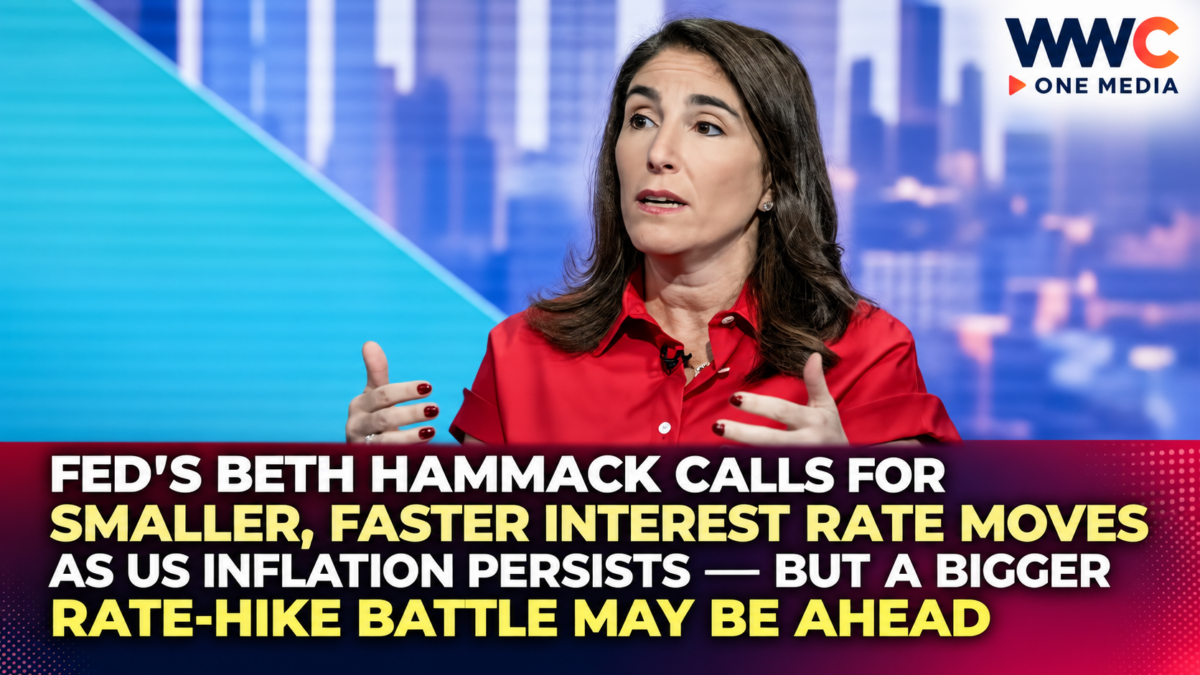
CLEVELAND, United States — October 14, 2026 — A leading Federal Reserve policymaker is warning that the US central bank should respond to inflation with smaller, timely interest-rate adjustments rather than risk waiting until much larger increases become necessary.
Federal Reserve Bank of Cleveland President Beth Hammack delivered the message on October 12 during the National Association for Business Economics annual meeting, adding to concerns that American interest rates could remain elevated as policymakers struggle to bring inflation back to their 2% target.
Hammack argued that economic conditions remain strong enough to support restrictive monetary policy, despite the rising cost of borrowing and growing pressure on American households and businesses.
Her comments came weeks after the Federal Reserve increased its benchmark interest rate by 25 basis points in September, taking the federal funds target range to 3.75%–4.00%.
The move was the central bank’s first rate increase in three years and reflected renewed concerns about inflation linked to energy prices and strong demand in parts of the economy.
Hammack did not specifically endorse another increase at the Fed’s October 27–28 meeting.
Instead, she outlined a broader policy approach: act before inflation expectations deteriorate, communicate decisions clearly and adjust monetary policy as economic conditions change.
But as investors debate whether the Federal Reserve will raise rates again in 2026, a bigger question is emerging: Can the world’s most influential central bank contain inflation without pushing borrowing costs even higher for consumers, companies and financial markets?
Fed Official Prefers Smaller, More Frequent Rate Adjustments
Hammack’s central message was that monetary policy should respond promptly when economic conditions justify action.
In her speech, titled Trimming the Sails: Communicating My Reaction Function, she compared central banking to navigating a vessel through changing weather.
The Federal Reserve knows its destination: price stability and maximum employment.
But the path toward those goals must change as new economic information becomes available.
Hammack said she generally prefers smaller policy adjustments made relatively quickly instead of delaying action until a major correction becomes necessary.
The approach is designed to reduce the risk of allowing inflation to become deeply embedded in the economy.
For financial markets, the comments reinforce the importance of monitoring economic data rather than assuming the Fed will follow a predetermined schedule of interest-rate moves.
However, her remarks do not establish that the central bank has adopted a formal policy of increasing rates at every meeting.
They describe her preferred approach to policymaking, subject to economic conditions.
US Interest Rates Remain at 3.75%–4.00%
The Federal Reserve is entering another important policy period following its September rate increase.
The central bank’s benchmark interest-rate range currently stands at 3.75%–4.00%.
Its next scheduled monetary policy decision is expected on October 28, following the October 27–28 Federal Open Market Committee meeting.
KEY FEDERAL RESERVE DEVELOPMENTS
| Indicator | Latest reported position |
|---|---|
| Federal funds target range | 3.75%–4.00% |
| September 2026 rate decision | 25-basis-point increase |
| Fed inflation objective | 2% |
| Hammack’s underlying inflation estimate | Mid-to-high 2% range |
| Next scheduled Fed meeting | October 27–28, 2026 |
| Hammack’s preferred strategy | Smaller, timely policy adjustments |
According to Reuters, investors broadly expected the Federal Reserve to leave interest rates unchanged at the October meeting.
However, expectations can shift as new inflation, employment and financial-market information becomes available.
A rate pause would not necessarily mean the Fed considers its inflation battle complete.
Likewise, one policymaker’s preference for tighter policy does not guarantee a committee decision.
Inflation Remains Too High for Comfort
Inflation is the central concern behind Hammack’s comments.
The Cleveland Fed president said underlying inflation remains in the mid-to-high 2% range.
That is still above the Federal Reserve’s official 2% objective.
While the difference may appear relatively small, persistent inflation can gradually erode purchasing power.
For households, the effect can be felt through higher grocery bills, transportation expenses, rent and other everyday costs.
For businesses, sustained price increases complicate budgeting, wage negotiations and long-term investment decisions.
Hammack warned that inflation is becoming a broader economic problem rather than remaining concentrated in a few categories.
She also expressed concern that businesses may increasingly expect higher prices to continue.
The longer inflation stays elevated, the more difficult it can become for the Federal Reserve to restore price stability without additional economic costs.
Oil Prices Are Not the Only Source of Inflation
The recent increase in energy prices has played an important role in US inflation concerns.
Higher oil, gasoline and diesel prices affect both consumers and businesses.
Transportation companies face greater fuel expenses, while manufacturers and retailers may pay more to move products through supply chains.
These costs can eventually influence the prices consumers pay.
However, Hammack argued that inflation pressures extend beyond energy.
She pointed to broader demand conditions and reports from businesses in the Cleveland Fed’s district.
Some companies told her they were planning price increases that exceeded the growth in their own input costs.
That suggests businesses in certain industries still have sufficient pricing power to raise what they charge customers.
For policymakers, this presents a difficult challenge.
If demand remains strong enough to support price increases, inflation may prove harder to reduce.
Artificial Intelligence Is Creating a New Inflation Risk
One of the more significant elements of Hammack’s speech involved artificial intelligence.
AI investment has become a major driver of demand for advanced computing infrastructure.
Technology companies are spending heavily on data centers, high-performance chips, networking equipment and electricity infrastructure.
That investment supports economic activity.
But it can also create supply constraints.
Hammack warned that strong demand connected to AI infrastructure is increasing prices for certain electronic components and other equipment.
The effects may extend beyond technology companies.
Industries such as aviation, construction and electricity generation also depend on components that can become more expensive when demand is unusually strong.
This creates a complicated situation for the Federal Reserve.
Artificial intelligence may eventually improve productivity and reduce some operating costs.
In the near term, however, building the infrastructure needed to support AI can create additional demand and contribute to inflationary pressure.
Hammack’s comments suggest the central bank is increasingly examining AI investment as an economic force with both benefits and risks.
Strong US Economy Gives Fed Room to Stay Restrictive
Hammack does not believe the American economy is currently too weak to withstand tighter monetary policy.
According to Reuters, she described economic conditions as resilient and argued that restrictive policy remains appropriate.
Her assessment reflects continued business activity, access to capital and investment demand in several sectors.
A strong economy can provide the Federal Reserve with more flexibility to prioritize inflation control.
However, policymakers must also consider the effects of high borrowing costs.
Higher rates can slow home purchases, business expansion and consumer spending.
They can also create financial pressure for companies carrying substantial debt.
The challenge is to prevent inflation from becoming entrenched without unnecessarily weakening employment or economic activity.
Hammack’s position is that waiting too long could ultimately make that trade-off more difficult.
Why Hammack Has Become One of the Fed’s More Hawkish Voices
In central banking, the term hawkish generally describes policymakers who place strong emphasis on controlling inflation and may favor higher interest rates.
Hammack has been among the more hawkish officials at the Federal Reserve.
In July 2026, she dissented from the committee’s decision and voted in favor of raising interest rates.
At the time, she argued that inflation had remained above target for too long and that waiting could make the eventual response more costly.
Her concerns were partly reflected in the Federal Reserve’s subsequent September rate increase.
Unlike July, the September decision to raise rates was unanimous.
However, agreement on one decision does not mean every committee member supports the same future interest-rate path.
Hammack’s October speech reinforces her view that policy should remain sufficiently restrictive until there is convincing evidence of progress toward the inflation target.
Fed Chairman Kevin Warsh Faces a Different Communication Debate
Hammack’s remarks also contribute to a broader discussion about how much guidance the Federal Reserve should provide to financial markets.
Fed Chairman Kevin Warsh has expressed a preference for less frequent public commentary and reduced reliance on forward guidance.
Forward guidance generally refers to signals or commitments concerning the future direction of interest rates.
Hammack supports transparency but distinguishes between explaining the Fed’s decision-making process and promising a particular outcome.
She argues that households, businesses and investors benefit when they understand how policymakers are likely to respond to changes in inflation, employment and other economic indicators.
This approach is known as explaining a reaction function.
For example, a policymaker might explain that stronger inflation would increase the case for higher rates, while weaker employment could justify a different response.
Such communication allows investors to anticipate possible decisions without assuming a future rate increase or cut is guaranteed.
The debate matters because central bank statements can affect bond yields, currencies and stock prices even before the Fed changes interest rates.
Treasury Bond Yields Are Already Increasing Borrowing Costs
The interest-rate debate is occurring during a period of unusually high US Treasury yields.
Recent increases in government bond yields have affected financing conditions throughout the American economy.
Longer-term Treasury yields influence a variety of borrowing costs, including mortgage rates and corporate debt financing.
In October, the 10-year Treasury yield reached levels not seen in more than two decades.
Although yields eased during October 13 trading, they remained elevated.
Federal Reserve Governor Christopher Waller said the rise in longer-term yields was partly connected to strong economic growth, government borrowing needs and heavy investment in AI infrastructure.
He also acknowledged that higher bond yields were contributing to tighter financial conditions.
This creates an important policy consideration.
If market-driven borrowing costs are already restraining economic activity, the Federal Reserve may not need to raise its short-term policy rate as aggressively.
However, Hammack has emphasized that movements in financial markets do not eliminate the need to make appropriate monetary policy decisions.
Financial Markets Await Critical Inflation Data
Investors are monitoring the next US inflation releases for evidence of whether price pressures are accelerating or moderating.
The September Consumer Price Index report is scheduled for release on October 14.
The data are particularly important because the Federal Reserve must assess whether renewed energy inflation is spreading to other parts of the economy.
A stronger-than-expected inflation report could increase speculation about further rate hikes.
A softer result might support expectations that the central bank can leave rates unchanged while evaluating economic conditions.
However, one monthly inflation report is unlikely to determine the entire future path of monetary policy.
The Fed also examines employment, wages, consumer spending, financial conditions and longer-term inflation expectations.
For Hammack, understanding those combined signals is essential to deciding when policy should change.
What Higher US Interest Rates Mean for American Consumers
Federal Reserve policy affects households through a range of financial channels.
Mortgages
Elevated interest rates and bond yields can make home financing more expensive, limiting affordability for prospective buyers.
Credit cards
Variable borrowing rates can remain high when the Fed maintains restrictive monetary policy.
Auto loans
Higher financing costs can increase monthly payments for consumers purchasing vehicles.
Savings accounts
Higher interest rates may benefit savers, although the rates paid by banks vary considerably.
Employment
Slower spending and investment can eventually affect company hiring decisions.
The overall effect depends on how long restrictive rates remain in place and whether inflation begins to ease sustainably.
The Federal Reserve aims to restore price stability while avoiding unnecessary damage to employment.
Could Higher Fed Rates Hurt Global Markets?
The decisions of the US Federal Reserve affect economies far beyond the United States.
US interest rates influence international capital flows, bond markets and exchange rates.
When US yields become more attractive, some investors may shift funds toward dollar-denominated assets.
This can create pressure on currencies and borrowing conditions in emerging markets.
However, the effect is not uniform.
Global investors also consider domestic economic growth, inflation, fiscal policy and political conditions when allocating capital.
Higher US interest rates do not automatically cause emerging-market currencies to weaken.
Nevertheless, the Federal Reserve’s decisions remain an important consideration for investors and central banks around the world.
What Hammack’s Warning Means for the Philippines
For the Philippines, the Federal Reserve’s policy direction matters because of its influence on global financing conditions and the US dollar.
If American interest rates remain elevated, peso-denominated assets may face additional competition from US investments.
Changes in the dollar can also affect the peso’s exchange rate.
A weaker peso may increase the local-currency cost of imported goods priced in dollars, including fuel and some industrial inputs.
Philippine companies borrowing in foreign currencies may also face higher financing costs.
However, the Bangko Sentral ng Pilipinas does not automatically follow every Federal Reserve decision.
The BSP considers domestic inflation, economic activity, financial stability and foreign-exchange conditions when setting Philippine monetary policy.
For local businesses and investors, the Fed’s inflation outlook is therefore important, but it is only one factor shaping Philippine borrowing costs and financial-market conditions.
Five Developments Investors Should Watch
1. September US inflation figures
The data will help determine whether inflation is becoming more persistent.
2. October 27–28 Federal Reserve meeting
Policymakers will decide whether to keep rates unchanged or make another adjustment.
3. US Treasury yields
Movements in longer-term borrowing costs could influence the need for further monetary tightening.
4. AI investment demand
Continued spending on data centers and semiconductor infrastructure may affect inflation and economic growth.
5. Federal Reserve communication
Comments from Warsh, Hammack and other officials could shape expectations for the final policy meetings of 2026.
The Bigger Question: Will the Fed Have to Raise Rates Again?
Hammack’s latest remarks reinforce the seriousness of the Federal Reserve’s inflation challenge.
The central bank has already increased interest rates, but price pressures remain above its target.
Energy costs, resilient demand and investment in artificial intelligence are creating complications for policymakers seeking to restore stable prices.
Hammack believes smaller, timely adjustments can help reduce the risk of allowing inflation to become more persistent.
Other officials are also evaluating whether higher bond yields are already tightening financial conditions enough to influence the need for additional rate hikes.
The coming inflation reports and Federal Reserve meetings will help determine which view gains broader support.
The question is not simply whether borrowing costs rise by another quarter-point.
It is whether the Fed can maintain confidence in its commitment to controlling inflation while protecting an economy that remains resilient but exposed to higher financing costs.
Beth Hammack is calling for a central bank willing to act sooner rather than later. But the bigger test is whether the Federal Reserve can bring inflation back to 2% through measured policy adjustments — or whether persistent price pressures will force a more painful tightening cycle for households, businesses and global markets.