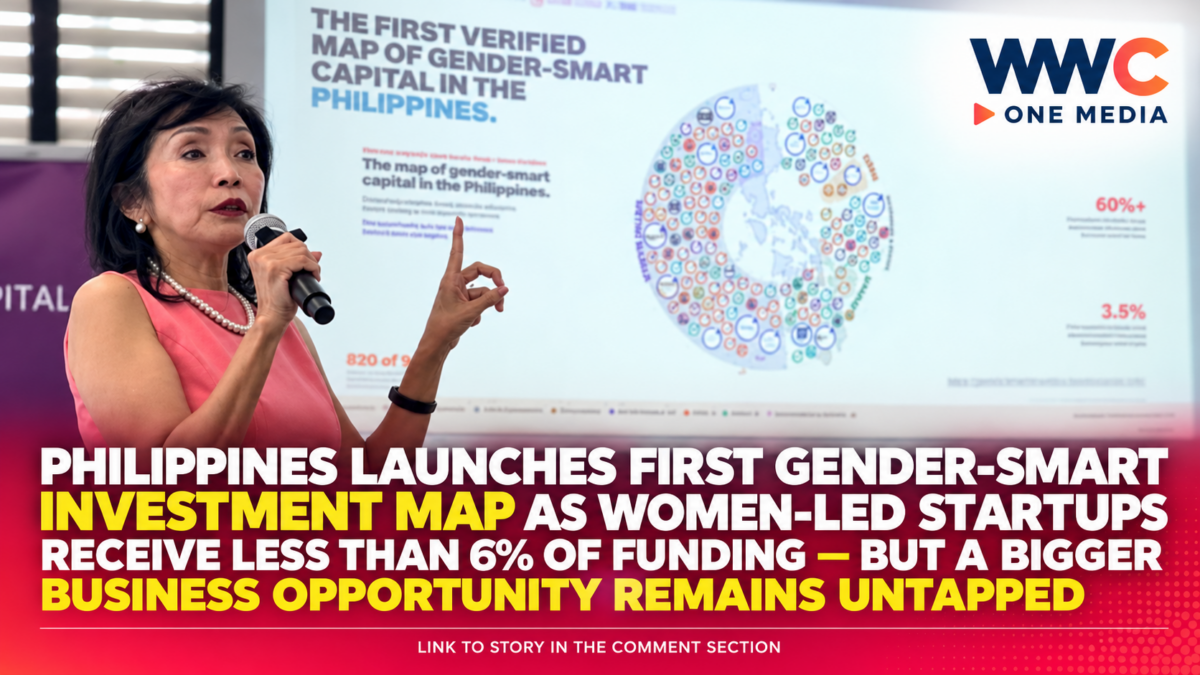
MANILA, Philippines — October 13, 2026 — A new investment platform is aiming to change how Filipino women entrepreneurs secure financing, as persistent funding disparities continue to prevent promising women-led startups from expanding into larger and more competitive businesses.
Kerubin Capital, in partnership with Investing in Women, an initiative of the Australian government, has introduced the Philippines’ first Gender-Smart Investing Directory and Map, a free digital platform connecting women founders with venture capital firms, angel investors, business accelerators, corporations and policy organizations.
The initiative, launched on October 8 and highlighted in an October 13 InsiderPH report, seeks to address one of the biggest obstacles facing women entrepreneurs: access to investors and the professional networks necessary to secure growth capital.
Across Southeast Asia, women-led businesses continue to receive only a small share of available venture funding, with industry estimates placing their share below 6%.
Separate reporting by BusinessMirror cited an estimate of approximately 3.6%, underscoring the severity of the funding gap, although the figures differ in scope and methodology.
But while the Philippines is creating new ways for women entrepreneurs to find investors, the bigger question remains: Will greater visibility finally translate into billions in meaningful investment opportunities, or will female founders continue struggling to secure the capital needed to grow?
Philippines Introduces Its First Gender-Smart Investing Map
The Gender-Smart Investing Directory and Map of the Philippines is designed to bring together information that has historically been scattered across different organizations, investment networks and industry communities.
For startup founders, finding investors can be a difficult and time-consuming process.
Entrepreneurs often need to identify potential funders, understand their investment priorities, build professional relationships and prepare extensive financial documentation before securing a meeting.
These barriers can be particularly challenging for founders without established connections to venture capital networks.
Kerubin Capital’s new platform attempts to reduce that information gap by creating a centralized, publicly accessible directory of investors and organizations supporting women-led businesses.
The platform allows users to search for relevant organizations, compare investor profiles and identify potential financing and business development opportunities.
It also gives investors greater visibility into companies that may fit their investment strategies.
The initiative is free to access and accepts submissions from organizations interested in joining the directory.
However, a listing or connection does not automatically qualify a startup for financing.
Women-Led Startups Receive Only a Small Share of Venture Capital
The investment map was created against a backdrop of persistent disparities in startup financing.
According to InsiderPH, women-led startups across Southeast Asia have historically received less than 6% of total venture capital funding.
BusinessMirror reported on October 8 that Kerubin Capital managing director Tina Di Cicco cited an estimate of approximately 3.6% of startup capital going to women-led enterprises.
The Philippine Star also highlighted the 3.6% figure in its coverage of the new investment directory.
The exact percentages depend on how women-led companies and investment activity are defined, and they should not be treated as interchangeable measurements of the same dataset.
Nevertheless, the reports point to the same underlying concern: women entrepreneurs remain significantly underrepresented in venture capital investment.
This creates a funding challenge for companies seeking to expand their operations, hire workers, enter new markets and develop innovative products.
For the Philippines, narrowing the funding gap could help unlock more business activity and support a more diverse startup ecosystem.
The Biggest Problem May Come After Startups Secure Their First Funding
Securing seed capital is only the beginning for a growing business.
According to BusinessMirror, Kerubin Capital has identified the transition from seed financing to Series A investment as a particularly difficult stage for women-led startups.
Seed funding typically helps a company develop its products, establish initial operations and test market demand.
Series A financing, by contrast, generally involves larger investment commitments intended to support business expansion.
At this stage, institutional investors often require stronger evidence of financial performance, sustainable revenue growth, corporate governance and commercial viability.
Companies may need professionally prepared financial statements, reliable operating records and a clear strategy for scaling their businesses.
Di Cicco said this transition represents a major gap in the funding pipeline.
For women entrepreneurs, the challenge may be intensified by limited access to investment networks and the additional difficulty of gaining visibility among larger capital providers.
The new directory is designed to help founders identify the investors and organizations that could support them through these stages.
However, improving access to information is only part of the solution.
Businesses still need financial preparation, regulatory compliance and investment readiness to secure larger funding rounds.
Kerubin Capital Says Every ₱1 Invested Mobilizes More Than ₱3.30
Kerubin Capital is seeking to address the funding gap through a model known as catalytic financing.
The approach uses initial investment capital to attract additional funding from other investors.
According to the company, every peso it invests has helped mobilize more than ₱3.30 in external co-investments.
For example, based on that reported ratio, an initial ₱1 million investment could be associated with more than ₱3.3 million in additional funding from other investors.
This is an illustration of Kerubin Capital’s reported investment-mobilization performance, not a guaranteed return or funding commitment for every startup.
The model seeks to encourage more private investors to participate in financing businesses that might otherwise struggle to attract institutional capital.
Kerubin Capital was established in 2021 with support from the Manila Angel Investors Network and Investing in Women.
According to its official website, the organization has mobilized more than 100 investors and capital partners through its network and reached more than 3,000 women through its programs, networks and portfolio companies since its establishment.
These figures reflect Kerubin Capital’s broader activities, rather than the results of the newly launched directory alone.
Five Major Categories Help Connect Women Founders With Investors
The Gender-Smart Investing Map organizes its ecosystem into five categories.
1. Investors
This category includes angel investor networks, venture capital firms, private equity firms, financial institutions and development finance organizations that support gender-focused investment.
2. Startups
The directory covers women-owned and women-led enterprises, as well as startups developing products and services that meaningfully benefit women.
3. Ecosystem Supporters
Business incubators, accelerators and support organizations help entrepreneurs develop products, improve business models, access mentorship and prepare for fundraising.
4. Policy Organizations
Government institutions, universities, research organizations and advocacy groups are included to improve access to information about the regulatory and policy environment.
5. Corporations
The platform also highlights companies and institutions supporting gender equity through leadership, procurement, investment and business partnerships.
By combining these groups, the directory aims to create a more connected business environment in which entrepreneurs can find both funding and practical support.
What Makes an Investment Gender-Smart?
Gender-smart investing refers to investment approaches that deliberately consider how capital can support women’s economic participation.
Kerubin Capital uses principles associated with the 2X Global Standard to assess gender-related investment characteristics.
These may include female ownership, women’s participation in leadership and employment, and products or services that disproportionately benefit women.
The approach is broader than simply investing in companies founded by women.
A male-led company, for example, may also demonstrate meaningful gender impact if its products or business activities create substantial economic benefits for women.
The framework aims to encourage investors to consider gender-related outcomes alongside business fundamentals and financial performance.
However, being categorized as gender-smart does not guarantee commercial success, profitability or investment eligibility.
Australian Government Partnership Supports Philippine Women Entrepreneurs
The investment map was developed with Investing in Women, an Australian government initiative supporting women’s economic participation in Southeast Asia.
The partnership highlights the role of international cooperation in addressing financial barriers faced by women entrepreneurs.
Australia has supported programs focused on gender equality, private-sector investment and women’s access to economic opportunities across the region.
The new platform seeks to improve connections between local founders, international investors and institutions supporting inclusive business growth.
The initiative also comes amid broader Philippine government calls for improved access to capital and digital opportunities for women.
During the ASEAN Women Leaders’ Summit in September 2026, President Ferdinand Marcos Jr. called for greater access to financing, digital skills and markets for women entrepreneurs.
He emphasized that women should participate as leaders and innovators in economic development.
The Kerubin Capital platform represents a private-sector initiative aligned with that broader objective.
Taxumo Highlights Importance of Financial Compliance for Startups
The initiative also brings attention to the role of technology companies that help entrepreneurs prepare for investment.
Among the industry participants was Taxumo CEO and co-founder Ginger Arboleda.
Taxumo provides automated tax calculation and filing services for businesses, helping entrepreneurs manage tax compliance and reduce administrative workloads.
For early-stage enterprises, maintaining accurate financial records and complying with tax obligations can become increasingly important when approaching investors.
Institutional funders often conduct extensive due diligence before making investment decisions.
Companies with incomplete financial records, inconsistent tax filings or weak accounting practices may encounter additional difficulties during fundraising.
Digital business tools can help entrepreneurs improve these processes and build more professional operating systems.
However, using such platforms does not independently establish that a company is ready for institutional investment.
UNAWA Brings Digital Legal Services Into Startup Funding Discussions
Legal technology is another important component of investment readiness.
UNAWA board director John Sybuenasenso participated in discussions surrounding the new investment initiative.
UNAWA provides digital legal technology solutions, including NotarizeIT, an electronic notarization service operating under applicable Supreme Court guidelines.
For startups seeking investment, properly executed agreements and organized legal records are essential.
Investors may examine ownership documents, shareholder agreements, corporate registrations, contracts and other legal requirements before committing funds.
Digital documentation tools can help businesses manage these processes more efficiently.
For women entrepreneurs with limited access to professional legal services, improved documentation systems may reduce some administrative barriers to fundraising.
Nevertheless, significant investment transactions may still require specialized legal and financial advice.
Philippine Startup Funding Reached an Estimated $1.5 Billion in 2025
The broader Philippine startup market has also attracted significant investment activity.
An October 8 report carried by The Philippine Star cited approximately $1.5 billion invested in Philippine startups during 2025, equivalent to around 19% of Southeast Asia’s reported startup funding.
The figure provides context for the scale of the startup investment ecosystem.
However, the amount should not be confused with funding received specifically by women-led businesses.
The same report noted the persistent disparity in financing available to female entrepreneurs.
The contrast highlights the opportunity the new directory is attempting to address.
Even when substantial capital is flowing into startup markets, some groups of entrepreneurs may struggle to access the investment networks and financial resources necessary for expansion.
A more transparent ecosystem could help investors discover businesses that have been overlooked.
Why the Investment Map Could Matter Beyond Metro Manila
The challenge of accessing startup financing is not limited to gender.
Location also affects entrepreneurs’ ability to connect with investors, mentors and business networks.
Many major investment institutions, accelerators and venture capital activities are concentrated in large commercial centers.
For women entrepreneurs operating outside Metro Manila, attending investor events or building professional relationships may require additional travel and resources.
A searchable online directory could reduce some of these geographical barriers by making relevant organizations easier to identify.
Businesses from Cebu, Davao, Iloilo, Bacolod and other locations may be able to use the platform to discover prospective investors or support organizations without depending entirely on existing personal networks.
However, actual investment decisions will still depend on business viability, investor requirements and the availability of funding.
The platform should therefore be viewed as a networking and discovery tool rather than a substitute for fundraising preparation.
Gender-Smart Investing Could Become a Bigger ASEAN Opportunity
The Philippine initiative also has potential regional implications.
According to the Gender-Smart Investing Map’s official website, the Philippines is intended to serve as the initial proof of concept for a broader Southeast Asian model.
The platform identifies Singapore, Malaysia and Vietnam as potential next markets.
If the system succeeds, similar directories could help investors and founders identify opportunities across multiple countries.
Cross-border visibility may be particularly valuable for startups seeking to expand into new consumer markets or attract foreign capital.
The initiative could also support collaboration among accelerators, corporations and development finance institutions throughout the region.
However, the proposed international expansion remains an ambition rather than a completed regional rollout.
Its future will depend on adoption, partnerships, data quality and demonstrated usefulness to founders and investors.
The Biggest Challenge: Turning Investor Connections Into Actual Funding
Although the new directory represents a potentially useful step, its ultimate value will depend on measurable results.
A platform may successfully list hundreds of businesses and investors without necessarily increasing the amount of capital reaching women-led enterprises.
For the initiative to have a lasting impact, relevant indicators could include:
- The number of women founders successfully connected with investors.
- The amount of financing secured through relationships initiated on the platform.
- The number of businesses progressing from seed to Series A funding.
- The geographical reach of participating startups.
- The number of investment partnerships and commercial opportunities generated.
- Improvements in startup survival, revenue growth and employment.
The platform also relies partly on information supplied by participating organizations.
Maintaining accurate and updated listings will therefore be important for investor confidence and user adoption.
Transparency about results could help determine whether the directory meaningfully reduces financing barriers.
How Filipino Women Entrepreneurs Can Access the New Investment Map
The Gender-Smart Investing Directory and Map is accessible online
Entrepreneurs and interested organizations can browse the directory, explore participating institutions and submit their information for review.
The platform supports searches by organization, sector and other relevant categories.
It also provides information about investors, startups, business support organizations, corporations and policy institutions.
Founders should prepare basic business information, including their company profile, business model, market opportunity and financing requirements before approaching potential investors.
Participation in the directory does not automatically create an entitlement to funding.
Applicants should also verify any requested fees or investment terms directly with the relevant organizations before proceeding with financial arrangements.
The Bigger Question: Can the Philippines Finally Close the Funding Gap for Women?
The Gender-Smart Investing Map represents an effort to address a longstanding weakness in the Philippine startup ecosystem.
Women entrepreneurs continue to establish businesses, introduce new products and contribute to economic activity.
Yet access to growth capital remains uneven.
Kerubin Capital and its partners hope that better information, stronger investment networks and increased visibility can help redirect more financing toward overlooked businesses.
The initiative could also encourage institutional investors to examine a wider range of investment opportunities and support more inclusive business development.
However, the true measure of progress will not be the launch of a digital directory.
It will be whether more women-led enterprises successfully raise capital, expand their operations, hire workers and compete in larger markets.
The Philippine startup ecosystem has demonstrated an ability to attract significant investment, but the distribution of that capital remains a major challenge.
The Philippines now has a digital map designed to connect women entrepreneurs with investors. But the bigger test is whether it can turn visibility into actual funding — and finally give more Filipina founders the financial backing needed to build the country’s next generation of successful businesses.