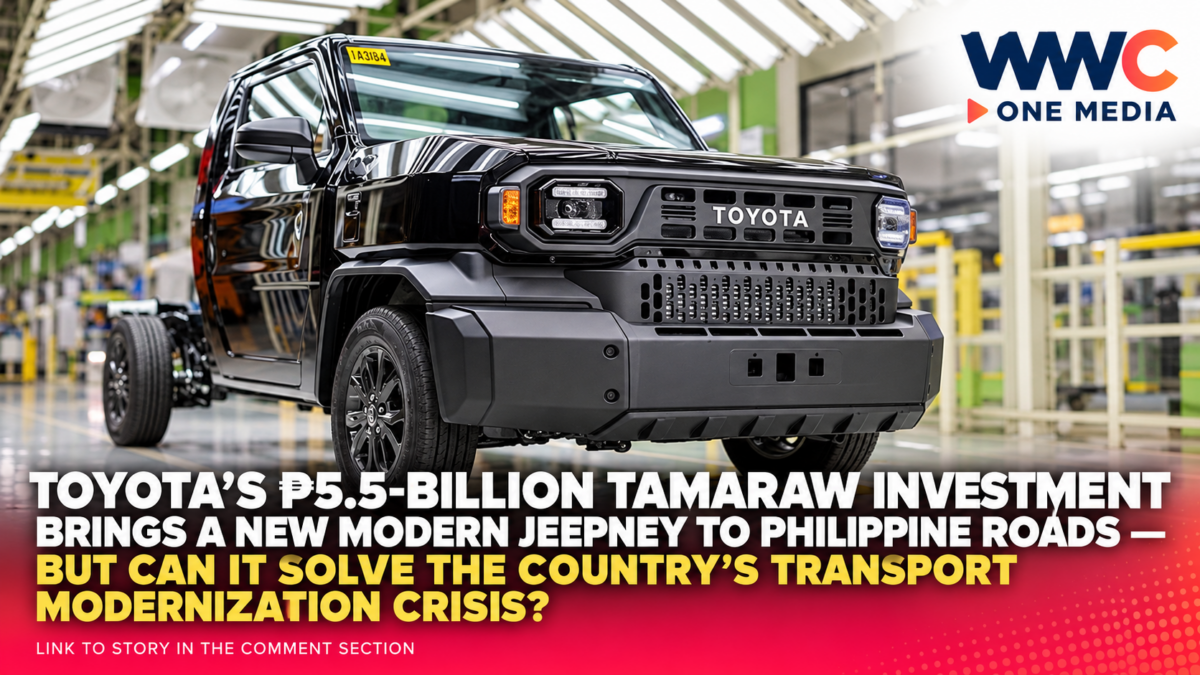
MANILA, Philippines | October 13, 2026 — Toyota Motor Philippines (TMP) is making a major push into the country’s public transportation sector, unveiling a locally manufactured, 11-passenger Next Generation Tamaraw modern jeepney backed by its ₱5.5-billion investment in domestic automotive production.
The move marks an important development in the Philippines’ controversial public utility vehicle (PUV) modernization program, offering transport operators and cooperatives another locally manufactured option as the government pushes to replace aging public transport vehicles with newer, standards-compliant units.
Toyota officially presented the Tamaraw Modern Public Utility Vehicle (MPUV) at its manufacturing facility in Santa Rosa, Laguna, on October 13, bringing one of the Philippines’ most recognizable automotive nameplates into a new era of public transportation.
But beyond the excitement surrounding the vehicle’s debut, a bigger question remains: Can Toyota make transport modernization affordable enough for Filipino jeepney drivers and operators?
Toyota Tamaraw Officially Enters the Modern Jeepney Market
The newly introduced Tamaraw MPUV has received Class 1 Modern Public Utility Vehicle certification from the Department of Transportation (DOTr), allowing it to operate as an 11-passenger vehicle for intra-city transport.
The certification, granted in May 2026, opened the door for Toyota to expand the Tamaraw beyond cargo delivery, logistics and business applications into everyday public transportation.
The vehicle was developed using feedback from government agencies, local government units, transport cooperatives and operators to better meet Philippine mobility requirements.
Toyota Motor Philippines President Masando Hashimoto described the modern jeepney as an important addition to the Tamaraw’s growing range of applications.
“Today, we add an important missing piece: a jeepney,” Hashimoto said during the launch.
He explained that introducing the Tamaraw into public transportation supports Toyota’s ambition to establish the vehicle as a national automotive icon serving both Filipinos and visitors.
The vehicle’s entry into the public transport market also represents a potential opportunity for operators seeking alternatives under the government’s modernization program.
Where Toyota’s ₱5.5-Billion Investment Is Going
Toyota’s Tamaraw initiative represents one of its significant commitments to Philippine automotive manufacturing.
The total ₱5.5-billion investment includes:
- ₱3.2 billion for vehicle production, supporting the manufacturing of Tamaraw units at Toyota’s Laguna facility.
- ₱1.2 billion for parts localization, strengthening the domestic automotive supply chain.
- ₱1.1 billion for vehicle conversion, including a purpose-built facility capable of producing specialized configurations.
A central feature is Toyota’s 1.5-hectare conversion factory in Santa Rosa, which allows the company to adapt the Tamaraw platform for different commercial and public-service requirements.
Toyota describes the facility as a significant regional manufacturing milestone, expanding the Philippines’ ability to produce specialized vehicles domestically.
The project also creates business opportunities for Filipino engineers, vehicle body builders, fabricators, suppliers and automotive workers.
Importantly, the ₱5.5-billion figure represents Toyota’s broader Tamaraw investment, rather than a newly announced investment made exclusively for the October 2026 jeepney launch.
Toyota Tamaraw Production Reaches 34,739 Units
Toyota’s move into public transportation comes as the locally manufactured Tamaraw continues to establish itself in the Philippine commercial vehicle market.
According to figures reported by InsiderPH and Daily Tribune, Toyota produced 14,711 Tamaraw units during the first nine months of 2026, bringing cumulative production to 34,739 units since 2024.
Data attributed to the Chamber of Automotive Manufacturers of the Philippines Inc. (CAMPI) also showed that the Tamaraw captured a 49% market share in the one-ton-and-above vehicle segment as of September 2026.
The figures highlight strong market demand for Toyota’s locally produced commercial vehicle platform.
Toyota’s wider network of dealers, suppliers, subsidiaries and affiliates also supports more than 83,000 jobs nationwide, according to the company figures cited by InsiderPH.
However, the 83,000 jobs represent the broader Toyota business network and should not be interpreted as employment created solely by the Tamaraw project.
Modern Jeepney Financing Could Start at ₱1,109 Per Day
One of the most important developments involves financing for transport operators who may want to acquire the new Tamaraw MPUV.
According to an October 13 report by Context.ph, eligible transport service entities may qualify for a ₱210,000 government subsidy per unit, subject to program requirements.
Toyota Financial Services is also offering financing arrangements with a down payment starting at 10%, repayment periods of up to 60 months, and estimated daily payments beginning at ₱1,109.
Government bank financing was separately reported to offer down payments starting at 5%, with repayment periods of up to 84 months.
These financing arrangements could make the Tamaraw more accessible to cooperatives and transport operators seeking to modernize their fleets.
However, the estimated ₱1,109 daily payment is a financing illustration, not a guaranteed total daily operating expense.
Operators must still account for fuel, maintenance, insurance, registration, labor and other operating expenses.
Loan approval, subsidies and actual repayment amounts will also depend on applicant eligibility and financing terms.
Can Toyota’s Tamaraw Help Address the Jeepney Modernization Challenge?
The Philippine government’s PUV modernization initiative aims to improve safety, reliability, accessibility and environmental performance across the country’s public transportation system.
However, modernization has faced persistent criticism over vehicle acquisition costs, financing requirements and the potential displacement of small operators unable to afford replacement units.
Toyota’s entrance could potentially intensify competition among modern PUV manufacturers and offer transport cooperatives another vehicle option.
Local manufacturing may also provide advantages through vehicle availability, domestic body conversion capabilities, parts sourcing and access to Toyota’s existing service network.
Nevertheless, affordability remains a central concern.
Even with financing support, operators must generate sufficient revenue to meet their obligations while keeping fares reasonable for passengers.
The success of the Tamaraw MPUV will therefore depend not only on vehicle quality but also on whether operators can sustain its financial and operational costs.
More Than a Jeepney: Tamaraw Expands Into Ambulances, Patrol Vehicles and Community Transport
Toyota’s strategy extends beyond public transportation.
The Next Generation Tamaraw has been developed as a flexible commercial vehicle platform capable of serving different business, government and community requirements.
Its applications include ambulances, patrol vehicles, fire trucks, food trucks, utility vehicles, cargo carriers and community shuttles.
The versatility is particularly relevant for micro, small and medium enterprises (MSMEs) that need practical transportation solutions for deliveries, mobile businesses and other daily operations.
By supporting different vehicle configurations, Toyota is positioning the Tamaraw as a multifunctional platform rather than a single-purpose commercial vehicle.
The company hopes that local manufacturing and specialized conversion capabilities will generate additional demand throughout the Philippine automotive supply chain.
Toyota’s Philippine Investment Strengthens Japan-Philippines Economic Relations
The Tamaraw modernization initiative also underscores the long-standing industrial relationship between the Philippines and Japan.
Toyota’s domestic production activities provide opportunities for local parts manufacturers, workers and automotive suppliers while reinforcing the Philippines’ role in regional vehicle manufacturing.
During the October 13 unveiling, Hashimoto connected the locally manufactured Tamaraw to the 70th anniversary of diplomatic relations between Japan and the Philippines in 2026.
The company sees the Japanese-designed, Filipino-built vehicle as a symbol of industrial cooperation and local manufacturing capability.
The investment also aligns with efforts to expand domestic industrial production and support higher-value manufacturing activities.
However, achieving broader industrial benefits will require continued investment in technology, worker training and the development of competitive local automotive suppliers.
The Bigger Test: Can a Filipino-Built Tamaraw Transform Public Transport?
Toyota’s new modern jeepney represents an important step in expanding the choices available to Philippine transport operators.
Its DOTr certification, local manufacturing base, financing options and established automotive support network give the Tamaraw a foundation for competing in the modern PUV market.
But entering the market is only the beginning.
The real test will come when drivers, cooperatives and transport operators evaluate whether the vehicle can deliver dependable service without placing unsustainable financial pressure on their businesses.
For passengers, successful modernization should ultimately mean safer, more reliable and more accessible public transportation.
For drivers and operators, it must also mean a viable livelihood.
Toyota’s ₱5.5-billion investment has already helped revive an iconic Philippine vehicle. The bigger challenge now is proving that the Tamaraw can help modernize public transportation without leaving ordinary Filipino drivers behind.