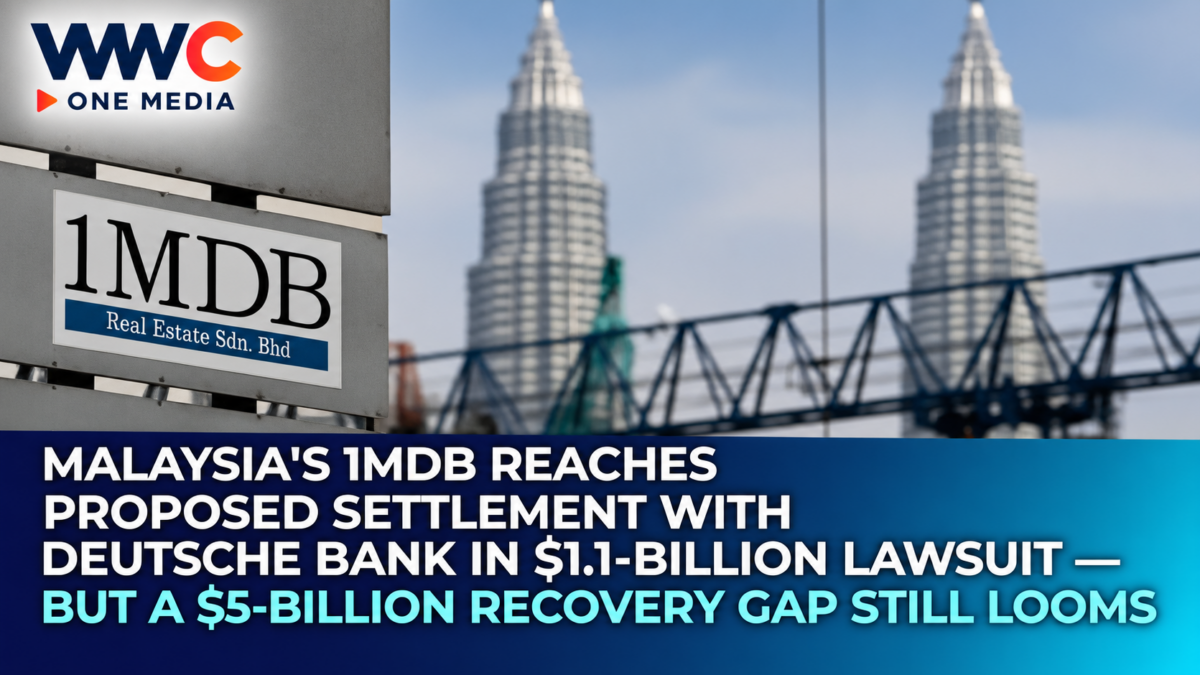
PUTRAJAYA, Malaysia — Malaysia’s long-running battle to recover billions of dollars lost in the 1Malaysia Development Berhad (1MDB) scandal has reached another potential breakthrough after the troubled state investment fund agreed in principle to settle its $1.1-billion lawsuit against Deutsche Bank.
The development, reported by Bloomberg on October 12, 2026, marks another step in Malaysia’s efforts to hold international financial institutions accountable over transactions connected to one of the world’s largest financial corruption scandals.
But the agreement does not mean Deutsche Bank has agreed to pay $1.1 billion.
The amount represents the original damages sought by 1MDB, while the financial terms of the proposed settlement have not been publicly disclosed.
The High Court has been informed of the proposed resolution, with another hearing scheduled for October 26.
For Malaysia, the potential settlement comes at a critical time.
Despite recovering more than RM31 billion in funds and assets connected to 1MDB, the government still faces a substantial financial shortfall from the scandal.
The biggest question is whether the latest deal will meaningfully reduce the burden on Malaysian taxpayers — or merely close another legal dispute while billions remain unrecovered.
1MDB and Deutsche Bank Move Toward Settlement
The proposed agreement was disclosed during court proceedings in Putrajaya on Monday, October 12.
Lawyer Lim Chee Wee, representing 1MDB, informed the judiciary that a settlement had been proposed in the dispute involving Deutsche Bank.
According to Bloomberg reporting carried by Malaysian newspaper The Star, the High Court had been informed of the arrangement.
The Edge Malaysia separately reported that Lim referred to settlement discussions during proceedings before Chief Judge of Malaya Hashim Hamzah.
The development emerged during a separate Federal Court application involving UK law firm White & Case.
A hearing in the Deutsche Bank case is scheduled for October 26.
Although Bloomberg characterized the development as a settlement, the publicly reported court statements establish that a proposed resolution has been communicated to the court.
The agreement’s financial details, implementation conditions and final procedural status have not been independently confirmed.
Why 1MDB Sued Deutsche Bank for $1.1 Billion
The legal dispute dates back to transactions conducted more than 15 years ago.
In 2021, 1MDB commenced proceedings against Deutsche Bank Malaysia Berhad, alleging responsibility in connection with three wire transfers executed on the fund’s behalf in 2009 and 2011.
According to Deutsche Bank’s own regulatory disclosures, the transfers totaled approximately $1.1 billion.
1MDB sought damages equivalent to the amount of those transactions, plus interest accruing from the relevant transfer dates.
The potential interest component was significant because many years had passed since the transactions occurred.
However, the total value of the original claim should not be treated as the amount eventually agreed upon in a negotiated settlement.
Deutsche Bank had contested the litigation and sought to dismiss it on legal grounds.
The lawsuit formed part of a wider international recovery campaign involving financial institutions and other parties linked to transactions associated with the scandal.
Malaysian Court Previously Rejected Deutsche Bank’s Attempt to Dismiss Case
An important development occurred on July 11, 2025, when the Malaysian High Court declined Deutsche Bank Malaysia’s application for summary dismissal based on limitation-period arguments.
The bank had argued that the lawsuit should not proceed because of the time elapsed since the transactions.
The court determined that the timing issue required consideration at a full trial rather than being resolved through summary dismissal.
Deutsche Bank disclosed the decision in its regulatory filings, noting that proceedings were scheduled for October and December 2026.
The ruling allowed 1MDB’s case to continue but did not establish that Deutsche Bank was liable for the claimed losses.
A negotiated resolution would potentially remove the uncertainty and expense associated with continued litigation for both parties.
But without disclosure of the settlement terms, it remains unclear how much money Malaysia may receive or whether the agreement includes other obligations.
How the 1MDB Scandal Became a Global Financial Crisis
1MDB was established by the Malaysian government to promote economic development and attract foreign investment.
Instead, the fund became the center of an international corruption and money-laundering scandal.
According to the US Department of Justice, more than $4.5 billion was allegedly misappropriated from 1MDB between 2009 and 2015.
Investigators traced funds through financial institutions and companies in multiple jurisdictions, including the United States, Switzerland, Singapore and Luxembourg.
Money connected to the scheme was allegedly used to purchase luxury real estate, artwork, a superyacht and other high-value assets.
The scandal triggered investigations and legal proceedings involving financial executives, political figures and institutions across several countries.
It also exposed weaknesses in anti-money-laundering controls, financial oversight and the management of state-owned investment funds.
For Malaysia, the consequences extended beyond reputational damage.
Government finances became exposed to substantial debt obligations linked to 1MDB’s activities.
Malaysia Has Recovered RM31.3 Billion — But a RM20-Billion Gap Remains
The proposed Deutsche Bank settlement comes amid continuing efforts to reduce the public financial burden.
In a statement issued on September 13, 2026, Malaysia’s Ministry of Finance reported that the government had recovered RM31.3 billion through 1MDB-related asset recovery efforts.
However, total obligations borne by the government amounted to RM51.4 billion.
That total included RM42.5 billion already paid and RM8.9 billion in remaining debt commitments.
After accounting for funds recovered, the ministry estimated that the government could still face approximately RM20 billion in losses.
These are different measures that should not be confused.
The RM51.4-billion figure represents total government obligations, including amounts already paid, not a remaining unpaid debt of the same size.
The RM20-billion figure represents the potential unrecovered burden based on the ministry’s reported figures.
The distinction is important when evaluating whether settlements are actually reducing the long-term cost of the scandal.
If the Deutsche Bank agreement produces additional recoveries, those funds could help offset the government’s obligations.
However, the actual effect cannot be calculated until the settlement amount and payment terms are disclosed.
JPMorgan Previously Agreed to RM1.4-Billion Settlement
The proposed resolution with Deutsche Bank follows other major financial settlements involving 1MDB.
In August 2025, JPMorgan Chase agreed to contribute RM1.4 billion to Malaysia’s asset recovery effort.
Malaysia’s Ministry of Finance later highlighted the agreement as part of its broader campaign to recover money associated with the scandal.
The proceeds are intended to support the Malaysia Asset Recovery Trust Account, which is used to meet outstanding financial obligations related to 1MDB and SRC International.
The JPMorgan settlement demonstrates how negotiated agreements with financial institutions can form part of the recovery process.
However, the existence of a previous settlement does not establish the amount Deutsche Bank may agree to pay.
Each legal claim involves its own facts, contractual arrangements and potential defenses.
US Authorities Have Recovered Billions in 1MDB-Linked Assets
Malaysia’s recovery campaign has received assistance from international enforcement agencies.
In June 2024, the US Department of Justice announced that approximately $1.4 billion in misappropriated 1MDB funds had been returned, or assistance provided for their return, to Malaysia.
In January 2025, the department announced an agreement to recover an additional $20 million.
US authorities have pursued numerous civil forfeiture actions involving property and funds allegedly connected to the scandal.
The investigations have covered luxury properties, financial accounts and other assets across several jurisdictions.
The scale of these proceedings demonstrates the international complexity of tracing allegedly misappropriated money.
Recoveries may require cooperation among prosecutors, regulators, courts and financial institutions operating under different legal systems.
Such proceedings can continue for years after the underlying transactions occurred.
Why the Settlement Matters to Deutsche Bank
For Deutsche Bank, resolving the dispute could remove one significant source of legal uncertainty associated with its Malaysian subsidiary.
In its 2025 annual report, the German lender warned that its potential exposure to the 1MDB litigation could be material.
The bank also acknowledged that the case could affect its reputation.
However, Deutsche Bank had not publicly disclosed the amount of any provision or contingent liability specifically associated with the case, explaining that disclosure could prejudice its legal position.
The proposed settlement could therefore be important from a litigation and risk-management perspective.
But without knowing the agreed amount, it is not possible to establish the direct financial effect on Deutsche Bank’s earnings, capital or cash flow.
The agreement also should not be described as a judicial finding of wrongdoing unless the terms or a court ruling specifically establish that conclusion.
Civil settlements can resolve disputed claims without an admission of liability.
The Bigger Question: Can Malaysia Recover Enough to Protect Taxpayers?
The proposed settlement represents another development in a recovery effort that has spanned multiple governments, jurisdictions and legal systems.
For Malaysia, the immediate objective is to recover as much money as possible while managing the debt burden associated with 1MDB.
The government has already secured substantial proceeds through asset seizures, settlements and international cooperation.
But the remaining financial gap continues to raise concerns about how much of the scandal’s cost may ultimately be borne by the public.
Future recoveries could help reduce that burden.
However, the outcome will depend on the amounts agreed, whether payments are actually received and the progress of other ongoing proceedings.
The proposed agreement with Deutsche Bank could close another important chapter in the 1MDB litigation, but it cannot be treated as a $1.1-billion recovery without confirmation of the actual settlement terms.
The October 26 court hearing may provide greater clarity about the agreement’s status.
Until then, the central questions remain unanswered.
How much will Deutsche Bank pay, if anything? What conditions are attached to the settlement? And how much of Malaysia’s remaining financial exposure can future recoveries realistically offset?
Malaysia may be nearing the end of another major 1MDB legal battle — but the bigger test is whether years of settlements and asset recoveries will be enough to prevent taxpayers from bearing billions in losses.