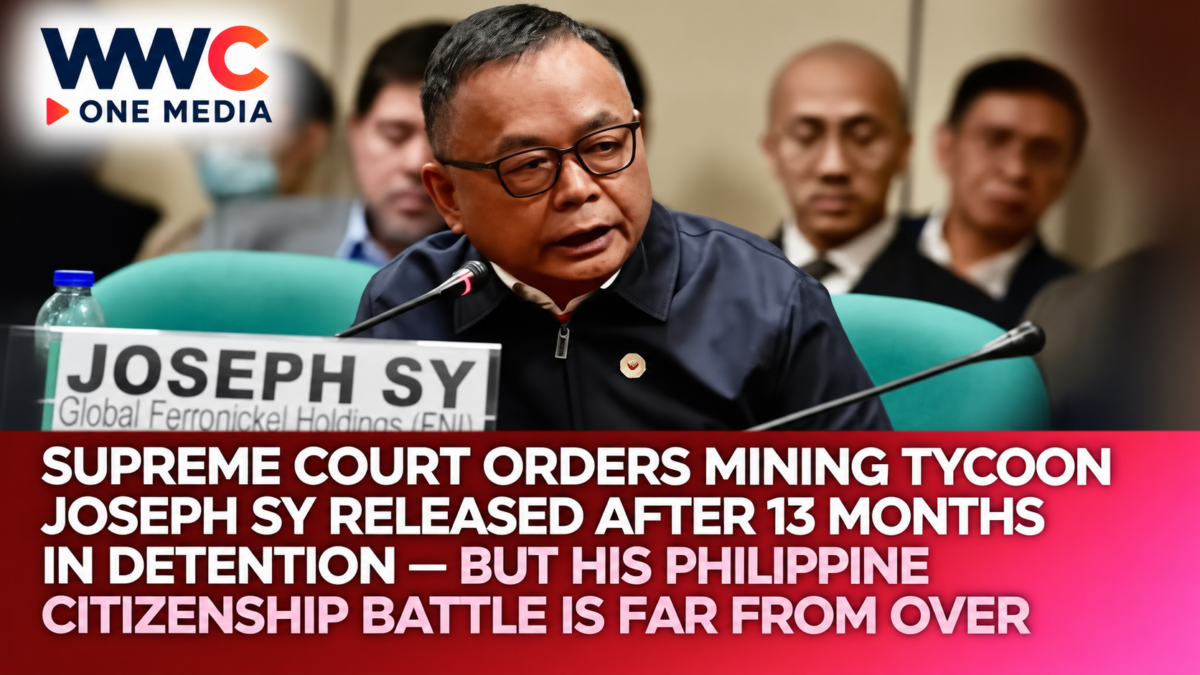
MANILA, Philippines — October 12, 2026 — The Supreme Court has ordered the release of businessman Joseph Cue Sy, former chairman of publicly listed Global Ferronickel Holdings Inc. (FNI), following more than 13 months in immigration detention over allegations that he is a Chinese national using a Filipino identity.
In an October 7 resolution, the Supreme Court’s First Division granted a preliminary mandatory injunction directing the Bureau of Immigration to release Sy after compliance with a reported ₱900,000 bond requirement.
The order comes after earlier rulings by a Taguig court and the Court of Appeals favoring Sy’s release, as well as an appeal by five major business organizations seeking intervention.
But the Supreme Court’s decision does not end the dispute over Sy’s citizenship.
Immigration officials maintain that biometric evidence links him to a Chinese national, while Sy insists that he is a legitimate Filipino citizen with valid government-issued documents.
The bigger question is whether the latest ruling will finally end his prolonged detention — or lead to another legal confrontation over citizenship, immigration authority and due process.
Supreme Court Orders Immediate Release Under Conditions
The Supreme Court’s First Division issued the resolution on October 7, granting interim relief in Sy’s continuing legal battle.
According to Bilyonaryo and Politiko, the court directed immigration authorities to release Sy upon submission of proof that the required bond had been posted.
The reported amount is ₱900,000.
The court also ordered the Bureau of Immigration and other concerned officials to submit written confirmation of compliance within 24 hours after the release.
The order specifically concerns Sy’s custody while related legal proceedings continue.
It is not a final decision determining whether he is a Filipino citizen.
Nor does it automatically dismiss any pending government proceedings involving his immigration status.
The distinction is crucial because the Supreme Court has granted preliminary relief rather than issued a final judgment resolving every legal issue in the case.
A separate account published by Philippine Commercial News identified a discrepancy in the text of the resolution, reporting that one passage referred to ₱900,000 while another mentioned ₱960,000.
The exact amount required for compliance should therefore be confirmed from the authenticated court order before any transaction or final report is treated as conclusive.
As of October 12, the available reporting established that release had been ordered, but did not independently confirm that Sy had physically left immigration custody.
More Than 13 Months Behind Bars
Sy’s detention began on August 21, 2025, when Bureau of Immigration officers arrested him at Ninoy Aquino International Airport.
He had arrived from Hong Kong.
Immigration officials alleged that biometric records linked Sy to a Chinese national identified in reporting as Chen Zhong Zhen.
Authorities argued that he had misrepresented himself as a Filipino citizen.
The case quickly became controversial because Sy was a prominent businessman associated with one of the Philippines’ major nickel mining companies.
Sy rejected the allegations.
His legal team maintained that he was born in the Philippines and possessed a registered birth certificate, Philippine passport and other official identification documents.
The disagreement developed into a prolonged legal dispute involving immigration authorities and several levels of the Philippine judiciary.
Immigration Bureau Defends Its Findings
Immigration Commissioner Joel Anthony Viado has defended the agency’s position.
The Bureau of Immigration maintained that biometric records provided grounds to question Sy’s citizenship and pursue immigration proceedings.
Officials also sought action involving his Philippine passport.
From the bureau’s perspective, the dispute concerned whether the businessman had obtained Filipino documents under a false identity.
However, biometric matching and allegations of identity misrepresentation must still be evaluated under applicable legal procedures.
The existence of a government accusation does not by itself establish citizenship fraud.
Sy remains entitled to due process and to challenge the evidence presented against him.
Taguig Court Had Already Ordered His Release
The Supreme Court decision follows earlier rulings favoring Sy.
In September 2025, a Taguig Regional Trial Court granted a petition for habeas corpus filed on his behalf.
The court concluded that his detention could not be justified on the evidence and legal circumstances before it.
The proceedings placed particular importance on Sy’s existing Philippine civil registry documents.
The validity of those documents had not been overturned through the appropriate legal process.
The ruling therefore raised concerns about the Bureau of Immigration’s authority to detain a person whose Philippine citizenship records remained legally effective.
Despite the release order, Sy’s custody continued as government lawyers pursued further remedies.
That created a dispute extending beyond his personal case to the relationship between immigration enforcement and judicial authority.
Court of Appeals Upholds Ruling Against Detention
Sy secured another favorable decision in February 2026.
The Court of Appeals affirmed the lower court’s habeas corpus ruling and rejected the Bureau of Immigration’s appeal.
In its February 20 decision, the appellate court emphasized the legal significance of Sy’s existing birth certificate.
It reasoned that immigration authorities could not simply disregard those records and subject him to summary deportation procedures without the appropriate legal foundation.
However, the decision did not conclusively resolve every issue concerning his citizenship.
The government retained the ability to challenge allegedly defective civil registry records through the proper proceedings.
The ruling was therefore important for determining whether his detention was lawful, rather than permanently settling all claims about his nationality.
Nevertheless, the decision intensified scrutiny of why Sy remained in immigration custody despite successive court orders favoring his release.
Five Business Organizations Appeal for Intervention
The case also attracted concern from the Philippine business community.
Bilyonaryo reported that five leading national business organizations submitted an appeal dated July 17, seeking executive intervention and Sy’s release.
According to the report, their involvement preceded the Supreme Court’s latest directive.
The October 7 resolution did not identify the five organizations.
Their names should therefore not be assumed or attributed without additional documentary confirmation.
For business leaders, the dispute raises concerns about procedural certainty and the treatment of executives facing government investigations.
Investors rely on predictable legal processes, especially when disputes involve government agencies, corporate leadership and individual liberty.
However, the business groups’ support for Sy’s release does not establish that all allegations against him are unfounded.
Their intervention is relevant to the debate over due process, not proof of the ultimate outcome of the citizenship dispute.
Global Ferronickel Faces a Major Leadership Controversy
The case has also had consequences for Global Ferronickel Holdings.
The company is involved in the Philippine nickel industry, which supplies raw materials used in steelmaking and other industrial processes.
After Sy’s detention, FNI announced changes to its board leadership.
In an August 27, 2025 disclosure to the Philippine Stock Exchange, the company said Sy had taken a voluntary leave of absence as chairman.
It elected company president Dante R. Bravo as chairman to maintain operational continuity.
The company subsequently disclosed Sy’s resignation as director in December 2025.
These governance changes are important because the latest Supreme Court order concerns a former chairman, not the company’s currently serving board chairman.
FNI has previously issued disclosures clarifying news reports about Sy and the legal controversy.
The company and Sy’s personal legal proceedings should be distinguished.
The dispute does not, by itself, establish wrongdoing by the listed company or invalidate its mining operations.
Senate Inquiry Raises Wider Citizenship Questions
The controversy also reached the Senate.
Senator Risa Hontiveros sought an investigation into allegations that Sy used a false Filipino identity.
The inquiry raised questions about citizenship documentation, business ownership and participation in sectors with constitutional restrictions on foreign ownership.
Mining is a particularly sensitive industry because the Constitution and related laws govern the terms under which foreign investors may participate in the exploration, development and utilization of natural resources.
The Senate proceedings drew comparisons with the earlier citizenship controversy involving former Bamban mayor Alice Guo.
However, the cases involve different individuals, evidence and legal proceedings.
Allegations in one case cannot establish wrongdoing in another.
Sy’s identity and citizenship must be determined based on the evidence specific to his case.
What the Latest Supreme Court Order Actually Means
The October 7 decision is significant because it concerns Sy’s immediate liberty.
A preliminary mandatory injunction provides temporary judicial relief while a case is being considered.
It does not necessarily determine the final rights of all parties.
In this case, the reported directive requires Sy’s release after compliance with the bond requirement.
The court consolidated two related petitions, identified by Politiko as G.R. Nos. E-07741 and E-07743.
It also directed Sy’s representative, Dante Bravo, to reply to the government’s submissions within a non-extendible period of 10 days from notice.
The substantive dispute therefore continues.
Future proceedings may examine the government’s evidence, the legal status of Sy’s documents and the immigration bureau’s authority.
Any final conclusion must come through the appropriate judicial process.
The Bigger Question: Who Has the Authority to Determine Citizenship?
Beyond one businessman’s detention, the case raises a difficult legal issue.
What happens when a government agency alleges that a person’s official identity records are fraudulent, but those records remain legally valid?
Immigration enforcement is important for protecting the country’s borders and applying citizenship laws.
However, the government must also comply with court orders and established legal procedures.
Where citizenship is disputed, the proper process for challenging civil registry documents becomes especially important.
Detaining a person for an extended period despite judicial rulings favoring release also raises concerns about the effective protection of individual rights.
At the same time, a release order does not prevent authorities from presenting legitimate evidence through lawful proceedings.
The challenge is ensuring that enforcement and due process operate together.
Could the Decision Affect Investor Confidence?
The involvement of business organizations demonstrates why the dispute has attracted attention beyond the legal community.
Mining and other capital-intensive industries depend on stable regulations and predictable treatment by public institutions.
Uncertainty involving company executives can create reputational and governance concerns.
But the broader economic impact of Sy’s detention should not be exaggerated.
There is no verified evidence that this single case has caused a measurable national decline in mining investment or foreign capital inflows.
Its significance lies primarily in the questions it raises about legal process and the treatment of contested citizenship documents.
For investors, a transparent and timely resolution would provide greater clarity than prolonged uncertainty.
The Bigger Test: Will the Release Order Finally Be Implemented?
Joseph Sy’s case has now produced a series of judicial developments.
A Taguig court ordered his release in September 2025.
The Court of Appeals upheld the ruling in February 2026.
And the Supreme Court issued a fresh directive on October 7, 2026, ordering release under specified conditions.
For Sy and his legal representatives, the immediate priority is compliance with the latest ruling.
For immigration officials, the responsibility is to follow the court’s directive while pursuing any remaining legal remedies through authorized channels.
For the business community, the case highlights the importance of legal certainty.
And for the public, it raises questions about the relationship between government enforcement powers and constitutional protections.
The Supreme Court’s latest decision is a major development in Sy’s favor, but it is not a final declaration resolving his citizenship dispute.
Whether the case ends soon will depend on compliance with the release order and the disposition of the remaining proceedings.
After more than 13 months in detention, Joseph Sy has secured another court order for his release — but the bigger question is whether the government will finally comply while the battle over his Filipino citizenship moves toward a definitive legal resolution.