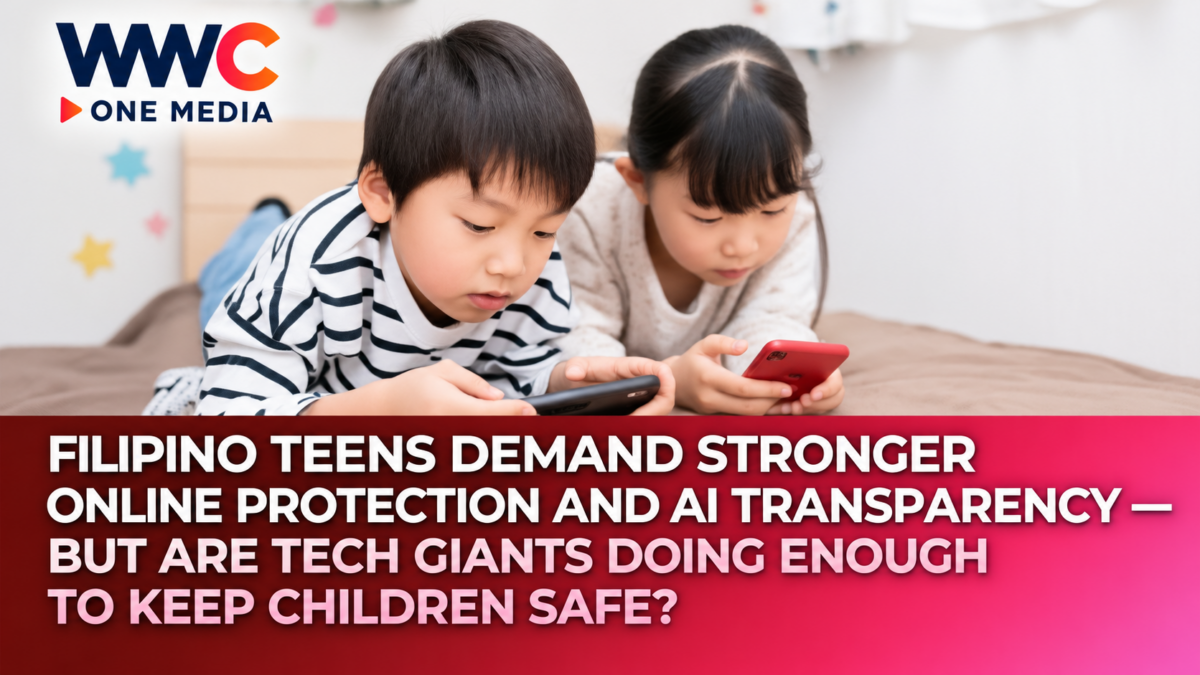
MANILA, Philippines — October 12, 2026 — Filipino teenagers are urging telecommunications companies, technology platforms and policymakers to strengthen online safety protections and make the use of artificial intelligence more transparent as digital threats become an increasingly important concern for young internet users.
The call emerged from a youth consultation organized by PLDT Inc. and Smart Communications Inc. in collaboration with Child Rights Coalition Asia (CRC Asia).
Participants aged 13 to 19 from Luzon, Visayas and Mindanao discussed their experiences with cyberbullying, online scams, misinformation and the growing use of AI in everyday life.
Although the teenagers recognized the benefits of digital technology for education, communication and creative activities, they argued that companies need to do more to protect users and explain how AI systems operate.
The discussion is taking place as the Philippine government considers stronger rules for children’s social media use and international organizations warn that online safety requires more than age restrictions.
The bigger question is whether technology companies will turn young people’s recommendations into meaningful safeguards — or leave Filipino families responsible for managing an increasingly complicated digital environment.
Filipino Teenagers Speak Out on Digital Safety
The consultation brought together young participants from different parts of the country to share their experiences online.
Organized by PLDT and Smart with CRC Asia, the initiative sought to incorporate children’s perspectives into the development of digital services, company policies and safety measures.
Participants raised concerns about harmful online interactions, cyberbullying, scams and misleading information.
They also discussed the growing influence of artificial intelligence on schoolwork, online content and digital communication.
Rather than calling for an outright rejection of technology, the participants emphasized the importance of understanding how digital systems work and protecting themselves against abuse.
The discussion highlighted a central concern: young people depend on digital platforms for learning and social interaction, but they often have limited control over the systems that collect their information or influence what they see.
Young Filipinos Want More Transparency in Artificial Intelligence
One of the clearest messages from the consultation concerned AI transparency.
Participants said technology companies should explain when artificial intelligence is being used in products and services.
They also emphasized the importance of checking whether AI-generated information is accurate.
Artificial intelligence can help students understand difficult topics, organize schoolwork and create digital content.
However, AI systems can generate inaccurate information or present misleading answers with apparent confidence.
Without adequate guidance, young users may find it difficult to distinguish reliable information from incorrect or fabricated material.
Smart Assistant Vice President and Center Head for Strategic Analytics Amabellee Gomez said the consultation demonstrated that young people wanted to understand and influence how artificial intelligence is used.
The broader message was that transparency should be built into digital services rather than treated as an optional feature.
Cyberbullying, Scams and Misinformation Remain Major Concerns
The teenagers also identified familiar but persistent online risks.
Cyberbullying can expose students to harassment and humiliation through social media, messaging services and other digital platforms.
Scammers may use deceptive links, messages or impersonation to steal money and personal information.
Misinformation can spread quickly when false claims are shared without verification.
AI-generated content introduces additional challenges by making fabricated text, images and audio increasingly convincing.
These problems affect people of all ages, but young users may require additional safeguards because of their developing judgment, limited experience and dependence on digital services.
Participants called for stronger protection while recognizing that the internet also creates important educational and social opportunities.
PLDT and Smart Say Children’s Views Will Inform Their Policies
PLDT and Smart Chief Sustainability Officer Melissa Vergel de Dios said the consultation provides insights into the experiences of young people.
The company recognizes children as active users of digital services and says it wants to understand the problems they encounter.
According to InsiderPH, the latest consultation builds on an earlier assessment involving children that identified child protection, cybersecurity and data privacy as major issues.
PLDT and Smart said those findings helped inform updated safeguarding policies.
The companies have emphasized safety-by-design and responsible AI practices.
Safety-by-design means incorporating protections into a product’s development rather than relying entirely on users to identify and avoid harmful situations.
For a telecommunications provider or digital platform, that approach may involve better privacy controls, security features, harmful-content prevention and accessible reporting systems.
However, announcing a policy is different from demonstrating its effectiveness.
The results will depend on implementation, testing and measurable improvements in users’ experiences.
More Than 213 Billion Malicious-Domain Access Attempts Prevented
PLDT and Smart also reported large-scale cybersecurity activity during the first six months of 2026.
The group said it prevented access to more than 213 billion malicious domains or domain-access attempts during the period.
It also reported disabling approximately 373,000 mobile numbers associated with phishing, text scams and voice-phishing activities.
These figures highlight the scale of potentially harmful digital traffic encountered by telecommunications networks.
However, they need careful interpretation.
Blocked access attempts are not the same as unique malicious websites or unique people targeted.
A single automated system may generate repeated requests.
Likewise, a disabled mobile number is not necessarily evidence of a separate individual criminal offender.
The figures describe the company’s reported cybersecurity enforcement activity, not independently verified totals of crimes prevented.
PLDT Blocks More Than One Million Attempts to Access Child-Abuse-Linked Websites
Another significant part of the report concerns efforts to prevent online sexual abuse and exploitation of children.
PLDT and Smart said they blocked more than one million attempts to access websites linked to online sexual abuse and exploitation of children during the first half of 2026.
Since June 2021, the group said it has blocked more than 2.3 million URLs associated with that activity.
Online sexual exploitation can involve grooming, coercion, abusive imagery, financial exploitation and other serious forms of harm.
Telecommunications providers can contribute to prevention by blocking access to identified illegal resources and cooperating with authorized child-protection institutions.
But technical blocking alone cannot eliminate exploitation.
Effective protection also requires investigation, victim support, education, reporting mechanisms and law enforcement.
The reported URL-blocking figure should not be confused with the number of individual victims or perpetrators.
UNICEF Warns That Social Media Bans Alone Will Not Protect Children
The teenagers’ concerns align with a warning issued by UNICEF Philippines on October 8.
UNICEF urged policymakers to pursue comprehensive online child-protection measures rather than relying solely on social media age restrictions.
The organization acknowledged growing concern over violent online content, grooming, sextortion and other forms of technology-facilitated harm.
But it warned that poorly designed restrictions could push young users toward less regulated spaces or interfere with access to information and support networks.
UNICEF recommended stronger safety features, better digital literacy, effective reporting systems and clearer accountability for technology companies.
It also emphasized the need for age-appropriate services that protect children’s privacy.
The organization’s position is particularly relevant to the PLDT-Smart consultation because both approaches recognize that children should participate in discussions about the systems affecting their lives.
Philippine Lawmakers Are Advancing Online Child-Safety Legislation
The government is also examining new regulatory measures.
On October 1, the House of Representatives reported that its appropriations committee had approved funding provisions for a proposed law aimed at protecting children using social media and online gaming platforms.
The substitute measure consolidated 42 House bills, including the proposed Children’s Social Media Safety Act.
The legislation would establish an office within the Department of Information and Communications Technology responsible for child online-safety standards and regulation.
However, committee approval of funding provisions does not mean the proposal has become law.
Further legislative action would still be required.
The debate reflects a central challenge: how to protect young internet users while respecting privacy, access to information and opportunities for digital learning.
DepEd and ChildFund Consult Stakeholders on Safer Digital Spaces
The Department of Education is also developing its response.
On September 24, the Philippine Information Agency reported that DepEd and ChildFund Philippines were preparing a national consultation on child online safety.
The September 25–26 gathering was intended to bring together government agencies, technology companies, youth advocates, academics and civil society groups.
Its purpose was to support a roadmap for forthcoming DepEd Online Safety Guidelines.
The initiative illustrates why school involvement matters.
Children encounter digital technology not only through social media but also through homework, online research, class communications and educational applications.
Teachers and schools need clear guidance on recognizing risks, responding to incidents and helping students use AI responsibly.
Policies that focus only on social media accounts may overlook educational technology and other digital environments where young people spend time.
Children Are Adopting AI Faster Than Adults
International research underscores the urgency of the issue.
In June 2026, UNICEF reported that children in the countries studied were adopting artificial intelligence more than three times faster than adults.
Its analysis drew on data from 10 countries and estimated that at least 20 million children in those markets had used AI.
UNICEF also found that many young people were using the technology for educational support and advice.
These findings demonstrate how quickly AI is becoming part of childhood.
However, the international figures should not be presented as statistics specifically measuring Filipino children.
The Philippine consultation offers qualitative insights into the concerns and priorities of its participants, not a nationally representative survey of all teenagers.
Both types of evidence are useful, but they answer different questions.
Young People Want a Voice in Technology Decisions
One important recommendation from the consultation was that children should participate in decisions about digital products.
CRC Asia Regional Executive Director Amihan Abueva stressed the importance of recognizing young people as active stakeholders rather than simply passive users requiring protection.
Children can provide firsthand information about harmful online interactions, confusing privacy settings and features that make reporting abuse difficult.
Their feedback may help companies identify problems that are not obvious during technical testing.
CRC Asia has previously worked with technology companies and youth groups to bring children’s perspectives into discussions about online privacy, content moderation and platform design.
In May, TikTok participated in a CRC Asia event involving approximately 30 Filipino teenagers from Luzon, Visayas and Mindanao.
The engagement demonstrated growing interest in youth-centered technology design.
However, the number of participants at the TikTok event should not automatically be attributed to the separate PLDT-Smart consultation.
International AI Safety Scrutiny Adds Pressure
The debate is not limited to the Philippines.
An October 2026 assessment by Common Sense Media criticized the effectiveness of certain safeguards in an AI chatbot experience designed for teenagers.
The organization raised concerns involving crisis responses, parental alerts and the potential for young users to develop unhealthy emotional dependence on AI systems.
OpenAI disputed the findings and questioned whether the testing fully reflected active parental-control settings.
The disagreement demonstrates a broader problem in AI governance.
Technology developers may announce safety features, but independent testing is needed to determine how consistently those safeguards work.
Such evaluations should use transparent methods and account for the systems and settings available at the time of testing.
For young users, the important issue is whether protections function reliably in real situations.
Why Responsible AI Matters for Filipino Students
AI is becoming increasingly relevant to education.
Students may use it to summarize readings, explore unfamiliar topics, generate ideas or improve written assignments.
These uses can support learning when combined with appropriate instruction and verification.
But students must understand that AI-generated responses can be incorrect.
They should check important facts against reliable references and remain aware of school policies governing AI-assisted work.
Personal information also requires careful handling.
Children should avoid entering passwords, identification numbers, private family information or other sensitive details into tools without understanding how that information may be processed.
Schools can help by teaching practical AI literacy rather than simply telling students to avoid the technology.
For technology providers, transparency includes explaining what AI does, its limitations and how users can report harmful or inaccurate outputs.
The Bigger Question: Will Technology Companies Listen?
The consultation organized by PLDT, Smart and CRC Asia shows that Filipino teenagers are not simply asking to be excluded from digital spaces.
They want safer platforms, clearer explanations and greater influence over the technologies they use.
The companies have pointed to cybersecurity measures, safeguarding policies and youth engagement as evidence of their work.
UNICEF has urged stronger accountability and safety-by-design.
Government agencies are developing guidelines and considering legislation.
But the success of these efforts will depend on measurable results.
Companies will need to demonstrate that harmful content is addressed, privacy is respected, AI systems are explained and children have accessible ways to report problems.
Government institutions will need to establish workable standards without unnecessarily restricting legitimate learning and participation.
Parents and schools will need practical resources to support young users.
And children themselves should have opportunities to evaluate whether the safeguards actually help them.
The message from Filipino teenagers is clear: digital technology should expand their opportunities without requiring them to sacrifice their safety or privacy.
The next challenge is translating that message into enforceable standards, effective company practices and safer experiences.
Filipino teenagers are demanding stronger protection and greater AI transparency — but the bigger test is whether telecommunications companies, technology platforms and regulators will turn those demands into real changes before online risks outpace the safeguards meant to stop them.