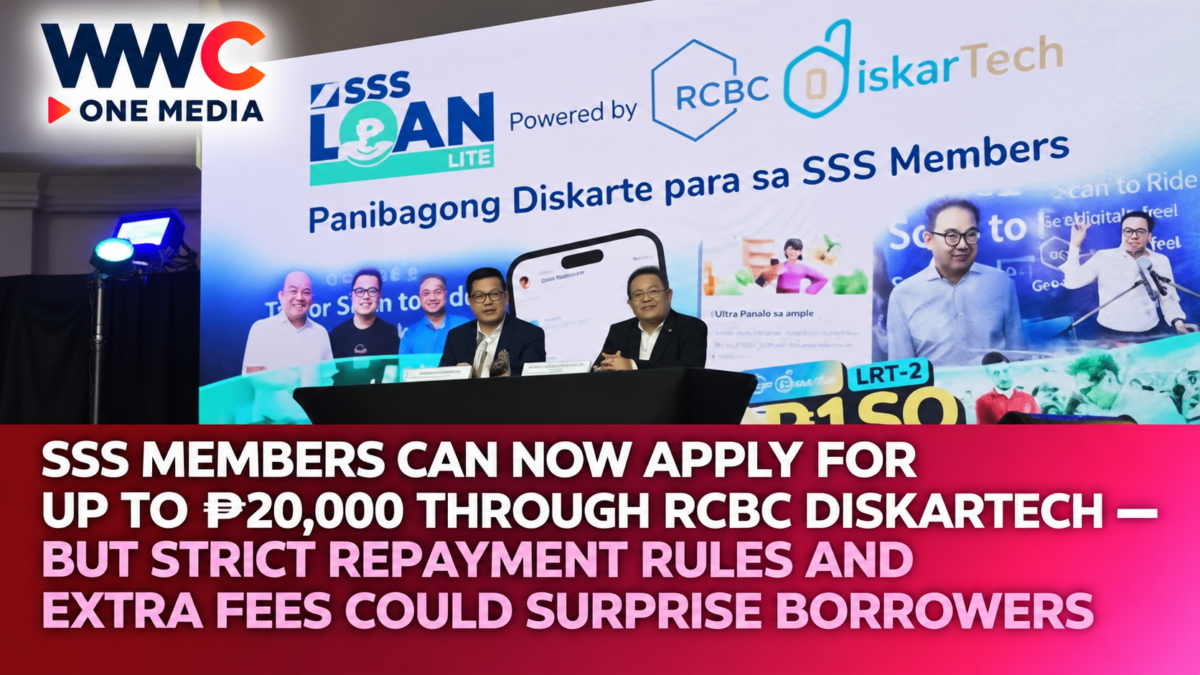
MANILA, Philippines — October 12, 2026 — Filipino workers facing unexpected expenses can now apply for short-term loans through their smartphones under the Social Security System’s (SSS) LoanLite program, made available through RCBC’s DiskarTech digital banking application.
The service allows qualified SSS members to seek financing ranging from ₱1,000 to ₱20,000 without visiting a bank branch or waiting for the delivery of a physical MySSS Card.
The digital lending arrangement is part of a partnership between SSS and Rizal Commercial Banking Corporation (RCBC) to improve access to regulated, short-term credit.
According to Bilyonaryo’s October 12 report, borrowers who complete the necessary registration and identity verification can submit applications through the DiskarTech app, subject to eligibility requirements.
The loans carry an annual interest rate of 8%, while the repayment options currently described by DiskarTech are 60 and 90 days.
However, other charges may apply.
The bigger question for Filipino borrowers is whether the convenience of accessing emergency funds online outweighs the cost of fees and the pressure of repaying the money within just two or three months.
SSS and RCBC Bring Short-Term Loans to Smartphones
SSS LoanLite is a digital microloan facility designed to give eligible members access to smaller amounts of short-term financing.
The program is intended for immediate financial needs such as medical bills, household essentials, educational expenses and other unexpected costs.
Rather than requiring every application to be completed at an SSS branch, the program uses the online services of participating financial institutions.
RCBC provides access through its DiskarTech platform.
Members can check their eligibility, review an available loan offer, accept the disclosed terms and complete the application online.
Once a loan is approved and the process is successfully completed, the net proceeds are credited directly to the borrower’s eligible DiskarTech account.
The service is designed to simplify the borrowing process, particularly for workers who may find it difficult to visit physical offices during business hours.
However, digital access does not guarantee approval.
Borrowers must still satisfy the requirements set by SSS and complete the necessary identity and account verification.
How Much Can SSS Members Borrow?
Under the program, eligible members can borrow from ₱1,000 to ₱20,000.
The amount offered depends on the member’s qualifications, contribution history and applicable financial assessment.
The maximum amount is not automatically available to every member.
According to the Philippine News Agency’s August 11 report on the partnership, borrowing limits consider the member’s recent monthly salary credits and the program’s contribution requirements.
Members generally need at least 12 posted monthly SSS contributions.
Additional conditions apply to borrowers seeking the maximum amount.
The Philippine News Agency reported that members seeking the maximum loan must have at least 36 total contributions, including six posted within the 12 months preceding the application.
Applicants can view their individual available offer through the participating financial institution’s digital platform.
They should not assume that submitting an application automatically entitles them to ₱20,000.
Who Qualifies for SSS LoanLite?
The official SSS program guidelines identify several requirements.
Applicants must be at least 18 years old when applying and younger than 65 at the end of the repayment period.
They must have a sufficient contribution history and no past-due short-term member loan.
Members with an active restructured loan or certain final benefit claims are not eligible.
They must also have an account with a participating financial institution and meet applicable identity verification requirements.
The SSS program covers eligible employed, self-employed, voluntary and overseas Filipino worker members.
RCBC DiskarTech adds account-specific requirements.
According to its official frequently asked questions, an applicant needs a verified DiskarTech Regular Savings Account and a successfully linked SSS Transaction Reference Number.
For borrowers, completing these steps in advance can reduce problems during the application process.
No Need to Wait for a Physical MySSS Card
One of the most useful features of the program is that eligible members do not have to wait for their physical MySSS Card to arrive before applying.
However, this does not mean the MySSS Card enrollment process can be skipped.
Members must first complete the relevant MySSS Card application and obtain a valid SSS Transaction Reference Number.
They can get this number through the My.SSS portal by selecting RCBC DiskarTech as their preferred participating financial institution.
The reference number must then be linked and validated in the DiskarTech app.
Applicants must also complete the necessary identity checks and account verification.
Once those requirements are satisfied, they can access the LoanLite function if SSS confirms their eligibility and the product is available on their account.
The physical card is therefore not required to begin the application, but the underlying registration and verification remain mandatory.
How to Apply Through RCBC DiskarTech
The application process begins through the official My.SSS portal and RCBC DiskarTech app.
First, the member logs into the My.SSS portal and applies for a MySSS Card, selecting RCBC DiskarTech as the preferred financial institution.
The member then obtains the SSS Transaction Reference Number.
Next, the applicant opens or registers a DiskarTech account and completes the required identity verification.
Members with a Basic Deposit Account may need to upgrade to a Regular Savings Account.
After linking the reference number and completing verification, eligible members can access SSS LoanLite inside the app.
The applicant can then enter the required SSS and employment information, review the available loan offer and select an eligible repayment period.
Before accepting, the borrower must review the disclosure statement, promissory note, interest charges, fees and repayment schedule.
Only after confirming the offer and successfully completing the required checks will the loan proceeds be credited.
Members should use only the official My.SSS website and legitimate RCBC DiskarTech application channels.
How Much Interest Will Borrowers Pay?
The loan carries an annual interest rate of 8%.
That is approximately 0.67% per month when expressed as a simple monthly equivalent.
However, the cost of borrowing is not limited to the stated interest rate.
DiskarTech’s official FAQ also discloses a transaction fee of up to ₱200 per loan and an additional add-on fee not exceeding 3% annually.
The exact charges depend on the individual loan offer.
Fees may be deducted from the proceeds before the borrower receives the money.
This means the amount credited to the account could be lower than the approved principal.
Borrowers should therefore examine both the total repayment obligation and the net amount they will actually receive.
The final disclosure statement in the app should be used to assess the full cost of the loan.
Example: Why Fees Matter Even on a Small Loan
Consider a borrower applying for ₱10,000.
At an annual interest rate of 8%, a simple-interest calculation over 60 days would produce approximately ₱131.51 in interest using a 365-day convention.
Over 90 days, the equivalent would be approximately ₱197.26.
These figures are illustrations only.
The actual interest calculation, payment schedule and total amount due depend on the applicable loan contract.
Additional transaction and add-on fees may increase the total cost.
For smaller loan amounts, a fixed processing fee can represent a meaningful percentage of the proceeds received.
A borrower seeking ₱1,000, for example, should pay particularly close attention if a transaction fee is included.
The advertised annual interest rate alone may not reflect the full effective cost of borrowing.
Repayment Could Be Due in Just 60 or 90 Days
RCBC DiskarTech currently identifies 60-day and 90-day repayment periods for its LoanLite offering.
The wider SSS program also permits 15-day and 30-day repayment options through participating institutions, although specific choices depend on the lender.
LoanLite is therefore different from a conventional long-term salary loan.
The repayment period is short.
Borrowers must consider whether their income and other obligations will allow them to repay on schedule.
DiskarTech says repayment is primarily handled through automatic debits from the borrower’s account.
Members should maintain sufficient funds before each due date.
A borrower who fails to maintain the required balance may face unpaid obligations and applicable penalties.
The short maturity makes the program potentially useful for temporary cash shortages but less suitable for expenses that require several months or years to repay.
Late Payments Could Affect Future Loans
The official DiskarTech guidelines warn that unpaid installments may be subject to additional collection attempts and applicable charges.
The platform may continue attempting automatic debits when funds become available in the borrower’s account.
Persistent nonpayment could also affect eligibility for future SSS borrowing.
Loan renewal is generally allowed only after the existing LoanLite obligation has been fully settled.
Members should therefore avoid borrowing more than they can realistically repay.
The digital approval process may be convenient, but repayment obligations remain legally enforceable.
How LoanLite Differs From the Regular SSS Salary Loan
SSS LoanLite is designed for relatively small and urgent expenses.
Its loan amounts range from ₱1,000 to ₱20,000.
Its repayment periods are generally measured in days rather than years.
The standard SSS Salary Loan is a separate product with different qualifying conditions and repayment arrangements.
For example, SSS requires at least 36 posted contributions for a one-month Salary Loan and at least 72 for a two-month Salary Loan, together with other qualifying conditions.
The regular Salary Loan is not interchangeable with LoanLite.
Members should compare the available programs based on their needs, contribution histories, repayment capacity and total borrowing costs.
A quick digital loan may be convenient, but that does not necessarily make it the best option for every financial situation.
RCBC and SSS Expand Their Digital Partnership
The LoanLite initiative builds on an existing partnership between SSS and RCBC involving the MySSS Card.
The institutions formally introduced the new digital microloan partnership at an August 11 event at the Yuchengco Museum in Makati City.
RCBC’s leadership described the initiative as part of its efforts to expand financial inclusion through digital banking.
The arrangement combines SSS’s membership and lending programs with RCBC’s mobile banking infrastructure.
The objective is to provide a more accessible formal lending option, especially for members who might otherwise turn to expensive informal credit.
The partnership also aims to simplify the process of receiving and managing SSS-related financial transactions through a mobile platform.
Digital Banking Could Help More Filipinos Access Formal Credit
For workers who live far from SSS offices or bank branches, online access can reduce the time and transportation expenses associated with borrowing.
Digital applications may also allow members to review their loan offers outside conventional banking hours.
For self-employed workers and overseas Filipino workers, the convenience can be particularly valuable.
However, digital financial inclusion also depends on reliable internet access, identity verification and consumers’ understanding of loan terms.
Members unfamiliar with mobile banking may need additional assistance.
The platform must also safeguard personal and financial information.
Applicants should avoid sharing passwords, one-time PINs or account credentials with anyone claiming to provide faster approval.
SSS loan applications should be completed only through official participating channels.
The Bigger Question: Does Easier Credit Mean Better Financial Security?
The partnership between SSS and RCBC represents a meaningful step toward making short-term formal credit more accessible.
It could help eligible Filipinos meet immediate expenses without relying on unregulated lenders.
But accessibility is only one part of responsible lending.
Borrowers must understand how much money they will receive, how much they must repay and when payments are due.
They must also consider whether emergency borrowing will solve a temporary problem or create a larger obligation.
For a household already facing financial strain, even a relatively small repayment can become difficult if income is uncertain.
The program’s value will therefore depend not only on application convenience but also on transparent pricing, fair eligibility assessments and responsible use.
SSS LoanLite can provide another financial option for eligible members, but it is not a cash grant or an automatic benefit available to every SSS contributor.
The terms require careful review.
Members should compare available borrowing alternatives and avoid accepting loan amounts they cannot reasonably repay.
Filipinos can now seek up to ₱20,000 in short-term SSS financing through RCBC DiskarTech without waiting for a physical card — but the bigger test is whether borrowers understand the fees and tight repayment deadlines before pressing the approval button.