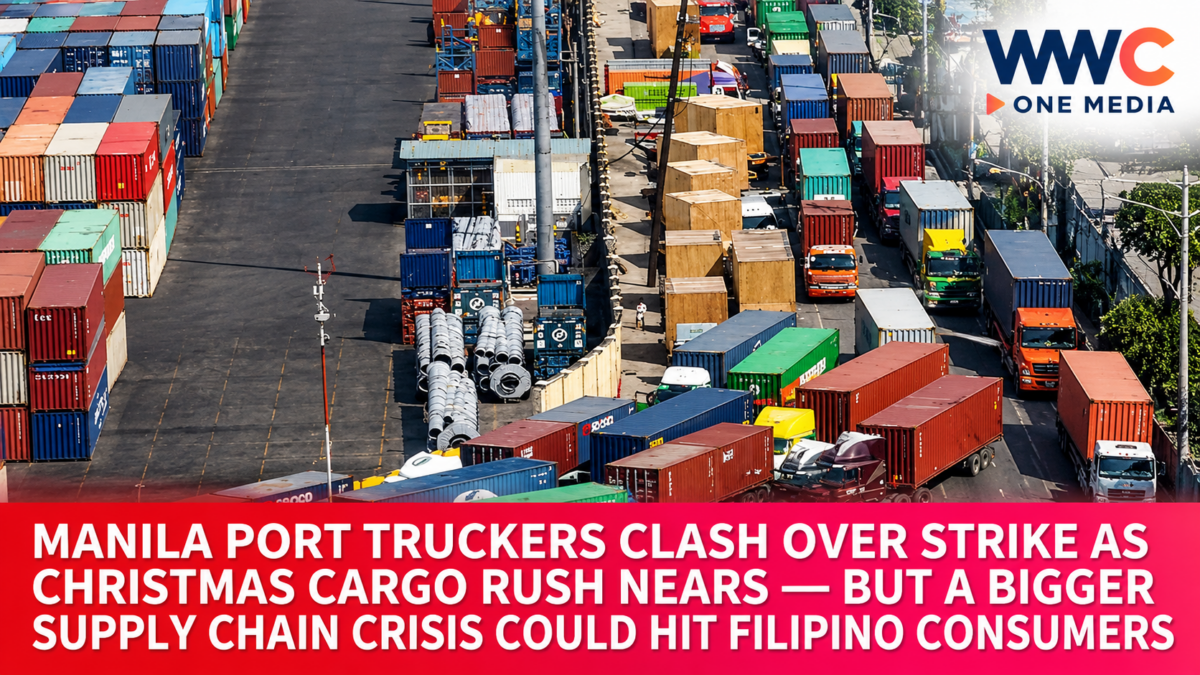
MANILA, Philippines — October 12, 2026 — A deepening disagreement among Philippine trucking and customs brokerage organizations is raising concerns about whether Manila’s already strained cargo-handling system can cope with the approaching Christmas shipping season.
The Alliance of Concerned Truck Owners and Organizations (ACTOO), which says it represents approximately 60% of port-based truckers, is questioning whether some industry groups are advancing proposals influenced by their own commercial interests rather than solutions that will benefit the wider logistics sector.
The dispute follows several days of port-related protests that disrupted some trucking and brokerage activities in early October.
While participating organizations have suspended their work stoppages, serious problems involving empty shipping containers, depot capacity, trucking costs and regulatory coordination remain.
In a letter dated October 2 and addressed to Senator Risa Hontiveros, ACTOO called for a broader and more independent examination of the port crisis.
The organization warned that the government should not rely exclusively on the accounts of a limited number of industry participants when deciding how to address congestion.
The bigger question is whether the government can unite competing business interests and fix Manila’s logistics bottlenecks before the holiday cargo rush places even greater pressure on the supply chain.
ACTOO Questions Motives Behind Port Congestion Proposals
According to Bilyonaryo’s October 12 report, ACTOO raised concerns about how certain organizations were presenting the port congestion problem to government officials.
The group’s October 2 letter urged Senator Hontiveros to consult a wider range of logistics stakeholders before endorsing proposed solutions.
ACTOO argued that information supplied by parties with commercial interests should be independently checked.
The alliance did not identify the organizations it was criticizing.
However, its warning came amid disagreements with trucking and customs brokerage groups that subsequently staged work stoppages at Manila’s ports.
The concerns center on whether proposed reforms would address the overall supply chain or favor individual businesses and industry participants.
ACTOO called for government agencies to examine operating data, identify the sources of delays and determine which changes would produce measurable improvements.
The allegations should not be treated as proof that any particular port group engaged in misconduct.
Without evidence of improper conduct, concerns about competing commercial interests remain a position expressed by ACTOO rather than an established finding.
Why ACTOO Refused to Join the Trucking Holiday
The disagreement became more visible when several port and trucking organizations organized temporary work stoppages in early October.
Among the protest organizers were the Confederation of Truckers Association of the Philippines (CTAP), led by Mary Zapata, and the Practicing Customs Brokers Association of the Philippines Inc. (PCBAPI), represented by Reynaldo Soliman.
Other participants included the Aduana Business Club, Inland Haulers and Truckers Association, Port Allied Logistics Group and Haulers and Truckers Association in the Watersouth.
Their actions were intended to draw attention to longstanding problems affecting cargo movement.
ACTOO declined to participate.
Vice President and Acting Chairperson Rina Papa argued that negotiations and coordinated government action would be more productive than suspending operations.
She acknowledged the seriousness of the trucking industry’s problems but warned that stopping cargo movement could impose additional costs on businesses and consumers.
The disagreement was therefore primarily about strategy.
Both sides were calling for solutions to port congestion, but they differed over whether temporary work stoppages were an effective way to obtain them.
Truckers Say Empty Containers Are Trapping Their Vehicles
One of the biggest operational concerns involves the return of empty shipping containers.
After imported cargo is delivered, truckers must return the empty containers to an authorized depot or location designated by the shipping line.
However, trucking organizations say inadequate depot space and restrictions on accepting empty containers have created substantial delays.
Some operators report waiting two weeks to a month before they can return containers.
Those delays can tie up equipment and prevent operators from accepting additional hauling assignments.
A truck or trailer that cannot complete its container-return obligation may be unable to move efficiently to the next job.
Meanwhile, costs continue accumulating.
Operators must still pay drivers, maintain vehicles, finance equipment and purchase fuel.
These expenses can turn an otherwise profitable hauling assignment into a financial loss.
However, the reported two-week-to-one-month delays reflect operators’ accounts and should not be presented as a verified average for every Manila port shipment.
The magnitude of congestion varies by shipping line, depot and operating conditions.
Six Major Issues Are Driving the Port Dispute
PortCalls Asia reported that the protesting organizations identified six main problems requiring government attention.
These include difficulties returning empty containers, charges imposed by shipping lines, shortages of qualified truck-trailer drivers and requirements involving passenger accident management insurance.
The groups also raised concerns about truck bans, related fees and the Terminal Appointment Booking System.
Each issue affects a different part of the logistics chain.
Container-return delays reduce equipment availability.
Shipping charges add to operating costs.
Driver shortages limit transport capacity.
Truck restrictions can complicate delivery schedules.
And terminal booking problems may increase the difficulty of coordinating cargo pickups and deliveries.
The combined effect can reduce the efficiency of cargo movement even when the ports themselves remain open.
For importers and exporters, these problems can create unpredictable transport costs and shipment delays.
Trucking Holiday Ends After Cabinet Secretary Abalos Intervenes
The protest action did not continue indefinitely.
According to PortCalls Asia, five trucking and port-user organizations ended their three-day trucking holiday on October 8 after Cabinet Secretary Benjamin Abalos Jr. contacted organizers.
The groups were subsequently preparing to meet Abalos during the following week to discuss their concerns.
CTAP President Mary Zapata and Inland Haulers and Truckers Association President Teodorico Gervacio confirmed the planned engagement.
The meeting was expected to involve discussions about port congestion, trucking regulations and operational costs.
Organizers have also initiated contacts with other government agencies.
However, ending the work stoppage does not mean all outstanding issues have been resolved.
The government and industry participants must still agree on specific measures, responsibilities and implementation schedules.
Customs Brokers Also Suspend Their Protest
The Practicing Customs Brokers Association of the Philippines separately suspended its port-related protest on October 8.
The group said its immediate concern about empty-container acceptance had improved.
According to PCBAPI, Manila port operators International Container Terminal Services Inc. and Asian Terminals Inc. were accepting empty containers for evacuation.
However, PortCalls Asia said it could not independently verify the entirety of the group’s claim.
Asian Terminals clarified that it had already been facilitating the re-export of excess empty containers through an existing shipping-line arrangement since 2019.
The distinction matters because different stakeholders have offered differing explanations about whether the problem is new, how widespread it is and which organizations should address it.
The situation reinforces ACTOO’s argument that decision-makers need reliable operating data rather than relying solely on individual accounts.
Did the Port Holiday Shut Down Manila’s Terminals?
Available operational data show that the protests did not result in a complete shutdown of Manila’s major container terminals.
PortCalls Asia reported figures provided by Asian Terminals showing that Manila South Harbor continued recording truck transactions during the protest period.
The terminal handled 1,435 truck trips on October 5, followed by 2,129 on October 6 and 2,530 on October 7.
The October 7 figure was higher than the 2,400 trips recorded on the comparable day a week earlier.
The Manila International Container Terminal also stated that it remained open for transactions during the protest period.
These figures do not mean individual truckers or customs brokers experienced no disruption.
They demonstrate that the work stoppages were not equivalent to a total closure of Manila’s ports.
That distinction is important when assessing the economic impact of the protests.
Bureau of Customs Calls for Dialogue
The Bureau of Customs acknowledged the industry’s complaints in an official statement dated October 5.
The agency recognized the difficulties associated with empty-container congestion and limited depot capacity.
It said it had been coordinating with relevant stakeholders to identify practical solutions.
Customs urged trucking groups, brokers, importers, exporters and other parties to participate in constructive discussions.
It recommended using the Customs Industry Consultative and Advisory Councils and regular stakeholder meetings to address operational concerns.
The bureau also cautioned that actions interrupting cargo flows could worsen existing difficulties.
Its position reflects a central challenge facing the government.
Authorities must respond to legitimate complaints without creating additional disruption to national trade.
Philippine Ports Authority Pushes More Empty-Container Yards
Another proposed solution is to increase the number of facilities accepting empty shipping containers.
Philippine Ports Authority General Manager Jay Santiago has advocated additional container-return yards as a near-term way to relieve congestion.
According to the Daily Tribune’s October 10 report, Santiago said expanding available return facilities could allow truckers to release containers more quickly and move on to new cargo assignments.
The proposal places particular attention on foreign shipping lines and their arrangements for storing or repositioning empty containers.
However, adding depot space involves land availability, investment, coordination and operating arrangements.
For truckers, the practical test will be whether facilities are accessible and able to receive containers without prolonged waiting periods.
More storage capacity could reduce some delays, but it may not resolve all the problems involving fees, driver availability and terminal scheduling.
Hapag-Lloyd Suspends New Bookings Through December 31
The urgency of the congestion problem became clearer after international shipping company Hapag-Lloyd announced restrictions on new bookings.
PortCalls Asia reported on October 8 that the shipping line was no longer accepting new bookings to Manila, Batangas and Subic Bay from any origin.
The carrier cited congestion and insufficient capacity at empty-container depots.
The announced restriction runs through December 31, 2026, unless changed earlier.
Customers with cargo already in transit were advised to contact the shipping line for shipment-specific guidance.
The development is significant because it shows that congestion concerns extend beyond trucking organizations.
International shipping carriers are also making commercial decisions in response to the situation.
However, the Hapag-Lloyd restriction should not be described as a suspension of all shipping services to the Philippines.
It concerns new bookings under the carrier’s announcement, not a nationwide closure of Philippine ports.
Christmas Cargo Rush Raises the Stakes
The timing of the trucking dispute is particularly sensitive.
Importers, wholesalers, retailers and distributors typically prepare inventories ahead of the Christmas shopping season.
Cargo moving through Philippine ports can include food, consumer electronics, clothing, household products, manufacturing materials and other merchandise.
If container turnaround times remain unpredictable, businesses may face difficulties scheduling deliveries and replenishing stocks.
Congestion can also raise logistics expenses.
For products with narrow profit margins, additional storage, demurrage, detention or trucking costs can become a significant burden.
Some businesses may absorb those costs.
Others may eventually pass part of them on to customers.
However, the port dispute has not yet been shown to have caused a measurable nationwide increase in consumer prices.
That remains a risk rather than an established outcome.
Consumer Groups Warn Against Another Stoppage
Consumer organizations have weighed in on the disagreement.
CitizenWatch and Konsyumer at Mamamayan criticized the use of prolonged work stoppages as a response to port congestion.
Their concern is that interruptions could affect deliveries of food, medicine, fuel and other essential products.
CitizenWatch co-convenor Christopher Belmonte called for practical solutions supported by clear deadlines and accountability.
The groups acknowledged that the industry’s problems are serious and require government attention.
But they argued that fixing those problems should not come at the expense of consumers.
Their position aligns with ACTOO’s preference for keeping cargo moving while pursuing negotiations.
However, organizers of the trucking holiday maintain that their actions were intended to highlight operational conditions that they believe have become financially unsustainable.
Both the right to protest and the public’s interest in uninterrupted access to essential goods are relevant considerations.
What Government Must Resolve Before December
ACTOO has called for a coordinated response involving multiple public agencies.
The dispute affects the Bureau of Customs, Philippine Ports Authority, transportation regulators, local governments and private-sector operators.
An effective response would require reliable information about container movements and depot availability.
Authorities would also need to identify how delays arise, which rules increase costs and where operational responsibility lies.
Specific actions could include improving access to empty-container facilities, reviewing disputed charges, addressing driver licensing issues and refining terminal scheduling systems.
The government would also need to establish clear timelines and procedures for monitoring progress.
Without measurable targets, meetings could produce announcements without meaningful improvements.
The approaching holiday shipping season makes implementation speed particularly important.
The Bigger Question: Can Manila Fix Its Port Crisis Before Consumers Pay the Price?
The latest disagreement among trucking groups shows how difficult it has become to develop a shared response to Manila’s logistics problems.
ACTOO wants government officials to independently verify industry claims and coordinate reforms.
Other trucking and customs brokerage groups used temporary work stoppages to demand urgent attention.
The Bureau of Customs is urging dialogue.
The Philippine Ports Authority is advocating additional empty-container facilities.
Shipping companies are adjusting their booking policies.
And consumer groups fear the economic consequences of further disruption.
The central problem is not simply that industry organizations disagree. It is that delays and costs persist despite years of complaints from businesses moving goods through Philippine ports.
For truckers, the priority is ensuring that vehicles can complete trips and generate sustainable income.
For shipping lines and port operators, the challenge is managing container capacity efficiently.
For regulators, the responsibility is establishing fair rules and enforcing accountability.
For consumers, the concern is that logistical inefficiencies could eventually translate into higher prices or delayed deliveries.
The coming weeks will show whether discussions produce practical reforms before holiday shipping pressures intensify.
Philippine trucking groups are divided over how to solve Manila’s port congestion crisis — but the bigger question is whether government intervention will arrive in time to protect Christmas deliveries and prevent ordinary Filipinos from bearing the cost of a troubled supply chain.