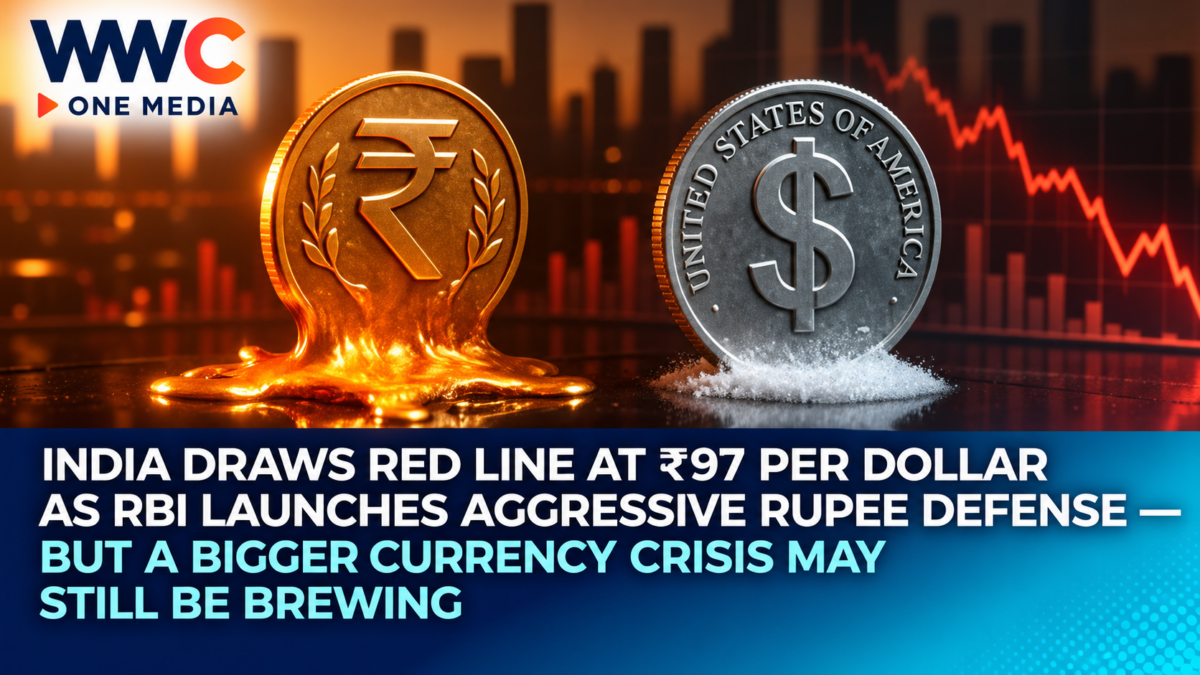
MUMBAI, India — India is mounting one of its most aggressive currency-defense operations in more than a decade as the Reserve Bank of India (RBI) moves to prevent the rupee from weakening beyond the psychologically important level of 97 against the US dollar.
The central bank has introduced extraordinary foreign-exchange measures, including a special dollar facility for state-owned oil companies, restrictions on currency derivatives and new reserve requirements intended to curb speculative demand for dollars.
The moves follow months of pressure on India’s currency, driven by soaring international oil prices, persistent foreign investment outflows and global financial uncertainty.
According to Bloomberg’s October 12, 2026 reporting, traders increasingly view ₹97 per dollar as the level Indian monetary authorities are determined to defend.
The measures initially delivered a significant market reaction.
The rupee strengthened approximately 1% to 95.76 against the dollar during Monday’s trading, recovering from Friday’s close of around 96.73, according to Reuters.
But while the immediate rebound has eased concerns about another record low, a deeper challenge remains.
India can use its foreign-exchange reserves and regulatory powers to slow the rupee’s decline, but the biggest question is whether those tools can overcome high energy import costs, global dollar strength and continued capital outflows.
RBI Signals ₹97 Per Dollar Is a Critical Threshold
The latest intervention comes after the rupee approached a record low of approximately 96.9650 per dollar during the previous week’s trading.
The currency had lost close to 7% of its value against the dollar in 2026, making it one of Asia’s weakest-performing currencies.
The depreciation accelerated as oil prices surged and investors pulled funds from Indian financial assets.
Abhishek Upadhyay, an economist at ICICI Securities Primary Dealership, told Bloomberg that ₹97 had effectively become the RBI’s line in the sand.
His assessment reflected the scale and timing of the central bank’s latest defensive measures.
However, the RBI has not announced a formal currency peg at ₹97.
India operates a managed floating exchange-rate system in which market forces influence the rupee while the central bank may intervene to reduce excessive volatility.
The distinction is important because market expectations about a defended level do not guarantee that the RBI will maintain that level indefinitely.
India’s Central Bank Takes Strongest Currency Action Since 2013
The RBI’s latest measures have been described as among its strongest foreign-exchange interventions since the 2013 taper tantrum.
That earlier episode triggered pressure on emerging-market currencies after the US Federal Reserve signaled plans to reduce monetary stimulus.
In 2026, India is again dealing with a challenging international environment.
Higher global interest rates, geopolitical uncertainty and increased demand for US dollars have contributed to capital leaving emerging markets.
At the same time, India’s dependence on imported crude oil has made its currency particularly sensitive to the Middle East conflict.
The RBI is responding through a combination of direct dollar supply, restrictions on selected currency-market transactions and tighter monetary policy.
Together, the measures are intended to reduce immediate selling pressure on the rupee and discourage excessive speculative activity.
But the effectiveness of the strategy will depend on how long external financial pressures persist.
RBI Opens Special Dollar Window for Oil Companies
One of the most significant policy changes involves the RBI’s decision to supply US dollars directly to major state-owned oil marketing companies.
The arrangement took effect on October 12 and covers Indian Oil Corporation, Bharat Petroleum Corporation and Hindustan Petroleum Corporation.
These companies need substantial amounts of foreign currency to pay for imported crude oil and petroleum products.
Normally, their purchases can generate significant demand for dollars in the foreign-exchange market.
When oil prices rise sharply, that demand can intensify and put additional downward pressure on the rupee.
Under the special facility, eligible oil companies can obtain dollars directly from the RBI rather than purchasing their requirements entirely through the regular spot market.
The arrangement is intended to reduce immediate market pressure and improve currency stability.
However, supplying dollars directly does not eliminate India’s underlying need to pay for oil imports.
It changes how dollar demand reaches the market and may place additional pressure on the RBI’s foreign-exchange resources if sustained for an extended period.
New Foreign-Exchange Rules Target Speculative Demand
The RBI has also introduced restrictions intended to discourage excessive currency hedging and speculative dollar purchases.
One change lowers the threshold for certain foreign-exchange derivative transactions without underlying exposure from $100 million to $5 million.
Another restricts the rebooking of canceled rupee-linked derivative contracts, reducing opportunities to repeatedly establish similar positions.
The central bank has also introduced a 20% cash reserve requirement for banks on certain qualifying foreign-exchange derivative contracts exceeding $2 million.
These measures can increase the cost of establishing selected currency positions.
Reuters reported that market participants expect hedging expenses to rise by approximately 80 to 150 basis points for affected transactions.
A basis point represents one-hundredth of one percentage point.
Higher costs may discourage some companies and traders from making aggressive bets on further rupee depreciation.
However, hedging is not inherently speculative.
Importers and other businesses use legitimate currency hedges to manage financial risk.
The RBI must therefore balance reducing destabilizing market activity with allowing companies to protect themselves against exchange-rate movements.
Rupee Jumps 1% After RBI’s Weekend Measures
The market responded quickly to the central bank’s actions.
On October 12, the rupee strengthened to approximately 95.76 per US dollar, up around 1% from the previous session.
The move represented one of its strongest daily performances in several months.
In offshore trading, one-month non-deliverable forward contracts also showed a sharp initial improvement.
Bloomberg reported that the relevant offshore rate briefly moved to around 94.17 per dollar before giving back some of its gains.
The reaction suggests that traders interpreted the RBI’s measures as a strong signal of its willingness to stabilize the market.
Nevertheless, the offshore forward rate should not be confused with the rupee’s domestic spot exchange rate.
Forward contracts reflect expectations, pricing conditions and interest-rate differences.
For investors, the initial rally provides evidence that the measures have influenced short-term positioning.
It does not establish that the rupee’s longer-term depreciation trend has permanently reversed.
India’s Foreign-Exchange Reserves Face Growing Pressure
The currency-defense campaign is drawing attention to India’s foreign-exchange reserves.
Bloomberg reported that the RBI’s reserves had approached $800 billion in early September, supported partly by efforts to attract deposits from Indians living overseas.
But the reserve position has weakened as pressure on the rupee intensified.
Reuters reported that reserves declined to approximately $734 billion by early October.
The decline reflects a difficult environment involving foreign-exchange intervention and changes in the valuation of reserve assets.
Not every change in reported reserves can be attributed directly to dollar sales.
Foreign-exchange holdings are also affected by valuation movements involving currencies, gold and other reserve components.
Nevertheless, sustained intervention can consume resources that might otherwise be available to respond to future financial shocks.
India continues to hold substantial reserves, providing an important buffer against external instability.
The challenge for the RBI is to use that protection without creating expectations that it will spend unlimited resources defending a specific exchange-rate level.
High Oil Prices Are India’s Biggest Currency Challenge
India is one of the world’s largest oil importers, making international crude prices a critical factor in its economic outlook.
When crude prices increase, Indian refiners need more dollars to pay for the same quantity of imported oil.
That demand can weaken the rupee, particularly when other sources of foreign currency are under pressure.
The Middle East conflict has intensified the problem by disrupting energy supplies and increasing uncertainty surrounding shipping routes.
Brent crude remained above $100 per barrel in October trading, although prices fluctuated as diplomatic developments affected market expectations.
Higher oil prices can increase India’s import bill and add pressure to its current account.
They can also raise domestic costs for transportation, manufacturing and other activities.
If the rupee weakens at the same time, imported energy becomes even more expensive in local-currency terms.
This creates a potentially damaging feedback loop in which high oil prices contribute to currency depreciation, making imports more costly and adding to inflationary pressure.
RBI Raises Interest Rates to 5.50%
Currency intervention is not the RBI’s only policy response.
On October 7, the central bank raised its benchmark repo rate by 25 basis points to 5.50%.
The increase marked its first interest-rate hike in nearly four years.
The Monetary Policy Committee also shifted its policy stance from neutral to calibrated tightening.
RBI Governor Sanjay Malhotra said inflation was becoming a more significant concern as higher energy prices threatened to spread through the economy.
The central bank projected consumer inflation to average approximately 5.8% over the following three quarters.
Higher interest rates can support a currency by making local assets more attractive and helping contain inflation.
But they also raise financing costs for households, companies and government borrowers.
The RBI is therefore confronting a difficult policy trade-off.
It must support currency stability and control inflation without unnecessarily weakening investment and economic growth.
Foreign Investors Continue Pulling Money From India
Another major source of pressure has been continued foreign investment outflows.
Global investors have reduced exposure to some Indian financial assets as international borrowing costs increase and emerging-market risks rise.
Foreign selling can weaken the rupee because investors converting proceeds into dollars generate additional foreign-exchange demand.
Higher US Treasury yields can also make dollar-denominated investments more attractive relative to some emerging-market assets.
India has introduced measures to attract foreign currency inflows, including initiatives involving diaspora deposits, foreign investment in debt markets and other capital-raising channels.
Bloomberg reported that a diaspora deposit program had attracted approximately $133 billion.
But efforts to encourage inflows have been competing against substantial demand for dollars and continuing investor caution.
The persistence of those pressures helps explain why analysts remain uncertain about the durability of the rupee’s latest rebound.
Wall Street Banks Warn the Recovery Could Be Temporary
Financial institutions are cautious about concluding that India’s currency problems have ended.
Reuters reported that strategists at Citi and ANZ believe the latest policy measures could provide near-term relief but may not fully overcome underlying balance-of-payments pressures.
The Wall Street Journal similarly reported that rupee strength could prove temporary if oil prices remain elevated and the US dollar continues to attract investors.
These concerns reflect the limitations of foreign-exchange intervention.
Central banks can influence market liquidity, discourage destabilizing trades and smooth sudden currency movements.
But they cannot directly eliminate a country’s need to import energy or force international investors to purchase domestic assets.
If external pressures persist, the currency may once again weaken after the initial effect of intervention fades.
The next major test will therefore be whether the rupee stabilizes without increasingly costly measures.
Why the Rupee’s Decline Matters to Indian Businesses
Exchange-rate volatility has major implications for Indian companies.
Importers purchasing energy, machinery, electronics and other foreign goods can face higher costs when the rupee depreciates.
Businesses with dollar-denominated debt may also experience higher repayment obligations in local-currency terms.
Exporters, by contrast, can sometimes benefit from a weaker currency because revenues received in dollars translate into more rupees.
However, exporters that depend heavily on imported inputs may also face rising expenses.
For consumers, the most significant concern is the possibility that currency weakness contributes to higher prices for imported goods and fuel.
These effects depend on pricing contracts, taxes, inventory levels and the ability of companies to absorb additional costs.
Currency stability therefore matters to both India’s financial markets and its broader economy.
The Bigger Question: Can India Defend ₹97 Without Draining Its Reserves?
The RBI’s latest measures demonstrate its determination to prevent disorderly currency movements.
The combination of direct dollar supplies, derivative restrictions and higher interest rates has already triggered a substantial short-term recovery.
But several major risks remain unresolved.
International oil prices are elevated.
Foreign investment flows remain uncertain.
US interest rates and bond yields continue influencing global currency markets.
India must also manage inflation while supporting domestic economic growth.
If these pressures ease, the rupee could stabilize without further extraordinary measures.
But if oil prices rise again or international investors continue reducing exposure to Indian assets, the central bank may face renewed pressure to intervene.
The RBI has demonstrated that it possesses powerful tools to defend the rupee, but stabilizing the currency over the longer term will require more than regulatory restrictions and foreign-exchange intervention.
Ultimately, India needs a more sustainable balance between foreign-currency inflows and demand for dollars.
For now, the market is watching the ₹97 level as a symbol of the central bank’s determination.
Yet there is no official guarantee that the RBI will defend that threshold at any cost.
India has drawn what traders see as a line in the sand for the rupee — but the bigger test is whether the country’s central bank can keep the currency stable without sacrificing reserves, growth or financial-market confidence.