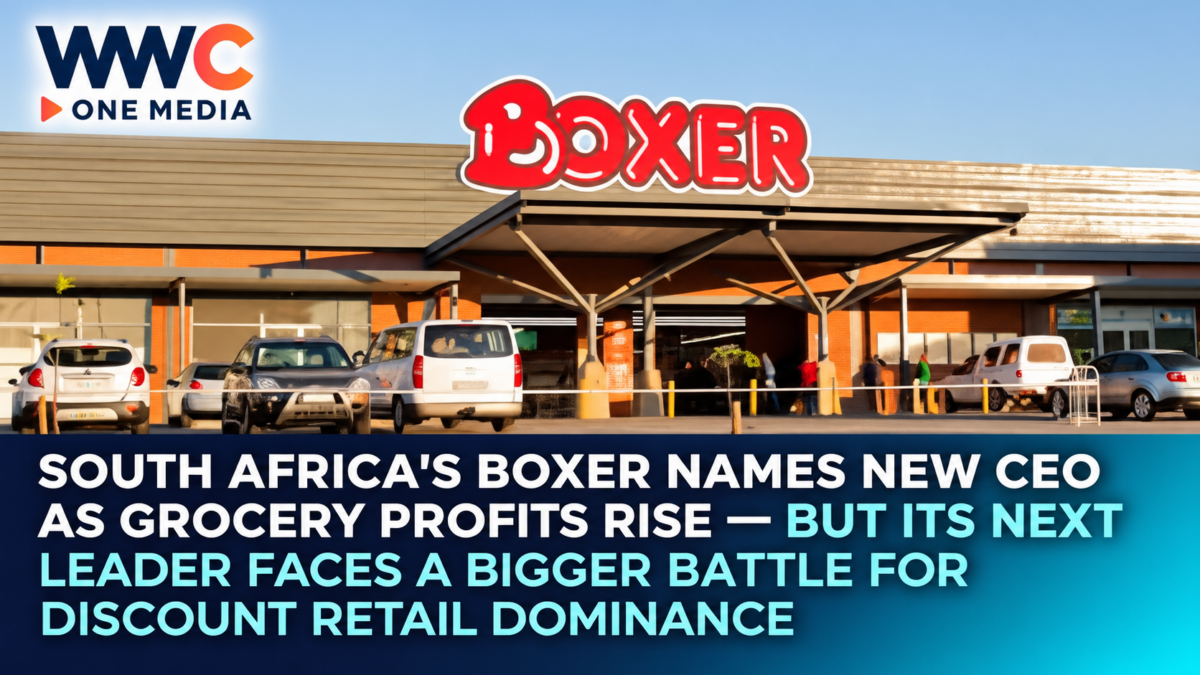
JOHANNESBURG, South Africa — South African discount supermarket chain Boxer Retail is entering a new leadership chapter as the company reports rising profits and appoints a new chief executive, according to Bloomberg’s October 12, 2026 report.
The development comes as Boxer seeks to strengthen its position in South Africa’s highly competitive grocery industry, where price-conscious consumers continue searching for affordable food and household essentials.
Boxer has become one of the country’s most prominent discount retailers, supported by an expanding store network, a focus on low prices and growing sales volumes.
Its success has been particularly important to the wider Pick n Pay group, which has been restructuring its traditional supermarket business while benefiting from Boxer’s stronger growth.
But a change in leadership presents a new test.
The next chief executive must preserve the operating formula that helped Boxer expand while managing competition, higher operating costs and the challenges of opening additional stores.
The precise details of the October 12 leadership appointment, including the incoming executive’s name, effective date and latest interim profit figures, could not be independently confirmed from accessible company disclosures at the time of this rewrite.
Boxer Enters a New Leadership Phase
Bloomberg’s October 12 report identifies a new CEO appointment alongside a rise in the South African retailer’s profit.
The announcement marks an important development for a business that has gained prominence through its discount grocery model.
Marek Masojada was Boxer’s chief executive during the company’s fiscal year ended March 1, 2026, when the retailer delivered strong financial and operational performance.
The leadership change comes after a period in which Boxer expanded its store footprint, improved operating profitability and strengthened its market position.
For investors, the appointment raises questions about strategic continuity.
Boxer’s next leader will need to maintain the company’s focus on affordability while deciding how aggressively to pursue further expansion.
A leadership transition can also create opportunities to introduce new technology, strengthen supply-chain systems and improve customer engagement.
However, the commercial significance of the change will depend on the incoming CEO’s priorities and ability to execute the company’s established strategy.
Boxer Builds Its Success Around Affordable Groceries
Boxer operates a discount retail model designed to appeal to households looking for lower prices on essential products.
Its supermarkets emphasize a selected range of groceries, household necessities and everyday consumer goods.
Compared with retailers offering extensive premium merchandise, the company focuses on affordability, efficient operations and high-volume sales.
The model is especially relevant in a country where household budgets remain under pressure.
Food, transport, electricity and other essential expenses influence how much consumers can spend at supermarkets.
Retailers that demonstrate consistent value can gain customers seeking to manage those costs.
Boxer’s business strategy relies on using operating efficiencies to support competitive prices while generating sufficient sales volumes to sustain profitability.
That balance has helped the company expand its presence across South Africa and Eswatini.
Revenue Reaches R46.7 Billion in Fiscal 2026
Boxer’s latest independently verified full-year financial results demonstrate the scale of its growth.
For the 52 weeks ended March 1, 2026, the company reported turnover of approximately 46.7 billion South African rand.
On a comparable 52-week basis, turnover increased 12.3% from the previous year.
Like-for-like sales grew 4.5%, indicating that existing stores contributed to growth alongside newly opened outlets.
Trading profit rose 17.3% on a comparable basis to approximately R2.64 billion.
The trading profit margin increased to 5.7%, compared with 5.4% in the prior comparable period.
These results indicate that Boxer was able to grow sales and improve operating profitability while maintaining its discount positioning.
However, they are full-year figures announced in May 2026, not the fresh interim earnings referenced in Bloomberg’s October 12 report.
The distinction matters because using historical results as if they were newly announced would misrepresent the company’s latest performance.
Boxer Expands to 576 Stores Across Its Network
Store expansion has been a major contributor to Boxer’s growth.
During fiscal 2026, the retailer added 51 net new stores, increasing its total network to 576 outlets.
The network included 338 Boxer Superstores, 206 Boxer Liquor stores and 32 Boxer Build outlets at the end of the financial year.
The new openings increased Boxer’s reach into additional communities and supported higher sales volumes.
Boxer has been expanding its presence in markets where demand for value-focused retail remains strong.
However, opening new stores also creates financial and operational requirements.
The company must invest in premises, equipment, inventory, distribution capacity and employees.
New outlets also need time to establish customer relationships and reach their expected sales potential.
For the incoming leadership team, maintaining an effective balance between expansion and profitability will be a major priority.
Thousands of New Jobs Highlight Boxer’s Growth
Boxer’s expansion has also generated employment opportunities.
The company reported creating approximately 3,400 jobs during fiscal 2026, taking its workforce to 35,314 employees.
The openings supported roles across store operations, distribution, logistics and other business functions.
These employment figures reflect the company’s previously reported expansion and should not be interpreted as new jobs announced in October.
For South Africa, where unemployment remains a major economic challenge, retail expansion can create opportunities for workers with different skills and experience levels.
However, employment growth must be supported by sustainable store performance.
Retailers face ongoing pressure from wages, property expenses, distribution costs and technology investments.
A successful expansion strategy therefore requires careful management of both sales and operating expenses.
Pick n Pay’s Turnaround Makes Boxer More Important
Boxer’s performance matters not only to its own shareholders but also to Pick n Pay, the larger grocery group from which it was separately listed.
Boxer joined the Johannesburg Stock Exchange in November 2024, allowing investors to obtain direct exposure to the discount retailer.
Pick n Pay retained a controlling stake following the listing.
In May 2026, Pick n Pay further reduced its holding by selling approximately R4.7 billion worth of Boxer shares, lowering its ownership to about 53.1%.
The transaction supported Pick n Pay’s efforts to strengthen its finances during its supermarket turnaround.
The parent company’s core grocery operations have faced difficult trading conditions, store closures and restructuring costs.
For fiscal 2026, Pick n Pay’s traditional supermarket segment reported a trading loss of approximately R1 billion, while Boxer delivered trading profit of about R2.6 billion.
The contrasting results illustrate how important the discount business has become to the wider group.
However, Boxer’s separately listed status means investors should distinguish between its own financial results and those of the Pick n Pay group.
Competition Intensifies in South African Discount Retail
Boxer operates in a highly competitive grocery market.
Major competitors include Shoprite’s Usave discount chain and other supermarket brands serving price-sensitive households.
Retailers compete through pricing, promotions, store accessibility, product availability and customer service.
Discount chains face the challenge of maintaining low prices while protecting margins.
For Boxer, operational efficiency is central to that strategy.
Its distribution network, supplier relationships and inventory systems help determine how effectively the company can deliver value to customers.
However, competing retailers are also investing in store networks and logistics.
This means Boxer cannot rely solely on past growth to maintain its position.
The company must continue improving its customer proposition while responding to changes in consumer demand.
Technology and Customer Data Become More Important
Boxer has also been expanding its use of technology to improve business performance.
In its 2026 financial disclosures, the company highlighted innovation as a central part of its operating strategy.
One initiative involves B-Inside, a supplier information platform designed to provide insights into consumer behavior and product performance.
The business has also developed its Boxer Rewards Club, which supports customer engagement and promotional activities.
These initiatives can help retailers understand purchasing patterns, strengthen supplier relationships and improve merchandise planning.
For a discount supermarket, better information can support inventory decisions and reduce unnecessary costs.
However, technology investments must deliver measurable operating benefits.
Customer data also need to be managed in accordance with applicable privacy and security requirements.
The incoming leadership team will have to determine how technology can support growth without undermining the simplicity and affordability of Boxer’s retail model.
Why Low Food Price Inflation Matters
Boxer’s previous annual results showed that its growth was not driven solely by increasing selling prices.
The company reported internal selling-price deflation of approximately 1.2% during fiscal 2026.
That means the measured prices of its comparable product basket declined, even as overall turnover rose.
For investors, this is an important distinction.
Sales growth generated through increased customer transactions and higher volumes can reflect stronger demand rather than simply the effect of inflation.
However, food price deflation can also create pressure on revenue if retailers cannot increase volumes sufficiently.
Maintaining profitability in that environment requires efficient purchasing, distribution and cost controls.
Boxer’s ability to combine competitive pricing with improved trading margins was an important feature of its prior-year performance.
Whether it can sustain those conditions in the latest reporting period requires confirmation from the new interim financial statements.
The Bigger Question: Can Boxer Sustain Its Growth Under New Leadership?
The appointment of a new chief executive comes at an important moment for Boxer Retail.
The company has demonstrated strong full-year financial performance, expanded its store network and strengthened its role in South Africa’s discount grocery market.
But its future success will depend on maintaining those advantages in a changing retail environment.
The new leadership team must continue delivering affordable groceries while managing investment in new outlets, logistics, technology and personnel.
Competition from established supermarket groups will remain significant.
Consumer spending could also be affected by changes in employment, inflation, interest rates and household income.
For shareholders, the central issue is whether Boxer can continue expanding profitably rather than simply increasing the number of stores.
Boxer’s leadership transition comes after a period of strong growth, but the company’s next challenge is proving that its discount retail strategy can continue delivering higher earnings as the business becomes larger and more complex.
A successful transition could strengthen Boxer’s position among South Africa’s major grocery operators.
But any slowdown in store productivity, weaker consumer demand or rising operating costs could test investor confidence.
The company’s profits may be rising as a new CEO prepares to lead its next chapter — but the real battle will be whether Boxer can preserve its low-price advantage while defending market share against South Africa’s biggest supermarket competitors.