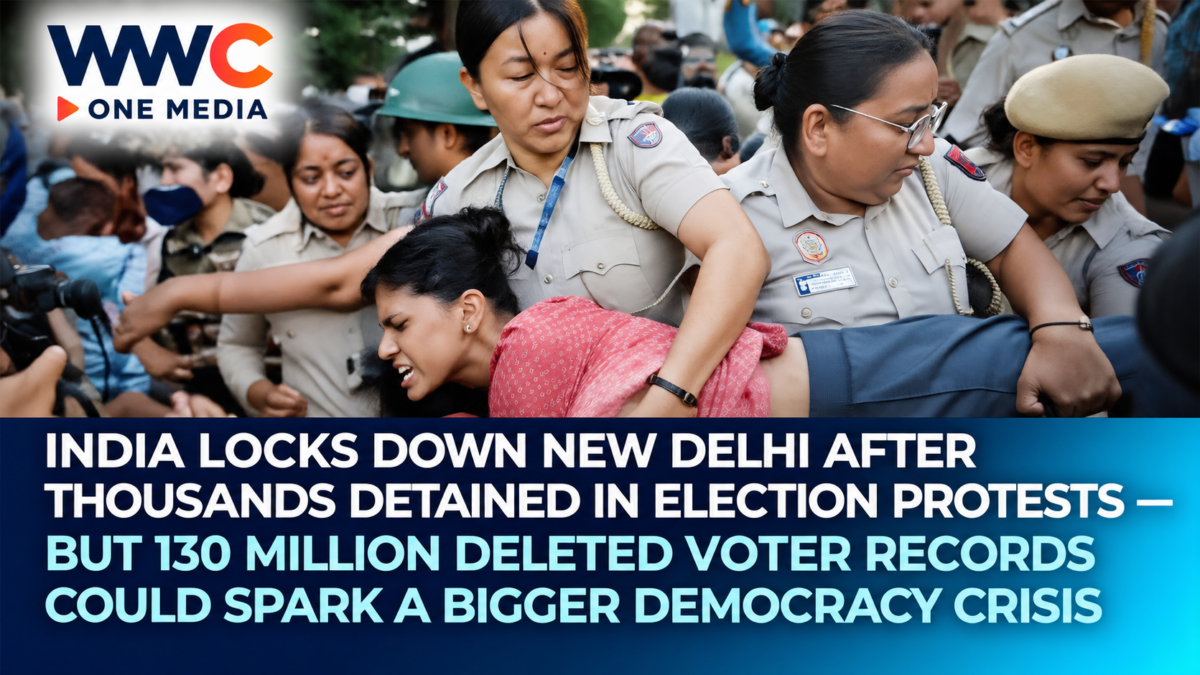
NEW DELHI, India — October 12, 2026 — India’s capital has been placed under heightened security after police detained thousands of protesters during a weekend of demonstrations over a controversial nationwide voter-list revision that has removed more than 130 million entries from electoral records.
Authorities closed six metro stations and introduced major traffic restrictions on Monday as opposition parties and youth activists prepared for another demonstration demanding the resignation of Chief Election Commissioner Gyanesh Kumar.
The protests have become a major political challenge for Prime Minister Narendra Modi’s Bharatiya Janata Party (BJP).
Opposition leaders accuse election authorities of improperly removing eligible voters and potentially benefiting the ruling party ahead of future elections.
The Election Commission denies political bias, maintaining that the revisions are necessary to eliminate outdated and invalid voter records.
The government also rejects allegations that the process is designed to manipulate elections.
But as demonstrators return to the streets and legal challenges continue, the controversy has raised wider questions about electoral transparency, civil liberties and public trust in India’s democratic institutions.
The bigger question is whether India’s election authorities can restore confidence in the voter-list review before the dispute triggers an even broader wave of political unrest.
New Delhi Tightens Security After Weekend Crackdown
Authorities increased security across central New Delhi on Monday following days of demonstrations.
According to Reuters, six metro stations were temporarily closed and traffic restrictions affected several major routes.
Police and security personnel were deployed around sensitive government buildings and areas where demonstrations were expected.
The restrictions followed a weekend during which police prevented thousands of people from gathering for protests against the country’s election chief.
Opposition groups had planned to march toward the Supreme Court, seeking to draw attention to the controversial voter-list revision.
The demonstration was part of a wider movement involving opposition parties, student organizations and youth activists.
Authorities said their security measures were intended to maintain public order.
However, protesters criticized the restrictions, arguing that citizens should be allowed to demonstrate peacefully against decisions affecting their voting rights.
More Than 2,000 Protesters Detained in One Day
The scale of the police response has intensified the controversy.
Reuters reported that more than 2,000 protesters were detained in Delhi on Saturday, October 10.
Associated Press also reported more than 2,000 detentions during the crackdown.
Thousands of police and paramilitary personnel were deployed as authorities restricted access to parts of the capital.
Transport links and mobile internet services were disrupted in some central areas during the security operation.
Among those detained were leaders of the youth-led Cockroach Janta Party, a protest movement that has emerged as an increasingly visible critic of the government.
Most of the people detained Saturday were subsequently released, according to available reporting.
Further detentions occurred during smaller demonstrations afterward.
However, reports vary in how many people were detained across the entire weekend.
The confirmed figure of more than 2,000 refers to Saturday’s operation and should not be presented as a final total for every day of unrest.
Why 130 Million Names Were Removed From India’s Voter Lists
At the center of the protests is India’s Special Intensive Revision, or SIR, a nationwide exercise intended to update electoral records.
The revision began last year and has resulted in the deletion of more than 130 million entries from voter lists.
According to Election Commission figures cited by Reuters, the removals included approximately:
- 63 million entries associated with people who had relocated.
- 30 million entries involving people who could not be traced.
- 28 million entries belonging to people recorded as deceased.
Those categories account for most of the reported deletions, with the remaining difference reflecting other categories and rounding.
Election authorities say updating voter rolls is necessary to prevent inaccurate records from affecting elections.
Opposition parties, however, argue that the verification process could remove legitimate voters who lack documentation or have difficulty completing the required procedures.
Critics have also raised concerns about whether minority communities and vulnerable populations are disproportionately affected.
The important distinction is that 130 million deleted records do not establish that 130 million eligible people have been unlawfully denied the right to vote.
Determining wrongful exclusion requires examining individual cases, documentation requirements, appeals and reinstatement procedures.
Opposition Accuses Election Commission of Favoring Modi’s BJP
India’s main opposition Congress party and other political groups have accused the Election Commission of failing to act impartially.
They argue that the revision process may disproportionately affect voters unlikely to support the BJP.
Some opposition leaders have specifically raised concerns about Muslim voters and other minority communities.
The Election Commission rejects allegations of partisan conduct.
It says people incorrectly removed from the rolls can apply for reinstatement.
The BJP has also accused opposition parties of undermining democratic institutions by challenging legitimate electoral procedures without sufficient evidence.
These competing positions have transformed an administrative exercise into a major political confrontation.
For election authorities, the challenge is demonstrating that the revision is lawful, transparent and applied consistently.
For opposition parties, the challenge is substantiating allegations of improper removals with evidence.
The political dispute cannot be resolved by the overall number of deleted entries alone.
Who Is Gyanesh Kumar and Why Do Protesters Want Him Removed?
Chief Election Commissioner Gyanesh Kumar has become the central target of the demonstrations.
Protesters accuse his leadership of failing to adequately safeguard voting rights during the revision exercise.
They are demanding his resignation and changes to the procedures used to verify electoral records.
The controversy intensified after The Indian Express reported in September that Kumar’s two fellow election commissioners had raised internal concerns about aspects of the revision process.
Those concerns reportedly involved registration procedures, electoral-roll changes and digital systems.
The Election Commission has described differences of opinion during internal discussions as a normal part of institutional decision-making.
Nevertheless, the reporting strengthened demands for an independent examination of how the revision was designed and implemented.
For the election chief, maintaining public confidence is becoming increasingly difficult amid sustained political pressure.
India’s ‘Cockroach’ Youth Movement Drives the Demonstrations
The demonstrations have been propelled partly by a youth-led organization known as the Cockroach Janta Party, or CJP.
The movement began as an online satirical response to controversies involving young people and their treatment by public institutions.
It subsequently developed into a broader protest network.
Its organizers have mobilized demonstrators around unemployment, education, public accountability and voting rights.
The group previously participated in protests concerning examination scandals that contributed to a political confrontation over education policy.
Its leaders include Abhijeet Dipke, Saurav Das and Ashutosh Ranka.
Associated Press reported that the three were detained in New Delhi and subsequently released.
They pledged to continue organizing demonstrations over the voter-list controversy.
The movement’s growth reflects wider frustration among some young Indians who believe conventional political institutions are not responding adequately to their concerns.
However, the group is not equivalent to a major established political party competing nationally in elections.
Its current significance is primarily as an organizing force in public demonstrations.
Rahul Gandhi Joins Calls for Electoral Accountability
Congress leader Rahul Gandhi has supported demands for greater scrutiny of the electoral revision.
Opposition parties planned a march toward the Supreme Court on October 12 to seek action over the controversial voter-list changes.
The protesters wanted the court to examine allegations involving the Election Commission and electoral procedures.
However, Reuters reported that Chief Justice Surya Kant declined to meet Congress leaders directly, indicating that their concerns should be pursued through established legal channels.
This distinction matters.
The planned march did not establish that the Supreme Court had accepted the protesters’ demands or ordered the election chief to resign.
Legal challenges remain separate from political demonstrations.
Any court decision regarding the revision would depend on arguments, evidence and applicable law.
Supreme Court Proceedings Increase Pressure for Transparency
India’s Supreme Court has been asked to examine aspects of the voter-list revision.
The Guardian reported earlier in October that the court sought explanations from the government and election authorities over the controversial exercise.
Petitions have raised concerns about the fairness of procedures and the possibility of wrongful voter deletions.
The legal debate centers on whether the verification system adequately protects eligible citizens while allowing authorities to maintain accurate electoral records.
Courts must consider both administrative responsibilities and constitutional protections.
Maintaining accurate voter rolls is important for election integrity.
But excluding legitimate voters through mistakes or unreasonable procedural requirements can also undermine democracy.
The court’s involvement therefore creates an important avenue for examining disputed procedures independently.
However, requests for explanations and ongoing hearings should not be confused with a final judicial finding that nationwide election fraud occurred.
Police Restrictions Raise Questions About Civil Liberties
The government’s response to the demonstrations has generated a separate debate about the right to peaceful assembly.
Police deployed substantial security forces, restricted transport and detained large numbers of people during the weekend.
Authorities defended the measures as necessary to prevent disorder.
Civil liberties advocates and opposition politicians have questioned whether the restrictions were proportionate.
The detention of peaceful demonstrators can raise serious legal concerns, depending on the circumstances and applicable law.
At the same time, authorities have responsibilities to protect public safety and manage large gatherings.
An independent assessment would need to examine whether individual detentions complied with legal requirements and whether restrictions were necessary and appropriately limited.
The issue is especially sensitive because the protests concern voting rights and democratic accountability.
Why the Controversy Is a Major Challenge for Modi
The unrest presents a political challenge to Prime Minister Narendra Modi’s government.
The BJP has been in power nationally since 2014, and opposition groups are seeking to turn voter-list concerns into a broader campaign over institutional independence.
The dispute has also brought together different sources of public dissatisfaction.
Students and youth activists have previously demonstrated over employment and education-related issues.
Opposition parties are now connecting those grievances with demands for electoral transparency.
This combination could sustain political pressure beyond a single protest.
But the ultimate electoral impact is uncertain.
It would be premature to conclude that the demonstrations will cause the government to fall or determine the outcome of future elections.
Much will depend on whether the protests continue, how authorities respond and whether credible evidence emerges about alleged irregularities.
What Election Authorities Must Demonstrate
The Election Commission’s central argument is that the revision is necessary to remove inaccurate records.
That objective is legitimate in principle.
Voter lists should not contain deceased individuals, duplicate registrations or other invalid entries.
However, the effectiveness of such exercises depends on safeguards protecting people who remain eligible.
Citizens need accessible procedures to verify their registration status.
They also need clear explanations when their names are removed.
Appeals and reinstatement procedures must be practical, particularly for people facing documentation difficulties.
Transparent statistics and independent scrutiny can help clarify whether certain communities are being disproportionately affected.
Without these safeguards, even an administrative process with a legitimate purpose can generate public distrust.
For India’s election authorities, demonstrating procedural fairness may be just as important as explaining the overall number of records removed.
Why the Crisis Matters Beyond India
India is the world’s largest democracy and one of Asia’s biggest economies.
Its electoral institutions play a central role in governing a population of more than 1.4 billion people.
A prolonged dispute over voting rights could affect political stability and international perceptions of democratic accountability.
The issue also raises questions relevant to other countries.
Many governments rely on increasingly complex databases and identification systems to manage elections.
Technology can improve the accuracy of records, but errors in automated or large-scale verification procedures can have serious consequences.
For countries such as the Philippines, the broader lesson is the importance of transparent voter registration systems, accessible correction processes and public trust in independent election administration.
However, India’s current protests do not establish that similar problems exist in the Philippines.
Could More Protests Follow?
The Cockroach Janta Party has pledged to continue its campaign.
Reuters reported that its leaders intended to engage with Delhi Police about obtaining permission for further peaceful demonstrations.
The movement indicated that additional mobilizations could follow if authorities failed to provide a satisfactory response.
Opposition parties are also continuing to challenge the revision process through political and legal channels.
The timing and scale of future demonstrations remain uncertain.
Security restrictions and public-order decisions could influence where protests take place.
But the underlying electoral dispute is unlikely to disappear simply because individual gatherings are prevented.
The key factor will be whether authorities offer credible explanations and effective remedies for eligible voters who believe their records were incorrectly removed.
The Bigger Question: Can India Restore Trust in Its Election System?
The confrontation in New Delhi has developed into a major political and institutional dispute.
Thousands have been detained.
Transport services have been disrupted.
Opposition leaders are demanding the resignation of the country’s election chief.
And more than 130 million deleted voter-list entries remain at the center of a national controversy.
For protesters, the immediate concern is protecting the right to vote.
For the Election Commission, the responsibility is maintaining accurate records while preventing wrongful exclusion.
For the Modi government, the challenge is defending the legitimacy of electoral administration without appearing to suppress peaceful dissent.
For the courts, the task is ensuring that legal questions are decided through evidence and established procedures.
The essential issue is not whether voter lists should be updated. It is whether the process is transparent, fair and capable of correcting mistakes before eligible citizens lose the opportunity to vote.
The answer will influence public confidence in India’s democratic institutions well beyond the current demonstrations.
India’s capital is facing renewed unrest after thousands of protesters were detained — but the bigger question is whether the 130-million-record controversy can be resolved before it becomes a lasting crisis of confidence in the world’s largest democracy.