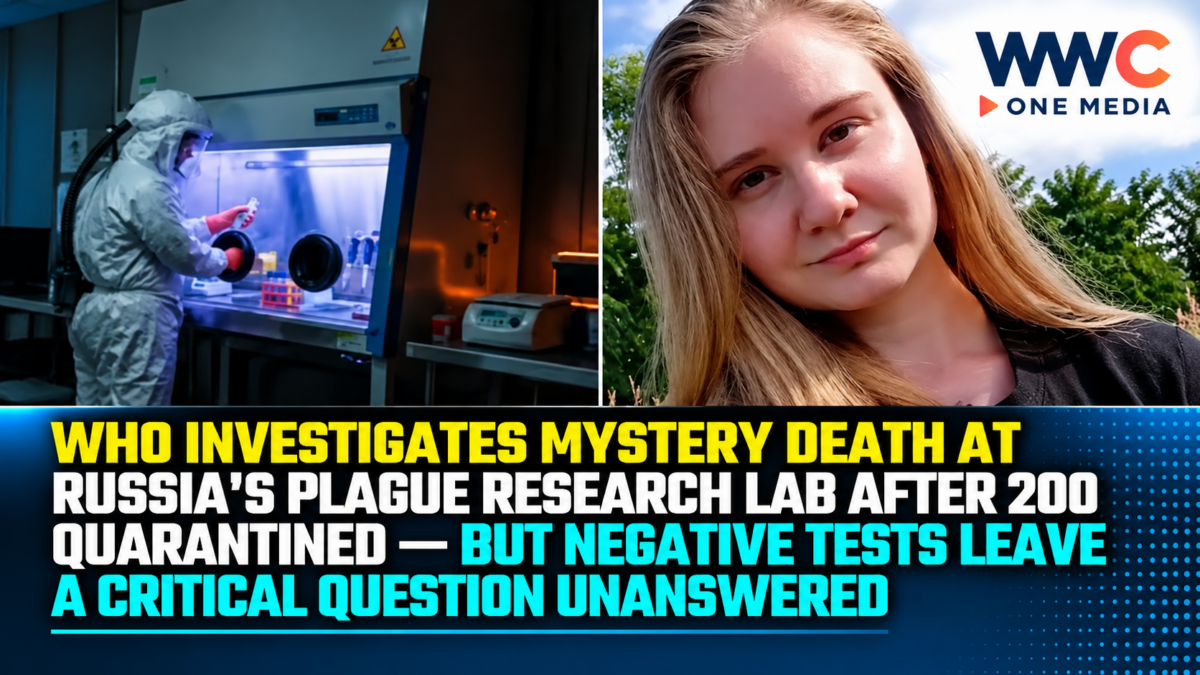
GENEVA / MOSCOW — The World Health Organization is seeking answers after a 28-year-old researcher died from unexplained pneumonia at a Russian laboratory that studies some of the world’s most dangerous infectious diseases. The death prompted precautionary quarantine measures involving approximately 200 contacts and speculation about a possible laboratory accident. But although Russian officials insist the illness was not plague and WHO has found no evidence of ongoing transmission, the exact cause of death remains unknown — leaving critical questions about laboratory safety, scientific transparency and the investigation unanswered.
An unexplained death at a Russian anti-plague research institute has attracted international attention, but global health authorities say the available evidence does not indicate an expanding outbreak.
On October 10, the WHO published an official disease-outbreak notice concerning a fatal case of pneumonia at the Irkutsk Antiplague Research Institute of Siberia and the Far East.
The organization confirmed that Russian authorities had investigated the death, tested the researcher’s contacts and implemented precautionary measures.
Laboratory tests reported by Russia did not identify plague or other tested high-threat pathogens.
None of the identified contacts developed a linked case of severe pneumonia.
However, WHO emphasized that one central question remains unresolved: What caused the worker’s fatal illness?
The uncertainty has fueled speculation online, including unverified claims of a laboratory accident and concerns about a possible infectious disease emergency.
The available evidence does not justify declaring a plague outbreak.
Instead, the case illustrates why a clear diagnosis and reliable laboratory reporting are essential when unexplained deaths occur in facilities handling dangerous microorganisms.
Who Was the Russian Laboratory Worker?
The deceased researcher has been identified in international reporting as Darya Shipilova, a 28-year-old employee of the Irkutsk Antiplague Research Institute.
The facility operates in Siberia and specializes in infectious diseases, including plague and other dangerous pathogens.
According to WHO’s account, the researcher was hospitalized on September 29, 2026, after developing severe pneumonia.
She died on October 2.
Initial media reports suggested that her illness might have resulted from exposure to the bacterium responsible for plague.
Some reports went further, alleging that a laboratory accident had occurred.
Those claims created immediate concern because the institute works with microorganisms that require strict safety precautions.
However, the institute’s research activities alone do not establish that the worker contracted a pathogen at work.
Russian authorities have denied that a laboratory accident occurred.
WHO has not independently confirmed the cause of her illness or the circumstances of any potential exposure.
Russia Says No Plague Infection Was Found
Russian public-health authorities have repeatedly stated that the researcher did not die from plague.
The country’s health regulator, Rospotrebnadzor, reported that the patient underwent testing for dangerous infectious agents.
The tests reportedly found no high-threat pathogens associated with the laboratory’s research.
Authorities also informed WHO that the researcher had been vaccinated against the high-threat pathogens with which she worked.
The official conclusion was pneumonia of undetermined etiology.
In medical terminology, this means pneumonia whose underlying cause has not been established.
It does not identify a new disease.
It also does not mean that the illness was necessarily caused by an unusually dangerous microorganism.
Pneumonia can result from different infectious and noninfectious causes, and determining the exact cause is not always possible.
The Russian government’s negative plague findings are important, but they do not explain what caused the fatal pneumonia.
Around 200 Contacts Placed Under Medical Observation
Authorities responded by identifying people who may have had contact with the researcher.
Approximately 200 individuals were placed under quarantine or medical observation as a precaution.
These included people connected to the workplace and healthcare settings.
The purpose was to determine whether anyone else developed symptoms suggesting a transmissible disease.
Russia subsequently reported that the contacts were tested for a range of pathogens.
According to information supplied to WHO, no high-threat pathogens were detected among them.
All identified contacts remained without symptoms linked to the fatal illness throughout the reported monitoring period.
By October 9, Russia had discontinued their medical observation.
This is a major development because evidence of a highly transmissible pathogen would generally be more concerning if linked cases were appearing among exposed individuals.
However, the absence of identified secondary cases does not establish the cause of the original fatal illness.
WHO Says No Evidence of Ongoing Transmission
The WHO’s October 10 update is the most authoritative public assessment of the incident.
It reported that Russian authorities had not identified plague or another tested high-threat pathogen in the deceased worker or her contacts.
The organization also stated that it had not identified evidence of ongoing transmission associated with the event.
This does not mean every possible cause has been excluded.
WHO specifically highlighted that the diagnosis remains unconfirmed.
The agency said the lack of an identified cause limits its ability to independently assess whether the reported contact-monitoring period was sufficient to rule out every plausible explanation.
In other words, the available information is reassuring about the absence of detected spread.
But the investigation still has an important scientific gap.
WHO says additional clinical, epidemiological and laboratory information would help clarify the incident.
Did a Laboratory Accident Occur?
One of the most sensitive questions involves whether Shipilova experienced an accidental exposure while working.
Early reports raised the possibility of an incident involving laboratory materials.
Russian authorities reject those accounts.
According to information provided to WHO, two separate investigations found no laboratory biosafety or biosecurity incident.
The government said media reports describing such an accident were inaccurate.
WHO has acknowledged Russia’s statement.
However, the organization has not independently established the source of the researcher’s illness.
Because Shipilova worked at a facility handling high-consequence pathogens, WHO said a laboratory-associated exposure cannot yet be completely excluded.
That is a statement of investigative uncertainty, not a finding that a leak or accident occurred.
A responsible account must distinguish between unverified allegations, Russian official findings and WHO’s independent assessment.
What Is Pneumonic Plague?
Pneumonic plague is one of the forms of plague caused by the bacterium Yersinia pestis.
Unlike the more familiar bubonic form, which commonly affects lymph nodes, pneumonic plague infects the lungs.
It can progress rapidly and become life-threatening without prompt treatment.
In certain circumstances, pneumonic plague can spread between people through infectious respiratory droplets during close contact.
However, it is not accurate to portray it as an unstoppable disease.
Plague is a known bacterial infection that can be treated with antibiotics, particularly when identified early.
Public-health authorities have established methods for investigating cases, treating patients and monitoring close contacts.
The serious nature of pneumonic plague explains why the initial reports from Irkutsk received attention.
But there is currently no confirmed evidence that Shipilova died from pneumonic plague.
That distinction is essential.
Why Did WHO Request More Information From Russia?
WHO initially became aware of the death through media reports on October 2.
The organization then sought information from Russia under the International Health Regulations.
Russia responded through its designated national reporting channel on October 6.
Further information was provided after WHO follow-up requests on October 7 and 8.
The Russian response included details about laboratory testing, contact tracing, quarantine measures and investigations into the possibility of a workplace incident.
WHO acknowledged that information had been provided.
However, the agency continued to request clarity about the actual cause of death.
The International Health Regulations provide a framework for countries to communicate about public-health events with possible international implications.
Such reporting is important because infectious disease investigations can affect neighboring countries and international health preparedness.
The unresolved diagnosis is the principal reason WHO continues monitoring the case.
More Than 5,500 Tests Reportedly Conducted
Associated Press reported that Russian authorities had conducted more than 5,500 diagnostic tests during the investigation.
The testing covered multiple potential pathogens rather than plague alone.
According to WHO’s October 10 update, Russian authorities reported testing for influenza, SARS-CoV-2, other respiratory infections and bacterial agents, including plague.
Among the contacts, investigators identified two COVID-19 infections, three rhinovirus infections, one Haemophilus finding and other opportunistic microorganisms.
Russian officials did not identify these findings as additional cases linked to the researcher’s unexplained fatal pneumonia.
The results underscore why laboratory interpretation matters.
Detecting a common respiratory infection in a contact does not prove that the infection caused the original fatal illness.
Likewise, finding no high-threat pathogen among contacts is reassuring but does not automatically establish the cause of death.
WHO Cannot Yet Fully Assess the Contact-Monitoring Period
One of the most important details in WHO’s report concerns the duration of monitoring.
Russian officials said all identified contacts had completed medical observation without developing relevant symptoms.
But WHO noted that without knowing what caused Shipilova’s illness, it could not independently determine whether the monitoring period was sufficient to exclude every plausible pathogen.
Different infections have different incubation periods.
That affects how long exposed individuals may need to be observed.
When the causative agent is unknown, selecting the appropriate observation period can be more complicated.
WHO has not announced that the monitoring was inadequate.
Instead, it has said the uncertainty prevents a definitive independent assessment.
This is another reason the agency is seeking more complete diagnostic information.
Why the Incident Has Raised International Attention
The death has attracted attention well beyond Irkutsk.
Following the COVID-19 pandemic, unexplained pneumonia cases can generate significant concern, especially when they involve laboratories handling dangerous pathogens.
The pandemic demonstrated the importance of early outbreak detection, information sharing and public trust.
However, it is scientifically unjustified to assume that every unexplained pneumonia death signals a new pandemic.
An isolated case with no identified transmission is very different from a rapidly expanding cluster of infections.
Reuters, Associated Press and other international outlets have examined the Irkutsk incident because of its location, the incomplete diagnosis and questions about laboratory procedures.
The available evidence supports continued investigation.
It does not support claims that a new pandemic has begun.
Experts Urge Transparency Without Creating Panic
The Financial Times has reported on the difficulty of interpreting early and sometimes conflicting accounts of the researcher’s death.
Experts have emphasized that plague is rare in many parts of the world and that effective treatments exist.
They have also noted that laboratory-associated infections are an important subject of biosafety monitoring.
In this case, however, there is no confirmed evidence establishing an occupational infection.
The unresolved diagnosis creates legitimate questions.
It is reasonable to seek clearer medical findings, documentation of laboratory safety procedures and continued communication with public-health institutions.
But that is different from claiming that Russian authorities have concealed a confirmed plague outbreak or that an unknown pathogen is circulating internationally.
Those stronger allegations have not been substantiated.
The appropriate response is scientific scrutiny proportionate to the available evidence.
What the Case Means for Asia and the Philippines
For readers across Asia, the incident is relevant as an example of how governments and international health institutions respond to unexplained infectious disease events.
The case highlights the importance of laboratory safety, contact tracing, diagnostic testing and timely international reporting.
However, no evidence reviewed establishes a plague outbreak linked to the Irkutsk incident in the Philippines, Singapore or elsewhere in Southeast Asia.
WHO has not identified ongoing transmission associated with the researcher’s death.
There is no basis for suggesting that ordinary readers in the Philippines face a direct new plague threat because of this single reported case.
The public should rely on established national and international health advisories rather than unverified claims circulating on social media.
The broader lesson concerns preparedness and transparency, not an immediate regional emergency.
The Bigger Picture: A Reassuring Investigation With One Critical Missing Answer
The death of a young Russian researcher has generated intense concern because of the facility where she worked.
Darya Shipilova was employed at an institute specializing in dangerous infectious diseases.
She developed severe pneumonia and died on October 2.
Around 200 contacts were initially monitored, and Russian officials reported extensive testing.
No linked plague cases or ongoing transmission have been identified.
Russian authorities also say two investigations found no laboratory accident.
These findings are significant and should prevent exaggerated claims about an unfolding epidemic.
But they do not resolve the central medical mystery.
WHO still does not know what caused Shipilova’s fatal pneumonia.
The agency has asked for more information because a confirmed diagnosis is necessary to evaluate the source of the illness and strengthen confidence in the investigation.
The immediate evidence points away from an ongoing plague outbreak.
But the bigger challenge is determining how a researcher at a high-security infectious disease facility died from unexplained pneumonia — and whether the investigation can provide enough transparency to answer that question convincingly.
For now, the strongest conclusion is not that the world faces a new plague emergency.
It is that a tragic, unexplained death deserves a thorough scientific explanation, even as the available evidence offers reassurance that the illness has not spread.