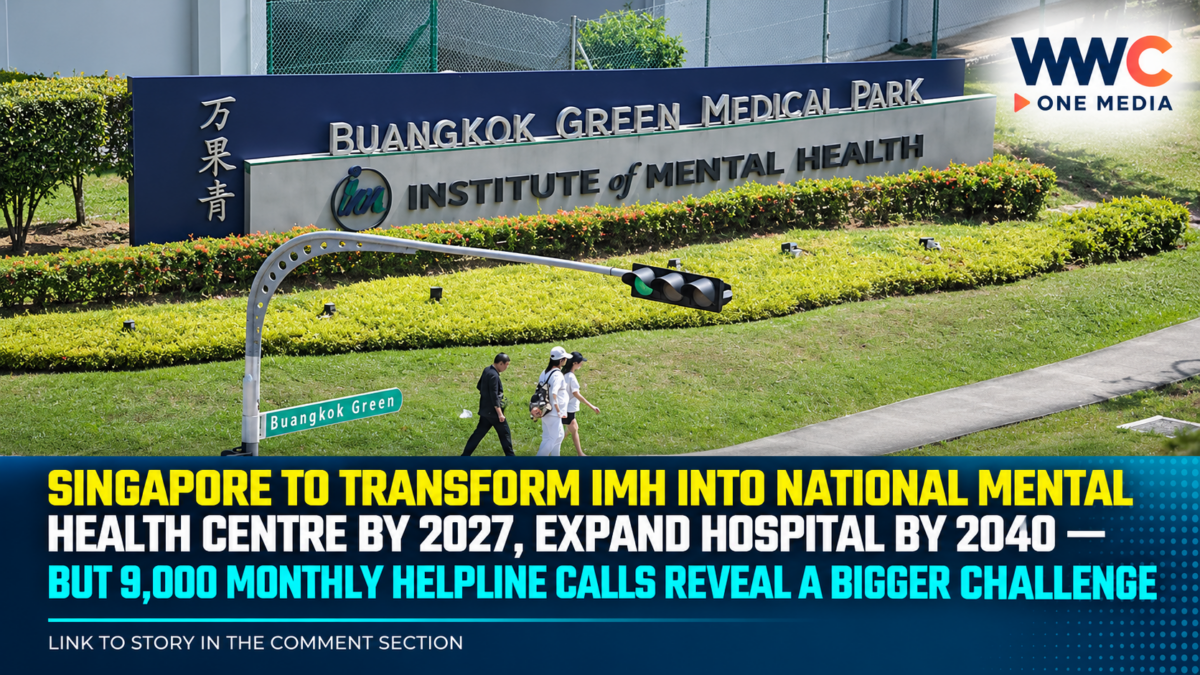
SINGAPORE — Singapore is preparing one of its most significant mental healthcare reforms in years, with plans to rename the Institute of Mental Health (IMH) as the National Centre for Mental Health Singapore in 2027 and expand its psychiatric hospital by 2040. But as thousands seek help every month and more young people turn to community mental health services, the government faces an even bigger challenge: making psychological care easier to access without stigma, fear or unnecessary barriers.
Health Minister and Coordinating Minister for Social Policies Ong Ye Kung announced the changes on Saturday, October 10, in a message marking World Mental Health Day.
The transformation will give Singapore’s leading psychiatric institution a broader national role, including research, coordination of specialist care and professional development across the healthcare system.
Under the plan, IMH’s existing site in Buangkok will be redeveloped into a larger, more modern hospital by 2040.
The government is also strengthening psychiatric capabilities at three regional hospitals to ensure that specialist services are not concentrated at a single institution.
The announcement comes as Singapore experiences rising demand for mental healthcare, particularly among young people.
According to the Ministry of Health (MOH), the national mindline 1771 service is handling approximately 9,000 calls for help every month.
At the same time, the number of young people receiving support through community-based services has more than doubled.
Together, these developments highlight why Singapore is rethinking not only its psychiatric hospital infrastructure but also how residents seek assistance and recover within their communities.
IMH Will Become the National Centre for Mental Health Singapore in 2027
One of the biggest announcements is the decision to give IMH a new identity.
Beginning in 2027, the institution will be redesignated as a national specialty centre and renamed the National Centre for Mental Health Singapore.
The change goes beyond branding.
Under the new designation, the centre will play a coordinating role across Singapore’s mental healthcare system.
Its responsibilities will include supporting psychiatric research, helping hospitals improve specialist care and developing expertise across the wider healthcare sector.
Singapore already operates national specialty centres in areas such as cancer, cardiovascular disease and eye care.
The redesigned mental health institution is intended to perform a comparable leadership role for psychiatric services.
The change also signals an evolution in how mental illness is treated.
Rather than concentrating all specialist psychiatric care within one large hospital, Singapore wants a more connected system involving hospitals, community organisations and residential support services.
However, the rename is scheduled for 2027. It has not yet taken effect as of October 11, 2026.
Singapore Plans Bigger, Modern Psychiatric Hospital by 2040
The government has begun planning the redevelopment and expansion of IMH at its present site in Buangkok.
The goal is to complete a larger, more modern facility by 2040.
The redevelopment will support rising demand for psychiatric care and the institution’s expanded role as a national specialty centre.
The announcement represents a long-term infrastructure commitment.
However, MOH has not yet disclosed a final construction budget, detailed building design, confirmed additional bed count or exact construction timetable.
Those figures should not be invented or treated as approved.
The 2040 target also does not mean the existing IMH will close immediately.
The institution continues to provide psychiatric services while the government plans its future redevelopment.
The significance lies in the combination of expanded physical capacity and a broader national healthcare role.
Three Regional Hospitals Will Strengthen Psychiatric Services
IMH will not handle the growing demand alone.
Ong confirmed that three hospitals are strengthening their psychiatric capabilities:
- Changi General Hospital
- Woodlands Hospital
- Alexandra Hospital
The aim is to expand national capacity for psychiatric care.
By developing expertise across multiple hospitals, Singapore can build a system in which psychiatric services are supported beyond IMH.
That could improve coordination and allow more patients to receive appropriate care within different parts of the healthcare network.
However, MOH has not announced specific new psychiatric bed numbers for these three hospitals under the October 10 initiative.
It would also be premature to conclude that all specialist psychiatric services will become available at every regional hospital.
The confirmed policy direction is an expansion of capabilities and stronger national coordination.
Mental Health Demand Rising, Especially Among Young People
A key reason behind the reforms is increasing demand for mental health support.
Ong said hospitals and specialist clinics have been seeing more patients, including young people who are still attending school.
Community services are also supporting growing numbers of residents.
The number of youths receiving community-based mental health support has more than doubled, according to MOH.
That increase is significant, but it requires careful interpretation.
Rising service use may reflect more people experiencing difficulties, greater willingness to seek assistance, improved access to care, or a combination of factors.
It does not independently prove that mental illness rates have doubled among young Singaporeans.
The government believes it needs to respond in two ways: by strengthening specialist treatment and placing greater emphasis on prevention and early intervention.
The latter is particularly important because getting support earlier can help people receive appropriate care before difficulties become more severe.
Singapore’s Mindline 1771 Handles Around 9,000 Calls Monthly
Another striking figure is the demand for national mindline 1771.
MOH says the service is receiving approximately 9,000 calls for help each month.
The figure illustrates the important role of accessible mental health support channels.
Mindline provides an avenue for people to seek assistance without immediately attending a specialist hospital.
Ong noted that callers can remain anonymous.
This can be particularly important for people who are hesitant to discuss sensitive personal concerns with family members, teachers or employers.
However, 9,000 monthly calls should not be interpreted as 9,000 different patients, 9,000 psychiatric diagnoses or 9,000 emergency admissions.
It refers to contacts handled through the helpline.
The distinction matters when assessing the scale of demand.
The government’s challenge is to ensure that people who reach out can be guided toward appropriate follow-up support when necessary.
Ong Ye Kung Wants to Tackle the Fear of Seeking Help
Stigma remains one of the government’s main concerns.
Ong highlighted the hesitation some people experience when considering mental healthcare.
Individuals may worry about judgment from relatives, classmates, colleagues or employers.
Others fear that seeking psychological support could affect future opportunities.
Their concerns may include education, scholarship applications, employment and insurance.
These fears can discourage people from discussing difficulties or seeking professional assistance.
Ong emphasized that accessing mental health support should not automatically create a disadvantage.
He said government agencies need to consider how information is disclosed and used when disclosure is genuinely necessary.
The objective is to protect individuals from unfair treatment while recognizing that certain decisions may legitimately require relevant health information.
The issue is not simply changing public attitudes.
It is also about whether institutional procedures make people feel safe when seeking support.
Parental Consent Rules for Youth Mental Healthcare Under Review
One of the most consequential proposed changes concerns parental consent.
Ong acknowledged that current approaches differ across service settings.
People contacting mindline 1771 can remain anonymous.
Community-based providers generally do not insist on parental consent before offering counselling and support.
Schools, meanwhile, are more likely to require parental consent before formal counselling begins.
That reflects an emphasis on collaboration between schools and families.
But the government recognizes that some young people may not be ready to tell their parents about mental health difficulties.
They may fear disappointing them or may struggle to understand what they are experiencing.
In such circumstances, an immediate requirement to involve parents could discourage a young person from obtaining assistance.
The proposed approach would seek a better balance between access to support, the young person’s welfare and appropriate family involvement.
Singapore Medical Council Revising Ethical Guidelines
The Singapore Medical Council is reviewing its ethical guidelines to provide doctors with clearer direction on parental consent.
The proposed guidance will address circumstances in which clinicians may proceed with treatment when it is in the patient’s best interests.
MOH is separately developing guidelines for different mental health service providers.
The goal is to improve access while protecting privacy, welfare and appropriate family participation.
Public views will be sought in the weeks following the October 10 announcement.
It is important to distinguish these plans from an immediate legal change.
The government has not announced that parental consent is abolished for all mental healthcare involving minors.
Nor has it said that parents should always be excluded.
The intended approach is more flexible, with decisions guided by the young person’s circumstances and best interests.
Details will depend on the final guidelines.
Singapore Is Moving Long-Term Psychiatric Care Into More Appropriate Settings
The October 10 announcement builds on an earlier government initiative involving long-term psychiatric care.
On October 5, Ong opened two Vanguard Healthcare residential facilities in Hougang.
They provide different levels of support for people with stable psychiatric conditions.
The Vanguard Care Home has a capacity of 257 beds and is intended for residents who require continuous nursing assistance.
The Vanguard Compass Home has a capacity of 48 beds and focuses on rehabilitation and greater independence.
At the opening, Ong said that IMH had close to 2,000 inpatient beds.
He explained that some patients with long-standing psychiatric conditions had remained at IMH for many years, sometimes because they lacked suitable alternatives or family support.
However, not every person with a stable condition requires continued treatment in an acute psychiatric hospital.
Some may benefit more from residential care, rehabilitation, nursing support and opportunities to rebuild daily living skills.
Singapore’s broader strategy is therefore to match patients with appropriate levels of care rather than relying exclusively on hospitalisation.
This approach could allow specialist psychiatric hospitals to focus more of their resources on patients needing complex or acute treatment.
Why Community Mental Healthcare Is Becoming More Important
Mental healthcare involves more than emergency treatment and hospital admission.
People may need counselling, medication, rehabilitation, family assistance, social support or long-term residential care.
Different individuals require different combinations of these services.
A system that depends too heavily on one large psychiatric hospital may struggle to respond flexibly.
Singapore’s planned reforms aim to distribute responsibilities across specialist institutions, regional hospitals and community providers.
This could improve continuity of care as a person’s needs change.
It may also reduce unnecessary long-term hospital stays for people who can receive appropriate support elsewhere.
But the benefits will depend on sufficient trained professionals, suitable facilities, coordinated referrals and consistent standards.
A larger hospital alone cannot solve every problem affecting mental healthcare access.
The Challenge of Protecting Privacy and Future Opportunities
Another major policy question involves how mental health information is treated.
Patients may hesitate to approach professionals if they believe a consultation will automatically affect their career, educational prospects or insurance options.
Ong has called for a fairer approach.
The principle is that seeking help should not, by itself, be treated as evidence that someone is incapable of studying, working or fulfilling responsibilities.
At the same time, there may be limited situations in which relevant medical information needs to be considered.
The challenge is ensuring that such decisions are necessary, proportionate and handled appropriately.
Singapore has not announced a blanket prohibition on every form of mental health-related disclosure.
Any future changes to institutional procedures will require more detailed guidance.
The policy discussion is therefore about balancing privacy, fairness, safety and legitimate decision-making.
What the Reforms Mean for Students and Parents
The planned review of parental consent could have particularly important implications for students.
A young person who feels anxious, distressed or overwhelmed may not know how to begin seeking help.
Some may be comfortable talking to parents immediately.
Others may need a private discussion with a counsellor or professional before involving their family.
The government’s proposed approach recognizes that these situations differ.
For parents, the objective is not to eliminate their role.
Rather, officials want a system that allows young people to begin receiving appropriate support while involving families in ways that benefit their care.
For schools and healthcare providers, clearer guidance could make it easier to determine when consent is required and how sensitive cases should be handled.
However, the final arrangements have not yet been announced.
What the Reform Could Mean for Southeast Asia
Singapore’s mental healthcare overhaul may attract attention from other ASEAN countries.
Across Southeast Asia, governments face questions about specialist capacity, youth mental health, community services and the social stigma associated with psychological treatment.
Singapore’s strategy combines major hospital investment with more accessible community support.
It also addresses barriers that are not purely financial, including concerns about privacy and parental consent.
For the Philippines and other countries, the policy provides a regional example of how mental healthcare systems can be developed across different levels of service.
However, the announcement is a Singapore government initiative.
It does not establish a new ASEAN-wide programme or provide direct access to the planned national centre for patients throughout the region.
Its wider relevance lies in the policy questions it raises about how countries can make appropriate mental healthcare easier to obtain.
The Bigger Picture: Singapore’s Mental Health Challenge Goes Beyond Building a Hospital
Singapore’s decision to redevelop IMH and establish the National Centre for Mental Health Singapore marks a major shift in the country’s healthcare planning.
The 2027 redesignation will give the institution a stronger national role in research, specialist coordination and professional development.
The 2040 redevelopment will expand and modernize hospital infrastructure.
Three regional hospitals will strengthen psychiatric capabilities, while community-based services and residential facilities are expected to play an increasingly important role.
But the most difficult challenge may not involve buildings or organisational structures.
It involves whether people feel comfortable seeking help when they need it.
Stigma, privacy concerns, uncertainty over parental consent and fear of discrimination can prevent individuals from reaching support.
Singapore is planning a larger mental health hospital and a new national specialty centre to respond to growing demand.
But with approximately 9,000 calls for help reaching mindline 1771 every month, the bigger test is whether the country can make mental healthcare accessible without fear or delay.
The success of Singapore’s reform will ultimately depend not only on the hospital it builds by 2040, but also on how effectively it helps people seek support today.